PETION DE VILLENEUVE (Jérôme).Livre Rare Book
732 résultats
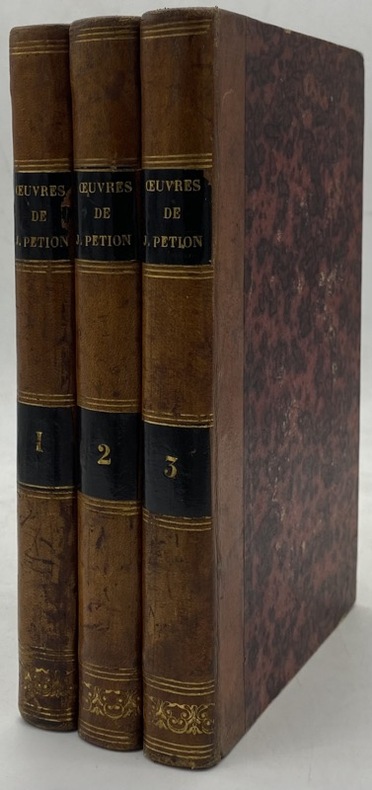
réf. 232912Paris, Garnery, an premier de la République (1792-1793) 3 vol. in-8, viij pp., 399 pp. ; [2] ff. n. ch., vj pp., pp. 7-[415] (mal chiffrées 435) ; [2] ff. n. ch., iv pp., pp. 5-436, demi-basane brique, dos lisses ornés de guirlandes et filets dorés, pièces de titre et de tomaison noires, coins en vélin vert, tranches mouchetées (reliure du début du XIXe).
réf. 210191Paris, chez Ponthieu, 1826 in-8, (8)-488 pp., demi-basane brune, dos lisse, filets dorés (reliure de l'époque). Début de fente au mors supérieur, mouillure angulaire.
réf. 36650Au Cap 23 germinal an 7 [12 avril 1799] in-folio (32,7 x 20 cm) en-tête imprimé, traces de plis, qq. petites déchir
1875réf. 373911Paris: L. Guerin et Cie 1875. Second edition. 42 engravings and maps. Folio. Bound in quarter contemporary red morocco and cloth. Good only plates with worm holes. Second edition. 42 engravings and maps. Folio. "Collection of views of the main locations of the French colony of Saint Domingue". Sabin 50578 L. Guerin et Cie unknown
1875réf. 373911Paris: L. Guerin et Cie 1875. Second edition. 42 engravings and maps. Folio. Bound in quarter contemporary red morocco and cloth. Good only plates with worm holes. Second edition. 42 engravings and maps. Folio. "Collection of views of the main locations of the French colony of Saint Domingue". Sabin 50578 L. Guerin et Cie unknown books
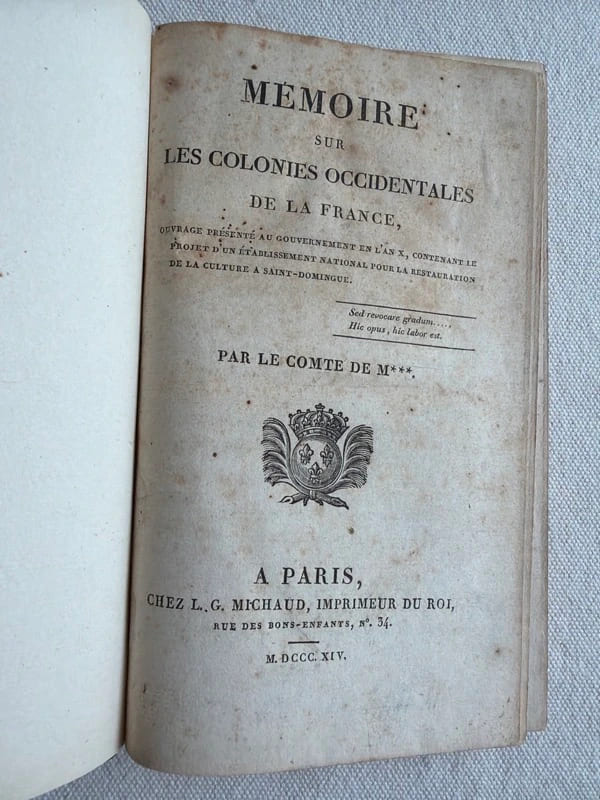
réf. 239894Paris, L.-G. Michaud, 1814 in-8, 119 pp., demi-veau havane moucheté, dos à nerfs orné de filets dorés, pièce de titre cerise, tranches marbrées (reliure moderne). Rousseurs.
2002384 pages. Extensive index. Notes on bibliography. Illustrated in color and black and white. Map endpapers. "Author served Israel's Ministry of Foreign Affairs in Columbia, Panama and Haiti. In those places, and many others in the Americas to which he traveled, he encountered descendants of Jewish colonists who recalled their religious heritage. Arbell has devoted a good part of his life to uncovering and documenting the elusive story of the Jews who lived in areas of Central and South America at one time ruled by the French, the Dutch, the Danish and the British." - from back board. Clean, bright and unmarked with very light wear. An excellent copy. Book
1796réf. 52307Port-au-Prince. May 13 1796. Supplying the British Occupation Force Printed in Pre-Revolutionary Haiti A rare pay order for supplies made out to Baron Jean-Charles de Montalembert on behalf of the invading British occupation force in Haiti. The document is signed by John Wigglesworth agent to the Commander of the British forces in Haiti and later Britain's envoy to the leader of the Haitian Revolution Touissant Louverture. By early the next century Louverture would become ever so briefly chief of the first free Black Republic in Haiti. The payee Montalembert has docketed the verso with an additional docket in French transferring the funds to Dutilh & Wachsmuth a Philadelphia mercantile house. Saint Domingo the French part of Haiti was a highly prosperous sugar coffee and cotton slave-estate island whose produce was described as exceeding that of the whole of the British Leeward and surrounding islands. In 1789 it was said to consist of 10000 white people 24000 free mixed-race people and 455000 negro slaves. Although free local laws decreed that mixed-race individuals could not accept any office or employment other than as planters. As news spread of the revolution this group revolted but were roundly defeated. Part of the white response to the uprising was to create their own local assembly which excluded those of mixed race and resolved to transfer the island's allegiance to Great Britain whereupon France sent Commissioners who according to some reports recruited negroes to fight the whites. Starting in August 1791 the slaves revolted in many towns implementing major massacres and destruction of estates and establishing free communities of their own. They were led by Touissant Louverture an ex-slave who later joined the French army after the country abolished slavery in 1793. Louverture swiftly rose to the rank of Commander in Chief of the French forces in Haiti and proved to be an effective leader. In 1794 the British army under the pretense of the Napoleonic war sent a force from Jamaica that occupied Port-au-Prince and some other towns a welcome development for the remaining white population on the island. This British force was commanded by General Sir Thomas Maitland of the 62 Foot Regiment for whom Wigglesworth was the army agent. In the end the British were not successful. By 1798 the army had been virtually wiped out by yellow fever and in April of that year Maitland withdrew the British forces from Haiti under a guarantee from Louverture that the remaining pro-British whites would be protected. In May 1801 Touissant established St. Domingo as an independent republic. This alarmed the French so badly that they subsequently sent an army of 25000 that recaptured the island within a year and then by a ruse conveyed Louverture to France where he soon after died in prison. Baron de Montalembert had commanded the Legion Britanniques de Sainte-Domingue a force of 1200 men composed of white colonials recruits from Europe and possibly some free mixed-race Haitians. Montalembert's Grenadiers were one of the most dependable units fighting for the British until the aforementioned fever along with heavy casualties decimated the unit. They disbanded on June 25 1797. A rare early Haitian document signed by two principal figures in the British occupation during the Haitian Revolution. Minor toning and edge wear. Very good. unknown
1796réf. 52307Port-au-Prince. May 13 1796. Supplying the British Occupation Force Printed in Pre-Revolutionary Haiti A rare pay order for supplies made out to Baron Jean-Charles de Montalembert on behalf of the invading British occupation force in Haiti. The document is signed by John Wigglesworth agent to the Commander of the British forces in Haiti and later Britain's envoy to the leader of the Haitian Revolution Touissant Louverture. By early the next century Louverture would become ever so briefly chief of the first free Black Republic in Haiti. The payee Montalembert has docketed the verso with an additional docket in French transferring the funds to Dutilh & Wachsmuth a Philadelphia mercantile house. Saint Domingo the French part of Haiti was a highly prosperous sugar coffee and cotton slave-estate island whose produce was described as exceeding that of the whole of the British Leeward and surrounding islands. In 1789 it was said to consist of 10000 white people 24000 free mixed-race people and 455000 negro slaves. Although free local laws decreed that mixed-race individuals could not accept any office or employment other than as planters. As news spread of the revolution this group revolted but were roundly defeated. Part of the white response to the uprising was to create their own local assembly which excluded those of mixed race and resolved to transfer the island's allegiance to Great Britain whereupon France sent Commissioners who according to some reports recruited negroes to fight the whites. Starting in August 1791 the slaves revolted in many towns implementing major massacres and destruction of estates and establishing free communities of their own. They were led by Touissant Louverture an ex-slave who later joined the French army after the country abolished slavery in 1793. Louverture swiftly rose to the rank of Commander in Chief of the French forces in Haiti and proved to be an effective leader. In 1794 the British army under the pretense of the Napoleonic war sent a force from Jamaica that occupied Port-au-Prince and some other towns a welcome development for the remaining white population on the island. This British force was commanded by General Sir Thomas Maitland of the 62 Foot Regiment for whom Wigglesworth was the army agent. In the end the British were not successful. By 1798 the army had been virtually wiped out by yellow fever and in April of that year Maitland withdrew the British forces from Haiti under a guarantee from Louverture that the remaining pro-British whites would be protected. In May 1801 Touissant established St. Domingo as an independent republic. This alarmed the French so badly that they subsequently sent an army of 25000 that recaptured the island within a year and then by a ruse conveyed Louverture to France where he soon after died in prison. Baron de Montalembert had commanded the Legion Britanniques de Sainte-Domingue a force of 1200 men composed of white colonials recruits from Europe and possibly some free mixed-race Haitians. Montalembert's Grenadiers were one of the most dependable units fighting for the British until the aforementioned fever along with heavy casualties decimated the unit. They disbanded on June 25 1797. A rare early Haitian document signed by two principal figures in the British occupation during the Haitian Revolution. Minor toning and edge wear. Very good. unknown books
1796réf. 52308Port-au-Prince. September 21 1796. Supplying the British Occupation Force Printed in Pre-Revolutionary Haiti A rare pay order for supplies intended for the British occupation force in Haiti made out to M. Juré Ainé. The document is signed by John Wigglesworth agent to the Commander of the British forces in Haiti and later Britain's envoy to the leader of the Haitian Revolution Touissant Louverture. By early the next century Louverture would become ever so briefly chief of the first free Black Republic in Haiti. The payee Jure has docketed the verso in French with an additional docket in French transferring payment to Dutilh & Wachsmuth a Philadelphia mercantile house. St. Domingo the French part of Haiti was a highly prosperous sugar coffee and cotton slave-estate island whose produce was described as exceeding that of the whole of the British Leeward and surrounding islands. In 1789 it was said to consist of 10000 white people 24000 free mixed-race people and 455000 negro slaves. Although free local laws decreed that mixed-race individuals could not accept any office or employment other than as planters. As news spread of the revolution this group revolted but were roundly defeated. Part of the white response to the uprising was to create their own local assembly which excluded those of mixed race and resolved to transfer the island's allegiance to Great Britain whereupon France sent Commissioners who according to some reports recruited negroes to fight the whites. Starting in August 1791 the slaves revolted in many towns implementing major massacres and destruction of estates and establishing free communities of their own. They were led by Touissant Louverture an ex-slave who later joined the French army after the country abolished slavery in 1793. Louverture swiftly rose to the rank of Commander in Chief of the French forces in Haiti and proved to be an effective leader. In 1794 the British army under the pretense of the Napoleonic war sent a force from Jamaica that occupied Port-au-Prince and some other towns a welcome development for the remaining white population on the island. This British force was commanded by General Sir Thomas Maitland of the 62 Foot Regiment for whom Wigglesworth was the army agent. In the end the British were not successful. By 1798 the British army had been virtually wiped out by yellow fever and in April of that year Maitland withdrew the British forces from Haiti under a guarantee from Louverture that the remaining pro-British whites would be protected. In May 1801 Touissant established St. Domingo as an independent republic. This alarmed the French so badly that they subsequently sent an army of 25000 that recaptured the island within a year and by a ruse conveyed Louverture to France where he soon after died in prison. Minor toning. Very good. unknown
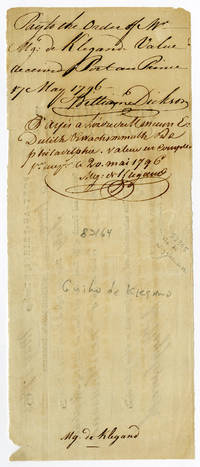
1717réf. 52305Port-au-Prince. May 17 1796. Supplying the British Occupation Force Printed in Pre-Revolutionary Haiti A rare pay order for supplies bought from William Dickson by the invading British occupation force in Haiti. The document is signed by John Wigglesworth agent to the Commander of the British forces in Haiti and later Britain's envoy to the leader of the Haitian Revolution Touissant Louverture. By early the next century Louverture would become ever so briefly chief of the first free Black Republic in Haiti. The payee Dickson has docketed the verso to pay "Mg. de Klegand" with an additional docket in French by de Klegand to pay Dutilh & Wachsmuth a Philadelphia mercantile house. St. Domingo the French part of Haiti was a highly prosperous sugar coffee and cotton slave-estate island whose produce was described as exceeding that of the whole of the British Leeward and surrounding islands. In 1789 it was said to consist of 10000 white people 24000 free mixed-race people and 455000 negro slaves. Although free local laws decreed that mixed-race individuals could not accept any office or employment other than as planters. As news spread of the revolution this group revolted but were roundly defeated. Part of the white response to the uprising was to create their own local assembly which excluded those of mixed race and resolved to transfer the island's allegiance to Great Britain whereupon France sent Commissioners who according to some reports recruited negroes to fight the whites. Starting in August 1791 the slaves revolted in many towns implementing major massacres and destruction of estates and establishing free communities of their own. They were led by Touissant Louverture an ex-slave who later joined the French army after the country abolished slavery in 1793. Louverture swiftly rose to the rank of Commander in Chief of the French forces in Haiti and proved to be an effective leader. In 1794 the British army under the pretense of the Napoleonic war sent a force from Jamaica that occupied Port-au-Prince and some other towns a welcome development for the remaining white population on the island. This British force was commanded by General Sir Thomas Maitland of the 62 Foot Regiment for whom Wigglesworth was the army agent. In the end the British were not successful. By 1798 the British army had been virtually wiped out by yellow fever and in April of that year Maitland withdrew the British forces from Haiti under a guarantee from Louverture that the remaining pro-British whites would be protected. In May 1801 Touissant established St. Domingo as an independent republic. This alarmed the French so badly that they subsequently sent an army of 25000 that recaptured the island within a year and by a ruse conveyed Louverture to France where he soon after died in prison. Minor toning and corner wear. Very good. unknown
1796réf. 52308Port-au-Prince. September 21 1796. Supplying the British Occupation Force Printed in Pre-Revolutionary Haiti A rare pay order for supplies intended for the British occupation force in Haiti made out to M. Juré Ainé. The document is signed by John Wigglesworth agent to the Commander of the British forces in Haiti and later Britain's envoy to the leader of the Haitian Revolution Touissant Louverture. By early the next century Louverture would become ever so briefly chief of the first free Black Republic in Haiti. The payee Jure has docketed the verso in French with an additional docket in French transferring payment to Dutilh & Wachsmuth a Philadelphia mercantile house. St. Domingo the French part of Haiti was a highly prosperous sugar coffee and cotton slave-estate island whose produce was described as exceeding that of the whole of the British Leeward and surrounding islands. In 1789 it was said to consist of 10000 white people 24000 free mixed-race people and 455000 negro slaves. Although free local laws decreed that mixed-race individuals could not accept any office or employment other than as planters. As news spread of the revolution this group revolted but were roundly defeated. Part of the white response to the uprising was to create their own local assembly which excluded those of mixed race and resolved to transfer the island's allegiance to Great Britain whereupon France sent Commissioners who according to some reports recruited negroes to fight the whites. Starting in August 1791 the slaves revolted in many towns implementing major massacres and destruction of estates and establishing free communities of their own. They were led by Touissant Louverture an ex-slave who later joined the French army after the country abolished slavery in 1793. Louverture swiftly rose to the rank of Commander in Chief of the French forces in Haiti and proved to be an effective leader. In 1794 the British army under the pretense of the Napoleonic war sent a force from Jamaica that occupied Port-au-Prince and some other towns a welcome development for the remaining white population on the island. This British force was commanded by General Sir Thomas Maitland of the 62 Foot Regiment for whom Wigglesworth was the army agent. In the end the British were not successful. By 1798 the British army had been virtually wiped out by yellow fever and in April of that year Maitland withdrew the British forces from Haiti under a guarantee from Louverture that the remaining pro-British whites would be protected. In May 1801 Touissant established St. Domingo as an independent republic. This alarmed the French so badly that they subsequently sent an army of 25000 that recaptured the island within a year and by a ruse conveyed Louverture to France where he soon after died in prison. Minor toning. Very good. unknown books
1717réf. 52305Port-au-Prince. May 17 1796. Supplying the British Occupation Force Printed in Pre-Revolutionary Haiti A rare pay order for supplies bought from William Dickson by the invading British occupation force in Haiti. The document is signed by John Wigglesworth agent to the Commander of the British forces in Haiti and later Britain's envoy to the leader of the Haitian Revolution Touissant Louverture. By early the next century Louverture would become ever so briefly chief of the first free Black Republic in Haiti. The payee Dickson has docketed the verso to pay "Mg. de Klegand" with an additional docket in French by de Klegand to pay Dutilh & Wachsmuth a Philadelphia mercantile house. St. Domingo the French part of Haiti was a highly prosperous sugar coffee and cotton slave-estate island whose produce was described as exceeding that of the whole of the British Leeward and surrounding islands. In 1789 it was said to consist of 10000 white people 24000 free mixed-race people and 455000 negro slaves. Although free local laws decreed that mixed-race individuals could not accept any office or employment other than as planters. As news spread of the revolution this group revolted but were roundly defeated. Part of the white response to the uprising was to create their own local assembly which excluded those of mixed race and resolved to transfer the island's allegiance to Great Britain whereupon France sent Commissioners who according to some reports recruited negroes to fight the whites. Starting in August 1791 the slaves revolted in many towns implementing major massacres and destruction of estates and establishing free communities of their own. They were led by Touissant Louverture an ex-slave who later joined the French army after the country abolished slavery in 1793. Louverture swiftly rose to the rank of Commander in Chief of the French forces in Haiti and proved to be an effective leader. In 1794 the British army under the pretense of the Napoleonic war sent a force from Jamaica that occupied Port-au-Prince and some other towns a welcome development for the remaining white population on the island. This British force was commanded by General Sir Thomas Maitland of the 62 Foot Regiment for whom Wigglesworth was the army agent. In the end the British were not successful. By 1798 the British army had been virtually wiped out by yellow fever and in April of that year Maitland withdrew the British forces from Haiti under a guarantee from Louverture that the remaining pro-British whites would be protected. In May 1801 Touissant established St. Domingo as an independent republic. This alarmed the French so badly that they subsequently sent an army of 25000 that recaptured the island within a year and by a ruse conveyed Louverture to France where he soon after died in prison. Minor toning and corner wear. Very good. unknown books
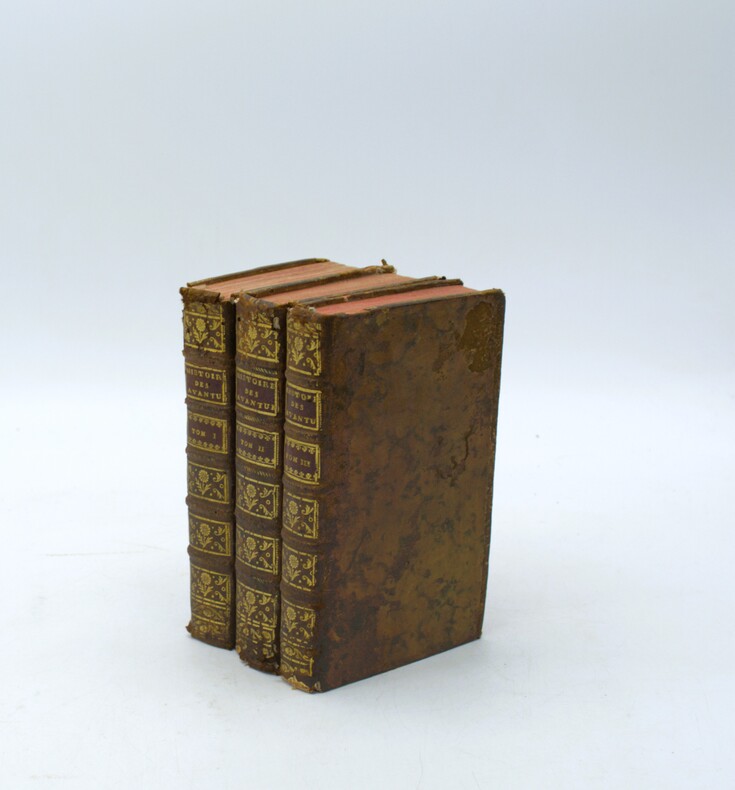
1744réf. PHO-2162Trévoux, par la Compagnie, 1744, 3 (4) volumes in-12 (17x10,5cm), (6) ff., 394 pp. ; (1) f., 428 pp. ; 346 pp., illustré de 7 cartes et plans, manque le frontispice au tome 1, veau marbré époque, dos à nerfs ornés avec pièces de titre et de tomaison grenat, tranches rouges, 4 planches détachées, frottements, épidermures plus marquées au tome 2, coiffes arasées au tome 2, petit manque au tome 1, coins usés, coupes usées au tome 2, manque de papier en marge p. 11, sans atteinte au texte.
réf. 004480Paris, Imprimerie Royale, 1780. In-8 (134 X 204 mm) veau fauve marbré, encadrement de triple filet doré sur les plats, dos cinq nerfs, caissons dorés ornés, pièce de titre maroquin grenat, roulette intérieure, tranches dorées (reliure de l'époque); XVI-312 pages.
1790réf. 26978[Cap-Français] Imprimerie de l'Assemblée provinciale du Nord s.d. (1790) in-8 de 4 pp. en feuilles
réf. 219851Paris, Grangé, 1776-1777 2 vol. in-8, XVI-327 pp. et [4]-IV-368 pp., tableau dépliant, demi-chagrin vert, tranches marbrées (reliure fin XIXe). Coiffes et nerfs frottés, coupes et coins usés. Rousseurs et mouillures au tome II.
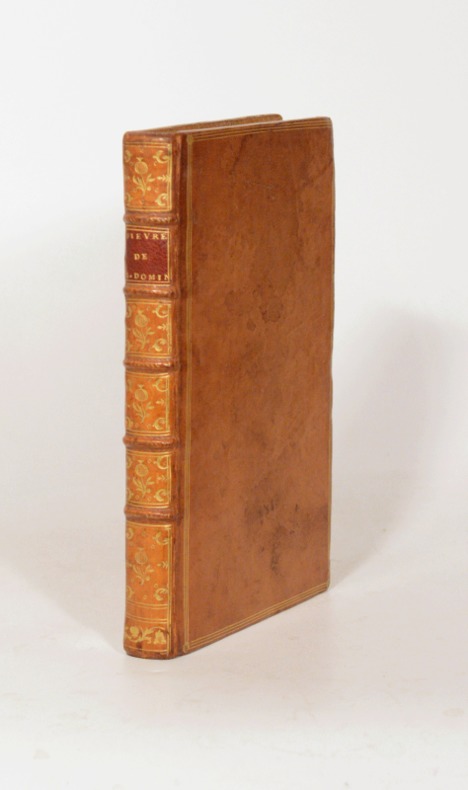
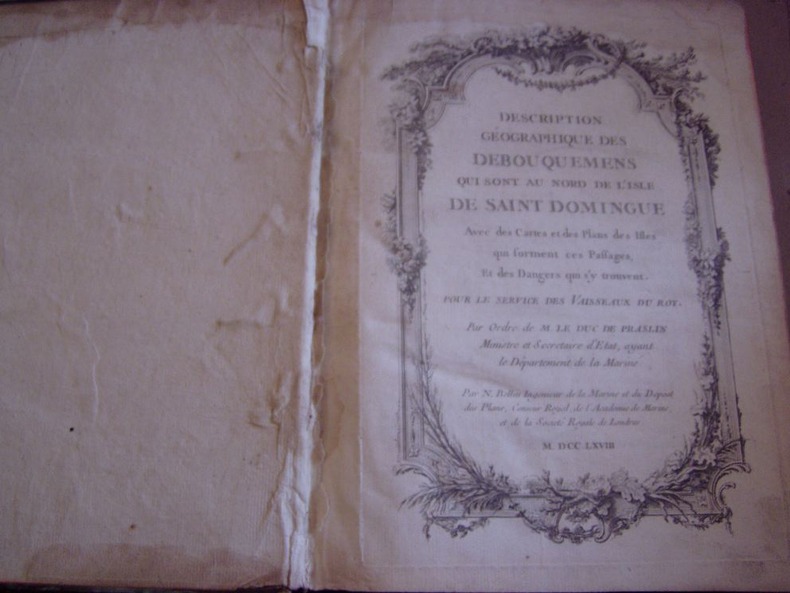
1768réf. 203001768 1768 ( A Versailles; Imprimerie du département de la Marine) , 1768. In/4 basane fauve marbrée, dos à nerfs orné d'ancres,152 p., page de titre gravée, page de titre imprimée manquante : 34 planches gravées (cartes) dont 15 rempliées,32 numerotées en continu,la 24 en double,et la carte des Isles Bermudes numerotée T1,N°48. Mouillure generale claire dans la marge superieure sur l’ensemble du volume,page de garde manquante. Armes sur le 2e plat,arrachées ou cachées sur le 1er plat.Coins usés.In-4 carré ( 250 X 195 mm. ) de: [5] ff. ( Titre, Titre gravé, Table des chapitres, Table des cartes et plans ), 152 pages, Joli bandeau allégorique signé Jean CHOFFARD et 34 cartes gravées dont 16 doubles ( 2 dépliantes ) par Nicolas BELLIN. Parmi les 34 cartes qui illustrent louvrage, une carte générale du Nord de St Domingue et de ses cinq débouquements, une du Canal de Bahama représentant le sud du Golfe du Mexique. Rare édition originale de ce routier des Antilles par le premier hydrographe de la Marine royale française, Jacques-Nicolas BELLIN ( 1703-1772 ). ( J. Polak 591 Sabbin, 4552 ).Conforme à l'exemplaire en ligne Gallica - Versailles.
réf. 235836Londres, J. Debrett, et se trouve à Paris, Laran, et chez les marchands de nouveautés, s.d. (1797) in-8, [3] ff. n. ch., 100 pp., cartonnage d'attente de papier bouteille, pièce de titre cerise, tranches citron (reliure de l'époque). Rousseurs
réf. 239741Paris, chez Arthus Bertrand, 1811 in-8, [4]-494 pp., portr., une vue et une carte dépl., demi-veau fauve, dos lisse, filets dorés (reliure à l'imitation).
1792réf. AQ13490London: Printed: and sold by J. Johnson 1792. 32pp. Handsomely bound in recent antique half-calf gilt marbled boards. Occasional mark three small paper flaws at end without loss of sense. A contemporary account of the only successful slave revolt in history which resulted in the foundation of a state ruled by those formerly enslaved on the French Caribbean island of St. Domingue now Haiti. As the inclusion of Coulon's account read to the French National Assembly in this volume suggests the first black insurrection was entwined with the causes and effects of Revolutionary France which despite the 1789 Declaration of the Rights of Man sought albeit unsuccessfully to retake the island from the rebels. ESTC T11240 c/f Sabin 75135. First edition in English. 8vo. Printed: and sold by J. Johnson hardcover
1730réf. PHO-2325Paris, Guérin, 1730-1731. 2 volumes in-4 (25,5 × 20 cm). XXVIII, 482 p., 29 ff. ; XIV, 506 p., 30 ff., reliures postérieures en demi-veau, pièces de titre et tomaison, coins et coupes légèrement frottés et émoussés, petits manques aux coiffes. Légèrement bruni, légères galeries de vers et traces d’humidité dans la marge intérieure au début du tome I ; les pages 17-20, 221/222, *19/*20 du tome I ainsi que les plans « Plan de la ville de San-Domingo » (tome I) et « Plan du Cap François » (tome II) sont déreliés ; petit déchirement restauré au pli de la garde de la « Carte de l’Isle de Saint-Domingue » (tome II). Ex-libris Jack Grout.
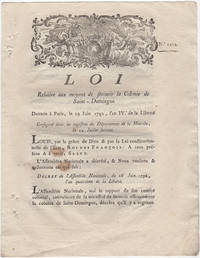
1792réf. 43209Nancy France: Chez Haener Imprimeur du Départment de la Meurthe 1792. First edition. Self wrappers. A very good copy with pin holes along inner margin two soiled spots signed in ink on last page. 4 pp. Illus. with a woodcut headpiece. Sm. 4to. Signed illegible. Law authorizing negotiation with the United States minister to obtain food and construction materials in the amount of 4000000 livres to be paid by the French Treasury but to be reimbursed by taxes on the colony. The money was much needed as the loan decree dated 26 Juin 1792 came in the midst of unparalleled upheaval in Haiti. The revolution of the year before with its "horrible carnage" had now given way "to strategic military operations tactical maneuvers and new political alliances as the slaves gain territory and stabilize their positions. They raid plantations for military equipment loot the whites' forces after they are repelled and trade with the Spanish for weaponry" Kona Shen History of Haiti The Revolution Builds Brown University. library.brown.edu/haitihistory/6.html. Toussaint Louverture is a rising star Civil Commissions arrive from France free blacks and mulattos in Saint-Domingue are granted equal political rights Spain declares war on England and France and battle ensues for control of Haiti. The U.S. is concerned with conditions on the island and in fact Jefferson writes of his concern to the Marquis de Lafayette 16 June 1792. Rare. OCLC BN France and other European Libraries locate no copies of this issue No. 1412 with additional text concerning the Departement de la Meurthe. A Paris printing No. 1813 can be found at Cornell Univ. Minn. and JCB which also has a Toulouse printing. Manioc Bibliotheque shows a digitized version of the Paris imprint. Chez Haener, Imprimeur du Départment de la Meurthe unknown
1792réf. 43209Nancy France: Chez Haener Imprimeur du Départment de la Meurthe 1792. First edition. Self wrappers. A very good copy with pin holes along inner margin two soiled spots signed in ink on last page. 4 pp. Illus. with a woodcut headpiece. Sm. 4to. Signed illegible. Law authorizing negotiation with the United States minister to obtain food and construction materials in the amount of 4000000 livres to be paid by the French Treasury but to be reimbursed by taxes on the colony. The money was much needed as the loan decree dated 26 Juin 1792 came in the midst of unparalleled upheaval in Haiti. The revolution of the year before with its "horrible carnage" had now given way "to strategic military operations tactical maneuvers and new political alliances as the slaves gain territory and stabilize their positions. They raid plantations for military equipment loot the whites' forces after they are repelled and trade with the Spanish for weaponry" Kona Shen History of Haiti The Revolution Builds Brown University. library.brown.edu/haitihistory/6.html. Toussaint Louverture is a rising star Civil Commissions arrive from France free blacks and mulattos in Saint-Domingue are granted equal political rights Spain declares war on England and France and battle ensues for control of Haiti. The U.S. is concerned with conditions on the island and in fact Jefferson writes of his concern to the Marquis de Lafayette 16 June 1792. Rare. OCLC BN France and other European Libraries locate no copies of this issue No. 1412 with additional text concerning the Departement de la Meurthe. A Paris printing No. 1813 can be found at Cornell Univ. Minn. and JCB which also has a Toulouse printing. Manioc Bibliotheque shows a digitized version of the Paris imprint. Chez Haener, Imprimeur du Départment de la Meurthe unknown books
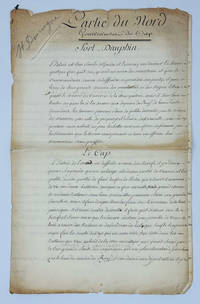
réf. MD31Folio ca. 37.5 x 23 cm or 14 ¾ x 9 in. Two bifoliums one inserted into other previously fastened with ribbon. 5 pp. Black ink on creamy laid paper. With an 18th century ink note on verso of last leaf dated 10 November 1745. Paper slightly age-toned fold marks minor tears and creases on extremities but overall a very good manuscript. A manuscript document of a report on French defences in the colony of Saint-Domingue modern-day Haiti created around 1745. The report covers Fort Dauphin now Fort-Liberté Le Cap Cap-Français now Cap-Haïtien and the dependencies of Port-de-Paix in the North as well as the governments of the West and South. It also covers recommendations concerning the King’s troops. The report was written around the time of the War of Austrian Succession 1740-1748 in which France was a major participant. The treaty ending the war was unsatisfactory for all of the signatories eventually leading to the much larger Seven Years War 1756-1763. The author of the report reviews the defences of Fort Dauphin Cap-Français the dependencies of Port-de-Paix and the governments of the West and South. They find that Fort Dauphin is easy to defend especially with a good commander; that a coral reef makes it harder to enter Cap-Français but they should close “Norman Pass” by sinking an old ship full of rocks there in order to heed off privateers; and that a fort was supposed to be established near Port-de-Paix but the project seemed to have died with its engineer and that hopefully it will be revived. They note that the government of the West has poor defences and detail the condition of the military’s troops in the government of the South. The author also makes recommendations for the King’s troops namely increasing their pay from three to five sols per day and improving the conditions of the hospital of Cap-Français criticizing the current doctor who “néglige son devoir pour son plaisir son jeu et son commerce neglects his duty for his pleasure his games and his business.” Overall an interesting early report on the French defences of their colony Saint-Domingue. Saint-Domingue was a French colony on the Caribbean island of Hispaniola between 1659 and 1803. Hispaniola was totally controlled by Spain until the early 17th century as its neglected western half was settled by French buccaneers along with the island of Tortuga near the northern coast of Hispaniola. The French settlement was officially established in 1659 under King Louis XIV and French control of Tortuga and the western half of Hispaniola was acknowledged by Spain in 1697. Sugar and coffee products of Saint-Domingue’s slave plantations made it the most prosperous French colony in the West Indies. However by the late 18th century an economic downturn in Saint-Domingue and the French Revolution 1789-1799 would lead to the end of the colony. The revolution spurred the Rebellion of Saint-Domingue 1791 and the start of the Haitian Revolution which would continue for the next several years. On 1 January 1804 Haiti declared its independence ending nearly 150 years of French rule. unknown