17 688 résultats
2003Cunning, fantastical tales about a Greek village of the imagination, from a startling new talent. Panos Karnezis's remarkable stories are all set in the same nameless Greek village. His characters are the people who live there - the priest, the whore, the doctor, the seamstress, the mayor and the occasional animal: a centaur, a parrot that recites Homer, a horse called History. Their lives intersect, as lives do in a small place, and they know each other's secrets: the hidden crimes, the mysteries, the little infamies that men commit. Karnezis observes his villagers with a worldly eye, and creates a place where magic invariably loses out to harsh reality, a place full of passion, cruelty, and deep reserves of black humor. Nineteen debut stories reflect daily life in a Greek village over many years. Greece, first of all, is a nation of villages - from the sooty neighborhoods of Athens down to the tiny place ("so poor it doesn't have a name") that's the epicenter of these tales. The first-time author (a Greek engineer living in Britain) knows the brusque clannishness of his native land and conveys the rhythms and tempers of its life with a deft touch. "Another Day on Pegasus," for example, is told from the perspective of a bus driver: a sort of Greek Ralph Kramden who argues with his conductor, insults (or flirts with) his passengers, and manages despite the odds to keep his bus ("Pegasus") running from day to day. Greek bureaucracy is portrayed in its harshest light in "Jeremiad," about the unhappy fate of an old man who gets to the Pension Office late and dies in the waiting room before his claim is settled. Shadows of the classical age stretch into the present in "Circus Attraction" and "Cassandra Is Gone," both about the career of a centaur who becomes the star attraction of a flyblown rural circus and falls in love with the tattooed lady (who may or may not be the original Cassandra of Agamemnon). "A Classical Education" (a small-town clerk's attempts to teach Homer to his parrot) has a Flaubertian tone to it, while "Sacrifice" (a brief sketch of a father and son who slaughter a murderous cow) has a bitter tensity reminiscent of Chekhov. The finest piece, "Immortality," is an elegiac, almost mystical account of villagers in the early 20th century as they beg a waylaid photographer to "make us live forever" by taking their picture. Fine and true: Karnezis breathes fresh life into traditional Greek society without mocking or sanitizing it. Book
2007It is the summer of 1975. An Onassis-like tycoon is nearing the end of his life. When he finds out that his daughter, with whom he's having a problematic relationship, is pregnant by a man he does not approve of, he has a birthday party for her on his private island, secretly intending to persuade her to end the pregnancy: a doctor is standing by to perform the procedure on the spot. The story starts on the morning of the party before the guests arrive and ends the following day when all the guests are gone. The novel intersperses the events that take place before, during and after the party with flashbacks to the tycoon's rise to wealth and fame, from his childhood in Asia Minor in the 1920s to old age, via Buenos Aires, New York, London and Paris. Book
1973[SERIES : Ancient Sites and Sanctuaries of Greece No.4 ] A well illustrated guide to the history, monuments, museums and artistic heritage of Rhodes. 168p.+ illus. 48 unnumbered pages of plates, bibliography. Book
2014In 8, br. edit. con band., pp. 349, alcune ill. a col. In francese.Come nuovo.Luogo di pubblicazione Athenes Editore Academie d'Athes Anno pubblicazione 2014Materia/Argomento Agricoltura, Storia, Grecia
Atene, Ekdotike Athenon, 1992, in-8, br., pp. 173. Con numerose illustrazioni a colori.
Ekdotike Athenon. 1982. In-8 Carré. Broché. Bon état. Couv. convenable. Dos satisfaisant. Intérieur frais. 172 pages. Illustré de nombreuses photos en couleur dans et hors texte. 2e plat légèrement abîmé en surface. Historique du Musée. Collections préhistoriques. Sculptures...
Ekdotike Athenon. 1977. In-8 Carré. Broché. Bon état. Couv. convenable. Dos satisfaisant. Intérieur frais. 172 pages. Illustré de nombreuses photos en couleur, dans et hors texte. Musée National d'Athènes.
1979Broché. 172 pages. Passages soulignés au stylo.
1977Large format softcover book with the major highlights of the National Museum in Athens 173p. plates (col.) Book
réf. ARCH0191Athen, Ekdotike Athenon (2178). 172 S. 1 Bl., mit zahlr. farb. Abb., farb. OKart. Illustrierter Führer durch das Archäologische Nationalmuseum in Athen.
1986In-8° gr. pp. 208 con 2 frandi carte ripiegate f.t. e molte foto a col. n.t. Bross. edit. ill.
Ekdotike Athenon. 1981. In-8 Carré. Broché. Bon état. Couv. convenable. Dos satisfaisant. Intérieur frais. 208 pages. Illustré de nombreuses photos en couleur dans et hors texte, et d'une grande carte en couleur dépliable en fin d'ouvrage. Histoire. La Corinthie. L'Argolide. L'Arcadie...
EKDOTIKE ATHENON.. 1996. In-8 Carré. Broché. Bon état. Couv. convenable. Dos satisfaisant. Intérieur frais. 208 pages. Nombreuses illustrations en couleurs dans le texte et hors texte. Note au stylo sur la page de titre. Couverture rempliée.
1981Athènes 1981. In-8 broché de 207 pages illustrées. Bon état
1985Well illustrated guide to tourist places in Greece. 211p. illus (col) Book
1982Detailed and well illustrated guide to places in the Peloponnese. 208p. illus (col) large fold-out-map Book
1987Detailed and well illustrated guide to places in the Peloponnese. 208p. illus (col) site plans. Large fold-out-map. Name of owner, else fine. Book
1973Wraps have minor shelfwear; Contents: the foundations of the kingdom of Nicaea Reexamined; Foundations of the Principality of Epiros; Ecclesiastical Conflict; The Schism; The Healing of the Schism. ; Vyzantina Keimena Kai Meletai, 7; 108 pages
1908réf. RO40233823Imprimerie Levé, Paris. 1908. In-12. Broché. Bon état, Couv. légèrement passée, Dos satisfaisant, Intérieur frais. Plaquette de 29 pages. Annotation sur le 1er plat.. . . . Classification Dewey : 949.5-Grèce
réf. 73481aafBasel, Helbing & Lichtenhahn, 1993, in-8vo, 127 p. brochure originale.
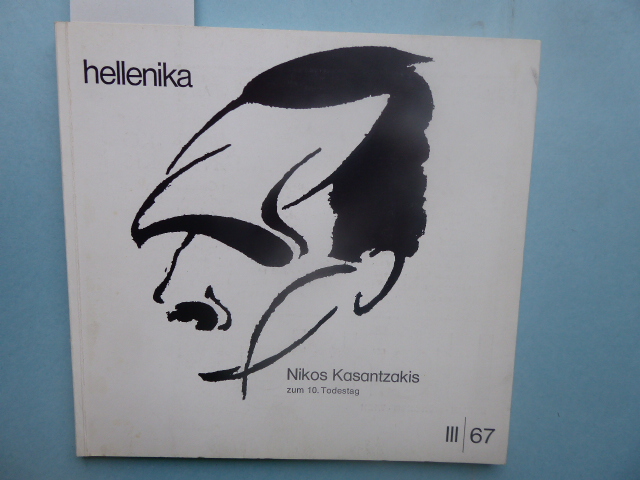
1967réf. 123941Vereinigung Deutsch-Griechischer Gesellschaften. 1967. 83 Seiten. Ill. Originalbroschur. (Etwas fleckig). 20x21 cm
Imprimerie Levé, Paris. 1908. In-12 Carré. Broché. Bon état. Couv. légèrement passée. Dos satisfaisant. Intérieur frais. Plaquette de 29 pages. Annotation sur le 1er plat. (Rare) Extrait de l' 'Hellénisme', aout-sept. 1908.
1989IN HEBREW. 160X235 mm. 317 pages. Hardcover with dust jacket. Gilt cover. DJ edges slightly tattered and wrinkled. Else in good condition.
199016x23.5 cm. 172 pages. Gilt hardcover in dust jacket. Slight chafe on front cover. Title page slightly dirty. Else in good condition.