18 355 résultats
1999pp. 372, cm 30x21, rilegatura editoriale, illustrazioni in nero.
2007"The author's first novel, set in a Cretan village with "kidnaps and killings, prayers and healings, ethics and ritual, and a darned good tale" CRETE - an archaeologists dream-land, with sedimentary layers of oppressors and resisters. Lefka Ori the fabled white mountains, where people in trouble have fled for centuries. Vraho a village on Lefka Ori divided by water rights and by wounds left over from World War II .Father Dimitrios, following his grandfathers way as Vrahos village priest for reasons he has yet to discover. Into this world comes Douglas Watkins, mindlessly slipping down the path of easy opportunity, no thought of goals or ethics or consequences, and no ones life remains unchanged Author inscription else neww ." Book
8vo. 293 pp., & 167 plates.
ND. {1960s}; Color Photographs; 8vo; 63 pages
1966réf. 44041Princeton University Press. Very Good with no dust jacket. Hardcover. Very minor shelfwear to volumes. Old price to ffeps.; 3 volumes in 4 parts as issued: Volumes I-III complete.; 3 Volumes in 4 Parts; 4to 11" - 13" tall; Textually complete with all plates and illustrations called for. This massive work on Nestor's Palace was compiled following its excavation by the University of Cincinnati in the 1950s. Nestor was a figure immortalized by Homer and his palace is believed to date back to 13000 B. C. It remained covered by an olive grove until the excavation and this work details all of the finds including tablets seals and frescoes etc. . 1966. Princeton University Press hardcover
New York, Garden City Publishing, 1931, in-8, tela edit. blu con titolo al dorso e vignetta oro al piatto ant., taglio sup. rosso, sguardie figurate, pp. XXVII, 537. Con 33 tavv. in b.n., 3 cartine in fine, ed ampia bibliografia. Blande scoloriture al dorso e al margine esterno del piatto posteriore.
1986Scholar's name to half-title (Robert Brown). Minor shelfwear to book. DJ is price-clipped. Light edgewear to DJ with a couple of small tears. ; 446pp, illustrated.; 8vo - over 7¾" - 9¾" tall; 882 pages
1986Former owner's name on ffep. Minor bumping to 1 corner and edge of front board. DJ has a minor shelfwear. ; 446pp, illustrated.; 8vo - over 7¾" - 9¾" tall; 882 pages
1986Small bump to lower edge of front board. DJ has chipping and small tears along top edge. Minor creasing to DJ. ; 446pp, illustrated.; 8vo - over 7¾" - 9¾" tall; 882 pages
2001pp. 520, mm 195x125, paperback edition.
1993Very minor shelfwear to book. DJ has minor shelfwear and creasing. ; 1.1 x 10.81 x 8.62 Inches; 444 pages; The art and architecture of Ancient Greece and Rome lies at the heart of the classical tradition of the Western world. Their legacy is so familiar as to have become commonplace. The legacy may appear simple, but the development of classical art in antiquity was complex and remarkably swift. It ran from near abstraction in 8th-century BC Greece, through years of observation and learning from the arts of the non-Greek world to the East and, in Egypt, to the brilliance of the classical revolution of the 5th century, which revealed attitudes and styles undreamt of by other cultures. After Alexander the Great, this became the art of an empire, readily learned by Rome and further developed according to the Romans' special character and needs until it provided the idiom for the imaging of Christianity. In this book, the story of this pageant of the arts is told by five leading scholars. Their aim has been to demonstrate how the arts served very different societies and patrons; the roles and objectives of the artists; the way in which the classical style was disseminated far beyond the borders of the Greek and Roman world; and the splendour and quality of the arts themselves.
2004Unrivaled in scope and scholarship, The Oxford Companion to Classical Civilization is an indispensable guide to the richly textured history of ancient Greece and Rome. The meticulously detailed entries contained within this volume breathe life into the people, places, and events that shaped the development of classical civilization. Readers will learn that Alexander the Great's grand army consisted of 48,500 soldiers and was the largest ever to leave Greek soil, that the white facades of refined Ionic structures in Greece were once washed with vibrant reds and blues, and that the Theodosian Code, a collection of Roman law published in AD 438, still survives today. Here are examinations of the Eves and works of great philosophers and literary figures, such as Aristotle, Plato, Socrates, Sophocles, Seneca, Aeschylus and the poets Ovid and Sappho. Mythology and religion were integral parts of classical civilization, and from Aphrodite and Hermes to funerary rites and sacrifice, they are integral parts of this volume as well. Filled with both essay length articles and short quick reference entries, this extraordinarily thorough yet accessibly written book is a treasury of information on classical civilization. 795p. bibliography [+ 10 pages of maps] NOTE : Large HEAVY volume [2 kg] [25X19X5 cm] Book
1998"In 1996, Oxford published the third edition of its excellent resource, The Oxford Classical Dictionary. The goal of this new volume is to appeal to a wider audience by making some changes in the way the material from that dictionary is presented. While no entries have been shortened, some that were considered too recondite or technical for the nonspecialist have been omitted. Bibliographies attached to entries in the dictionary have been replaced by a general bibliography at the back of the book, and color and black-and-white illustrations illuminate some of the entries. Entries are now grouped under the following broad subject areas: History, Law & Society, Literature & Scholarship, Philosophy & Religion, and Science,Technology,& Material Culture" 795p. bibliography [+ 10 pages of maps] NOTE : Large HEAVY volume [2 kg] [25X19X5 cm]793p. + maps. Book
1998réf. 042280Oxford: Oxford University Press 1998 Book. New. Hardcover. 1st UK Edition. "In 1996 Oxford published the third edition of its excellent resource The Oxford Classical Dictionary. The goal of this new volume is to appeal to a wider audience by making some changes in the way the material from that dictionary is presented. While no entries have been shortened some that were considered too recondite or technical for the nonspecialist have been omitted. Bibliographies attached to entries in the dictionary have been replaced by a general bibliography at the back of the book and color and black-and-white illustrations illuminate some of the entries. Entries are now grouped under the following broad subject areas: History Law & Society Literature & Scholarship Philosophy & Religion and ScienceTechnology& Material Culture" 795p. bibliography 10 pages of maps NOTE : Large HEAVY volume 2 kg 25X19X5 cm793p. maps. Oxford University Press hardcover
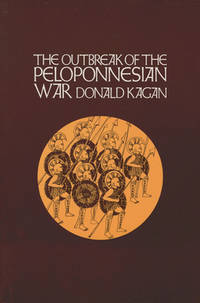
1981réf. 39316Cornell University Press. Near Fine in Very Good dust jacket. Hardcover. Very faint shelfwear to book. DJ has some rubbing and a bit of chipping and small tears. .; New evaluation of the origins and causes of the Peloponnesian war based on evidence produced by modern scholarship and on a careful reconsideration of the ancient texts.; 9.5 x 1.25 x 6.5 Inches; 420 pages . 1981. 0801405017 . Cornell University Press hardcover
1994réf. 007730Ithaca New York U.S.A.: Cornell Univ Pr 1994. 420pp. Clean no marks. Trade Paperback. Near Fine/No Jacket - Wraps. 8vo - over 7¾" - 9¾" tall. Cornell Univ Pr Paperback
3 Vols., 4to, 246; 238; 234pp., orig. decorated stiff wrappers, 1629 lots.
2016New English Original bdg. HC. 4to. (28 x 20 cm). In English and Turkish. 554 p., ills. The Ottoman period in Cyprus.= Osmanli döneminde Kibris Uluslararasi Sempozyum Bildirileri.
1994réf. 6238Institute for Mediterranean Studies: Halcyon Days in Crete I - A Symposium held in Rethymnon 11-13 January 1991. Soft cover 24 cm 244 pp. The conversion of a small emirate in the powerful Ottoman Empire which succeeded that of Byzantium and was in close contact with the western world for many centuries is a phenomenon with multiple interpretations. The theories of the great historian Kuprulu and Wittek formed both in the 1930's have recently changed. Recent discoveries and studies have caused numerous debates with new arguments and gave additional explanations. The dervish role becomes more important than was thought and the discovery of coins casts new light on the humble beginnings of Turk emirs of the 14th century while the archival material clarified many of the newer institutions of the Ottoman Empire. CONTENTS: MICHEL BALIVET Culture ouverte et echanges inter-religieux dans les ottomanes du XIVe s. IRENE BELDICEANU-STEINHERR La population non-musulmane de Bithynie deuxieme moitie du XIVe s. - premiere moitie du XVe s. VASSILIS DEMETRIADES Some Thoughts on the Origins of the Devsirme FERIDUN EMECEN Ottoman Policy of Conquest of the Turcoman Principalities of Western Anatolia with Special Reference to Sarukhan Beyligi ALDO GALLOTTA Il "mito oguzo" e le origine dello stato ottomano: Una riconsiderazione GYORGY HAZAI La place du XIVe siecle dans l'evolution de la langue turque COLIN IMBER The Legend of Osman Gazi HALIL INALCIK Osman Ghazi's Siege of Nicaea and the Battle of Bapheus JACQUES LEFORT Tableau de la Bithynie au XIIIe siecle ANTHONY LUTTRELL Latin Responses to Ottoman Expansion before 1389 IRENE MELIKOFF L'origine sociale des premiers Ottomans AHMET YASAR OCAK Les milieux soufis dans les territoires du beylicat ottoman et le probleme des 'Abdalan-i Rum' 1300-1389 NICOLAS OIKONOMIDES The Turks in Europe 1305-1313 and the Serbs in Asia Minor 1313 STEPHEN W. REINERT From Nis to Kosovo Polje: Reflections on Murad I's Final Years SP. VRYONIS JR. The Muslim Family in 13th-14th Century Anatolia as Reflected in the Writings of the Mawlawi Dervish Eflaki ELIZABETH A. ZACHARIADOU The Emirate of Karasi and that of the Ottomans: Two Rival States KONSTANTIN ZHUKOV Ottoman Karasid and Sarukhanid Coinages and the Problem of Currency Community in Turkish Western Anatolia '40s-'80s of the 14th Century CUP paperback
1991Scholar's name to ffep (R. E. Fantham). Very light shelfwear to book else fine. DJ has tear to head of spine with small strip torn off. Light yellowing along top edge of DJ. Includes tipped in offprint review by Richard Martin with his initials to R. E. Fantham. ; Is it fair to judge early Greek rhetoric by the standards of Plato and Aristotle? This text argues that it is not, and yet this is the path taken by current scholarship on the subject. Arguing against this view, this work sees early Greek rhetoric as largely unsystematic efforts to explore, more by means than by precept, all aspects of discourse. Replacing these early text by such treatises as the "Rhetoric" of Aristotle, Cole explains, can only be understood as part of a gradual process, as artistic prose came to be disseminated in written texts and so available in a form that, for the first time, be analyzed, evaluated and closely imitated. ; Ancient Society and History; 191 pages
1991Pencilling to rear endpaper else fine. ; Is it fair to judge early Greek rhetoric by the standards of Plato and Aristotle? This text argues that it is not, and yet this is the path taken by current scholarship on the subject. Arguing against this view, this work sees early Greek rhetoric as largely unsystematic efforts to explore, more by means than by precept, all aspects of discourse. Replacing these early text by such treatises as the "Rhetoric" of Aristotle, Cole explains, can only be understood as part of a gradual process, as artistic prose came to be disseminated in written texts and so available in a form that, for the first time, be analyzed, evaluated and closely imitated. ; Ancient Society and History; 191 pages
1991Scholar's bookplate to inner cover (G. P. Goold). Foxing/dustsoiling to top of textblock. Erratum page tipped in. ; Is it fair to judge early Greek rhetoric by the standards of Plato and Aristotle? This text argues that it is not, and yet this is the path taken by current scholarship on the subject. Arguing against this view, this work sees early Greek rhetoric as largely unsystematic efforts to explore, more by means than by precept, all aspects of discourse. Replacing these early text by such treatises as the "Rhetoric" of Aristotle, Cole explains, can only be understood as part of a gradual process, as artistic prose came to be disseminated in written texts and so available in a form that, for the first time, be analyzed, evaluated and closely imitated. ; Ancient Society and History; 191 pages
1995One faint crease to lower corner of book. Small stain to rear wrap. ; Is it fair to judge early Greek rhetoric by the standards of Plato and Aristotle? This text argues that it is not, and yet this is the path taken by current scholarship on the subject. Arguing against this view, this work sees early Greek rhetoric as largely unsystematic efforts to explore, more by means than by precept, all aspects of discourse. Replacing these early text by such treatises as the "Rhetoric" of Aristotle, Cole explains, can only be understood as part of a gradual process, as artistic prose came to be disseminated in written texts and so available in a form that, for the first time, be analyzed, evaluated and closely imitated. ; Ancient Society and History; 208 pages
1961Former owner's name on ffep, some ink underlining and marginalia on first 44pp, else Very Good. Dustjacket torn in places and price-clipped. ; 385pp. ; 385 pages
1990Very minor shelfwear. ; 0.75 x 8.75 x 5.75 Inches; 288 pages; In this unusual synthesis of political and socio- economic history, Philip Manville demonstrates that citizenship for the Athenians was not merely a legal construct but rather a complex concept that was both an institution and a mode of social behavior. He further shows that it was not static, as most scholarship has assumed, but rather has slowly evolved over time. The work is also an explanation of the origins and development of the polis.