Jordan, BorimirBiblio.com
18 761 résultats
1975réf. 16148University of California Press. Very Good. Softcover. Writing to ffep from author: "To Professor Hammond with the compliments of the author". Spine and top edge of rear wrap are a bit sunned. Minor shelfwear to wraps.; University of California publications : Classical studies ; v. 13; 306 pages . 1975. 0520094824 . University of California Press paperback
2008réf. 42478Edinburgh University Press. Very Good with no dust jacket. Hardcover. Underlining in pencil to a few pages. Very minor shelfwear.; Where did "democracy" come from and what was its original form and meaning Here Josiah Ober shows that this "power of the people" crystallized in a revolutionary uprising by the ordinary citizens of Athens in 508-507 B. C. He then examines the consequences of the development of direct democracy for upper-and lower-class citizens for dissident Athenian intellectuals and for those who were denied citizenship under the new regime women slaves resident foreigners as well as for the general development of Greek history. When the citizens suddenly took power into their own hands they changed the cultural and social landscape of Greece thereby helping to inaugurate the Classical Era. Democracy led to fundamental adjustments in the basic structures of Athenian society altered the forms and direction of political thinking and sparked a series of dramatic reorientations in international relations. It quickly made Athens into the most powerful Greek city-state but it also fatally undermined the traditional Greek rules of warfare. It stimulated the development of the Western tradition of political theorizing and encouraged a new conception of justice that has striking parallels to contemporary theories of rights. But Athenians never embraced the notions of inherency and inalienability that have placed the concept of rights at the center of modern political thought. Thus the play of power that constituted life in democratic Athens is revealed as at once strangely familiar and desperately foreign and the values sustaining the Athenian political community as simultaneously admirable and terrifying.; Edinburgh Readings On The Ancient World; 8vo 8" - 9" tall; 368 pages . 2008. 0748625852 . Edinburgh University Press hardcover
1942IN HEBREW. SIGNED BY AUTHOR. 23.5X16.5 cm. 52 pages. Softcover. Cover edges slightly chafed. Cover slightly faded. Front cover slightly detached. Spine slightly worn. Binding visible on one page. Else in good condition.
1988"... a comprehensive survey of how the Aegean peoples expressed themselves during a period of some 5000 years after the end of the Bronze Age (circa 1100 BC), and before the rise of Greek art. Work produced in the ambience of the palaces of Crete (including the palace of Minos at Knossos) and of Mycenae on the mainland is fully described and illustrated. For purposes of clarity the arts are considered by function and material rather than by geographical region or chronological period; but the main political upheavals affecting them are kept in mind. Little wall-painting has survived, and the so-called minor arts are examined for the light they thow on it, as well as to assess artistic development in the Aegean as a whole." 311p. illus bibliography index. Text crisp and unmarked, slightly scuffed paper covers.. Book
1975Some creasing to book. ; Plates at end. ; Lectures in Memory of Louise Taft Semple (Third Series) ; 61 pages
1967"Combines sound scholarship and searching criticism to review and explain the major episodes in The Odyssey, to elucidate the special techniques of Homeric poetry, and to demonstrate the literary sophistication of Homer." 120p.ntes, index. Book
196823x18. 258p. Firma anterior poseedor. Fotogr. Enc. Tela ed. La sobrecubierta algo deteriorada.
2004réf. EEzz8004Cambridge Univ. Press (2004). 163 S., 3 w. Bl., mit 141, tls. farb. Abb., flex., farb. ill. OKart., Vorderdeckel etw. aufgebogen.
1967247p. illus (some col) diagrs. maps. index. Book
1925Gilt lettering to spine with gilt design to front board. Very light shelfwear. ; Viii, 58 pp + LVI plates. ; 58 pages
1976English translation of " Kreta und frühes Griechenland" by Anne. E.Keep. 258p. illus plates (some col) index Book
1976English translation of " Kreta und frühes Griechenland" by Anne. E.Keep. 258p. illus plates (some col) index Book
1972Small illustrated handbook on Greek and Etruscan art 158p. plates. col Donor inscription on ffep, else fine. Book
1972Scholar's name to ffep (Roger Beck). Light smudging to rear board. Minor shelfwear to book. DJ has light chipping to top of spine. ; 158 pages
1967Scholar's name to ffep (Jenifer Neils). DJ has some tears and chipping. ; With 50 four-colour plates, 71 halftone plates, 77 line illustrations, map and chronological table. Looks at the period from 500 to 325 B. C. ; 288 pages
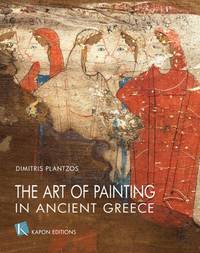
2018réf. 226622Athens: Kapon 2018. In English. Soft cover 28 cm 360 pp. ill.; net weight 1800 gr. ISBN: 978-618-80006-5-0. This innovative fresh look on Greek painting combines a standard comprehensive survey of the material record wall-paintings painted panels or slabs with an in-depth exploration of the ways in which the Greeks themselves appreciated this demanding art. The book dwells on techniques styles themes and masters as well as their admirers clients and critics. At the same time the author discusses recent breakthroughs in archaeology cultural studies and art history in order to offer a well-rounded picture of a unique phenomenon in Greek culture a celebrated art that enjoyed a long afterlife. In this respect this book is unique in its kind as it reflects new multidisciplinary scholarly approaches to the material record which it combines with a more traditional art-historical exploration. Drawing on a wide range of ancient authorities from Plato and Xenophon to Cicero Pliny Lucian and Philostratus the author discusses the surviving works within their chronological framework and under the light of recent discoveries. After a wide-ranging discussion of painting in Bronze-Age Greece Cyclades Crete Santorini Mycenaean Greece the book establishes a highly readable narrative of all technical stylistic iconographical and aesthetic developments through the Archaic the Classical and the Hellenistic period before it culminates with the study of Graeco-Roman painting in the 2nd-3rd ce. AD. The study thus covers all significant milestones in the development of Greek painting from the prehistoric through to the Roman era as well as most surviving works including many lesser known or recently discovered ones; it also pays tribute to the oeuvre and individual contributions of most great masters of antiquity. The book's introduction offers a thorough account of the techniques and materials employed in ancient painting alongside contemporary technical scientific and theoretical approaches to its study. The text is fully illustrated in color and accompanied by an extensive bibliography and index. Kapon paperback
1996". incorporates the most recent archaeological discoveries and literary scholarship, and offers a broad synthesis of Archaic Greek culture." 368p. Illus. index. seller information Book
1954No marks or inscriptions. A lovely clean very tight copy with bright unmarked boards and spine, very slight foxing to page edges and no bumping to corners. Dust jacket not price clipped or marked or torn or creased with a little foxing to sunned spine. Fold-out map at end in excellent condition. Protected in a very good slipcase with rusty staples and lightly foxed title label to spine. 192 plates plus 279pp. A very detailed study of North African and Middle Eastern architecture from around 3000 to 3500 BC up to about 500 BC.. Very well illustrated.
200725x17.5cm. LXIV+528 pages. Hardcover. Cover bottom edge slightly worn. Else in good condition. PLEASE NOTE: This item is overweight. We may ask for extra shipping costs.
1954réf. 69185Kalimpong: printed by Gergan Tharchin at the Tibet "Mirror" Press 1954. First edition issue with 41 not 43 pages of text; 7¼" x 5" pp. 41 1; 2 photographic illustrations on recto and verso of 1 plate; fine in original printed gray wrappers. With the ownership stamp of "C. A. Muses" inside the upper wrapper. Charles Arthur Muses 1919-2000 was a mathematician cyberneticist and esoteric philosopher who wrote articles and books under various pseudonyms. He founded the Lion Path a shamanistic movement. He held unusual and controversial views relating to mathematics physics philosophy and many other fields. See Wikipedia. "From the work of the 3rd Danish expedition to Central Asia." Yakushi P-175 noting only the 43-page issue. printed by G[ergan] Tharchin at the Tibet "Mirror" Press unknown books
1954réf. 69185Kalimpong: printed by Gergan Tharchin at the Tibet "Mirror" Press 1954. First edition issue with 41 not 43 pages of text; 7¼" x 5" pp. 41 1; 2 photographic illustrations on recto and verso of 1 plate; fine in original printed gray wrappers. With the ownership stamp of "C. A. Muses" inside the upper wrapper. Charles Arthur Muses 1919-2000 was a mathematician cyberneticist and esoteric philosopher who wrote articles and books under various pseudonyms. He founded the Lion Path a shamanistic movement. He held unusual and controversial views relating to mathematics physics philosophy and many other fields. See Wikipedia. "From the work of the 3rd Danish expedition to Central Asia." Yakushi P-175 noting only the 43-page issue. printed by G[ergan] Tharchin at the Tibet "Mirror" Press unknown
2000In the bleakest years of World War II, when it appeared that nothing could slow the German army, Hitler set his sights on the Mediterranean island of Crete, the ideal staging ground for German domination of the Middle East. But German command had not counted on the eccentric band of British intelligence officers who would stand in their way, conducting audacious sabotage operations in the very shadow of the Nazi occupation force. The Ariadne Objective tells the remarkable story of the secret war on Crete from the perspective of these amateur soldiers - scholars, archaeologists, writers- who found themselves serving as spies in Crete because, as one of them put it, they had made '' "the obsolete choice of Greek at school".Patrick Leigh Fermor, a Byronic figure and future travel-writing luminary who as a teenager had walked across Europe in the midst of Hitler's rise to power; John Pendlebury, a swashbuckling archaeologist with a glass eye and a swordstick, who had been legendary archeologist Arthur Evans's assistant at Knossos before the war; Xan Fielding, a writer who would later produce the English translations of books like Bridge over the River Kwai and Planet of the Apes; and Sandy Rendel, a future Times of London reporter, who prided himself on a disguise that left him looking more ragged and fierce than the Cretan mountaineers he fought alongside. Infiltrated into occupied Crete, these British gentleman spies teamed with Cretan partisans to carry out a cunning plan to disrupt Nazi maneuvers, culminating in a daring, high-risk plot to abduct the islands German commander. In this thrilling untold story of World War II, Wes Davis offers a brilliant portrait of a group of legends in the making, against the backdrop of one of the wars most exotic locales. 329p. bibliography.index Small remainder mark, else near fine Book
1980Exact Reprint of the Tetypeset original (1809) Chicago 1930 ARES PUBLISHERS INC. In his school edict Julian prohibits Christian teachers from using pagan scripts e. G. The Illias, that formed the core of Roman education. This was an attempt to remove some of the power of Christian schools by alienating their students from Roman society, not to mention a satirical attack at what Julian may have viewed as a hypocrisy: Christian schools teaching the Bible as the sole source of knowledge while simultaneously teaching classical pagan texts as well, knowledge of which was needed for success in Roman society. In his tolerance edict of 362, Julian decreed the reopening of pagan temples, the restitution of alienated temple properties, and called back Christian bishops that were exiled by church edicts. The latter was an instance of tolerance of different religious views, but may also have been an attempt by Julian to widen a schism between different Christian sects, further weakening the Christian movement as a whole. ; 8.25 x 0.5 x 5.5 Inches; 119 pages
1989A study of the Areopagos council of Athens down to 307 BC. In spite of the importance of the Areopagos for the history of Athens, no comprehensive or detailed analysis of that council has been undertaken since 1874. ; 1 x 9.5 x 6.5 Inches; 320 pages