2501 risultati
rif. elala3232Venice: Gabriel Giolito De’ Ferrari 1558. Second Edition of the Italian Translation by Lodovico Domenichi first: 1548. Adams X40. Bongi II p. 64. BM STC Italian 738. Graesse VI 403. Hoffmann III p. 605. Schweiger I p. 344. small 8vo. ff. 163. lacking final leaf with printer’s device. part of title within woodcut border. woodcut printer’s device on title. woodcut ornaments & initials. 19th century calf worn & oxidized several small holes in title affecting 2 letters light dampstains & foxing to outer leaves Venice: Gabriel Giolito De’ Ferrari, 1558 unknown
rif. 38646XENOPHON. GREEK XENOPHONTIS. DE CYRI INSTITUTIONE LIBRI OCTO. Philadelphia: Wm. Poyntell 1806. 8vo. Contemporary sheep. iv 547 pages. First edition. Shaw and Shoemaker 11903. This is the first book printed in America from Greek type made in this country. Carey's edition of Epictitus 1792 the first American book printed in Greek type was made from type cast from matrices imported from France by Benjamin Bache. The two Greek fonts used in the 1806 edition of Xenophon were cast by Binny and Ronaldson under the direction of John Watts who was specifically brought from England to supervise the type production as well as the editing and printing of this book. John Watts opened his own printing shop in New York 1809 and became one of the earliest practitioners of stereotyping in this country. Aside from being a landmark in the history of American printing the text of Xenophon was carefully prepared correcting more than one thousand errors found in the London printing of Thomas Hutchinson edition on which this is based. It was the first of a series of school books published by William Poyntell which were cast in Greek type. Early hand-made bookplate on inside of front board; contemporary owner's signature dated 1817 on title leaf. Hinges of this volume has been professionally strengthened else a very good copy. unknown
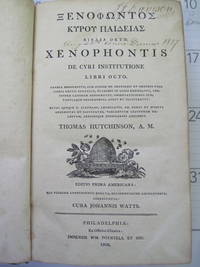
rif. 38646XENOPHON. GREEK XENOPHONTIS. DE CYRI INSTITUTIONE LIBRI OCTO. Philadelphia: Wm. Poyntell 1806. 8vo. Contemporary sheep. iv 547 pages. First edition. Shaw and Shoemaker 11903. This is the first book printed in America from Greek type made in this country. Carey's edition of Epictitus 1792 the first American book printed in Greek type was made from type cast from matrices imported from France by Benjamin Bache. The two Greek fonts used in the 1806 edition of Xenophon were cast by Binny and Ronaldson under the direction of John Watts who was specifically brought from England to supervise the type production as well as the editing and printing of this book. John Watts opened his own printing shop in New York 1809 and became one of the earliest practitioners of stereotyping in this country. Aside from being a landmark in the history of American printing the text of Xenophon was carefully prepared correcting more than one thousand errors found in the London printing of Thomas Hutchinson edition on which this is based. It was the first of a series of school books published by William Poyntell which were cast in Greek type. Early hand-made bookplate on inside of front board; contemporary owner's signature dated 1817 on title leaf. Hinges of this volume has been professionally strengthened else a very good copy. unknown books
rif. 124151London Printed for R. Dodsley at Tully's Head in Pall-Mall 1750. . Third edition; 8vo 20.5 x 13 cm; engraved portrait frontispiece engraved vignette to A7 woodcut head and tailpieces internally crisp and clean; contemporary sprinkled calf ruled in gilt contrasting red morocco lettering-piece to spine spine headcap chipped with slight loss joints and extremities a little rubbed very good; xii 1 14-179 1pp. A lovely crisp copy of this life of Socrates in English by John Gilbert Cooper. The source material is derived principally from Xenophon's Memorabilia and Plato's dialogues but also draws upon the writings of Aristotle Cicero Boethius and other classical authors. ESTC T121642. London, Printed for R. Dodsley at Tully's Head in Pall-Mall, 1750. unknown
1712rif. 1008F33London: T. Ilive for G. Sawbridge 1712 . Leather. Good. 8" by 5.5". Not Stated. The first edition of Edward Bysshe's very scarce translation of the 'Memorabilia' of Greek military leader philosopher and historian Xenophon. The very scarce first edition of this work to be translated by English writer Edward Bysshe.Illustrated with a frontispiece and one further plate. Collated complete.Bysshe has here translated Xenophon's classic work 'Memorabilia' which offers anecdotal accounts and dialogues intended to defend Socrates against the charges that led to his trial illustrating his moral teachings on virtue self-control piety and practical wisdom.ESTC T145657With the bookplate of Avancez to the front pastedown and of Michael Cecil de Courcy Peele to the front free endpaper.The work emphasises Socrates's character and philosophical method. In a contemporary panelled calf binding. Renewed spine label to back strip. Small losses of calf to back strip head and tail. Front joint and rear joint head and tail starting with boards tenderly held. Bookplates to front pastedown and front free endpaper. Internally firmly bound. Pages lightly age toned due to paper type but clean. Good T. Ilive, for G. Sawbridge hardcover
1767rif. 38606Glasgow Robert & Andrew Foulis 1767 4 vol. petits in-8 veau blond, dos lisses cloisonnés et ornés de semis de grotesques dorés, pièces de titre et de tomaison noires, encadrement de triple filet doré sur les plats, tranches mouchetées de bleu [Rel. de l'époque],
1661rif. RMP788París Antoine de Sommaville 1661. 12mo. 48 538 12 pp. Encuadernación de finales siglo XVIII al estilo Cambridge con cinco nervios y lomo cuajado; marcos dorados en tapas y ornamentos gofrados en esquinas; cantos color rojo; ligero desgaste en los bordes y etiqueta de papel pegada en la parte superior del lomo. Pequeño orificio en la bisagra delantera inferior. Subrayados ocasionales en el texto; manchas de humedad a lo largo de la obra que no afectan. Edición parisina poco común de la Ciropedia de Jenofonte biografía histórica en forma novelada de Ciro el Grande fundador del Imperio aqueménida. La obra combina elementos de historia y filosofía política y presenta a Ciro como modelo de gobernante ideal resaltando sus virtudes cualidades de liderazgo y métodos de gobierno. Ciropedia del griego ΚÏÏου παιδεία / Kýrū paidèiÄ "Educación de Ciro" es una obra biográfica parcialmente ficticia que abarca la juventud ascenso y gobierno de Ciro escrita posiblemente entre los años 380 y 365 a. C. La obra consta de ocho libros los cuales tienen el objetivo de representar el ideal de soberano y caballero a partir de la figura ejemplar de Ciro. El libro I presenta el devenir de su personaje en cambio los libros del II al VIII narran su modo de actuar producto de ese devenir. Jenofonte en griego antiguo: Ξενοφῶν XenÅfṓn; en griego moderno: Ξενοφών ca. 431 a. C.-354 a. C. fue un historiador militar y filósofo de la Antigua Grecia. Antoine de Sommaville hardcover
1711rif. BTETM0002675Oxford: Sheldonian 1711. 1st Edition. Contemporary panelled calf. Very Good/No Jacket. Octavo Standard 8vo 6 נ9 in 152 נ229 mm . Michael Burghers. Please email for Photographs or further information.1711 Oxford Edition With Important Oxford ProvenancePLATONOS KAI XENOPHONTOS SYMPOSIABy Plato Xenophon Plutarch & Lucian Ed. Henry AldrichKEY DETAILSCondition: Very GoodFormat: Contemporary panelled calf Octavo Standard 8vo 6 נ9 in 152 נ229 mm Note: Binding/size selection follows standard bibliographic conventions and is approximate; exact measurements may vary.Published By: Sheldonian Oxford 1711Language: Greek with Latin prefatory and editorial materialIllustrated By: Michael BurghersProvenance: Very probably Edwin Sandys 17261797 later 2nd Baron Sandys; acquired in 1747 as a gift from his very dear friend Ant. Champion very probably Anthony Champion 17251801Collation: Unpaginated preliminaries; 94 52 11 pp.; terminal errata presentSKU: BTETM0002675Shipping Info: Approximate Package Dimensions H: 12.5 L: 30 W: 25 Units: cm W: 2KgTracked Shipping Insurance Coverage as per Customer RequestDESCRIPTIONPlatonos kai Xenophontos SymposiaPloutarchou Symposion Hepta Sophon Loukianou Symposion LapithaiAn attractive and unusually well-provenanced Oxford Greek anthology bringing together four of antiquitys great literary treatments of the symposium: Platos Symposium Xenophons Symposium Plutarchs Banquet of the Seven Sages and Lucians satirical Symposium or The Lapiths.Printed at Oxfords Sheldonian Theatre in 1711 and edited by Henry Aldrich the volume places the philosophical Socratic moral and satirical traditions of the classical banquet beside one another allowing the symposium to be followed from Platos celebrated exploration of love and philosophical ascent through Xenophons convivial portrait of Socrates and Plutarchs legendary sages to Lucians comic dismantling of philosophical pretension.The edition is principally in Greek accompanied by Latin prefatory and editorial material and concluding annotations. The title page is particularly attractive with a finely engraved view of the Sheldonian Theatre the Oxford University printing house from which the book was issued.Institutional and modern auction catalogues attribute the editing of the 1711 Symposia to Henry Aldrich. Aldrich died in December 1710 making this one of the classical works associated with his scholarship to appear immediately after his death. An early nineteenth-century auction catalogue unusually records the edition as a Fairfax; the precise basis and identity behind that attribution have not been established and Fairfax is therefore not retained here as a co-editor.The present copy is preserved in an appealing contemporary panelled calf binding and is distinguished by an important manuscript provenance from the Oxford classical milieu of the 1740s.PROVENANCEVery probably Edwin Sandys 17261797 later 2nd Baron Sandys; acquired in 1747 as a gift from his very dear friend Ant. Champion very probably Anthony Champion 17251801The front flyleaf bears the early ink inscription:Ed: Sandys 1747 Ex dono amici charissimi Ant: Champion approximately From the gift of my very dear friend Anthony Champion.The Ed: Sandys is very probably Edwin Sandys 17261797 later 2nd Baron Sandys of Ombersley. Sandys matriculated at New College Oxford on 21 May 1743 aged seventeen and became a notable classical scholar and bibliophile. He was later appointed a trustee of the British Museum and records made at his death attest to a substantial personal library.The attribution is supported by comparison with securely provenanced books from Sandyss library including a 1746 Oxford presentation volume now held by New College Library. The abbreviated form Ed: Sandys the formation of the name and the date of the present inscription are closely consistent with material associated with Sandys during precisely this period of his life.The donor recorded as Ant: Champio - For full description please contact the seller Sheldonian unknown
1625rif. 57998Lutetiae Parisiorum Paris: Societatem Graecarum Editionum 1625. Early edition. Good . 1213pp. Thick folio 36 cm 3/4 leather with marbled paper over boards. Red text block edges. Spine label perished at edges. Title page vignette. Double columns. The inner columns are in Greek the outer columns are in Latin. Decorative headpieces and initials. Appendix and three indices at the rear. Joints and spine ends skillfully restored. Tape was formerly present at the head and foot of spine and the surrounding areas of the front board. It has been professionally removed. New endbands. The hinges have been reinforced. A tear to the front flleaf has been repaired with Japanese tissue. There is a lengthy and very warm contemporary gift inscription dated 1854 from a student to his former Greek and Latin professor on the front flyleaf. There are light tidemarks in the the bottom margins of the pages which very slightly bleed into the text. There are several pages which do have a bit more dampstaining. There are periodic instances of error in pagination however the text runs consecutively. The text opens with a description of Xenophon's life. This edition was originally published in Frankfurt in 1595. Xenophon produced a large body of work. His works are an important because they reveal much about late Classical Greece. They were also very novel for the times representing some of the earliest examples of the nonmedical treatise and autobiographical narrative "Anabasis". Furthermore not only were many of his works inspired by his own personal experiences giving them a personal touch and rendering them significant in that way as well but they were also created with the ultimate goal of serving as moral instruction. Xenophon was exiled from Athens following a fight in Coronea in 394 in which Xenophon had supported Sparta against the Greek Coalition. The cause of his exile still remains a matter of dispute. Societatem Graecarum Editionum unknown
1625rif. 57998Lutetiae Parisiorum Paris: Societatem Graecarum Editionum 1625. Early edition. Good . 1213pp. Thick folio 36 cm 3/4 leather with marbled paper over boards. Red text block edges. Spine label perished at edges. Title page vignette. Double columns. The inner columns are in Greek the outer columns are in Latin. Decorative headpieces and initials. Appendix and three indices at the rear. Joints and spine ends skillfully restored. Tape was formerly present at the head and foot of spine and the surrounding areas of the front board. It has been professionally removed. New endbands. The hinges have been reinforced. A tear to the front flleaf has been repaired with Japanese tissue. There is a lengthy and very warm contemporary gift inscription dated 1854 from a student to his former Greek and Latin professor on the front flyleaf. There are light tidemarks in the the bottom margins of the pages which very slightly bleed into the text. There are several pages which do have a bit more dampstaining. There are periodic instances of error in pagination however the text runs consecutively. The text opens with a description of Xenophon's life. This edition was originally published in Frankfurt in 1595. Xenophon produced a large body of work. His works are an important because they reveal much about late Classical Greece. They were also very novel for the times representing some of the earliest examples of the nonmedical treatise and autobiographical narrative "Anabasis". Furthermore not only were many of his works inspired by his own personal experiences giving them a personal touch and rendering them significant in that way as well but they were also created with the ultimate goal of serving as moral instruction. Xenophon was exiled from Athens following a fight in Coronea in 394 in which Xenophon had supported Sparta against the Greek Coalition. The cause of his exile still remains a matter of dispute. Societatem Graecarum Editionum unknown books
rif. 117141Bath Printed by C. Pope in Stall-Street: and sold by A. Millar in the Strand London 1762. . First Fielding edition; 8vo 21 x 13 cm; engraved ornaments head and tailpieces armorial bookplate to front pastedown a little toned with occasional light spotting; contemporary sprinkled calf covers ruled in gilt gilt spine in 6 compartments contrasting red morocco lettering-piece renewed upper joint with repaired split very good; 2 8 2 vi 339 1 21 1pp. First translation by a woman author and the only book Fielding signed with her name. The first edition of Sarah Fielding's 1710-1768 English-language translation Xenophon's Memorabilia and Apology which with Plato's dialogues represents the most important source for the life and teachings of the philosopher Socrates. Sarah was the sister of the novelist Henry Fielding 1707-1754 and enjoyed a successful literary career in her own right publishing her first novel The Adventures of David Simple in 1744 and The Governess or The Little Female Academy thought to be the first English novel intended expressly for children in 1749. The present work is notable for a number of reasons: it was Fielding's only translation it is the only book Fielding signed with her name and it marks the first translation of Xenophon into English by a woman writer. From the library of Samuel Sandys 1st Baron Sandys 1695-1770 a contemporary of the Fieldings and fellow Whig who served as Chancellor of the Exchequer under the Pelham ministry. Sandys is perhaps best remembered for his unsuccessful attempt to persuade King George II to dismiss Sir Robert Walpole as prime minister. ESTC T52845. Bath, Printed by C. Pope in Stall-Street: and sold by A. Millar, in the Strand, London, 1762. unknown
rif. 003200London: printed for J. Millan at Locke's Head in Shug-Lane and the next Bookseller to the Horse-Guards 1727. Hardcover. Very Good. Octavo. 112pp. Title-page in red-and-black. Five books in one volume. Contemporary blindstamped sheep respined in cloth at a later date. Corners and edges worn. Deaccessioned from Harvard. Harvard bookplate on front pastedown gift of Mary Bryant Brandegee in memory of William Fletcher Weld. ESTC T105254. Mary Bryant Pratt Brandegee 1871-1956 was a granddaughter of Boston shipping magnate William Fletcher Weld. Stains on rear endpapers. Some thumbing and foxing. 0 London: printed for J. Millan at Locke's Head in Shug-Lane, and the next Bookseller to the Horse-Guards, 1727. hardcover
1865rif. 12674Harper & Brothers 1865. Hardcover. Very Good. 0x0x0. Violet cloth boards are rubbed and bumped on the corners sunned top edge and spine tears head/tail of spine. Scattered foxing throughout. All orders packed with care most dust jackets protected by Brodart sleeve independent bookseller since 2011 Harper & Brothers hardcover
2001rif. 20922Malden MA: Blackwell Pub. New. Hardcover. FREE UPGRADE to Courier/Priority Shipping Upon Request - IN STOCK AND IMMEDIATELY AVAILABLE FOR SHIPMENT - 300 pages -- Interior text is clean tight and unmarked. Pages are intact and tight to the spine. From a review by Theodore Scaltas University of Edinburgh: "This is the most insightful overarching analysis of the good in Plato and Aristotle of recent decades. Santas offers a comprehensive framework for the classification and detailed discussion of Plato's and Aristotle's theories of good with valuable comparisons to positions in the history of philosophy and contemporary debates. A very wise investment for moral and ancient philosophers." -- with a bonus offer--; TOS006370; Santas Gerasimos Xenophon Goodness and Justice: Plato Aristotle and the Moderns PHILOSOPHY JUSTICE PLATO ARISTOTLE LAW PHILOSOPHY . 2001. 0631172599 . Blackwell Pub hardcover
2001rif. 14046Williston Vermont U.S.A.: Blackwell Publishing. New. Hardcover. FREE UPGRADE to Courier/Priority Shipping Upon Request - IN STOCK AND IMMEDIATELY AVAILABLE FOR SHIPMENT - Flawless -- with a bonus offer--; 014046; JUSTICE PLATO ARISTOTLE LAW PHILOSOPHY . 2001. 0631172599 . Blackwell Publishing hardcover
2001rif. 33673Williston Vermont U.S.A.: Blackwell Publishing. New. Hardcover. FREE UPGRADE to Courier/Priority Shipping Upon Request - IN STOCK AND IMMEDIATELY AVAILABLE FOR SHIPMENT - FLAWLESS COPY BRAND NEW NEVER OPENED -- 300 pages -- DESCRIPTION: "This volume explores Plato's and Aristotle's theories about good things goodness and the best life for human beings and draws comparisons between ancient and modern theories of good and justice. Goodness and Justice argues that goodness was the most fundamental normative concept in the ethics of Plato and Aristotle and illustrates how they used their functional and formal theories of good to build their theories of virtue justice and happiness. It also shows that they fought subjective theories of good as desire satisfaction and good as pleasure in favor of what they thought was a more objective concept of good found in form and function. The comparisons with the moderns illuminate the merits and limits of ancient and modern ethical theories and place them within a broad philosophical and historical context. " -- AUTHOR: "Gerasimos Santas is Professor of Philosophy at the University of California at Irvine. He is author of Socrates: Philosophy in Plato's Early Dialogues 1979 and Plato and Freud: Two Theories of Love." - Blackwell -- with a bonus offer--; 520-Santa; JUSTICE PLATO ARISTOTLE LAW PHILOSOPHY . 2001. 0631172599 . Blackwell Publishing hardcover
1994rif. 14384Ithaca New York U.S.A.: Cornell Univ Pr. New. Hardcover. FREE UPGRADE to Courier/Priority Shipping Upon Request - IN STOCK AND IMMEDIATELY AVAILABLE FOR SHIPMENT - Book In fine Condition -- with a bonus offer--; 014384; SOCRATES PHILOSOPHY HISTORY SURVEYS ANCIENT . 1994. 0801429633 . Cornell Univ Pr hardcover
1711rif. 66266Chez Henri Schelte | à Amsterdam 1711 | 9.50 x 15 cm (In-12) | relié
1838rif. 054600Cairo: Bulaq Printing House 1838. 1st Edition . Leather. Very Good. 8vo - over 7¾ - 9¾" tall. Original full leather bdg. with its miklep traditional flap embossed shamsa mystical sun on boards. Roy. 8vo. 24 x 17 cm. In Ottoman script. 8 263 p. Sarlavla page decorated with traditional ornaments. First edition of this extremely rare and the first translation of the Anabasis of Alexander in the Ottoman / Turkish literature. One of 1010 copies. The Anabasis of Alexander was composed by Arrian of Nicomedia in the second century AD most probably during the reign of Hadrian. The Anabasis which survives complete in seven books is a history of the campaigns of Alexander the Great specifically his conquest of the Persian Empire between 336 and 323 BC. Both the unusual title "Anabasis" literally "a journey up-country from the sea" and the work's seven-book structure reflect Arrian's emulation in structure style and content of the Greek historian Xenophon whose own Anabasis in seven books concerned the earlier campaign "up-country" of Cyrus the Younger in 401 BC. The Anabasis is by far the fullest surviving account of Alexander's conquest of the Persian Empire. It primarily revolves around the military history reflecting the content of Arrian's model Xenophon's Anabasis; the work begins with Alexander's accession to the Macedonian throne in 336 BC and has nothing to say about Alexander's early life in contrast say to Plutarch's Life of Alexander. Nor does Arrian aim to provide a complete history of the Greek-speaking world during Alexander's reign. Arrian's chief sources for writing the Anabasis were the lost contemporary histories of the campaign by Ptolemy and Aristobulus and for his later books Nearchus. One of Arrian's main aims in writing this work on history seems to have been to correct the standard "Vulgate" narrative of Alexander's reign that was dominant in his day primarily associated with the lost writings of the historian Cleitarchus. The Anabasis gives a broadly chronological account of the reign of Alexander the Great of Macedonia 336-323 BC with a particular focus on military matters. George Rhasis Yorgaki Razi translated Anabasis Alexandrou = "History of Alexander the son of Philip" the work of Xenophon under the title "Târîh-i Iskender bin Filipos". This is the first translation of an ancient Greek historian into Turkish. Georgios Rhasis who was one of the first writers of the French-Turkish dictionary in the early period was an Ottoman intellectual who worked as an instructor and translator in Ottoman and French languages. He also taught at the Eastern Languages School in Paris and continued her studies in Corfu and Paris. In 1821 he came to be in Istanbul as a famous orientalist. Rhasis left the city and the homeland he lived in to settle in Tsarist Russia due to concerns during the Greek Revolution in 1821. The Bulaq or El-Amiriya Press is the first official and governmental printing press to be established in Egypt and functions according to industrial printing basis causing not just a qualitative but also a quantitative and knowledgeable leap in science throughout the Arab region. It was established in 1820 by Muhammad Ali Pasha of Egypt and Sudan 1769-1849 and was part of Muhammad Ali's inclusive development plans for the modernization of Egypt. Aynur 112 Müteferrika 64.; Library of Congress Karl Süssheim Collection no. 129. OCLC: 966315151.; Only six copies in OCLC: 27236333.; Alex II 25.; BM e15.; Cairo FKT 166.; IstUKT 802.; Bianchi CD 155.; Bulaq IF 8:21.; Bulaq FK 7:8.; Ridwan 162.; Özege 19837 No author and no translator in Özege record. Bulaq Printing House hardcover
1711rif. 66266à Amsterdam: Chez Henri Schelte 1711. Fine. Copy bearing the arms of Queen Elisabeth Farnese of Spain Princess of Parma. Chez Henri Schelte à Amsterdam 1711 9.50 x 15 cm In-12 relié First bilingual edition with French facing Greek translated by Pierre Coste with his footnotes. Title page printed in red and black. Extended preface by Pierre Coste. Copy bearing the arms of Queen Elisabeth Farnese of Spain Princess of Parma queen from 1714 to 1746. A woman of power whose policies profoundly influenced Spain. Double coat of arms surmounted by a closed royal crown encircled by the collars of the Orders of the Holy Spirit and the Golden Fleece. Dexter: Spain; sinister: Farnese ""or with six fleurs-de-lys azure 321"". An intriguing feature of the queens arms: the collars of the Orders of the Holy Spirit and of the Golden Fleece although these orders were never bestowed upon women. Contemporary full speckled blond calf binding. Spine with raised bands richly gilt. Crimson morocco title-piece. Arms gilt-stamped at the centre of the covers. Triple fillet border on the covers. All edges gilt. Slight wear to headcaps. Upper joint largely split. Lower joint split at head. Hieron is a dialogue by Xenophon between a philosopher Simonides and a king Hieron; through Simonides questions emerges a vision of kingship. As the edition dates from 1711 and Elisabeth Farnese only acceded to royal dignity in 1714 the association of this text with the rare arms of the young and newly crowned queen takes on a distinctly symbolic dimension: a reflection on power and on the way of preparing for it through the reading of the Ancients. Chez Henri Schelte hardcover
1999rif. 90896Routledge. New. Hardcover. FREE UPGRADE to Courier/Priority Shipping Upon Request - IN STOCK AND IMMEDIATELY AVAILABLE FOR SHIPMENT - Flawless copy brand new pristine never opened -- 360 pages. -- with a bonus offer--; This book is available either individually or as part of the specially-priced Arguments of the Philosphers Collection. . 1999. 0415203546 . Routledge hardcover
rif. 831926Societatem Græcarum Editionum. Hardcover. Used-Very Good. Paris: Typis Regiis apud Societatem Græcarum Editionum 1625. Folio about 350 mm two volumes in 1 8 1013 pp. col. 1014-1213 71 pp. At p. 1013 the numbering switches from page numbers to column numbers. Text in parallel columns of Greek text and Latin translation with marginal commentary. Full dark green calf ruled in gilt. Some scuffing to covers with some damage along board edges and spine edges but still very sound and sturdy. Hinges restored. Internally very sound and clean with wide margins. Dibdin p. 567 notes that this 'sumptuously printed' reimpression of the edition of Frankfort 1595 is considered somewhat less accurate than the original though much superior in production quality. Societatem Græcarum Editionum hardcover
1613rif. qmsc155Cologny i.e. Geneva: Pierre Aubert pour la Societe Caldorienne 1613. Folio original full burgundy calf bearing the armorial crest of the 2nd Lord Scott of Buccleuch viii 777 xvii pp. Front joint a bit tender some shelf wear. Pierre Aubert, pour la Societe Caldorienne, 1613. unknown
1613rif. qmsc155Cologny i.e. Geneva: Pierre Aubert pour la Societe Caldorienne 1613. Folio original full burgundy calf bearing the armorial crest of the 2nd Lord Scott of Buccleuch viii 777 xvii pp. Front joint a bit tender some shelf wear. Pierre Aubert, pour la Societe Caldorienne, 1613. unknown books
1525rif. 133029Venice: Heirs of Aldus Manutius and Andrea Torresano 1525. The Aldine Xenophon First Aldine edition of the collected works of Xenophon including the Anabasis recounting his leadership of the Ten Thousand against the Persian Empire and the Cyropaedia his partly fictionalized biography of Cyrus the Great which became a model for medieval writers of the mirror-for-princes genre. The edition is almost complete with the only absent Xenophon text being the Apology. The edition marks the first printing of Xenophon's De Atheniensium re publica and De vectigalibus alongside the Hellenica which the Aldine press had published in October 1503 and the Agesilao which had previously been erroneously attributed to Plutarch. The text was edited by Aldus's brother-in-law Gian Francesco d'Asola who in his preface makes disparaging comments about the 1516 Filippo Giunta edition showing the rivalry between the two great Venetian printing houses. This edition is universally recognized as superior. Provenance: library of the College of Santa Maria Coronata Pavia ownership inscription "Biblioth. Collegij S. Mariae Coronatae Papiensis" and old small stamp on title page. Folio 306 x 209 mm. Woodcut Aldine device on title and on verso of final leaf. Complete with blank leaves L8 and a1. Seventeenth-century sprinkled calf spine lettered and tooled in gilt red speckled edges. Some early annotations in margins in Greek. Spine ends and head of front joint repaired with new calf very minor insect damage to rear cover a few instances of light finger-soiling yet contents generally clean and crisp. A very good copy. Adams X4; Ahmanson-Murphy 229; Cataldi Palau 94; Renouard 100.1; STC Italian 738. unknown