1.755 Ergebnisse
1832Best.-Nr. 48329(Paris, Crochard, 1832). No wrappers. In: ""Annales de Chimie et de Physique"", 2e Series, vol. 51, Cahier 4. Pp. 337-444 (Entire issue offered). Faraday's letter: pp. 404-434 a. 1 engraved plate. Some brownspots.
1777Best.-Nr. 46614London, W. Bowyer and J. Nichols, 1777. 4to. Extracted from ""Philosophical Transactions"", Year 1777. Vol. 67 - Part I. Pp. 260-265. Clean and fine, broadmargined.
1879Best.-Nr. 47275(Paris, Gauthier-Villars), 1879. 4to. No wrappers. In: ""Comptes Rendus Hebdomadaires des Séances de L'Academie des Sciences"", Tome 88, No 7. Pp. (313-) 352. (Entire issue offered). Boisbaudran's paper: pp. 322-324.
1878Best.-Nr. 48210(Paris, Gauthier-Villars), 1878. 4to. No wrappers. In: ""Comptes Rendus Hebdomadaires des Séances de L'Academie des Sciences"", Tome 87, No 17. Pp. (570-) 616. (Entire issue offered). Marignac's paper: pp. 578-581.
1833Best.-Nr. 51493Paris, Crochard, 1833. Contemp. hcalf. Raised bands, gilt spine with gilt lettering. A few scratches to spine. Stamps to verso of titlepage. In: ""Annales de Chimie et de Physique, Par MM. Gay-Lussac et Arago."", Series 2, tome 53. Entire volume offered. 448 pp. Payen & Persoz's paper: pp. 73-92. Clean and fine.
1829Best.-Nr. 49248Leipzig Johann Ambrosius Barth 1829. Without wrappers as issued in "Annalen der Physik und Chemie. Hrsg.von Poggendorff" Bd. 16 Siebentes Stück. 2 pp. 1 folded engraved plate. Entire issue offered with titlepage to volume 16. Berzelius's paper: pp. 387-415. Clean and fine. First German printing - printed simultaneously with the English and Swedish version - of the paper in which Berzelius described his discovery of Thorium the first element after Uranium to be identified as such. In 1829 Jöns Jakob Berzelius of the Royal Karolinska Institute Stockholm extracted thorium from a rock specimen sent to him by an amateur mineralogist who had discovered it near Brevig and realised that it had not previously been reported. The mineral turned out to be thorium silicate and it is now known as thorite. Berzelius even produced a sample of metallic thorium by heating thorium fluoride with potassium and confirmed it as a new metal. He called the black mineral thorite in honor of the Scandinavian god Thor.Parkinson "Breakthroughs" 1829 C. unknown
1832Best.-Nr. 48329Paris Crochard 1832. No wrappers. In: "Annales de Chimie et de Physique" 2e Series vol. 51 Cahier 4. Pp. 337-444 Entire issue offered. Faraday's letter: pp. 404-434 a. 1 engraved plate. Some brownspots. First printing of Faraday's famous letter to Gay-Lussac in which he claim to be the discoverer of electro-magnetic induction analysed the results of the Italian philosophers pointing out their errors and defending himself from what he regarded as imputations on his character. The style of this letter is unexceptionable for Faraday could not write otherwise than as a gentleman; but the letter shows that had he willed it he could have hit hard. The letter was later translated into English and published in "Philosophical Magazine" in 1840 under the title "On Magneto-electric Induction"."In 1831 seemingly out of nowhere came the discovery of electromagnetic induction and the beginning of the experimental researches in electricity which were to lead Faraday to the discovery of the laws of electrochemistry specific inductive capacity the Faraday effect and the foundations of classical field theory." DSB. unknown
1777Best.-Nr. 46614London W. Bowyer and J. Nichols 1777. 4to. Extracted from "Philosophical Transactions" Year 1777. Vol. 67 - Part I. Pp. 260-265. Clean and fine broadmargined. First apperarance of this paper constituting the first reliable account of colour blindness.Usually Goethe or John Dalton - Huddart's case was cited in Dalton's paper of 1794 - is supposed to have discovered colourblindness. However the English oculist Joseph Huddart was the discoverer of this phenomenon. The first physiological explanation of it does come from Goethe.Garrison & Morton: 5832. unknown
1879Best.-Nr. 47275Paris Gauthier-Villars 1879. 4to. No wrappers. In: "Comptes Rendus Hebdomadaires des Séances de L'Academie des Sciences" Tome 88 No 7. Pp. 313- 352. Entire issue offered. Boisbaudran's paper: pp. 322-324. First apperance of the paper in which Boisbaudran revealed his discovery of a new earth that precipitated had a unique spectrum. De Boisbaudran named it samaria after the mineral from which it was derived. The mineral samarskite is named for a Russian mining engineer and Chief of Staff - Corps of Mining Engineers Colonel Vasili Evgrafovich Samarsky-Bykhovets."Samarium was discovered by French chemist Paul Émile Lecoq de Boisbaudran in 1879. He noticed in his research that impure didymium praseodymium and neodymium with other impurities seemed to contain more than just didymium based on spectroscopic work on various rare-earth minerals. When Lecoq de Boisbaudran added ammonium hydroxide to a concentrate prepared from the mineral samarskite he observed a precipitate that formed before the didymium Weeks and Leicester 1968 p. 685. Partington "Breakthroughs" 1879 C. unknown
1878Best.-Nr. 48210Paris Gauthier-Villars 1878. 4to. No wrappers. In: "Comptes Rendus Hebdomadaires des Séances de L'Academie des Sciences" Tome 87 No 17. Pp. 570- 616. Entire issue offered. Marignac's paper: pp. 578-581. First apperance of the paper relating Marignac's discovery of the rare earth Ytterbium Ytterbia."He began his study of the rare earths in 1840 when he was barely twenty-three years old. According to P.T. Cleve "Marignac's work on the rare earths is undoubtedly the most importent in this particular department of chemistry". In 1878 marignac heated some erbium nitrate obtained from gadolinite until it decomposed. When he extracted the resulting mass with water he obtained two oxides: a red one for which he retained the name Erbia and a colorless one which he named Ytterbia." Weeks "The Discovery of the Elements".Parkinson "Breakthroughs" 1878 C unknown
1833Best.-Nr. 51493Paris Crochard 1833. Contemp. hcalf. Raised bands gilt spine with gilt lettering. A few scratches to spine. Stamps to verso of titlepage. In: "Annales de Chimie et de Physique Par MM. Gay-Lussac et Arago." Series 2 tome 53. Entire volume offered. 448 pp. Payen & Persoz's paper: pp. 73-92. Clean and fine. First printing of a pioneering paper in industrial chemistry and microbiology being the discovery of the first Enzyme Diastase. It catalyses the breakdown of starch into maltose. hardcover
1879Best.-Nr. 47273(Paris, Gauthier-Villars), 1879. 4to. No wrappers. In: ""Comptes Rendus Hebdomadaires des Séances de L'Academie des Sciences"", Tome 88, No 12. Pp. (625-) 676. (Entire issue offered). Nilson's papers: pp. 642-645 a. 645-648. First leaf with a tear to right margin, no loss of paper.
1801Best.-Nr. 43599Halle Rengerschen Buchhandlung 1801. Without wrappers as published in "Annalen der Physik. Herausgegeben von Ludwig Wilhelm Gilbert" Bd. 7 Zweites Stück. The entire issue offered =Heft 2. Pp. 137-264 a. 2 folded engraved plates. Herschels papers: pp. 137-156. The plate depicts Herschel's experimental arrangements. First appearance in German of Herschel's epochal announcement of his discovery of infrared light in 1800. This was the first time that a form of light beyond visible light had been detected. The paper offered is the German translation of the main parts of Herschel's paper "An Investigation of the Powers of Prismatic Colours to Heat and Illuminate Objects"."In 1800 he tested various portions of the sun's spectrum by thermometer to see if he could find interesting differences in the amount of heat the different colors delivered. He did but in a rather unexpected way for he found that the temperature rise was highest in no color at all at a spot beyond the red end of the spectrum. He concluded that the sunlight contained invisible light beyond the red. This is now called infrared radiation. The following year Ritter was to extend the visible spectrum in the other direction."Asimov.Parkinson "Breakthroughs" 1800 P. unknown
1801Best.-Nr. 43599Halle, Rengerschen Buchhandlung, 1801. Without wrappers as published in ""Annalen der Physik. Herausgegeben von Ludwig Wilhelm Gilbert"", Bd. 7, Zweites Stück. The entire issue offered (=Heft 2). Pp. 137-264 a. 2 folded engraved plates. Herschels papers: pp. 137-156. The plate depicts Herschel's experimental arrangements.
1879Best.-Nr. 47273Paris Gauthier-Villars 1879. 4to. No wrappers. In: "Comptes Rendus Hebdomadaires des Séances de L'Academie des Sciences" Tome 88 No 12. Pp. 625- 676. Entire issue offered. Nilson's papers: pp. 642-645 a. 645-648. First leaf with a tear to right margin no loss of paper. First apperance of the papers in which Nilson describes his discovery of a new element and its properties and naming it Scandium. It was the second new element found after Mendeleev's prediction of its existence as "Eka-Boron"."Mendeléeff had predicted that another element which he called eka-boron and which he said would have an atomic weight between 40 calcium and 48 titanium would some day be revealed. It was discovered in 1879 by Lars Fredrik Nilson. Nilson extracted 63 grams of the rare earth erbia from gadolinite and euxenite and converted it into the nitrate. Upon decomposing this salt by heat as Marignac had done he obtained some very pure ytterbia and to his great surprise an earth that was unknown to him.Upon thoroughly investigating this new earth he found that it contained an element whose properties concided almost exactly with those Mendeléef had predicted for ekaboron. Nilson called it scandium in honour of his fatherland."Weeks "Discovery of the Elements" pp. 219-20.Parkinson "Breakthroughs" 1879 C. unknown
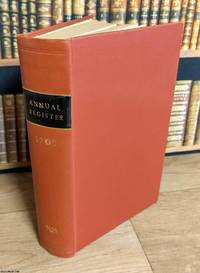
1793Best.-Nr. 373234J. Dodsley London 1793. 5th Edition. Hardcover. Very Good Condition. 21 pages. This 1765 article published in The Annual Register provides a detailed account of John Harrison's groundbreaking work in solving the longitude problem at sea through the use of artificial time-keepers. Harrison an English clockmaker developed the marine chronometer a device that allowed sailors to accurately determine their longitude while at sea. His invention was crucial for safe navigation reducing the risk of ships becoming lost or wrecked due to miscalculations. The article outlines the proceedings and debates surrounding Harrison's work including his struggles with the Longitude Board which was reluctant to grant him the full 20000 prize promised under the 1714 Longitude Act. Despite proving the accuracy of his time-keepers Harrison faced political opposition and bureaucratic delays before finally receiving recognition for his achievements. Published at around the same time that Harrison's book of a similar title was published this contemporary 21 page account quotes Harrison extensively and represents the opinions and ideas regarding navigation from the perspective of the time. The whole volume extends to around 600 pages. Bound in modern but not recent brown buckram with a contrasting black leather lettering piece gilt title. Library label to the endpapers stamp on first blank and label to reverse of the title page. The first blank has a hand note stating "Given by Lt.Col. A.R. Hurst". Hurst has served with the Royal Field Artillery in the First World War. The whole volume is very clean with bright pages very firmly bound and in attractive condition. Size: 13.5 x 21 cms. Category: Antiquarian & Rare; Featured Items; Printed before 1800; Special Interest. This item may require more postage than the rates shown for delivery outside the UK. If extra postage is required we will contact you before processing your order and you will be given the details and option to decline the extra cost. J. Dodsley hardcover
Paris, La Belle édition, s.d. 3 volumes petits in-4 (19,5 x24,5 cm),299 - 269 - 231 pp étui individuel. Un des 800 exemplaires numérotés sur vélin de Lana. Les aquarelles ont été reproduites par Duval et coloriés dans les Ateliers de Maurice Beaufumé. Bel exemplaire.
Best.-Nr. 25667Paris, La Belle édition, s.d. 3 volumes petits in-4 (19,5 x24,5 cm),299 - 269 - 231 pp étui individuel.
Best.-Nr. 8982Nouvelle édition revue et augmentée, enrichie de notes scientifiques par M. François ARAGO et précédée d’une introduction par M. Jules JANIN Deux tomes en un volume in 8 demi-chagrin marron à nefs, titre, roulette, caissons dorés. Plats percaline, triple filet à froid en encadrement. Tome 1 : faux-titre, frontispice gravé sous serpent. Portrait de Jacques ARAGO. Titre général illustré, titre orné d’une vignette, XII, 449 pages, notes scientifiques, XXVIII et 2 pages de table des matières. Tome 2 : faux-titre, portrait gravé de François Dominique ARAGO en frontispice, sous serpente. Titre orné d’une vignette, 439 pages, XXII, notes scientifiques, 2 pages de table des matières, tranches dorées. 22 gravures hors-texte, 150 gravures dans le texte. Paris H. Lebrun éditeur, Garnier Frères sans date rousseurs éparses plus ou moins fortes, dorure éclatante
Paris, Aux éditeurs associés, Les éditions du Monde nouveau, 1925-1926. 4 volumes in-8, demi-chagrin rouge à coins, dos à 4 nerfs, couvertures conservées. Tome 1. XVI pp Avant-propos de Pierre Borel - Un portrait en frontispice - une double page fac-similé d'une lettre autographe de M. B - un deuxième portrait et 325 pp. Tome II. XIX pp. Préface de Charles Régismanset.- 217 pp. Tome III. XII pp. Préface de Jean-Jacques Brousson - 245 pp. Tome IV et dernier. XV pp. Préface d'Albéric Cahuet. - 221 pp. Edition originale. Un des 300 exemplaires numérotés sur vélin pur fil (3ème papier après 15 sur Japon et 120 sur Hollande). Bel exemplaire.
192632 pages. Features: The Senator Nobody Knows - William E. Borah will not play politics; Our Soldiers and Reform of Court-Martial System - Ex-Noncommissioned Officer says that in the World War American Soldiers were tried by Court-Martial System of George III; Heroes of the Air Mail - they carry on every day of the year, through rain or fog, over mountains and treacherous valleys; Lo! The Poor Indian, A Citizen Who Has Few Rights; Did High Freight Rates Occasion the Discovery of America?; Henry Ford's Page - America is a challenge to other nations to put their social foundations at the bottom instead of the top; Editorials - anti-American forces arrayed against Hon. Albert Johnson, Farmer Butte discovers dinotherium in Ohio, gunplay in Pittsburgh; Exploring Where Paul Preached - notable architectural and art treasures unearthed on the site of ancient Antioch - photo-illustrated article; The Lobster is Supreme in the village of Cape Porpoise; Can Courage be Cultivated?; Chats with Office Callers; The Strange Transient Woman - A One-Act Play; I Read In the Papers; Can You Tell Me? Soiling to front cover near spine. Unmarked with average wear. A worthy vintage copy. Book
Best.-Nr. 109644Petit In-8, demi percaline - 5 volumes reliés en un, répartis comme suit :(1) A Paris, Chez Leiber, Librairie-Editeur - 1866 - 72 p.(2) A Paris, Chez Gauthier-Villars, Imprimeur-Librairie, Série "Actualités scientifiques" - 1876 - Deuxième édition, augmentée du formulaire de Th. Sutton - 63 p.(3) A Paris, Chez Gauthier-Villars, Imprimeur-Librairie, Série "Actualités scientifiques" - 1878 - 84 p.(4) A Paris, Chez Gauthier-Villars, Imprimeur-Librairie, Série "Bibliothèque photographique" - 1876 - Troisième édition, refondue et complétée - 87 p.(5) A Paris, Chez Gauthier-Villars, Imprimeur-Librairie - 1885 - 204 p. (Avec 91 figures dans le texte)
Best.-Nr. 212Grand in 8 demi-chagrin vert à nerfs,titre,filets,caissons dorés.plats percaline verte à filets à froid en encadrement.Faux-titre,frontispice (chasse au lasso),titre,XXXVI,444 pages,tranches dorées,20 gravures sur acier hors texte sous serpentes,dont deux en couleurs par MM Jules NOEL,LEBRETON,Gustave JANET, gravées par MM Willmann,Outhwaite,Naigrot,Delannoy et Aubert.Ancienne maison Morizot, F de P. Mellado & Cie successeurs 1867.Rousseurs éparses habituelles.Bel exemplair,belles vues de La Havane,Buenos-Ayres,Veracruz et...
Best.-Nr. 47628, Paris, Librairie Hachette, 1893, Reliure en demi chagrin. Dos a 5 nerfs. Titre et auteur en lettres dorees. Tranche superieure doree. 395pp., 20.5x28.5cm. Tres belle exemplaire!!! (qq traces d'usure a la reliure).
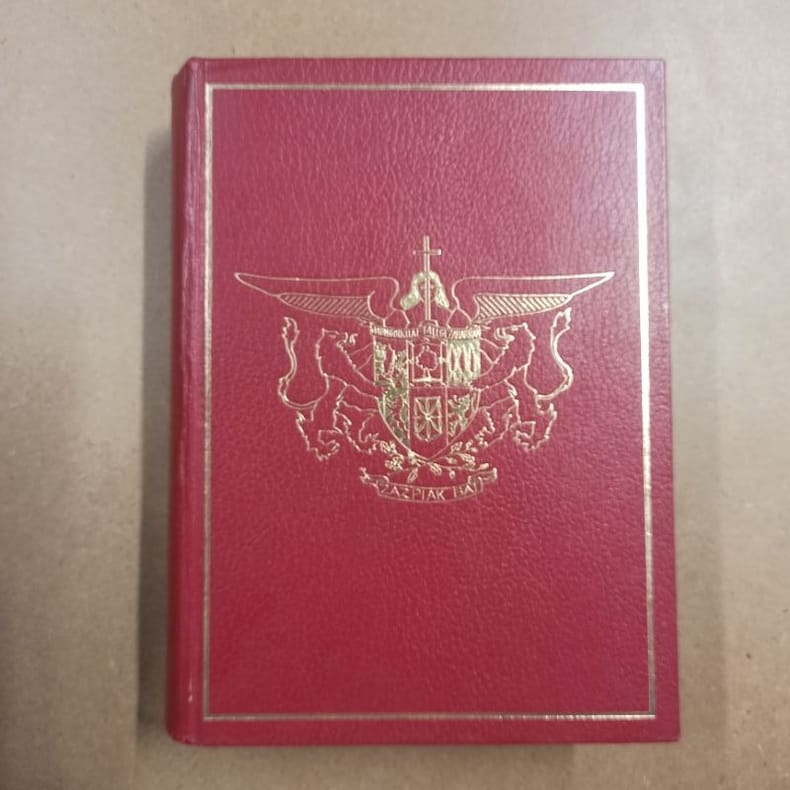
1979Best.-Nr. 5871979 - reliure - Société Nouvelle d'Editions Régionales et de Diffusion, Pau - 1979 - Fort in-4 (30 x 22 cm) reliure éditeur plein cuir rouge, avec cadre et décor doré au premier plat. Titre doré au dos - 671 pages - Très nombreuses photographies en noir et blanc hors texte + Cartes in fine - Louis COZZOLINO (Directeur de la rédaction) - Marguerite DEMANGEON (Reliure) - Monique MORALES (Cartographie) - Robert BRU (Photographie) - Ouvrage sous titré : "Le Pays Basque. Soule, Labourd, Basse-Navarre" - Tirage limité. Exemplaire nominatif, ouvrage numéroté N° 715, imprimé pour M et Mme Bernard ARDOHAIN