1 819 résultats
1750réf. 42895(Petropoli (St. Petersbourg), 1750). 4to. Uncut, without wrappers. Extracted from ""Novi Commentarii Academiae Scientiarum Imperialis Petropolitanae"", Tom. I. ad Annum 1747 et 1748. Pp. 245-266 a. 1 engraved plate (ad. p. 251). Clean and fine.
1832réf. 44146Leipzig Johann Ambrosius Barth 1832. Contemp. hcalf. raised bands gilt spine. Light wear along edges. In "Annalen der Physik und Chemie. Hrsg. von J.C. Poggendorff" Band 25. Entire volume offered. VIII648 pp. and 6 folded engraved plates. Small stamps on verso of titlepage and plates. Faraday's papers: pp. 91-142 a. pp. 142-186. with 3 folded engraved plates. Clean and fine. First German editions of the 2 first memoirs of Faradays groundbreaking researches on electricity constituting the first 2 papers of his "Experimental Researches in Electricity" and containing his fundamental discovery of electromagnetic induction THE FOUNDATION OF NEARLY ALL THE ELECTRICITY IN USE TODAY. In 1820 Oersted had generated magnetism from electricity Faraday here finds the opposite effect generating electricity by magnetism. He also described the first electrical generator second paper. THESE PAPERS ARE SOME OF THE GREAT CLASSICS OF CHEMISTRY AND PHYSICS."Faraday demonstrated this theory involving the lines of force.by inserting a magnet into a coil of wire attached to a galvanometer. While the magnet was being inserted or removd current flowed through the wire. If the magnet was held stationary and the coil moved over it one way or the other there was current in the wire. In either case the magnetic lines of force about the magnet were cut by the wire.If the magnet and coil were both held motionless whether the magnet was within the coil or not there was no current.Faraday hd thus discovered electricalinduction.It was to lead to great things but this was not apparent."Asimov."Although his discovery of the electric motor and the dynamo was almost entirely identical to his theoretical discoveries it laid the foundation of the modern electrical industry - electric light and power teælephony wireless telegraphy televison etc. - by providing for the production of continous mechanical motion from an electrical source and vice versa." PMM 308.Horblit 29 - Milestones 62. - Dibner 64. - PMM 308.The volume contains further notable papers. Elie de Beaumont "Zweiter geologischer Brief.an A.v. Humboldt über die relative Alter der Gebirgszüge" pp. 1-58 a. 2 plates one handcoloured papers by Döbereiner E. Lenz Moser Mitscherlich de Saussure J. Dumas F.E. Neumann Gay-Lussac Johannes Müller "Beobachtungen zur Analyse der Lymphe des Bluts und des Chylus" pp. 513-590. hardcover
1832réf. 44145Paris Crochard 1832. Contemp. hcalf. gilt spine light wear along edges. In: "Annales de Chimie et de Physique Par MM. Gay-Lussac et Arago." tome 50 Series 2. Entire volume offered. 448 pp. 2 folded engraved plates. Faraday's papers: pp. 5-67 a. pp. 113-162. First French editions of the 2 first memoirs of Faradays groundbreaking researches on electricity constituting the first 2 papers of his "Experimental Researches in Electricity" and containing his fundamental discovery of electromagnetic induction THE FOUNDATION OF NEARLY ALL THE ELECTRICITY IN USE TODAY. In 1820 Oersted had generated magnetism from electricity Faraday here finds the opposite effect generating electricity by magnetism. He also described the first electrical generator second paper. THESE PAPERS ARE SOME OF THE GREAT CLASSICS OF CHEMISTRY AND PHYSICS."Faraday demonstrated this theory involving the lines of force.by inserting a magnet into a coil of wire attached to a galvanometer. While the magnet was being inserted or removd current flowed through the wire. If the magnet was held stationary and the coil moved over it one way or the other there was current in the wire. In either case the magnetic lines of force about the magnet were cut by the wire.If the magnet and coil were both held motionless whether the magnet was within the coil or not there was no current.Faraday hd thus discovered electricalinduction.It was to lead to great things but this was not apparent."Asimov."Although his discovery of the electric motor and the dynamo was almost entirely identical to his theoretical discoveries it laid the foundation of the modern electrical industry - electric light and power teælephony wireless telegraphy televison etc. - by providing for the production of continous mechanical motion from an electrical source and vice versa." PMM 308.Horblit 29 - Milestones 62. - Dibner 64. - PMM 308. unknown
1750réf. 42895Petropoli St. Petersbourg 1750. 4to. Uncut without wrappers. Extracted from "Novi Commentarii Academiae Scientiarum Imperialis Petropolitanae" Tom. I. ad Annum 1747 et 1748. Pp. 245-266 a. 1 engraved plate ad. p. 251. Clean and fine. First appearance of a groundbreaking paper in chemistry in which Lomonosov describes his discovery of the transition of a metal into passive state and this is the first scientific description of this phenomena. He observed and described fast termination of the dissolution of iron in concentrated nitric acid and attributed this to a change in the solvent properties."Lomonosov employed corpuscular mechanics in chemical explanations more extensively than Boyle had done. Treating chemical compounds as particles in adhesion he held that "adhesion is eliminated and renewed by means of motion.since no change in a body can take place withouy motion". He attempted to apply these theories to chemical phenomena - although he was limited to speculation- in papers on the action of chemical solvents in general."DSB VIII p. 469."Lomonosov was founder of Russian science and he would be universally recognized as a great pioneer of science had he been born a West European. He was famous also for his literary works including poems and dramas. In 1755 he wrote a Russian Grammar that reformed the language and in the same year he helped found the University of Moscow. In 1760 he published the first history of Russia."Isaac Asimov. unknown
réf. 80428Paris, Typographie de Firmin-Didot et Cie. 1903, 300x245mm, 360pages, broché. Couverture supérieure détachée, dos fendu. A faire relier. Intérieure en très bon état, aucun défaut. Sous emboitage. A faire relier. - Cet exemplaire attend les soins d’un bon reliure afin d’en être dignement et justement habillé selon son importance historique et son impacte phénomal dans les découvertes scientifiques. Ce traité est la synthèse définitive des découvertes de Becquerel sur la radioactivité spontanée, qui lui ont valu le prix Nobel de physique en 1903 aux côtés de Pierre et Marie Curie. C’est une pièce maîtresse pour tout collectionneur de sciences (référencé au célèbre Printing and the Mind of Man, PMM 393) -.
réf. 14501Nouvel atlas portatif destiné principalement pour l’instruction de la jeunesse d’après la géographie moderne de feu l’abbé DELACROIX par le S. Robert de VAUGONDY géographe du Roi de S.M Polonoise Duc de Lorraine et de Bar de la société royale des sciences et belles lettes de Nancy et censeur royal . A Paris chez le Sr FORTIN 1778. In 4 demi-chagrin fauve à nerfs, pièce de titre chagrin rouge, fers, roulette, filets, caissons dorés. Cartes 290x420mm. Faux titre, Titre gravé avec frise décorative en encadrement. IX, et suite de 52 cartes, sur double page pages, montées sur onglets. Contours couleurs d’origine., gavées par DUSSY. Complet. Coiffe inférieure manquante, mouillure pâle en marge supérieure visible au recto, jusqu’à la carte 20. Pages de faux titre avec quelques légères salissures sans gravité,. Cartes avec coloris frais Cartes numérotées au pochoir, au verso.
réf. 4671" undertaken by the command of his majesty, for making discoveries in the Northern Hemisphere. Performed under the direction of captains Cook, Clerke and Gore, in his majesty's ships the Resolution and Discovery; in the years 1776, 1777, 1779, and 1780. IN THREE VOLUMES : Volume 1- 3; Vol. I and II written by Captain James Cook; Published by Order of the Lords Commissioners of the Admiralty, Vol. III by Captain James King . Second edition."
1841réf. 002830Paris et Nancy, Tresse, et Chez Lauteur, 1841
1984réf. 2548821984. unbound. Outstanding official NASA photograph signed by all six members of Flight STS-41-D Discovery's first mission. This vibrant color 8 x 10-inch photo features all six crew members in flight gear: Charles Walker the first non-government person to fly in space Judy Resnik who died two years later at the age of 36 in the Challenger explosion Richard "Mike" Mullane a former Air Force Colonel Steve Hawley Hank Hartsfield and Michael L. Coats the pilot of this mission. No place no date circa 1984. Set in a cream-colored matte and brown wooden frame measuring 12 x 14 inches. Near fine condition. unknown books
réf. 11997dessinés d’après nature par Jules COIGNET, avec des notes d’Amédée ACHARD. Grand in folio 615x430mm. Pleine percaline noire de l’éditeur, titre au dos et sur le premier plat , avec armes, dorés. Filets à froid en encadrement. . Titre illustré, 56 pages de notes par Amédée ACHARD, 27 superbes lithographies hors –texte de SABATIER, plus la page de titre d’après les dessins de Jules COIGNET. 1) Bade chemin de Fremersberg. 2) Bade vu sous les murs du château. 3) route du vieux château.4) intérieur du vieux château.5) Rocher du vieux château.6) Vue générale du vieux château. 7) Eglise d’Elersteinburg. 8 )Allée de Lichtenhal. 9) Cascade de Géroldsau. 10) Tour d’Yburg. 11) Scierie de la route d’Eberstein. 12) Eberstein. 13) la gorge du loup. 14) Vieille route de Gernbach. 15) la murg à Gernsbach. 16) Maison de ville à Gernsbach. 17) Route de Forbach. 18) Forbach. 19) Fontaine à Forbach. 20) chute du Schwarzembarch. 21) chute des bois dans le Schwarzembarch. 22) une des sept cascades. 23) une des cascades d’Allerheiligen. 24) Ruines d’Allerheilingen. 25) Le Mummelsee. 26) Le Val d’Enfer ; 27) Entrée du Val d’Enfer. Charnières intérieurs toile noire. Complet des superbes lithographies de SABATIER d’après Jules COIGNET. A signaler de petits raccommodages à la reliure coiffes et coins, une déchirure réparée, à une page de note, en fin de volume. Bel ensemble Hachette éditeur 1858.
1828réf. 43318Leipzig, Johann Ambrosius Barth, 1828. Without wrappers as issued in ""Annalen der Physik und Chemie. Hrsg.von Poggendorff"", Bd. 14, Zweites Stück. (=Jahrgang 1828, zehntes Stück). Pp. 191-306 a. 3 engraved plates. (the entire issue offered (Heft 2) together with the titlepage to 14. Band). Brown's paper: pp. 294-313. Clean and fine. Small stamp on verso of titlepage.
1735réf. 46590(Paris, L'Imprimerie Royale, 1735). 4to. Without wrappers. Extracted from ""Mémoires de l'Academie des Sciences. Année 1733"". Pp. 23-39, pp. 73-84, pp. 233-254 a. 1 engraved plate, pp. 457-476. With titlepage to the volume (1733/1735). Margins of titlepage with a few brownspots.
1828réf. 43318Leipzig Johann Ambrosius Barth 1828. Without wrappers as issued in "Annalen der Physik und Chemie. Hrsg.von Poggendorff" Bd. 14 Zweites Stück. =Jahrgang 1828 zehntes Stück. Pp. 191-306 a. 3 engraved plates. the entire issue offered Heft 2 together with the titlepage to 14. Band. Brown's paper: pp. 294-313. Clean and fine. Small stamp on verso of titlepage. First appearance in German of this monumental paper in atomic theory and kinematics as it was the first evidence for atomism that was an observation rather than a deduction from abstract principles."In 1827 as he was viewing a suspension of pollen in Water under the microscope he noted that the individual grains were moving about irregularly. This he thought was the result of the life hidden within the pollen grains. However when he studied dye particles indubitably nin-livin suspended in water he found the same erratic motion. This has been called "Brownian motion" ever since and Brown could merely report on the observation. He had no explanation for it. Nor had anyone else until the development of the kinetic theory of gases by men such as Maxwell a generation later. It seemed plain. after Maxwell and especially after the work of Einstein and Perrin a half century after Maxwell that the Brownian Motion was actually a visible effect of the fact that water was composed of particles. It was the first evidence for atomism that was an observation rather than a deduction." Asimov.The issue contains other importent papers by C. Naumann G. Magnus Th. Saussure "Kohlensäuregas in der Atmosphäre" andothers.PMM: 290 the English paper from 1828 - Sparrow Milestones of Science No 31. - Magie "A Source Book in Physics p. 251-255. - Dibner Heralds of Science No 156. unknown
1735réf. 46590Paris L'Imprimerie Royale 1735. 4to. Without wrappers. Extracted from "Mémoires de l'Academie des Sciences. Année 1733". Pp. 23-39 pp. 73-84 pp. 233-254 a. 1 engraved plate pp. 457-476. With titlepage to the volume 1733/1735. Margins of titlepage with a few brownspots. First appearance of these milestone papers in the histroy of electricity in which Dufay explains his discovery of two kinds of electricity and the relation between them attraction and repulsion shocks and sparking and the full recognition of electrostatic repulsion. He formulates the two-fluid theory of electricity. He further showed that "not all bodies can become electrified themselves" by friction and went on to show "that they can all acquire a considerable electrical virtue when the tube of rubbed glass wood metals or liquids are brought near them" provided only that they are insulated by beiing stood on "a support of glass or of sealing-wax".Dufay "TRANSFORMED A COLLECTION OF MISCELLANEOUS WEEDS INTO THE FIRST GARDEN OF EUROPE" Heilbron"Dufay's substantive discoveries - ACR the two electricities shocks and sparking - are but one aspect and perhaps not the most significant of his achievement. His insistence on the impiortence of the subject on the universal character of electricity on the necessity of organizing digesting and regulariizing known facts before grasping new ones all helped to introduce order and professionel standards into the study of electricity at precisely the moment when the accumulation of data began to require them. He foundthe subject a record of often capricious disconnected phenomena the domain of the polymaths textbook writers and prfesional lecturers and left a body of knowledge that invited and rewarded prolonged scrutinity from serious physicists." Heilbron "Electricity in the 17 & 18 Centuries" p. 260.Parkinson "Breakthroughs" 1734 P - Ronalds Library p. 145. - Not in Wheeler Gift Cat. unknown
réf. Z1-C-088-07697Assn for Computing Machinery. Used - Good. Ships from UK in 48 hours or less usually same day. Your purchase helps support Sri Lankan Children's Charity 'The Rainbow Centre'. Ex-library so some stamps and wear but in good overall condition. 100% money back guarantee. We are a world class secondhand bookstore based in Hertfordshire United Kingdom and specialize in high quality textbooks across an enormous variety of subjects. We aim to provide a vast range of textbooks rare and collectible books at a great price. Our donations to The Rainbow Centre have helped provide an education and a safe haven to hundreds of children who live in appalling conditions. We provide a 100% money back guarantee and are dedicated to providing our customers with the highest standards of service in the bookselling industry. Assn for Computing Machinery unknown
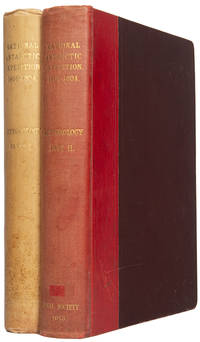
réf. 115669London Royal Society 1908-1913. . First edition; 2 vols 4to; vol. I: frontispiece 14 plate leaves large folding coloured map 1 very large chart dissected into 4 parts with title sheet; vol. II: 261 leaves of weather maps printed on one side only vol. I in red buckram backed boards vol. II in bright carmine red cloth backed boards spines faded lightly soiled a very good set; xiv 544; 26 pp. From the library of Professor Otto Nordenskjöld 1869-1928 the distinguished Swedish Antarctic explorer and scientist. Nordenskjöld was on the Swedish scientific expedition to the Antarctic 1901-1903 and would have had a particular interest in the results of the Discovery expedition. Meteorology is an important work providing a compendium of over a thousand synoptic charts concerning the Antarctic drawn not only from Scott's expedition but also from the Scottish Swedish and German expeditions. This was the first attempt to give an idea of the general principles underlying atmospheric circulation in the southern hemisphere. Rosove 288-9.A1 288-210.A1 binding b; Taurus 50; Spence 840. London, Royal Society, 1908-1913. hardcover
réf. 5466Album de vues de Constantinople et vues de Cordoue, Séville,Grenade 25 photographies tirage albuminés,19 x26 pour la plupart pour Costantiople et 23 x 32 pour Espagne,contrecollées sur carton très fort.l’ensemble monté sur onglets toilés,dans un Album pleine toile rouge,titre doré sur le premier plat,7 filets,et écoinçons dorés en encadrement.Format 47x34cm.Vers 1880 1) pont de Constantinople du quartier Pera enjambe la corne d’or en reliant Pera à Istambul.2) Sainte Sophie 3) intérieur de Sainte Sophie 4)la tribune impériale à Sainte Sophie 5)Eaux douces d’Asie 6)femmes Turcques en costumes d’apparat avec leurs admirateurs 7) Eaux douces d’Europe 8)Yildis–Kiosk 9)Palais de Beylerbey 10) Yéni-Mahallé 11)Tour de Léandre 12)Palais de Tchergham 13 Mosquée de St Isaac 14)les Isles 15) Palais sur le Bosphore 16) Environs de St Isaac 17)jardins à Cordoue 18 Palais à Cordoue 19)Cordoue la mezquita 20)Séville 21) Séville 22) Cordoue, 23) Cordoue, 24)et 25).(une décoloration angle supérieur droit au deuxième plat- rousseurs éparses sur les cartons forts) Photographes attitrés des sultans Abdulaziz et Abdülhamid II, les frères Abdullah, d’origine arménienne, se sont rendus célèbres dans tout l’Empire ottoman et jusqu’en Europe où leur participation aux Expositions universelles de 1867 et 1878 a été très remarquée. Situé à Péra, leur studio était le passage obligé des touristes à la recherche de vues sur Constantinople. Mais c’est avec le portrait en studio que les frères Abdullah ont acquis leur renommée. Ils ont notamment réalisé un portrait d’Abdulaziz qui leur a décerné en 1863 le titre de photographes officiels du sultan. Sous leur objectif, se sont alors succédés les membres de la famille impériale et les dignitaires ottomans, les monarques et les princes européens en visite ainsi que des figures éminentes des différentes communautés de Constantinople
1792In-4°: pp. 25. Testatine e capilettera xilografati. Legatura in cartonato.
1848réf. 49336Paris, Victor Masson, 1848 a. 1851. 8vo. 2 contemp. hcalf, raised bands, gilt spine. Light wear along edges. Small stamps on verso of titlepages and on verso of 1 plate. In ""Annales de Chimie et de Physique"", 3me Series - Tome XXIV and XXXI. (6),512 pp. and 2 plates + 512 pp. a. 4 plates.(2 entire volumes offered). Pasteur's papers: pp. 442-459 a. pp. 459-460, 1 double-page folded engraved plate + pp. 67-102 a. 1 plate. Some scattered brownspots to first part of the first volume, not affecting P's papers.
1848réf. 49336Paris Victor Masson 1848 a. 1851. 8vo. 2 contemp. hcalf raised bands gilt spine. Light wear along edges. Small stamps on verso of titlepages and on verso of 1 plate. In "Annales de Chimie et de Physique" 3me Series - Tome XXIV and XXXI. 6512 pp. and 2 plates 512 pp. a. 4 plates.2 entire volumes offered. Pasteur's papers: pp. 442-459 a. pp. 459-460 1 double-page folded engraved plate pp. 67-102 a. 1 plate. Some scattered brownspots to first part of the first volume not affecting P's papers. First full exposition of Pasteur's momentous and revolutionary discovery of "molecular assymetry" and founding the science of Polarimetry.The discovery was first announced by Pasteur in may 1848 by the printing of the preliminary report of only 4 short pages in order to establish priority. The announcement - 4 pages - was published in Comptes rendus hebdomadaires de l’Académie des Sciences Paris Seance of May 15 1848 26 21 535-538 Published on May 1848."In 1848.Pasteur studied the crystals of tartrates one of the substances that exhibited the now-clockwise now-counterclockwise effect under the microscope and found that the crystals were mirror images of the others. The two crystals resembled each other as a right-hand glove resembles a left-hand glove.This was a revolutionary discovery and it took some courage to announce it. A few years before the well-known chemist Mitscherlich had studies the same tartrate crystals and declared them all to be identical. Pasteur was only a twenty-sic-year-old unknown. neverthelless he announced his findings and went before Biot to repeat the separation ofthe crystals before the eyes of the aged authority in the field. Biot was convinced and Pasteur received the Rumford medal of the Royal Society for his work.Pasteur had thus founded the science of polarimetry in which the measurements of the manner in which the plane of polarized light was twisted could be used to help to determine the structure of organic substance to follow various chemical reactions and so on."Asimov. Leicester & Klickstein "A Source Book of Chemistry" p. 374-379. hardcover
1906Very Good Turkish, Ottoman (1500-1928) Original wrappers. Foolscap 8vo. (17 x 12 cm). In Ottoman script (Old Turkish with Arabic letters). 152 p. Roumi: 1324 = Gregorian: 1906. Taken from a volume including multiple books. Spine is restored. A very good copy. First and only edition of this early and extensively rare book including a first-hand account of the topography and descriptions of Hejaz, Mecca, and other parts of Arabian Peninsula such as Taif and Yemen by Sadiq Sherif, who was the first person to take photographs of Mecca, Medina, and the Hajj in 1880 and 1881 as well. Sadiq Sherif was the grandson of Serif Abdulmuttalib, the Emîr of Mecca. This book written by Sherif was dedicated to 'the Progress and Union Society' [i.e. Ittihad ve Terakki Cemiyeti]. The book describes the way of administration and territorial division of Hejaz after giving some information of its geography, borders, tribes and natives, mountains, rivers, crops and products, and animals of this Ottoman 'vilâyat' [i.e. province]. Sherif gives detailed information on how and when the Ottoman Empire ruled Hejaz, the location of Mecca city, its borders, physical and social geography, crops in Mecca and around, its flora, fauna, demographic structure, 'nahiyes', Kâba's construction, and its history, sacred places around, Masjid-i Haram and other masjids, cemeteries, mountains, gifts by Ottoman caliphs to Kaba, 'Taif' area, people who were 'Emîr' of Mecca from the period of Mohammad, Wahhabism and its birth, etc. At the last, Sherif gives place to his personal letter (layihâ) including 49 articles. The letter was about the reforms that Hejaz needs and it was sent to the Ottoman 'sadâret' [i.e. prime ministry]. (Source: History of geographical literature during the Ottoman Empire, Edited by Ihsanoglu). Muhammad Sadiq Sherif Bey was the first person to take photographs of Mecca, Medina, and the Hajj in 1880 and 1881. Sadiq Bey trained as a military engineer after completing his studies in Cairo and at the École Polytechnique in Paris. It is not known when, or from whom, Sadiq Bey learned to take photographs but it was most probably through one of the resident photographers in Egypt. In 1861, prompted by the need to carry out more extensive military land surveys of the area between Wajh and Medina, Sadiq Bey made his first journey to Arabia. He took a camera along with his surveying equipment and took his very first photographs of Medina. In a series of articles published in the Egyptian Military Gazette in 1877, he refers to his early photography at Medina describing the use of a 'photographia'. Sadly, however, none of the photographs from this first journey has survived. In 1880 he was appointed as the treasurer of the Mahmal, the ornate cloth to cover the Ka'ba brought each year on a special litter to Mecca. He accompanied the Mahmal to Medina and Mecca from September 1880 until January 1881. Again equipped with his camera, he succeeded in producing the series of photographs that are now considered some of the earliest known photographs of the region, those of the Ka'ba, taken under great secrecy. Sadiq Bey published various accounts of his travels in Arabia in military journals, through the Emiry Grand Press in Cairo, but the 1880/81 series of photographs appear to have been issued separately for wider distribution through the Société Khédiviale de Géographie. The society's secretary, Dr. Frederic Bonola, advertised sets of photographs for sale. In January and April 1880 Sadiq Bey gave a talk and report to the society on his earlier 1861 expedition, and on 20 May 1881 he presented a report on his recent journey to Mecca; detailed accounts were published in the society's bulletins, numbers 9/10 and 12. (Source: Christie's). Özege 11888.; Karatay, TM II: 695.; MKAHTBK, II: 991.; OCLC 248374684 / 4082352.
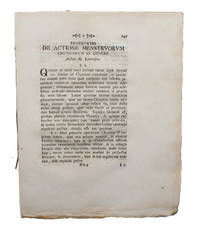
1820réf. 46026(Paris, Crochard, 1820). No wrappers. In ""Annales"". In ""Annales de Chimie et de Physique, Par MM. Gay-Lussac et Arago"" Tome XIV, Cahier 4, Titlepage to vol. 14 + pp. 337-442. (Entire issue offered). Ørsted's paper: pp. 417-25. A few scattered brownspots.
1820réf. 46026Paris Crochard 1820. No wrappers. In "Annales". In "Annales de Chimie et de Physique Par MM. Gay-Lussac et Arago" Tome XIV Cahier 4 Titlepage to vol. 14 pp. 337-442. Entire issue offered. Ørsted's paper: pp. 417-25. A few scattered brownspots. First French translation and the first translation of Oersted's epoch-making announcement in his Latin pamphlet "Extperimenta circa effectum conflictus electrici in acun magneticam. Hafniæ 1820" privately printed in a very small number and only distributed to colleques in Europe. This discovery and confirmation of the connection between 2 forces electricity and magnetism must be considered one of the happiest events in the history of science both with regard to scientific and practical results. - "From the moment that Ørsted's discovery became known it created an enormous sensation. The results communicated were so astounding that they were received with a certain distrust but they were stated with such accuracy that it could hardly be permitted to entertain any doubts. In the course of a short time the treatise was translated into all the chief languages." Kirstine Meyer. - Dibner:61 - PMM: 282 - Horblitt: 3 b. - Sparrow: 152. unknown
réf. 56401-19Fine. Fern Cave: The history of the discovery exploration and mapping of the Fern Cave System unknown
191469 pages. Complete with 8 protected map plates. Signed and inscribed by E.O.S. Scholefield, Archivist of British Columbia atop front cover. Pages 3-4 constitute a letter of submittal by Mr. Scholefield to the Honourable Henry Esson Young, Provincial Secretary. This work "represents the first bulletin of the British Columbia Provincial Archives Department." - page 3. "Vindicates the contention of Captain Vancouver that his ships were the first to complete the navigation of the inner channels which separate Vancouver Island from the British Columbia mainland." - M. Menzies. Errata neatly affixed to verso of Map List. Map plate V loose but present. Rough cut edges. Contents clean, unmarked and lightly toned. Short openings to bottom edges of beige card covers. Strathern 399. Book