1711 risultati
1810rif. 42219London W. Bulmer and Co. 1810. 4to. No wrappers as extracted from "Philosophical Transactions" 1810 - Part I. Pp. 16-74 and 2 engraved plates showing Davy's electrochemical apparatus for decomposing substances. The plates dampstained. Text fine and clean. First appearence of this historical chemical paper Davy' fifth Bakerian Lecture in which he announced his discovery of hydrogen telluride."Mr. Davy having from the commencement of his electro-chemical researches communicated the several steps of his progress to the Society The Royal Society takes the present opportunity of reporting the results of his further inquiries under four principal heads. First on the nature of the metals of the fixed alkalis. Second on the nature of Hydrogen and composition of ammonia. Thirdly on the metals of the earth; and Fourthly he makes a comparison between the antiphlogistic doctrine and a modified phlogistic hypothesis."Abstract. He further gives arguments for considering potassium and sodium which he discovered in 1808 as a element."Humphry Davy was one of the most brilliant chemists of the early nineteenth century. His early study of nitrous oxide brought him his first reputation but his later and most importent investigations were devoted to electrochemistry. Following Galvani's experiments and the discovery of the voltaic pile interest in galvanic electricity had become widespread. The first electrolysis by means of the pile was carried out in 1800 by Nicholson and Carisle who obtained oxygen and hydrogen from water. Davy began to examine the chemical effects of electricity in 1800 and his numerous discoveries were presented in his Bakerian lectures." - Wheeler Gift: 2518. unknown
1777rif. 46614London W. Bowyer and J. Nichols 1777. 4to. Extracted from "Philosophical Transactions" Year 1777. Vol. 67 - Part I. Pp. 260-265. Clean and fine broadmargined. First apperarance of this paper constituting the first reliable account of colour blindness.Usually Goethe or John Dalton - Huddart's case was cited in Dalton's paper of 1794 - is supposed to have discovered colourblindness. However the English oculist Joseph Huddart was the discoverer of this phenomenon. The first physiological explanation of it does come from Goethe.Garrison & Morton: 5832. unknown
1835rif. 47003Philadelphia Fraklin Institute 1835. 8vo. Later full green cloth. Tome-and titlelabels in leather with gilt lettering on spine. In: "Journal of the Franklin Institute of the State of Pennsylvania. Edited by Thomas P. Jones" Vol. XV. New series. Engraved frontisp. 2446 pp. 2 folded engraved plates and 2 folded engraved maps. Entire volume offered. Henry's announcement: pp. 169-70. A stamp to verso of frontispiece Library of Congress duplicate stamp. First printing of this importent paper the first to describe in detail how the phenomena of Self-Induction was discovered. Henry discovered the induction phenomena - how an electric current in one coil may set up a current in the other through the development of the magnetic field - independently of Faraday but Faraday was first to publish on electromagnetic induction. Henry's experiments with induction led him to his importent discovery of SELF-INDUCTION which is the phenomenon in which a change in electric current in a coil produces an induced emf in the coil itself. This phenomenon was also discovered inependently by Faraday but this time Henry had published first. The basic unit of inductance was to be called "the Henry". Relevant to the controversy between Faraday and Henry is the following statement by A D Bache Secretary of the American Philosophical Society introducing an abstract of Henry in J Franklyn Inst. 1835 pp. 169-70 H. Norman 1053 and the paper offerd: "A memoir on this subject has been since submitted to the Society containing an extension of the subject the primary fact in relation to which was observed by Professor Henry as early as 1832 and announced by him in the American Journal of Science. Mr. Faraday having recently entered upon a similar train of observations the immediate publication of the accompanying is important that the prior claims of our fellow countryman may not be overlooked."Spark Museum.Magee "Source Book in Physics" p. 515. hardcover
1834rif. 43654Paris Crochard 1834. No wrappers. In: "Annales de Chimie et de Physique" 2. Series Tome 56 Cahier 4 last issue of tome 56. Entire issue offered. Pp. 337-444. Peltier's paper: pp. 371-386. The text calls for a plate but not present here. First printing of the paper in which Peltier describes his discovery of the "Peltier-Effect" the thermo-electric cooling and heating of an electrical junction dependent on the direction of the current."Stimulated by the work of Nobili Peltier constructed a sensitive galvanometer to measure the conductivities of antimony and bismuth for small currents. Peltier's use of small samples of these nonductile materials was fortunate because the anomalous behavior of these materials led him to construct a thermoelectric thermoscope and to measure the temperature distribution along a series of thermocouple circuits. He discovered that a cooling effect can take place at one junction and an excessive heating at the other. He then confirmed this discovery by using an air thermometer in place of the thermoscope. Peltier did not pursue the effect he had discovered and its importence was not fully recognized until after the thermodynamic work of William Thomson twenty years later."DSB X p. 500.Wheeler Gift no 2684. - Ronald's Library p. 389. - Parkinson "Breakthroughs" 1834 P. unknown
1923rif. 49718Paris Gauthier-Villars et Cie 1923. 4to. Bound in one contemp. full buckram. Spines gilt and with gilt lettering. In: "Comptes Rendus Hebdomadaires des Séances de L'Academie des Sciences" Tome 177. Bound with orig. printed front-wrapper to No. 1 half-title and title-page to vol. 177. 1513 pp. Entire volume offered. De Broglie's papers: pp. 507-510 pp. 548-551 a. pp. 630-32. Clean and fine. A punched stamp on foot of title-page. First edition of these papers which ESTABLISHED A NEW ERA IN PHYSICS by introducing the epochal new principle that particle-wave duality should apply not only to radiation but also to matter and thus CREATING QUANTUM MECHANICS. These 3 papers were extended to form his doctoral thesis of 1924 "Recherches sur la Théorie des Quanta."De Broglie relates "After long reflection in solitude and meditation I suddenly had the idea during the year 1923 that the discovery made by Einstein in 1905 should be generalized by extending it to all material particles and notably to electrons" Preface to his PhD thesis 1924."He made the leap in his September 10 1923 paper: E=hv should hold not only for photons but also for electrons to which he assigns a 'fictitious associated wave'. In his September 24 paper he indicated the direction in which one 'should seek experimental confirmations of our ideas': a stream of electrons traversing an aperture whose dimensions are small compared with the wavelenght of the electron waves 'should show diffraction phenomena' ."Pais "Subtle is the Lord" pp. 425-436.In the third paper October 8 he discusses "The interplay between the propagation of the particle and of the waves could be expressed in more formal terms as an identity between the fundamental variational principles of Pierre de Fermat rays and Pierre Louis Maupertuis particles as de Broglie discussed it further in his last communication . Therein he also considered some thermodynamic consequences of his generalized wave-particle duality. He showed in particular how one could using Lord Rayleigh’s 1900 formula for the number of stationary modes for phase waves obtain Planck’s division of the mechanical phase space into quantum cells.Louis de Broglie achieved a worldwide reputation for his discovery of the wave theory of matter for which he received the Nobel Prize for physics in 1929. His work was extended into a full-fledged wave mechanics by Erwin Schrödinger and thus contributed to the creation of quantum mechanics. After an early attempt to propose a deterministic interpretation of his theory de Broglie joined the Copenhagen school’s mainstream noncausal interpretation of the quantum theory."DSB."This idea i.e. de Broglie's that matter might behave as waves was tested and confirmed by Davisson and Germer in 1927. Thus the duality of both light and matter had been established and physicists had to come to terms with fundamental particles which defied simple theories and demanded two sets of 'complementary' descriptions each applicable under certain circumstances but incompatible with one another." Printing and the Mind of Man 417. hardcover
1847rif. 48815Paris Bachelier1847. 4to. No wrappers. In: "Comptes Rendus Hebdomadaires des Séances de L'Academie des Sciences" Tome XXIV No. 7. Pp. 209- 252. Entire issue offered. Sobrero's paper: pp. 247-248. Clean and fine. First appearance of the paper in which Sobrero announced his discovery of nitroglycerin."When I think of all the victims killed during nitroglycerine explosions and the terrible havoc that has been wreaked which in all probability will continue to occur in the future I am almost ashamed to admit to be its discoverer." Sobrero"Nitroglycerin was synthesized by the chemist Ascagne Sobrero in the middle of the nineteenth century. When he tasted it as all good nineteenth century chemists did when they discovered a new compound it gave him what he called a migraine because of its vasodilatory effect which was later harnessed in the treatment of angina by William Murrell 1879 following the experience of a distinguished British clinician Lauder Brunton using amyl nitrite 1867 Later in the nineteenth century Alfred Nobel discovered how to stabilize nitroglycerin using kieselguhr diatomite clay; this led to highly successful industrial applications of dynamite and created the fortune that eventually funded the eponymous prizes. For medical purposes nitroglycerin was subsequently renamed glyceryl trinitrate to hide the fact that it was literally dynamite as well as metaphorically." unknown
1898rif. 43857Berlin J.A. Barth 1898. No wrappers. In "Annalen der Physik" Neue Folge Band 65 No 5. Pp. 1-240. Entire issue offered No.5. Titlepage to vol. 65. Stamp on titlepage. Schmidt's paper: pp. 141-151 textillustr. A tear to inner lower corners of pp. 24-32. not affecting Schmidt's paper. Clean and fine. First printing of Schmidt's full exposition in which he describes his discovery of the radioactivity of Thorium. Schmidt and Marie Curie independently demonstrated the radioactive quality but Schmidt's demonstration took place a few months before Curie's. The discovery was announced but not described in full in a short message published in "Verhandl. d. Phys. Gesellsch. zu Berlin 1898."Schmidt made his discovery while examining "many elements and compounds" in an effeort to determine whether any of the rays that were emitted bore a resemblance to those that Henri becquerel had found emerging from uranium and uranium compounds. He located only one such element thorium and immediately conducted absorption ionization reflection refradction and poklarization studies to determine the characteristics of its rays. Having combined a misinterpretation of Becquerel's with one of his own Schmidt concluded that thorium rays most resembled Röntgen rays - a conclusion that soon required revisoln in view of the researches of Marie Curie and Ernest Rutherford."DSB XII p. 191. unknown
1870rif. 42423London Taylor and Sons 1870. 4to. No wrappers as extracted from "Philosophical Transactions" 1869 Vol. 159 - Part I. Pp. 425-444 and 2 lithographed plates 1 with the spectrum of helium 1 with his spectroscope not requiring eclipses to function. Clean and fine. First appearance of this milestone paper in chemistry physics and astronomy announcing the discovery of helium in the sun and naming it 'helium' for Helios the Greek God of the Sun. In the same paper he demonstrates his invention of the spectroscope by which the prominences of the sun could be observed and studied without an eclipse by leading the light from the very edge of the sun through a prism. - Helium was not discovered on the earth before 1895 by William Ramsay and it was Crookes who established its identity with the helium Lockyer observed in the spectrum of the sun."This the last discovery was announced on the same day by the French astronomer Janssen who was in India observing a total eclipse. As a result the French government some ten years later struck a medallion showing the heads of both scientists.By that time the two men had made a much more dramatic discovery at the same time this time in cooperation. Janssen studying the spectrum ofthe sun during the eclipse had noted a fine line he did not recognize. he send a report on this to Lockyer an acknowledges expert on solar spectra. Lockyer compared the reported position of the line with lines of known elements concluding that it must belong to a yeat unknown element possibly not even existing on the earth. He named the element from the Greek word for the sun."Asimov. unknown
1858rif. 47111Paris Mallet-Bachelier 1858. 4to. No wrappers. In: "Comptes Rendus Hebdomadaires des Séances de L'Academie des Sciences" Tome 47 No 6 a. No 10. Pp. 245- 279 a. pp. 393- 431 entire issues offered. Bernard's papers: pp. 245- 253 a. pp. 393 -400. First appearance of these landmark papers in which Barnard explains his discovery of how the nerves controls the blood vessels. This is the "discovery of the vascoconstrictor and vasodilator nerves and description of their function of regulating the blood supply to the different parts of the body."Garrison & Morton No. 774."In 1858 the papers offered Bernard demonstrated the existence of vasodilator nerves by finding an increased blood flow through the submaxillary gland when the corda tympani is stimulated. He also observed that the venous blood became bright red. Since that time an enormous amount of research has been carried out on the vasomotor system."R.J.S. Mcdowall.Garrison & Morton No. 774. unknown
1874rif. 49327Leipzig Johann Ambrosius Barth 1874. 8vo. Contemp. hcalf. 5 raised bands gilt spine and gilt lettering to spine. A few scratches to spine. Small stamp on verso of first -and general- titlepage. In: "Annalen der Physik und Chemie. Hrsg. von J.C. Poggendorff" Sechste Reihe Bd. 3 = Poggendorff Bd. 153. X636 pp. 4 plates. Entire volume offered. Braun's paper: pp. 556-563. First printing of Brown's importent paper in which he described his discovery of a semiconductor diode noting that electrical currents flows freely in only one direction at the contact between a metal point and a galena crystal."In 1874 Braun published the results of his research on mineral metal sulfides. He found that these crystals conducted electric currents in only one direction. This information was important in electrical research and in measuring another property of substances the electrical conductivity but Braun’s discovery did not have immediate practical application. In the early twentieth century the principle that Braun had discovered was employed in crystal radio receivers."DSB.The Nobel Prize in Physics 1909 was awarded jointly to Guglielmo Marconi and Karl Ferdinand Braun "in recognition of their contributions to the development of wireless telegraphy". hardcover
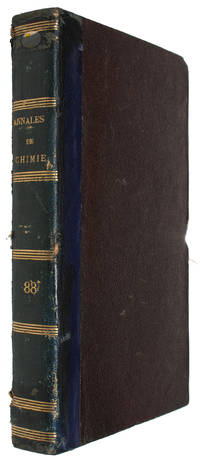
1813rif. 43081Paris J. Klostermann 1813. Contemp. hcalf. Spine gilt. A few scratches to binding. In: "Annales de Chimie ou Recueil de Mémoires concernant la Chemie" Tome 88. - 336 pp. the entire volume offered. Pp. 304-310 311-318 319-321 a. 322-329. Scattered brownspots. First printing of this paper announcing the discovery of Iodine. Courtois found this substance which he suspected to be a new element while burning algae in order to obtain sodium and potassium compounds. Although Courtois discovered the element in 1811 the announcement of it was not made until two years later after he had turned it over to Charles Desormés and Nicolas Clément."The first publication on iodine are somewhat confusing. Courtois's research is found in a paper attributed to him the paper offered but actually the work of Clément. was followed by an anonymous article the second paper offered. Gay-Lussac. who repeated and extended Courtios's work was responsible for this paper. Courtois himself published nothing. These two articles were immediately followed by short contributions of Gay-Lussac and Humphry Davy on the new element third and fourth paper offered. Gay-Lussacs views none too flattering to Davy on the history ofthe discovery of iodine appeared in his "Mémoire sur l'iode" 1814."DSB III p. 455. - Weeks "Discovery of the Elements" pp. 257-262.The volume contains further importent papers in chemistry Guyton de Morveau "Sur la chaux maigre" "Sur le dissolvant des pierres biliaires" an importent paper by Chevreul on animal fats "Recherches chimiques sur plusieurs corps gras et particulierement sur leurs combinaisons avec les alcalis" Berzelius's papers "Mémoires sur la compositions des fluides animaux" first edition in French Suite first edition Parmentier etc. etc. unknown
1914rif. 41545London 1914. No wrappers but stiched. All three papers contained in: "Philosophical Magazine" Sixth Series Vol. 27. No. 159. March 1914. The whole issue issue offered =no. 159: pp. 397-540 and 2 plates.Rutherford's paper.pp. 488-498. - Darwin's paper: pp. 499-506. - Bohr's paper: pp. 506-523. All clean and fine. First edition and first printing of all three papers. Rutherford in this paper for the first time identifies the hydrogen nucleus and called it the 'positive electron'. He later called it 'the proton' . In his definitive paper of 1911 he estimated the radius of the nucleus a hundred thousand times smaller than that of an atom. Darwin in his paper offered here gave a more precise measure.In the first lines of the paper Rutherford outlines the content "The present paper and and the accompanying paper by Mr. C. Darwin the second paper offered here deal with certain points in connection with the "nucleus" theory of the atom which were purposely omitted in my first communication on that subject Phil. Mag. May 1911. A brief account is given of the later investigations which have been made to test the theory and of the deductions which can be drawn from them. At the same time a brief statement is given of recent observations on the passage of alpha particles through hydrogen which throw importent light on the dimensions of the nucleus." - Rutherford had studies alpha-particles intensely in the years before 1914 and proved quite conclusively that the individual particle was a helium atom with its electrons removed. The alpha particles were like the positive rays that had been discovered by Goldstein 1886 and now in 1914 the paper offered Rutherford suggested that the simplest positive rays must be those obtained from the hydrogen and that these must be the fundamentall positively-charged particle. He names it a 'positive electron'.Darwin in the paper offered "concluded from the known data:"No force proportional to some power of the distance other than the inverse square can give the dependence the Rutherford scattering cross section on the initial velocity" and he then calculated the distance of closest alpha-particle-nucleus approach.The paper by Niels Bohr relates to "The Stark effect". In 1913 appeared "an importent new discovery: when atomic hydrogen is exposed to a static electrical field its spectral lines split the amount of splitting being proportional to thefield strenght the linear Stark effect. After Rutherford read this news in "Nature" he at once wrote to Bohr:'I think it is rather up to you at the present time to write something on.electric effects.'" A. Pais. Bohrs paper on The Stark effect appeared in 1914 the paper offered here. - Rosenfeld. Niels Bohr' publications No. 10. unknown
1934rif. 47071Paris Gauthier-Villars 1934. 4to. No wrappers. In: "Comptes Rendus Hebdomadaires des Séances de L'Academie des Sciences" Tome 198 No 3. Titlepage to vol. 198. Pp. 213- 292. Entire issue offered. The joint paper: pp. 254-256 a. 1 photographic illustration in the text. Titlepage with a stamp on verso 2 small tears and a tiny bit of upper right corner gone. Titlepage a bit browned. First appearance of this seminal paper in which artificial radioactivity was announced for the first time. Curie and Joliot were awarded the Nobel Prize in Chemistry 1935 "in recognition of their synthesis of new radioactive elements"."Until this date 1934 atomic nuclei emitting radiation were found in nature: it was called the natural radioactivity. It had been known since Rutherford that this natural radioactivity changed a nucleus into an other one: for instance radium becomes finally lead after many radioactive decays. We could say that lead does not become gold but gold becomes lead! But. this change of matter was not under control. It was not possible to construct the desired chemical element as the alchemist dreamed. But Irene and Frederic Joliot-Curie made the dream become almost reality.""Another very important development in the early 1934 by the Joliot-Curies in connection with irradiation of aluminum by alpha particles. The two French scientists detected the production of the recently discovered positrons. . However they soon realized that the positron activity continued after the alpha source was removed and that they had in fact discovered positive beta radioactivity. The importance of the discovery of artificial radioactivity was immediately recognized and resulted in a Nobel Prize in chemistry to the Joliot-Curies in 1935. The new phenomenon immediately became widely employed in nuclear physics chemistry biology and medicine." Kragh Quantum Generations p. 187"These elegant experiments which provided the first chemical proof of induced transmutations and showed the possibility of artificially creating radioisotopes of known stable elements were repeated and extended in the major nuclear physics laboratories of various countries " DSB.Born on 12 September 1897 in Paris Irène Curie was the daughter of Pierre and Marie Curie. "During World War I she worked as a nurse helping her mother operate radiography equipment and then studied physics and mathematics at the Sorbonne gaining a doctorate for studying the range of alpha particles. She then went to work for her mother at the Radium Institute. There she met Frédéric Joliot whom she married in 1926. Frédéric Joliot was born on 19 March 1900 in Paris - He joined the Radium Institute in 1925 and obtained his PhD in 1930. Together the Joliot-Curies worked on radioactivity and the transmutation of the elements. Twice they just missed major discoveries: in 1932 when Chadwick beat them to the neutron and in 1933 when Anderson discovered the positron. However in 1934 whilst bombarding light elements with alpha particles the Joliot-Curies noticed that although proton production stopped when the alpha particle bombardment stopped another form of radiation continued. The alpha particles had produced an isotope of phosphorus not found in nature. This isotope was radioactive and was decaying through beta-decay" DSB. unknown
1848rif. 47149Paris Bachelier 1848. 4to. No wrappers. In: "Comptes Rendus Hebdomadaires des Séances de L'Academie des Sciences" Tome 26 No 21. Pp. 529- 548. Entire issue offered. Pasteur's paper: pp. 535-538. First appearance of the announcement of Pasteur's momentous and revolutionary discovery of "molecular assymetry" and founding the science of Polarimetry.The discovery was first announced by Pasteur in may 1848 by the printing of the preliminary report of only 4 short pages in order to establish priority the paper offered. A more full exposition was published the same year in "Annales de Chimie et de Physique" 3me Series - Tome XXIV."In 1848.Pasteur studied the crystals of tartrates one of the substances that exhibited the now-clockwise now-counterclockwise effect under the microscope and found that the xcrystasls were mirror images of the others. The two crystals resemmbled each other as a right-hand glove resembles a left-hand glove.This was a revolutionary discovery and it took some courage to announce it. A few years before the well-known chemist Mitscherlich had studies the same tartrate crystals and declared them all to be identical. Pasteur was only a twenty-sic-year-old unknown. neverthelless he announced his findings and went before Biot to repeat the separation ofthe crystals before the eyes of the aged authority in the field. Biot was convinced and Pasteur received the Rumford medal of the Royal Society for his work.Pasteur had thus founded the science of polarimetry in which the measurements of the manner in which the plane of polarized light was twisted could be used to help to determine the structure of organic substance to follow various chemical reactions and so on."Asimov. Leicester & Klickstein "A Source Book of Chemistry" p. 374-379. unknown
1848rif. 49336Paris Victor Masson 1848 a. 1851. 8vo. 2 contemp. hcalf raised bands gilt spine. Light wear along edges. Small stamps on verso of titlepages and on verso of 1 plate. In "Annales de Chimie et de Physique" 3me Series - Tome XXIV and XXXI. 6512 pp. and 2 plates 512 pp. a. 4 plates.2 entire volumes offered. Pasteur's papers: pp. 442-459 a. pp. 459-460 1 double-page folded engraved plate pp. 67-102 a. 1 plate. Some scattered brownspots to first part of the first volume not affecting P's papers. First full exposition of Pasteur's momentous and revolutionary discovery of "molecular assymetry" and founding the science of Polarimetry.The discovery was first announced by Pasteur in may 1848 by the printing of the preliminary report of only 4 short pages in order to establish priority. The announcement - 4 pages - was published in Comptes rendus hebdomadaires de l’Académie des Sciences Paris Seance of May 15 1848 26 21 535-538 Published on May 1848."In 1848.Pasteur studied the crystals of tartrates one of the substances that exhibited the now-clockwise now-counterclockwise effect under the microscope and found that the crystals were mirror images of the others. The two crystals resembled each other as a right-hand glove resembles a left-hand glove.This was a revolutionary discovery and it took some courage to announce it. A few years before the well-known chemist Mitscherlich had studies the same tartrate crystals and declared them all to be identical. Pasteur was only a twenty-sic-year-old unknown. neverthelless he announced his findings and went before Biot to repeat the separation ofthe crystals before the eyes of the aged authority in the field. Biot was convinced and Pasteur received the Rumford medal of the Royal Society for his work.Pasteur had thus founded the science of polarimetry in which the measurements of the manner in which the plane of polarized light was twisted could be used to help to determine the structure of organic substance to follow various chemical reactions and so on."Asimov. Leicester & Klickstein "A Source Book of Chemistry" p. 374-379. hardcover
1900rif. 51313Paris Gauthier-Villars 1900. 4to. No wrappers. In: "Comptes Rendus Hebdomadaires des Séances de L'Academie des Sciences" Tome 130 No 15 a. No 18. Pp. 962- 1044 a. pp. 1145- 1220. Entire issues offered. Villard's papers: pp. 1010-1012 a. 1178-1182 textillustrations. Clean and fine. First apperance of Villard's two papers in which he announced and described the discovery of a new type of radiation more powerfull and penetrating than alpha-and beta rays. The new type of rays was named by Rutherford as gammarays. unknown
1831rif. 49604Paris Crochard 1831. Contemp. hcloth. Some scattered brownspots. "Annales de Chimie et de Physique" 2. Series Tome 48. 448 pp. 1 engraved plate. Entire volume offered. Soubeiran's paper: pp. 113-157. Scattered brownspots. First appearance of an importent paper in chemistry and medicine as it for the first time relates the finding of Chloroform which some years later was proved to have anaesthetic effects and was introduced in chirurgy in 1848 by Simpson.Justus von Liebig Souberain and Guthrie independently discovered Chloroform in 1831 but Souberain was the first to publish his results. Garrison & Morton No. 1851. - Gedeon "Science and Technology in Medicine" 36.7.The volume contains other notable papers by LIEBIG DUMAS DUTROCHET WÖHLER LECANU BECQUEREL etc. hardcover
1832rif. 48329Paris Crochard 1832. No wrappers. In: "Annales de Chimie et de Physique" 2e Series vol. 51 Cahier 4. Pp. 337-444 Entire issue offered. Faraday's letter: pp. 404-434 a. 1 engraved plate. Some brownspots. First printing of Faraday's famous letter to Gay-Lussac in which he claim to be the discoverer of electro-magnetic induction analysed the results of the Italian philosophers pointing out their errors and defending himself from what he regarded as imputations on his character. The style of this letter is unexceptionable for Faraday could not write otherwise than as a gentleman; but the letter shows that had he willed it he could have hit hard. The letter was later translated into English and published in "Philosophical Magazine" in 1840 under the title "On Magneto-electric Induction"."In 1831 seemingly out of nowhere came the discovery of electromagnetic induction and the beginning of the experimental researches in electricity which were to lead Faraday to the discovery of the laws of electrochemistry specific inductive capacity the Faraday effect and the foundations of classical field theory." DSB. unknown
1859rif. 43325Leipzig Johann Ambrosius Barth 1859. Without wrappers as issued in "Annalen der Physik und Chemie. Hrsg.von Poggendorff" Bd. 107 Viertes Stück.= Heft No. 8 of 1859. The entire issue offered Heft 4 of vol. 107 with titlepage to vol. 107. Pp. 497-660. - Plücker's papers: pp. 497-539 a. 638-643. Clean and fine. First printing of this milestone paper describing Plückers first observations on Cathode Rays which he called "the beautiful and mysterious green glow" and produced by discharges in tubes exhausted by means of the Geissler pump. These importent observations lead directly to Röntgens discovery of the Röntgen Rays."Cathode rays were first observed by Julius Plücker in 1859 the paper offered. They are rays which are found in the neighbourhood of the point of exit of an electrical current passing through a Geissler tube. These rays stimulated intense interest and experiment. William Crookes greatly improved these discharge tubes and intensified the degree of rarification of gases within them. The tubes in this form is known as Crookes tube. Crookes declared his conciction that the cathode rays represented matter in a fourth hitherto unobserved form.It was reserved for J.J. Thomson in 1908 to discover the true nature of the cathode rays."PMM no 386. unknown
1898rif. 46852Paris Gauthier-Villars 1898. 4to. No wrappers. In: "Comptes Rendus Hebdomadaires des Séances de L'Academie des Sciences" Tome 126 No 15. Entire issue offered. With htitle and titlepage to vol. 126. Pp. 1059-1110. Curie's paper: pp. 1101-1103. First printing of this milestone paper being the first "Note" from Marie Curie about "radioactivity". This same "Note" contains a the fundamental observation: "Two uranium ores. are much more active than uranium itself. This fact. leads one to believe that these ores may contain an element much more active than uranium." This paper gives the first proof of the fact that radiation is an atomic property."Henri Becquerel discovered 1896 that uranium salts shielded from light for several months spontaneously emit rays related in their effects to Roentgen rays. Mme. Curie became enthusiastic about this subject filled with the unknown and as she later acknowledged involving no bibliographic research.The first step in the research was to determine whether there existed other elements capable like uranium of emitting radiation. Abandoning the idea of hyperfluorescence couldn’t one calculate by electrical measurement the effects on the conductivity of air that were revealed by the gold-leaf electroscope Pierre Curie and his brother Jacques had constructed an extremely sensitive apparatus to measure weak currents; Mme. Curie employed it in testing both pure substances and various ores. In her first "Note" in the Comptes rendus"de l Académie des sciences 12 April 1898 she described the method that she followed throughout her life the method that enabled her to make comparisons through time and crosschecks with other techniques:"I employed. a plate condenser one of the plates being covered with a uniform layer of uranium or of another finely pulverized substance diameter of the plates eight centimeters; distance between them three centimeters. A potential difference of 100 volts was established between the plates. The current that traversed the condenser was measured in absolute value by means of an electrometer and a piezoelectric quartz. In general she preferred the zero method in which the operator compensates for the current created by the active material by manipulating the quartz. All of her students followed this procedure."DSB.The first results came in 1898: the measurements varied between 83 × 10-12 amperes for pitch blende to less than 0.3 × 10⁻¹² for almost inactive salts passing through 53 × 10-12 for thorium oxide and for chalcolite double phosphate of uranium and copper. Thorium would thus be "radioactive" the term is Mme. Curie’s; its radioactive properties were discovered at the same time independently by Schmidt in Germany. unknown
1898rif. 44238London Taylor and Francis 1898 No wrappers. In "Proceedings of the Royal Society of London." Vol.63 Nos. 399-400 both issues offered. Pp. 373-480 a. 5 plates. Ransay & Travers' paper: pp. 405-408. First appearance of the paper in which Ramsay and Travers announced their discovery of a new element which they named "krypton" meaning hidden."Dr. William Hampson presented them Ransay & Travers with about a liter of liquid air which they used not for liquefying the argon but for obstaining sufficient skill in manipulation so that they would not risk loosing their precious fifteen liter of argon.The residue left after most of the liquid air had boliled away consisted largly of oxygen and nitrogen which Ramsay and Travers temoved with red-hot copper and magnesium. .they then examined the twenty-five cibic centimeters of residual gas and when they found it to be inerst they immediately placedit in a Pl'ucker tube connected to and induction coil and observed its spectrum. There was a bright yelælow line with a greener tint than that of the helium line and a brilliant green line that did nor coincide with any line of argon helium mercury or hydrogen. They discoverede this gas on 30 May 1898 and named it 'krypton'.they found that it belonged between bromine and rubidium in the periodic table and so great was their excitement that the younger chemist almost forgot about his examination for doctor of sciwence which had been schedules for the next day."Weeks p. 267.Parkinson "Breakthroughs" 1898 C. unknown
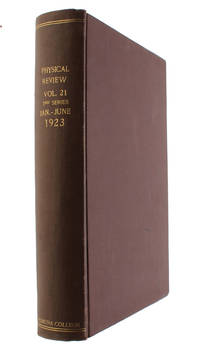
1923rif. 47061Lancaster The Physical Review 1923. Royal8vo. Contemp. full buckram. In:"The Physical Review" Series II vol. 21. 4736 pp. Plates and textillustr. Entire volume offered. A perforated stamp in upper margin on a few leaves. Compton's paper: pp. 483- 501. First printing of this milestone paper in quantum physics in which Compton verifies Planck's quantum postulate and found that some of the X-rays had in scattering lenghtened their wavelenght. This phenomena was called the "Compton Effect" in his honour. For this discovery Compton received the Nobel prize in physics in 1927."Compton was able to account for this lenghtening of wavelenght by presuming that a photon of light struch an electron which recoiled subtracting some energy from the photon and therefore increasing its wavelenght. This made it seem that a photon acted as a particle: thus after more than a century the particulate natuer of light as evolved by Newton was revived. What itamounted to was that Compton brought to fruition the view that electromagnetic radiation had both a wave aspect and a particle aspect and that the aspect which was most evident depended on how the radiation was tested. De Broglie was at the same time showing that this held true also for ordinary particles such as electrons." AsimovParkinson "Breakthroughs" 1923 P. - Sigmund Brandt "The Harvest of as Century" Episode 31. hardcover
1810rif. 46377Paris J. Klostermann 1810. Contemp. hcalf. Spine gilt. Slightly rubbed. A few scratches to binding. Small stamps on verso of titlepage.In: "Annales de Chimie ou Recueil de Mémoires concernant la Chemie" Tome 75. 336 pp. a. 2 folded engraved plates. Some scattered brownspots. The papers: pp. 27-77 129-175 256-263 264-273 274-289 a. 290-316. First French version of Davy's "The Bakerian Lecture for 1809. On some new Electrochemical Researches on various Objects particularly the metallic Bodies from the Alkalies and Earth and on some Combinations of Hydrogene. Read November 16 1809." together with the controversy papers by Davy and Gay-Lussac & Thenard."Mr. Davy having from the commencement of his electro-chemical researches communicated the several steps of his progress to the Society The Royal Society takes the present opportunity of reporting the results of his further inquiries under four principal heads. First on the nature of the metals of the fixed alkalis. Second on the nature of Hydrogen and composition of ammonia. Thirdly on the metals of the earth; and Fourthly he makes a comparison between the antiphlogistic doctrine and a modified phlogistic hypothesis."Abstract. He further gives arguments for considering potassium and sodium which he discovered in 1808 as a element.""Gay-Lussac had a slight rivalry between himself and the creation scientist Sir Humphry Davy. Davy was chemically preparing Potassium and Sodium through an electrical current and this made Gay-Lussac and Thénard envious of his success. They too decided to perform the same task but they had no battery at their disposal as Davy had so they had to form another way to chemically prepare the two elements. In 1808 they used a red-hot iron fused to potash the water-soluble form of a manufactured salt containing potassium to perform this task a method that Davy admitted had its advantageous qualities. Gay-Lussac and Thénard were successful in preparing Potassium and continued to make a full analysis of its chemical properties and began to use it for their own experiments. In 1809 Davy performed the same task using it to reduce Boron in Boracic acid." unknown
1834rif. 45159Leipzig Johann Ambrosius Barth 1834. Without wrappers. Extracted from "Annalen der Physik und Chemie. Hrsg.von Poggendorff" Bd. 31 No 5. Pp. 65-80. First printing of the paper in which Runge discloses his discovery of carbolic acid or phenol and how he prepared it by distilling coal.Parkinson "Breakthroughs" 1834 C. - Partington IV pp. 183-84. unknown
1921rif. 46992London Taylor and Francis 1921. Blank wrapper. In: "The London Edinburgh and Dublin Philosophical Magazine and Journal of Science" Sixth Series Vol.42 No. 252 December 1921. Pp. 873-1024 textillustr. a. 1 plate. Entire issue offered. Chadwick & Bieler's paper: pp. 923-940 textillustr. First printingof this milestone paper in which the strong nuclear forces are mentioned for the first time."It was only in 1921 that Chadwick had first shown that at very small distances the interactions of alpha particles with the atomic nucleus did not follow exactly the inverse square law predicted from the repulsion of their positive electrical scharges. Chadwick concluded that his experiments showed that these nuclear forces are of "very great intensity". According to Pais this is THE FIRST PUBLISHED STATEMENT ABOUT THE EXISTENCE OF A STRONG NUCLEAR FORCE. This 'new force' interpretation was disputed untill well into 1920s."Hey & Walters."In any event Chadwick and Bieler's final conclusion avoid all reference to a possible electromagnetic cause for the deviations from the simple theory: "The present experiments do not seem to throw any light on the nature of the law of variation of the forces at the seat of an electric charge but merely show that the forces are of very great intensity. It is our task to find some field of force which will reproduce these effects." I consider this statement made in 1921 as marking the birth of the strong interaction."Pais in "Inward Bound" p. 240. unknown