Discovery ChannelBiblio.com

1819 risultati
rif. DADAX1603209905Hachette 2014-07-08. paperback. New. 0.94x8.27x9.92. Buy with confidence. Excellent Customer Service & Return policy. Hachette paperback
rif. GOR008435040Paperback. Very Good. paperback
rif. C7-FYOP-ZXD2Discovery Channel University. VHS Tape. Good. 0x0x0. Good Discovery Channel University unknown
1998rif. DADAX0738500488Arcadia Publishing 1998-11-15. First Edition. paperback. New. 6.50x0.31x9.25. Buy with confidence. Excellent Customer Service & Return policy. Arcadia Publishing paperback
rif. DADAX1618934074TI Inc. Books 2015-10-13. paperback. New. 8.50x0.60x10.37. Buy with confidence. Excellent Customer Service & Return policy. TI Inc. Books paperback
2012rif. DADAX1603209301TI Inc. Books 2012-07-03. paperback. New. 8.00x0.50x11.00. Buy with confidence. Excellent Customer Service & Return policy. TI Inc. Books paperback
2014rif. 1-1603209905Time Home Entertainment Inc 2014. Paperback. New. 192 pages. 10.25x8.50x0.60 inches. Time Home Entertainment Inc paperback
2015rif. 1-1618934074Time Home Entertainment Inc 2015. Paperback. New. 191 pages. 12.00x10.00x1.00 inches. Time Home Entertainment Inc paperback
2016rif. 1-1250097770Feiwel & Friends 2016. Hardcover. New. 160 pages. 11.50x9.25x0.75 inches. Feiwel & Friends hardcover
1996rif. USD_9780070160613MGH 1996. 1st. Hardcover. Used - Like New/Used - Like New. MGH hardcover
1996rif. AME_9780070160613MGH 1996. 1st. Hardcover. New/New. MGH hardcover
2007rif. AME_9781588296726Humana Press 2007. 1st. Hardcover. New/New. Humana Press hardcover
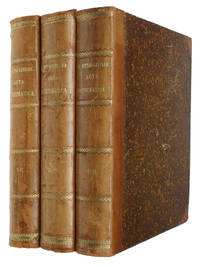
1884rif. 60243Berlin Stockholm Paris F. & G. Beijer 1882-84. Large4to 272 x 230 mm. Three volumes uniformly bound in contemporary half calf with gilt lettering to spine. In "Acta Mathematica" volume 1-5. Light wear to extremities boards and spines with scratches. Stamp to verso of front board in all volumes. First three leaves in first volume detached otherwise internally fine and clean. Vol. I pp. 1-62; Pp. 193-294; Vol. II pp. 97-113; Vol. III. pp. 49-92; Vol. IV pp. 201-312; Vol. V pp. 209-278. First publication of these groundbreaking papers which together constitute the discovery of Automorphic Functions. "Before he was thirty years of age Poincaré became world famous with his epoch-making discovery of the "automorphic functions" of one complex variable or as he called them the "fuchsian" and "kleinean" functions." DSB.These manuscripts written between 28 June and 20 December 1880 show in detail how Poincaré exploited a series of insights to arrive at his first major contribution to mathematics: the discovery of the automorphic functions. In particular the manuscripts corroborate Poincaré's introspective account of this discovery 1908 in which the real key to his discovery is given to be the recognition that the transformations he had used to define Fuchsian functions are identical with those of non-Euclidean geometry. See Walter Poincaré Jules Henri French mathematician and scientist.The idea was to come in an indirect way from the work of his doctoral thesis on differential equations. His results applied only to restricted classes of functions and Poincaré wanted to generalize these results but as a route towards this he looked for a class functions where solutions did not exist. This led him to functions he named Fuchsian functions after Lazarus Fuchs but were later named automorphic functions. First editions and first publications of these epochmaking papers representing the discovery of "automorphic functions" or as Poincaré himself called them the "Fuchsian" and "Kleinian" functions."By 1884 Poincaré published five major papers on automorphic functions in the first five volumes of the new Acta Mathematica. When the first of these was published in the first volume of the new Acta Mathematica Kronecker warned the editor Mittag-Leffler that this immature and obscure article would kill the journal. Guided by the theory of elliptic functions Poincarë invented a new class of automorphic functions. This class was obtained by considering the inverse function of the ratio of two linear independent solutions of an equation. Thus this entire class of linear diffrential equations is solved by the use of these new transcendental functions of Poincaré." Morris Kline.Poincaré explains how he discovered the Automorphic Functions: "For fifteen days I strove to prove that there could not be any functions like those I have since called Fuchsian functions I was then very ignorant; every day I seated myself at my work table stayed an hour or two tried a great number of combinations and reached no results. One evening contrary to my custom I drank black coffee and could not sleep. Ideas rose in crowds; I felt them collide until pairs interlocked so to speak making a stable combination. By the next morning I had established the existence of a Class of Fuchsian functions those which come from hypergeometric series; i had only to write out the results which took but a few hours.the transformations that I had used to define the Fuchsian functions were identical with those of Non-Euclidean geometry." hardcover
1893rif. 59360Copenhagen 1893. Folio. 51 x 45 cm. Orig. printed clothbacked boards. Stamp on title-page. 28 pp. "In the present reproduction only those few pages are printed which concerns the discovery of America by the Northmen in the first years of the 11th century.". Lower right corners damaged by insect-bites no loss of text. Old Norse text English and Danish translation. hardcover
1842rif. 59217Paris Bachelier 1842. 4to. No wrappers. In: "Comptes Rendus Hebdomadaires des Séances de L'Academie des Sciences" Tome 14 No. 10. Pp. 349- 378. Entire issue offered. Donné's paper: pp. 366-368. First printing of the paper announcing the discovery of blood-platelets THE THIRD CORPUSCLES OF THE BLOOD. Platelets or thrombocytes or yellow blood cells are very small irregularly shaped clear cell fragments i.e. cells that do not have a nucleus containing DNA 2-3 µm in diameter which derive from fragmentation of precursor megakaryocytes. The average lifespan of a platelet is normally just 5 to 9 days. Platelets are a natural source of growth factors. They circulate in the blood of mammals and are involved in hemostasis leading to the formation of blood clots. Platelets release thread-like fibers to form these clots.Garrison & Morton 864. unknown
1826rif. 59047Paris Crochard 1826. Contemp. hcloth. Gilt lettering on spine. In: "Annales de Chimie et de Physique par Gay-Lussac et Arago" tome 32. 448 pp. 3 folded engraved plates. Balard's paper: pp. 337-84. Entire volume offered with original memoirs by Savart Berzelius Humboldt Arago Poisson Liebig Dumas et al. First printing of Balard's famous memoire in which he records his discovery of the new element Bromine le brôme. While he was studying the flora of a salt marsh he notized a deposit of sodium saulfate which had crystallized out in a pan containing mother liquer from common salts. "In an attempt to find a use for the waste liquers he performed a number of experiments and notized that when certain reagents were added the mother liquer bacame brown. His investigation of this phenomenon.ked to the remarkable discovery.Weeks p. 264. "The discovery of a new chemical element by a young and obscure provincial pharmacist caused a sensation in Paris. Balard's achievemnt was recognized by the Academie des Sciences and he was awarded a medal by the Royal Society of London."DSB I p. 416. "The discovery of bromine is a very importent acquisition to chemistry and gives M. Balrad honorable rank inthe career of the sciences. We are of the opinion that this young chemist is every way worthy of the encouragement of the Academy and we have the honour to propose that his memoir shall be printed in the "Recueil des Savants Étrangers" The report from the French Academy signed by Vaugelin Thenard and Gay-Lussac. hardcover
1869rif. 59086Paris Gauthier-Villars 1869. 4to. In: "Comptes Rendus Hebdomadaires des Séances de L'Academie des Sciences" Tome 68 No 7. Pp. 349- 408. Entire issue offered. Janssen's paper pp. 367-376. First printing of the paper in which Janssen announced the discovery of a new element. On August 18 1868 Janssen managed to do just that. He became the first person to observe helium an element never before seen on Earth in the solar spectrum. At the time though Janssen didn’t know what he’d seen"just that it was something new""Helium the second most abundant element in the universe was discovered on the sun before it was found on the earth. Pierre-Jules-César Janssen a French astronomer noticed a yellow line in the sun's spectrum while studying a total solar eclipse in 1868. Sir Norman Lockyer an English astronomer realized that this line with a wavelength of 587.49 nanometers could not be produced by any element known at the time. It was hypothesized that a new element on the sun was responsible for this mysterious yellow emission. This unknown element was named helium by Lockyer." unknown
1801rif. 43492Halle Rengerschen Buchhandlung 1801. Without wrappers as published in "Annalen der Physik. Herausgegeben von Ludwig Wilhelm Gilbert" Bd. 7 Viertes Stück. The entire issue offered =Heft 4. Pp. 387-528. Ritter's announcement p. 525. With titlepage to volume 7. Clean and fine. Titlepage a bit shavedin inner margin. First printing of Ritter's announcement of his discovery of ultraviolet light in a halfpage letter addressed to Gilbert's Annalen. With that discovery it became clear that visible light represents no more than a fraction of a continous spectrum.A year earlier in 1800 William Herschel discovered infrared light. This was the first time that a form of light beyond visible light had been detected. After hearing about Herschel's discovery of an invisible form of light beyond the red portion of the spectrum Ritter decided to conduct experiments to determine if invisible light existed beyond the violet end of the spectrum as well. He had heard that blue light caused a greater reaction in silver chloride than red light did. Ritter decided to measure the rate at which silver chloride reacted to the different colors of light. He directed sunlight through a glass prism to create a spectrum. He then placed silver chloride in each color of the spectrum and found that it showed little change in the red part of the spectrum but darkened toward the violet end of the spectrum. Johann Ritter then decided to place silver chloride in the area just beyond the violet end of the spectrum in a region where no sunlight was visible. To his amazement this region showed the most intense reaction of all. This showed for the first time that an invisible form of light existed beyond the violet end of the visible spectrum. This new type of light which Ritter called Chemical Rays later became known as ultraviolet light or ultraviolet radiation the word ultra means beyond. - Parkinson Breakthroughs: 1801 P. unknown
1832rif. 44145Paris Crochard 1832. Contemp. hcalf. gilt spine light wear along edges. In: "Annales de Chimie et de Physique Par MM. Gay-Lussac et Arago." tome 50 Series 2. Entire volume offered. 448 pp. 2 folded engraved plates. Faraday's papers: pp. 5-67 a. pp. 113-162. First French editions of the 2 first memoirs of Faradays groundbreaking researches on electricity constituting the first 2 papers of his "Experimental Researches in Electricity" and containing his fundamental discovery of electromagnetic induction THE FOUNDATION OF NEARLY ALL THE ELECTRICITY IN USE TODAY. In 1820 Oersted had generated magnetism from electricity Faraday here finds the opposite effect generating electricity by magnetism. He also described the first electrical generator second paper. THESE PAPERS ARE SOME OF THE GREAT CLASSICS OF CHEMISTRY AND PHYSICS."Faraday demonstrated this theory involving the lines of force.by inserting a magnet into a coil of wire attached to a galvanometer. While the magnet was being inserted or removd current flowed through the wire. If the magnet was held stationary and the coil moved over it one way or the other there was current in the wire. In either case the magnetic lines of force about the magnet were cut by the wire.If the magnet and coil were both held motionless whether the magnet was within the coil or not there was no current.Faraday hd thus discovered electricalinduction.It was to lead to great things but this was not apparent."Asimov."Although his discovery of the electric motor and the dynamo was almost entirely identical to his theoretical discoveries it laid the foundation of the modern electrical industry - electric light and power teælephony wireless telegraphy televison etc. - by providing for the production of continous mechanical motion from an electrical source and vice versa." PMM 308.Horblit 29 - Milestones 62. - Dibner 64. - PMM 308. unknown
1750rif. 42895Petropoli St. Petersbourg 1750. 4to. Uncut without wrappers. Extracted from "Novi Commentarii Academiae Scientiarum Imperialis Petropolitanae" Tom. I. ad Annum 1747 et 1748. Pp. 245-266 a. 1 engraved plate ad. p. 251. Clean and fine. First appearance of a groundbreaking paper in chemistry in which Lomonosov describes his discovery of the transition of a metal into passive state and this is the first scientific description of this phenomena. He observed and described fast termination of the dissolution of iron in concentrated nitric acid and attributed this to a change in the solvent properties."Lomonosov employed corpuscular mechanics in chemical explanations more extensively than Boyle had done. Treating chemical compounds as particles in adhesion he held that "adhesion is eliminated and renewed by means of motion.since no change in a body can take place withouy motion". He attempted to apply these theories to chemical phenomena - although he was limited to speculation- in papers on the action of chemical solvents in general."DSB VIII p. 469."Lomonosov was founder of Russian science and he would be universally recognized as a great pioneer of science had he been born a West European. He was famous also for his literary works including poems and dramas. In 1755 he wrote a Russian Grammar that reformed the language and in the same year he helped found the University of Moscow. In 1760 he published the first history of Russia."Isaac Asimov. unknown
1799rif. 44095Halle Rengerschen Buchhandlung 1799 1800. Without wrappers extracted from "Annalen der Physik. Herausgegeben von Ludwig Wilhelm Gilbert" Bd. 2. p. 483 one page. and Bd. 6 pp. 105-115. Some scattered brownspots. First German translation of Davy's announcement the announcement on 1 page of his discovery of the unusual anaesthetic effects of nitrous oxide which on being inhaled gave rise to a giddy intoxicated feeling. On announcing his discovery he says that he will publish a paper discribing the experiments with the gas later. This is the paper offered here also in the first German version. Both the announcement and the paper were issued in the "Annalen" the same year as they appeared in Nicholson's Journal.The gas was first synthesized by English natural philosopher and chemist Joseph Priestley in 1772 who called it phlogisticated nitrous air."Following Priestley's discovery Humphry Davy of the Pneumatic Institute in Bristol England experimented with the physiological properties of the gas such as its effects upon respiration. He even administered the gas to visitors to the institute and after watching the amusing effects on people who inhaled it coined the term 'laughing gas'! Davy even noted the anaesthetic effects of the gas: "As nitrous oxide in its extensive operation appears capable of destroying physical pain it may probably be used with advantage during surgical operations in which no great effusion of blood takes place".Wikipedia."Davy discovered the anaesthetic properties of nitrous oxide and suggested its use during surgiical operations a suggestion which was not turned to useful account until 1844."Garrison & Morton 5646 not mentioning the announcing of its discovery in 1799. unknown
1801rif. 43599Halle Rengerschen Buchhandlung 1801. Without wrappers as published in "Annalen der Physik. Herausgegeben von Ludwig Wilhelm Gilbert" Bd. 7 Zweites Stück. The entire issue offered =Heft 2. Pp. 137-264 a. 2 folded engraved plates. Herschels papers: pp. 137-156. The plate depicts Herschel's experimental arrangements. First appearance in German of Herschel's epochal announcement of his discovery of infrared light in 1800. This was the first time that a form of light beyond visible light had been detected. The paper offered is the German translation of the main parts of Herschel's paper "An Investigation of the Powers of Prismatic Colours to Heat and Illuminate Objects"."In 1800 he tested various portions of the sun's spectrum by thermometer to see if he could find interesting differences in the amount of heat the different colors delivered. He did but in a rather unexpected way for he found that the temperature rise was highest in no color at all at a spot beyond the red end of the spectrum. He concluded that the sunlight contained invisible light beyond the red. This is now called infrared radiation. The following year Ritter was to extend the visible spectrum in the other direction."Asimov.Parkinson "Breakthroughs" 1800 P. unknown
1842rif. 42843London Richard and John E. Taylor 1842. 4to. No wrappers as extracted from "Philosophical Transactions" 1842 - Part II. Pp. 181-214 and one double-page folded engraved plate. First appearance of a pioneer-paper in the history of early photography in which Herschel announced some of his importent discoveries of the photographic printing processes the process of photographic contact-printing in Prussian blue brought to light just three years after Louis Daguerre and Henry Talbot had announced their independent inventions of photography in silver using metal and paper substrates respectively. and the photographic properties of red ferro sesquicyanuret of potassium."This is the first recorded observation of Prussian blue being formed for a photographic purpose by the action of light on potassium ferricyanide so it represents the moment of discovery of the first cyanotype process although this name still lay in the future. The significance of this observation impressed Herschel sufficiently to mention it also in his general diary entry for 23 April 1842."Mike Ware in "John Herschel's Cyanotype. Invention or discovery ". unknown
1805rif. 45516Paris Chez Bernard AN XIII 1805. No wrappers. In: "Annales de Chimie ou Recueil de Mémoires." Vol. 55 Cahier 2 30 Thermidor an XIII. Pp. 113-224 entire issue offered. Htitle to vol. 55 present. Robiquet's paper: pp. 152-171. First appearance of Robiquet's first chemical paper in which he relates his discovery of asparagine by analysis of asparagus juice the first amino acid to be discovered. The following year he made the first isolation of this amino acid together with Vaguelin. Pierre Jean Robiquet was a French chemist who laid founding work in identifying amino acids the fundamental bricks of proteins through recognizing the first of them asparagin in 1806 in the take up of the industry of industrial dyes with the identification of alizarin in 1826 and in the emergence of modern medications through the identification of codeine in 1832 a powerful molecule today of widespread use with analgesic and antidiarrheal properties. unknown
1855rif. 45031Paris Victor Masson 1855. 8vo. Without wrappers. In 'Annales de Chimie et de Physique' Series 3 tome 30 December-issue. With halftitle to vol. 30. Pp. 385-508 a. 1 plate. Entire issue offered. Wurtz's paper: pp. 443-506. First appearance of the entire memoir in which Wurtz describes his outstanding discovery of Liebig’s prediction that there might be organic compounds analogous to ammonia and derivable from it by the replacement of hydrogen - the amines. The discovery was announced in 1849 and a small extract was printed in "Comptes rendu" 4 pp. The offered paper is the memoir in full.Wurtz is most noted for his investigation of glycols and for his discovery of the amines. The latter discovery in 1849 the paper offered was very significant at the time for ot suggested the possibility of a new type the ammonia type which helped to explain the behaviour of nitrogenous compounds. Leicester & Klickstein "A Source Book." pp. 362-63. - Parkinson "Breakthroughs" 1849 C.Charles Adolphe Wurtz was born at Strasbourg 1817. For many years he was Professor of Chemistry at the Ecole de Médicine and at Sorbonne in Paris. He was known not only for his researches in organic chemistry but also for his many literary works. He was editor of a Dictionnaire de Chemie Pure et Appliquée and after 1868 one of the editors of the Annalen der Chemie et de Physique. He died in Paris in 1884. unknown