BEAUCLAIR GermainLivre Rare Book

1 822 résultats
réf. 13602in 8 carré broché 170x230mm,couverture rempliée illustrée, faux-titre, titre, 187 pages, 1 page de table des matières, 87 héliogravures d’après les photos de l’auteur ; Complet de la carte. Arthaud éditeur.
réf. 87542Flammarion, 1989, 271 p., cartonnage éditeur sous jaquette, bon état.
réf. 16586, Paris, Flammarion, 1997, Broche, couverture carton illustree, frontispice, 230 x 305mm., illustration abondante en couleures. ISBN 9782080102966.
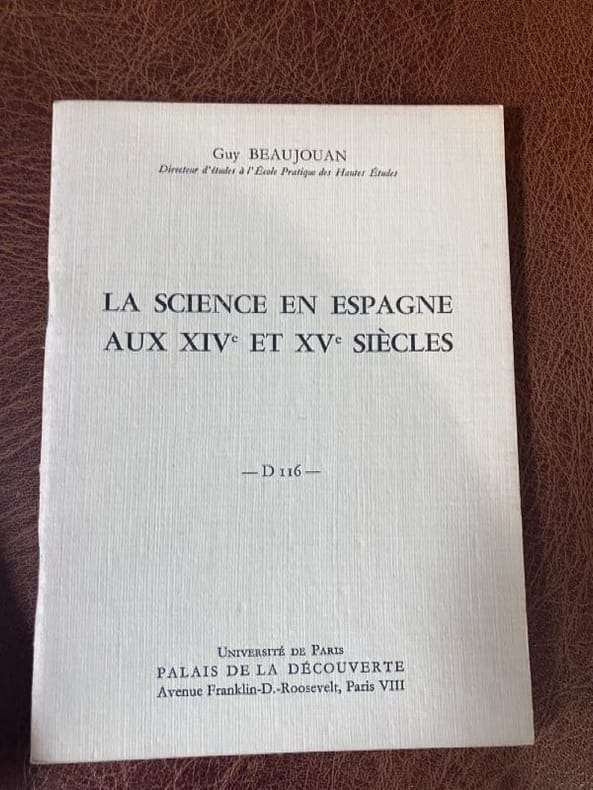
1967réf. 21271967 Paris Université de Paris Palais de la découverte 1967 Un volume in°12 broché 45 pages LR30
réf. 42209Paris, Gallimard, 1992. 15 x 23, 341 pp., très nombreuses illustrations et cartes en couleurs, broché, très bon état.
réf. 8082Promenades aux Etats-Unis et aux Antilles.In 12 demi-cuir fauve, dos lisse,longs filets à froid, filets, roulette, titre dorés ;préface de M H.H.VILLEMASSANS,titre,VIII,304 pages,Alexandre Cadot 1856,édition originale,rousseurs habituelles,principalement concentrées en marges, mouillure angle supérieur droit page 243,marge extérieure plus courte, pages 131 à 134.Relation de la tournée en Amérique de la comédienne RACHEL
réf. 8792La Table Ronde In-8, broché, couverture souple ill (cherchers acroupis dans un desert), 239 pages, qq clichés ht en couleurs, bel ensemble.
1896réf. 46854Paris Gauthier-Villars 1896. 4to. Near contemp. full cloth. Spine gilt and with gilt lettering. Bookmark "The Chemists Club" in gold on lower part of spine. Light wear along edges. In: "Comptes Rendus Hebdomadaires des Séances de L'Academie des Sciences" Tome 122 Entire volume offered.1633 pp. The papers: 420-421 pp. 501-502 pp. 559-564 pp. 689-694 pp. 762-767 and pp. 1086-1088. First appearance of the six landmark papers in which Becquerel documents his discovery of Radio-activity PROMPTING THE NUCLEAR AGE.Becquerel was an expert in fluorescence and phosphorescence continuing the work of his father and grandfather. Follwing the discovery of X-rays by Röntgen Bexquerel investigated fluorescent materials to see if they also emitted X-rays. He exposed a fluorescent uranium salt pechblende to light and then placed it on a wrapped photographic plate.He found that a faint image was left on the plate which he believed was due to the pichblende emitting the light it had absorbed as a more penetrating radiation. However by chace he left a sample that had not been exposed to light on top of a photographic plate in a drawer. he noticed that the photographic plate also had a a faint image of the pechblende. After several chemical tests he concluded that these "Becquerel rays" were a property of atoms. He had by chace discovered radio-activity and prompted thee beginning of the nuclear age. He shared the Nobel Prize for Physics in 1903 with Marie and Pierre Curie. The "Becquerel Rays" were later discovered to be a composite of three forms of emanation distinguished by Rutherford as alpha beta and gamma rays.Dibner: 163 the later Mémoire from 1903 - PMM: 393 1903- Mémoire - Garrison & Morton: 2001 only the first paper. - Magie "A Sourve Book in Physics" p. 610 ff. - Norman:157. hardcover
réf. 80428Paris, Typographie de Firmin-Didot et Cie. 1903, 300x245mm, 360pages, broché. Couverture supérieure détachée, dos fendu. A faire relier. Intérieure en très bon état, aucun défaut. Sous emboitage. A faire relier. - Cet exemplaire attend les soins d’un bon reliure afin d’en être dignement et justement habillé selon son importance historique et son impacte phénomal dans les découvertes scientifiques. Ce traité est la synthèse définitive des découvertes de Becquerel sur la radioactivité spontanée, qui lui ont valu le prix Nobel de physique en 1903 aux côtés de Pierre et Marie Curie. C’est une pièce maîtresse pour tout collectionneur de sciences (référencé au célèbre Printing and the Mind of Man, PMM 393) -.
1972568 pages. Black and white illustrations. Facsimile reprint of the 1894 first edition as published by William Briggs. "The most comprehensive early history of the province." - from dust jacket. Heavily worn former library copy with usual markings. A worthy reading copy. Book
réf. 3506in 8 broché,couverture rempliée,illustrations en couleurs de Pierre MATOSSY faux-titre,frontispice,titre avec photo, 160 pages,photos de Jean ROUBIER, éditions Alpina 1947 très bon état
1879réf. 100302Couverture souple. Broché. 300 pages. Défraîchi.
1977346 pages. Bibliography. Author index. Report of the Estuary Working Group, Department of Fisheries and the Environment, Regional Board Pacific Region. Contains 9 pages of memorial dedicated to Roderick Haig-Brown who passed away in 1976. Includes a full-page photo of Mr. Haig-Brown, a bibliography of his writings, copies of two letters written by RHB to Dr. M. Waldichuk, Director of the Special Estuary Series, and more. Contents include: Geology and Soils, Climatology, Hydrology, Oceanography, Fish, Invertebrates, Flora, Wildlife, Land and Water Use, Pollution and Water Quality, Effects of Development, and more. Average wear. Unmarked. Binding intact. Quality copy. Book
1985réf. 126077Ouest France 1985 In-8 cartonnage éditeur 23,5 cm sur 16,6. 267 pages. Bon état d’occasion.
réf. 3507in 12 broché,faux-titre,titre,365 pages,illustrations dans le texte et pleine page de G de BURGRAFF Ch.Delagrave éditeur sans date
réf. 1222In 8 carré percaline rouge à biseaux,premier plat personnalisé,256 pages,tranches dorées,illustrations de léopold Flameng.Ducrocq éditeur.rousseurs
réf. 9800Perrin In-8, broché, couverture souple ill, Bel exemplaire, 273 pages, index et bibliographie in fine.
réf. 3510in 8 broché,couverture illustrée en couleurs de Charles MATHONAT faux-titre,frontispice,titre avec photo,160 pages, illustrations photos,Alpina éditeur 1949,bon état
192632 pages. Features: The Senator Nobody Knows - William E. Borah will not play politics; Our Soldiers and Reform of Court-Martial System - Ex-Noncommissioned Officer says that in the World War American Soldiers were tried by Court-Martial System of George III; Heroes of the Air Mail - they carry on every day of the year, through rain or fog, over mountains and treacherous valleys; Lo! The Poor Indian, A Citizen Who Has Few Rights; Did High Freight Rates Occasion the Discovery of America?; Henry Ford's Page - America is a challenge to other nations to put their social foundations at the bottom instead of the top; Editorials - anti-American forces arrayed against Hon. Albert Johnson, Farmer Butte discovers dinotherium in Ohio, gunplay in Pittsburgh; Exploring Where Paul Preached - notable architectural and art treasures unearthed on the site of ancient Antioch - photo-illustrated article; The Lobster is Supreme in the village of Cape Porpoise; Can Courage be Cultivated?; Chats with Office Callers; The Strange Transient Woman - A One-Act Play; I Read In the Papers; Can You Tell Me? Soiling to front cover near spine. Unmarked with average wear. A worthy vintage copy. Book
1958réf. AUB-8324Lausanne, la Guilde du Livre 1958. Bel exemplaire relié, reliure pleine toile ornée d'éd., fort in-4, 404 pages avec annexes.
réf. Frost, OrcuttIn Pristine Condition. unknown
1985réf. 3345Les Editions du Pacifique 1985 191 pages IN4. 1985. Reliure editeur cartonnée. 191 pages.
1858réf. 47111Paris Mallet-Bachelier 1858. 4to. No wrappers. In: "Comptes Rendus Hebdomadaires des Séances de L'Academie des Sciences" Tome 47 No 6 a. No 10. Pp. 245- 279 a. pp. 393- 431 entire issues offered. Bernard's papers: pp. 245- 253 a. pp. 393 -400. First appearance of these landmark papers in which Barnard explains his discovery of how the nerves controls the blood vessels. This is the "discovery of the vascoconstrictor and vasodilator nerves and description of their function of regulating the blood supply to the different parts of the body."Garrison & Morton No. 774."In 1858 the papers offered Bernard demonstrated the existence of vasodilator nerves by finding an increased blood flow through the submaxillary gland when the corda tympani is stimulated. He also observed that the venous blood became bright red. Since that time an enormous amount of research has been carried out on the vasomotor system."R.J.S. Mcdowall.Garrison & Morton No. 774. unknown
1855réf. 47110Paris Mallet-Bachelier 1855 a. 1857. 4to. No wrappers. In: "Comptes Rendus Hebdomadaires des Séances de L'Academie des Sciences" Tome 41 No 13 and Tome 44 No 12 a. No. 26. Pp. 461-500 pp. 578-640 a. pp. 1293-1363 3 entire issues offered. Bernard's papers: pp. 461-469 pp. 578-586 a. pp. 1325-1331. Some scattered brownspots to the first paper. First printing of these two milestone-papers in physiology in which Bernard discovers and isolates glycogen from the liver shows that it is converted into blood glucose and discovers the process of gluconeogenesis. He further creates the concepts "experimental determination" and "local interieur"Bernard undertook the task of tracing out the various transformations of food stuffs within the animal organism beginning with the carbohydrates; and he not only found contrary to the accepted view that sugar was formed in the liver but he was also able to isolate a substance from the hepatic tissue which though not sugar was converted by fermentation into dextrose. He made a special study of its properties and called it "glycogen"."The culmination of Bernard's work on the glycogenic function of the liver. He invented the term "internal secretion" and can be said to have started the scientific investigation of the internal secretions although for 30 years the significance of his work was not generally realized. By his research on glycogene Bernard showed that the body not only can break down but can also build up complex chemical substances."Garrison & Morton .Claude Bernard 1813-78 was a key figure in French nineteenth-century science and one of the world's great physiologists. With good reason he has been called the ‘father of experimental medicine’.Garrison & Morton No. 1000 a. 999.1 unknown
1850réf. 48830Paris Bachelier1850. 4to. No wrappers. In: "Comptes Rendus Hebdomadaires des Séances de L'Academie des Sciences" Tome XXXI No. 17. With titlepage to vol. 31. Pp. 561- 592. Entire issue offered. Bernard's paper: pp. 571-574. Titlepage with a faint stamp to top and a stamp in lower margin. First appearance of the first exposition of the glycogenic function of the liver - one of the greatest physiological discoveries of the 19th century. Bernard showed that the liver builds up complex substances including glycogen from the nutriment brought to it by the blood and that these are subsequently modified for distribution to the body.Dibner "Heralds of Science" No 131 - Horblit "One Hundred Books famous in Science" No. 11a here listing "Nouvelle Fonction du Foie" from 1853 but with the remark "The work appeared earlier in abbreviated form in the "Comptes rendus" the paper offered. - Exhibition of First Editions of Epochal Achievements in the History of Science Berkeley 1934. No 107. unknown