Harry HORSELivre Rare Book

réf. 500343367Pastel Sans date. Pour son anniversaire Petit Lapin qui se considère désormais comme un grand lapin est emmené par ses parents au parc d'attractions. Il réalise rapidement que cet endroit est immense et se retrouve séparé de sa famille confronté à son désir d'indépendance
1967réf. 21401967 Paris Université de Paris Palais de la découverte 1955 Un volume in°12 broché 23 pages LR30
Paris, Poulet-Malassis et de Broise, 1859-1861. 7 volumes in-12, demi-percaline grise, dos lisse, auteur titre et tomaison en lettres dorées, (reliure époque). T. 1. XXXII-(préface)-475 pp. T. 2. 479 pp. T. 3. 512 pp. T. 4. 466 pp. T. 5. 482[1]. T. 6. 550 pp. T. 7. 606 pp. Pour chaque tome : 3 ff-(1 f blanc, faux-titre et titre). Eugène Louis Hatin, né à Auxerre le 8 septembre 1809 et mort à Paris le 16 septembre 1893, est un historien, journaliste et bibliographe français. Son travail considérable de l’Histoire politique et littéraire de la presse en France a été considéré comme n’ayant guère d’équivalent à l’étranger. Sa Bibliographie de la presse est un recueil précieux abondant en renseignements curieux. Sept volumes sur 8. Le tome 7 s'arrête à La Presse sous L'Empire. (Le Publiciste - Journal des Débats - Journal de Paris - Le Spectateur du Nord). Edition originale. Bons exemplaires rares.
réf. 27158Paris, Poulet-Malassis et de Broise, 1859-1861. 7 volumes in-12, demi-percaline grise, dos lisse, auteur titre et tomaison en lettres dorées, (reliure époque). T. 1. XXXII-(préface)-475 pp. T. 2. 479 pp. T. 3. 512 pp. T. 4. 466 pp. T. 5. 482[1]. T. 6. 550 pp. T. 7. 606 pp. Pour chaque tome : 3 ff-(1 f blanc, faux-titre et titre).
réf. 9302in 8 broché couverture illustrée en couleurs (dos et premier plat) Faux-titre, frontispice, titre, 240 pages, illustrations hors-texte et dans le texte. Paris H. Lecène & H OUDIN éditeurs, 1887. Rousseurs, principalement en début et fin de volume.
réf. 10585ouvrage complet en 4 livraisons de 16 pages chacune. 48 illustrations dans le texte et à pleine page, une carte. Hachette & Cie 1874 Le Tour du Monde livraisons 722-723-724-725,avec les couvertures de livraison(2 avec des déchirures)
réf. ria9780198825937_inpPaperback / softback. New. New Book; Fast Shipping from UK; Not signed; Not First Edition; The first textbook to describe the ecology and epidemiology of wildlife and zoonotic animal-to-human infectious diseases and the applications to conservation biology and public health. Examples of disease agents enliven the text and i paperback
1930pp. xi, 339 + Plus frontis and photographs. Map endpapers. 8vo. Original full blue cloth binding, decorated in blue. Original dust jacket, torn with loss. First Edition. "A narrative of gallant men and bold exploits in Antarctica" - Spence 579. **PRICE JUST REDUCED! POLAR 1
1975385 pages. Many black and white illustrations. Chapter titles include: Mineral Country; Mandy Mine; The Discovery; The Engineers; Construction; Early Businesses; Townsite; Civic Affairs; Social, Ethnic and Service Groups; Churches; Recreation and Arts; and more. Clean and unmarked with light wear. Binding tight. Excellent copy. Hackett (2) 330. Book
1888404p., illus. , fold. map at end Hardcover Very good condition, in red cloth, black & gilt decoration Cover title: Au Pole Nord Voyages au pays des glaces par F. von Hellwald . . .
1890313p., illus. Hardcover Very good condition, in red cloth, black & gilt decoration Cover title: Au Pole Nord Voyages au pays des glaces par F. von Hellwald . . .
1960réf. LR51-R-R44Avec 1 carte et 5 hors texte. Broché, couverture illustrée d'un dessin du peintre A. Cheinet, très bon état, 159 p.
réf. 23790Plon, collection "Les recentes decouvertes archeologiques", 1960. Format 14x20 cm, reliure souple sous jaquette illustree, 335 pages. Jaquette sale.Bon etat, petites traces d'usage sur un livre d'occasion.
réf. 23789Plon, collection "Les recentes decouvertes archeologiques", 1958. Format 14x20 cm, reliure souple sous jaquette illustree, 265 pages. Jaquette sale.Bon etat, petites traces d'usage sur un livre d'occasion.
réf. 23791Plon, collection "Les grandes fouilles archeologiques", 1961. Format 14x20 cm, reliure souple sous jaquette illustree, 420 pages. Jaquette sale.Bon etat, petites traces d'usage sur un livre d'occasion.
1940réf. 3989Gallimard 1940 347 pages in8. 1940. broché. 347 pages. La Conquête des pôles d'Henry Bidou retrace l'histoire dramatique de l'exploration des régions polaires présentée comme une quête humaine fondamentale pour prendre possession des espaces les plus hostiles de la planète. L'ouvrage examine l'évolution de cette conquête à travers les âges depuis les motivations instinctives jusqu'aux expéditions modernes
1979réf. ARCH6223MBroché, 96 pages, paru en 1979 chez Zodiaque, livre en très bon état général.
réf. 6694histoire et description de l'Antarctide, traduction de l’anglais et chapitre annexe par R. JOUAN.In 8 broché, couverture illustrée titre,243 pages,10 pages de catalogue une carte du pôle sud Payot 1952, bibliothèque géographique très bon état
1835réf. 47003Philadelphia Fraklin Institute 1835. 8vo. Later full green cloth. Tome-and titlelabels in leather with gilt lettering on spine. In: "Journal of the Franklin Institute of the State of Pennsylvania. Edited by Thomas P. Jones" Vol. XV. New series. Engraved frontisp. 2446 pp. 2 folded engraved plates and 2 folded engraved maps. Entire volume offered. Henry's announcement: pp. 169-70. A stamp to verso of frontispiece Library of Congress duplicate stamp. First printing of this importent paper the first to describe in detail how the phenomena of Self-Induction was discovered. Henry discovered the induction phenomena - how an electric current in one coil may set up a current in the other through the development of the magnetic field - independently of Faraday but Faraday was first to publish on electromagnetic induction. Henry's experiments with induction led him to his importent discovery of SELF-INDUCTION which is the phenomenon in which a change in electric current in a coil produces an induced emf in the coil itself. This phenomenon was also discovered inependently by Faraday but this time Henry had published first. The basic unit of inductance was to be called "the Henry". Relevant to the controversy between Faraday and Henry is the following statement by A D Bache Secretary of the American Philosophical Society introducing an abstract of Henry in J Franklyn Inst. 1835 pp. 169-70 H. Norman 1053 and the paper offerd: "A memoir on this subject has been since submitted to the Society containing an extension of the subject the primary fact in relation to which was observed by Professor Henry as early as 1832 and announced by him in the American Journal of Science. Mr. Faraday having recently entered upon a similar train of observations the immediate publication of the accompanying is important that the prior claims of our fellow countryman may not be overlooked."Spark Museum.Magee "Source Book in Physics" p. 515. hardcover
1837réf. 47418London Richard and John E. Taylor 1837. No wrappers. Extracted fron "Scientific Memoirs selected from The Transactions of Foreign Academies of Science and Learned Societies. Edited by Richard Taylor." Vol. I. Pp. 540-547. Henry's milestone paper announcing his discovery of electrical self-induction. "Henry independently discovered electro-magnetic induction and in this paper announced his discovery of electric self-induction one of the prime properies of an electro-magnetic circuit. Henry was an eminent experimenter but was casual in publishing his findings with resulting lack of recognition of his contributions."Bern Dibner.Dibner "Heralds of Sciece" No.63.It was also printed the same year in "Transactions of the American Philosophical Society New Series Vol. 5". The paper was later printed in "Philosophical Magazine" 1840."The direction of Henry’s thought became somewhat apparent in his 1835 paper refers to the papers reading before the American Phil. Soc. febr. 6th 1835 on the action of a spiral conductor in increasing the intensity of galvanic currents. The paper started out as an affirmation of Henry’s priority in the discovery of self-induction. He then combined induction proper using Faraday’s findings and his own with selfinduction to show how these produce a pattern of repulsions yielding an increased effect in spirals. He specifically linked these “magneto-electrical” results to the principles of static induction developed by Cavendish and Poisson. This explanation was then applied to Savary’s report of changes of polarity when magnetic needles were placed at varying distances from a wire in which a current was being transmitted "Mémoire sur l’aimantation" in Annales de chimie et de physique 34 1827. That is currents appeared periodically in the air surrounding a current-bearing straight wire as a result of the actions of induction and self-induction." DSB.Wheeler Gift: 2724-2725a. unknown
1842réf. 44147Leipzig Johann Ambrosius Barth 1842. Without wrappers. In "Annalen der Physik und Chemie. Hrsg. von J.C. Poggendorff" Ergänzungsband 1 Stück 2. Pp. 193-384 a. 1 folded engraved plate. The entire issue offered. Henry's paper: pp. 282-312. First German version of Henry's description of his discovery of self-induction. He missed the credit for the discovery of induction to Faraday but he had done the key experiment ahead of Faraday but Faraday was the first to publish. But he is credited for the discovery of self-induction 1832 and Faraday discovered it independently two years later 1834."In Henry's paper however he explained thet the electric current in a coil can induce another current not only in another coil but in itself. The actual current observed in the coil is then the combination of the original current and the induced current. This is called self induction."Isac Asimov.The issue contains further notable papers Michael Faraday's "Vierzehnte Reihe von Experimental-Untersuchungen über Elektricität" § 2o-22. Nos 1667-1748. Pp. 249-281. First German version. In this paper FARADAYamplifies his theory of electrostatic induction by making further use of the analogy with the induction of magnetism. Whittaker describes the paper as having "THE FUNDAMENTAL EQUATION OF ELECTROSTATICS" as modified in order to take into account the effect of the specific inductive capacity."Whittaker I pp.187-89. unknown
réf. 6695in 12 pleine toile verte d’éditeur,titre doré au dos et sur le premier plat,filets noir en encadrement.Faux-titre, titre,XII,621 page,non rogné.Deuxième édition revue et augmentée avec 273 figures intercalées dans le texte.J.B Baillière & fils 1884,reliure légèrement frottée quelques traces de manipulations en fin de volume tamons de bibliothèque
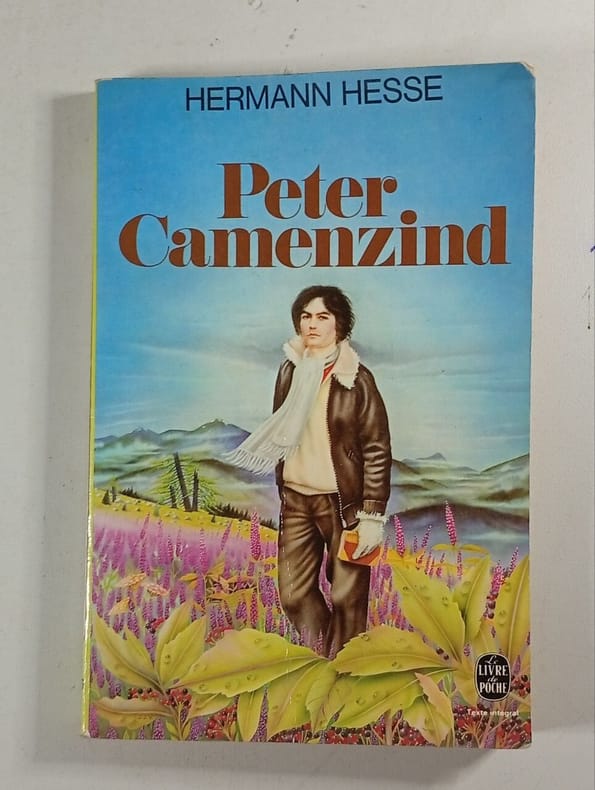
réf. 500367197LIVRE DE POCHE Sans date. Premier roman d'Hermann Hesse Peter Camenzind raconte l'histoire d'un jeune paysan alpin qui poussé par son amour de la nature et sa quête de sens voyage à travers l'Europe. Le livre explore les thèmes chers à l'auteur : la passion de la nature la méfiance envers la société la nostalgie de l'enfance et la recherche d'une identité spirituelle
1843réf. 42662London Richard and John E. Taylor 1843. 4to. No wrappers as extracted from "Philosophical Transactions" 1843 - Part I. Pp. 1-6. First appearance of a pioneer-paper in the history of early photography as Herschel here for the first time describes his discovery of the iron printing process with ammonio-citrate of iron by both methods namely with blue lines on a white background and white lines on a blue ground. unknown
1842réf. 42843London Richard and John E. Taylor 1842. 4to. No wrappers as extracted from "Philosophical Transactions" 1842 - Part II. Pp. 181-214 and one double-page folded engraved plate. First appearance of a pioneer-paper in the history of early photography in which Herschel announced some of his importent discoveries of the photographic printing processes the process of photographic contact-printing in Prussian blue brought to light just three years after Louis Daguerre and Henry Talbot had announced their independent inventions of photography in silver using metal and paper substrates respectively. and the photographic properties of red ferro sesquicyanuret of potassium."This is the first recorded observation of Prussian blue being formed for a photographic purpose by the action of light on potassium ferricyanide so it represents the moment of discovery of the first cyanotype process although this name still lay in the future. The significance of this observation impressed Herschel sufficiently to mention it also in his general diary entry for 23 April 1842."Mike Ware in "John Herschel's Cyanotype. Invention or discovery ". unknown