2048 risultati
1907rif. 23881907 L'EPAVE - DECOUVERTE - UN PARRICIDE - LE RENDEZ-VOUS - BOMBARD - LE PAIN MAUDIT - LES SABOTS - LA BUCHE - MAGNETISME - DIVORCE - UNE SOIREE . PARIS, SOCIETE' D'EDITIONS LITTERAIRES ET ARTISTIQUES, 1907, reliure demi chagrindos tres joliment decoré, on peut regreter un papier jauni , mais parfait etat general
1954rif. 67689Nice 1954 Editions La Tarente - 1954 - In-12, broché, couverture illustrée - 187 p. - Couverture dessinée par R.R. Giordan.
1967rif. 21281967 Paris Université de Paris Palais de la découverte 1964 Un volume in°12 broché 22 pages LR30
1894rif. 103595Klincksieck 1894 Librairie C. Klincksieck, 1894, 424 p., broché, dos en mauvais état (restauré), des franges le long des plats, intérieur propre.
rif. 14128Les Japonais. Leur pays, leurs mœurs. Voyage autour du monde Préface de Henri DUVEYRIER ? In 12 demi toile marron muette, faux titre, titre, 338 pages 195x130mm. Figures hors texte sous serpentes figures dans le texte, Une carte dépliante en fin de volume. Paris Librairie PLON E. PLON & NOURRIT & Cie imprimeurs éditeurs 1885. Premier plat de couverture (épidermures) conservé. A signaler travail de rongeur, angle inférieur droit en diminuant jusqu’ à la page 60 ; cependant bon exemplaire à grandes marges.
2007rif. 3922007 - cartonné - Cosacnaify - Livraria Duas Cidades - Quatrième édition revisitée - 2007 - In-8 format à l'italienne (18,5 x 24,5 cm), cartonné - 190 pages - Très nombreuses photographies en noir et blanc - Avec une carte de la ville in fine - ISBN : 9788575036488 - Texte en portugais brésilien
rif. 6357in 8 demi-chagrin marron à nerfs titre et caissons dorés, plats percaline chagrinée,filet à froid en encadrement. Faux-titre,frontispice sous serpente, titre avec vignette 285 pages,sur papier fort 1 feuillet de table des chapitres,tranches dorées,texte et figures encadrés d’un double filet noir illustrations hors-texte de Daniel VIERGE,et FERAT.Théodore Lefèvre éditeur sans date.Un cahier légèrement décalé sinon très bon état
rif. 2395dans les montagnes du Canton de Fribourg et dans diverses parties du pays de Vaud en 1793. In 8 demi-cuir marron à petits coins,dos liesse très orné, fers,filets roulette,palmettes dorés.(il manque la pièce de titre)faux-titre,titre,287 pages,2 feuillets sur 3 de table des chapitres.Levrault-Heinrich an XII,(1804)Mouillure pâle en début de volume sans gravité et en toute fin de volume en marge.Bon état d’ensemble
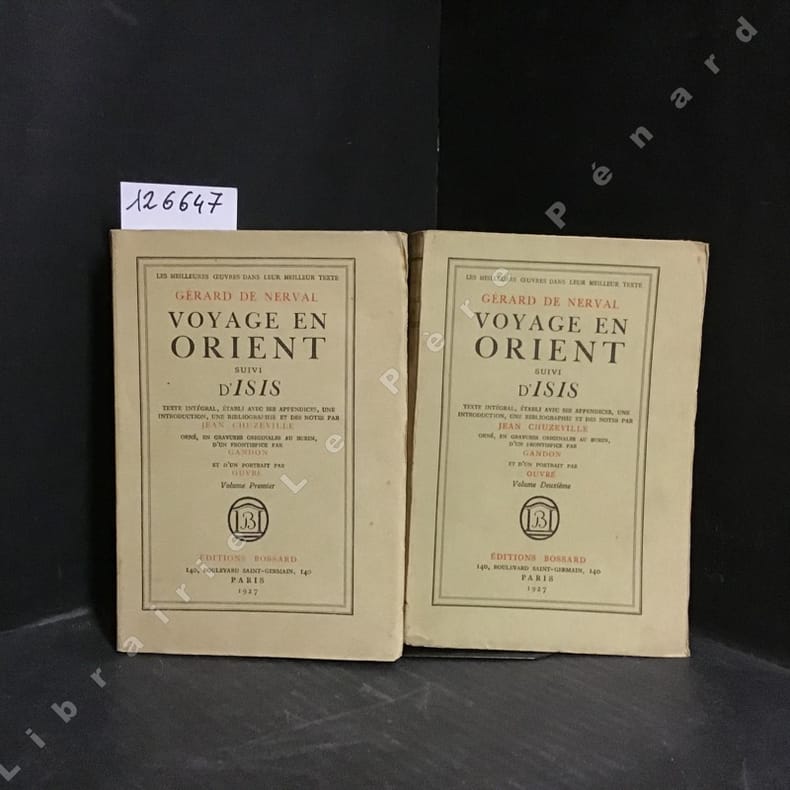
1927rif. 1266471927 Editions Bossard, Paris - 1927 - Complet en 3 volumes in-8 brochés - 344 + 270 + 390 pages - L'un des 1850 exemplaires sur vélin de fil Lafuma de Voiron, numéroté 1721
1940rif. 723881940 Agence Parisienne de Distribution Editeur, collection "REX" N° 19 - 1940 - 1 fascicule in-8, broché couverture illustrée - 63 pages
1938rif. 723891938 Agence Parisienne de Distribution Editeur, collection "REX" N° 3 - 1938 - 1 fascicule in-8, broché couverture illustrée - 63 pages
rif. DADAX1436818990New unknown
2010rif. 500280262Fleurus 2010 32 pages 23 2x1x28 8cm. 2010. board_book. 32 pages.
2010rif. 500280275Fleurus 2010 32 pages 23 2x1x28 8cm. 2010. board_book. 32 pages.
1905xl, 451, 4 [ads] pages. Two large colour fold-out maps of North American drainage basins by J.G. Bartholomew; Black and white photographic plates and diagrams. "In the following pages an attempt has been made to set forth in order the chief facts relating to the discovery and exploration of the northeastern part of the continent of North America." - Preface. Professionally rebacked using original cloth. Unmarked with average wear. Small tape repair to first fold-out map. Second fold-out map loose but present with minor loss to one corner. A sound copy. MORLEY [Ontario] p.7, MORLEY [Atlantic] p.3. Book
1799rif. 44095Halle Rengerschen Buchhandlung 1799 1800. Without wrappers extracted from "Annalen der Physik. Herausgegeben von Ludwig Wilhelm Gilbert" Bd. 2. p. 483 one page. and Bd. 6 pp. 105-115. Some scattered brownspots. First German translation of Davy's announcement the announcement on 1 page of his discovery of the unusual anaesthetic effects of nitrous oxide which on being inhaled gave rise to a giddy intoxicated feeling. On announcing his discovery he says that he will publish a paper discribing the experiments with the gas later. This is the paper offered here also in the first German version. Both the announcement and the paper were issued in the "Annalen" the same year as they appeared in Nicholson's Journal.The gas was first synthesized by English natural philosopher and chemist Joseph Priestley in 1772 who called it phlogisticated nitrous air."Following Priestley's discovery Humphry Davy of the Pneumatic Institute in Bristol England experimented with the physiological properties of the gas such as its effects upon respiration. He even administered the gas to visitors to the institute and after watching the amusing effects on people who inhaled it coined the term 'laughing gas'! Davy even noted the anaesthetic effects of the gas: "As nitrous oxide in its extensive operation appears capable of destroying physical pain it may probably be used with advantage during surgical operations in which no great effusion of blood takes place".Wikipedia."Davy discovered the anaesthetic properties of nitrous oxide and suggested its use during surgiical operations a suggestion which was not turned to useful account until 1844."Garrison & Morton 5646 not mentioning the announcing of its discovery in 1799. unknown
1810rif. 46377Paris J. Klostermann 1810. Contemp. hcalf. Spine gilt. Slightly rubbed. A few scratches to binding. Small stamps on verso of titlepage.In: "Annales de Chimie ou Recueil de Mémoires concernant la Chemie" Tome 75. 336 pp. a. 2 folded engraved plates. Some scattered brownspots. The papers: pp. 27-77 129-175 256-263 264-273 274-289 a. 290-316. First French version of Davy's "The Bakerian Lecture for 1809. On some new Electrochemical Researches on various Objects particularly the metallic Bodies from the Alkalies and Earth and on some Combinations of Hydrogene. Read November 16 1809." together with the controversy papers by Davy and Gay-Lussac & Thenard."Mr. Davy having from the commencement of his electro-chemical researches communicated the several steps of his progress to the Society The Royal Society takes the present opportunity of reporting the results of his further inquiries under four principal heads. First on the nature of the metals of the fixed alkalis. Second on the nature of Hydrogen and composition of ammonia. Thirdly on the metals of the earth; and Fourthly he makes a comparison between the antiphlogistic doctrine and a modified phlogistic hypothesis."Abstract. He further gives arguments for considering potassium and sodium which he discovered in 1808 as a element.""Gay-Lussac had a slight rivalry between himself and the creation scientist Sir Humphry Davy. Davy was chemically preparing Potassium and Sodium through an electrical current and this made Gay-Lussac and Thénard envious of his success. They too decided to perform the same task but they had no battery at their disposal as Davy had so they had to form another way to chemically prepare the two elements. In 1808 they used a red-hot iron fused to potash the water-soluble form of a manufactured salt containing potassium to perform this task a method that Davy admitted had its advantageous qualities. Gay-Lussac and Thénard were successful in preparing Potassium and continued to make a full analysis of its chemical properties and began to use it for their own experiments. In 1809 Davy performed the same task using it to reduce Boron in Boracic acid." unknown
1809rif. 50198Paris Mad. Ve Barnard 1809. Contemp. hcalf. Spine gilt. Wear to top of spine. A few scratches to binding. Small stamps on verso of titlepage.In: "Annales de Chimie ou Recueil de Mémoires concernant la Chemie" Tome 70. 336 pp. Entire volume offered. Davy's paper: pp. 189-254. First edition in French the first English 1808 of this importent historical paper in chemistry in which Davy shows that electricity is capable of decomposing some alkalies isolating two new substances and discovering potassium and sodium. Neville in his Historical Chemical Library vol. I p.340 writes about this paper "ONE OF THE GREAT CLASSIC RESEARCHES IN CHEMISTRY in which Davy announced in this his second Bakterian lecture the isloation of metallic potassium and sodium by the electrolytic decomposition of their fused oxides.""He Davy began his own electrical experiments.The results were spectacular. On October 6 1807 the current passing through molten potash liberated a metal which Davy called potassium. The little globules of shining metal tore the water molecule apart as it eagerly recombined with oxygen and the liberated hydrogen burst into lavender flame. Davy danced about in a delirium of joy. A week later he isolated sodium from soda."Asimow. The paper offered here describes these discoveries."Humphry Davy was one of the most brilliant chemists of the early nineteenth century. His early study of nitrous oxide brought him his first reputation but his later and most importent investigations were devoted to electrochemistry. Following Galvani's experiments and the discovery of the voltaic pile interest in galvanic electricity had become widespread. The first electrolysis by means of the pile was carried out in 1800 by Nicholson and Carisle who obtained oxygen and hydrogen from water. Davy began to examine the chemical effects of electricity in 1800 and his numerous discoveries were presented in his Bakerian lecture to the Royal Society on November 20 1806. A Source Book in Chemistry p. 243. unknown
1815rif. 45715London W. Bulmer and Co. 1815. 4to. No wrappers as extracted from "Philosophical Transactions" 1815 - Part II. Pp. 203-213 a. pp. 214-219. First appearance of two importent papers by davy. In the second paper offered he relates his discovery of chlorine dioxyd."By explosion over mercury he found that 2 vols. give from 2.7 to 2.9 of gas and this would probably be 3 vols. if no chlorine had been absorbed by the mercury. This gas contains 2 vols. of oxygen and the remainder chlorine hence the compound consists of 'two in volume of oxygen and one of chlorine condensed into the space of two volumes' ClO2. He found it to explode at about 100 deg. with more viollence than euchlorine."Partington III p. 57.Together with ROBERT PORRETT "Further analytical experiments relative to the constitution of the prussic; of the ferruretted chyazic and of the sulphuretted chyazic acids; and of their salts; together with the application of the atomic theory to the analysis of these bodies." pp. 220-230 a. 2 tables one folding. unknown
1810rif. 42219London W. Bulmer and Co. 1810. 4to. No wrappers as extracted from "Philosophical Transactions" 1810 - Part I. Pp. 16-74 and 2 engraved plates showing Davy's electrochemical apparatus for decomposing substances. The plates dampstained. Text fine and clean. First appearence of this historical chemical paper Davy' fifth Bakerian Lecture in which he announced his discovery of hydrogen telluride."Mr. Davy having from the commencement of his electro-chemical researches communicated the several steps of his progress to the Society The Royal Society takes the present opportunity of reporting the results of his further inquiries under four principal heads. First on the nature of the metals of the fixed alkalis. Second on the nature of Hydrogen and composition of ammonia. Thirdly on the metals of the earth; and Fourthly he makes a comparison between the antiphlogistic doctrine and a modified phlogistic hypothesis."Abstract. He further gives arguments for considering potassium and sodium which he discovered in 1808 as a element."Humphry Davy was one of the most brilliant chemists of the early nineteenth century. His early study of nitrous oxide brought him his first reputation but his later and most importent investigations were devoted to electrochemistry. Following Galvani's experiments and the discovery of the voltaic pile interest in galvanic electricity had become widespread. The first electrolysis by means of the pile was carried out in 1800 by Nicholson and Carisle who obtained oxygen and hydrogen from water. Davy began to examine the chemical effects of electricity in 1800 and his numerous discoveries were presented in his Bakerian lectures." - Wheeler Gift: 2518. unknown
1808rif. 42218London W. Bulmer and Co. 1808. 4to. No wrappers as extracted from "Philosophical Transactions" 1808 - Part I. Pp. 1-44. First printing of this importent historical paper in chemistry in which Davy shows that electricity is capable of decomposing some alkalies isolating two new substances and discovering potassium and sodium. Neville in his Historical Chemical Library vol. I p.340 writes about this paper "ONE OF THE GREAT CLASSIC RESEARCHES IN CHEMISTRY in which Davy announced in this his second Bakterian lecture the isloation of metallic potassium and sodium by the electrolytic decomposition of their fused oxides.""He Davy began his own electrical experiments.The results were spectacular. On October 6 1807 the current passing through molten potash liberated a metal which Davy called potassium. The little globules of shining metal tore the water molecule apart as it eagerly recombined with oxygen and the liberated hydrogen burst into lavender flame. Davy danced about in a delirium of joy. A week later he isolated sodium from soda."Asimow. The paper offered here describes these discoveries."Humphry Davy was one of the most brilliant chemists of the early nineteenth century. His early study of nitrous oxide brought him his first reputation but his later and most importent investigations were devoted to electrochemistry. Following Galvani's experiments and the discovery of the voltaic pile interest in galvanic electricity had become widespread. The first electrolysis by means of the pile was carried out in 1800 by Nicholson and Carisle who obtained oxygen and hydrogen from water. Davy began to examine the chemical effects of electricity in 1800 and his numerous discoveries were presented in his Bakerian lecture to the Royal Society on November 20 1806.A Source Book in Chemistry p. 243. - Wheeler Gift: 2514. unknown
1810rif. 45887London W. Bulmer and Co. 1810. 4to. No wrappers as extracted from "Philosophical Transactions" 1810 - Part I. Pp. 16-74 and 2 engraved plates showing Davy's electrochemical apparatus for decomposing substances Davy's versions of the Voltaic-pile. Plates a bit brownspotted otherwise clean and fine wide-margined. First appearence of this historical chemical paper Davy' fifth Bakerian Lecture in which he announced his discovery of hydrogen telluride."Mr. Davy having from the commencement of his electro-chemical researches communicated the several steps of his progress to the Society The Royal Society takes the present opportunity of reporting the results of his further inquiries under four principal heads. First on the nature of the metals of the fixed alkalis. Second on the nature of Hydrogen and composition of ammonia. Thirdly on the metals of the earth; and Fourthly he makes a comparison between the antiphlogistic doctrine and a modified phlogistic hypothesis."Abstract. He further gives arguments for considering potassium and sodium which he discovered in 1808 as a element."Humphry Davy was one of the most brilliant chemists of the early nineteenth century. His early study of nitrous oxide brought him his first reputation but his later and most importent investigations were devoted to electrochemistry. Following Galvani's experiments and the discovery of the voltaic pile interest in galvanic electricity had become widespread. The first electrolysis by means of the pile was carried out in 1800 by Nicholson and Carisle who obtained oxygen and hydrogen from water. Davy began to examine the chemical effects of electricity in 1800 and his numerous discoveries were presented in his Bakerian lectures." - Wheeler Gift: 2518.Also with William Hyde Wollaston "The Croonian Lecture. Read November 16 1809.On Muscular Action - On Sea-Sickness - On the salutary Effects of Riding and other Modes of Gestation. Pp. 1-15. unknown
1866rif. 64961866 Hachette 1866 broché : 580 pages Bon exemplaire.
1808rif. 42218(London, W. Bulmer and Co., 1808). 4to. No wrappers as extracted from ""Philosophical Transactions"" 1808 - Part I. Pp. 1-44.
rif. DADAX0367573989New unknown