Daladier Jean - Daridan Jean ( Pour les annotations )Livre Rare Book

2 710 résultats
réf. 14169Calmann-Lévy, 1991 - In-8, broché, couverture ill ( portrait ) 391 pages, index sélectif, repères biographiques, bel ouvrage.
1928réf. 1198581928 A Paris, Librairie Plon, Les petits-fils de Plon et Nourrit - 1928 - In-8, broché - 336 pages - 73 reproductions photographies en N&B hors texte + Carte dépliante in fine
réf. SONG0896038203Used: Good unknown
réf. DADAX022631944XNew unknown
1880réf. 47008Paris Gauthier-Villars 1880. 4to. No wrappers. In: "Comptes Rendus Hebdomadaires des Séances de L'Academie des Sciences" Tome 91 No 5 entire issue offered. Pp. 251-310. The Curie's paper: pp. 294-295. First apperance of the paper in which the two brothers announced their discovery of the Piezoelectric Effect as they observed how an electric potential appeared across crystals of quartza and of Rochelle salt when pressure was applied to them. The potential varied directly with the pressure and they named the phenomenon Piezoelectricity meaning "to press" Greek. Crystals with piezoelectric properties form an essential portion of sound-electronics devices such as microphones and record-players."The applications of piezoelectric crystals are innumerable; one of the most important is their use in frequency stabilization of oscillating electromagnetic cirasciots for radio broadcasting stations. They are used in most piezometers for measuring with great precision either very strong pressure variations such as those of a cannon at the moment of firing or very weak ones such as artery pulsations. These applications have led to the creation of a new industry the manufacture of large "mono" such as quartz obtained hydrothermally around 500°C. under high water pressures or crystals such as Rochelle salt obtained from aqueous solutions. These two substances were mentioned in the Curie brothers’ report announcing the discovery of piezoelectricity." DSB."The first experimental demonstration of a connection between macroscopic piezoelectric phenomena and crystallographic structure was published in 1880 by Pierre and Jacques Curie. Their experiment consisted of a conclusive measurement of surface charges appearing on specially prepared crystals tourmaline quartz topaz cane sugar and Rochelle salt among them which were subjected to mechanical stress. These results were a credit to the Curies' imagination and perseverance considering that they were obtained with nothing more than tinfoil glue wire magnets and a jeweler's saw." Piezo Systems Inc.Magee "A Source Book in Physics" p. 547 ff. unknown
1934réf. 47071Paris Gauthier-Villars 1934. 4to. No wrappers. In: "Comptes Rendus Hebdomadaires des Séances de L'Academie des Sciences" Tome 198 No 3. Titlepage to vol. 198. Pp. 213- 292. Entire issue offered. The joint paper: pp. 254-256 a. 1 photographic illustration in the text. Titlepage with a stamp on verso 2 small tears and a tiny bit of upper right corner gone. Titlepage a bit browned. First appearance of this seminal paper in which artificial radioactivity was announced for the first time. Curie and Joliot were awarded the Nobel Prize in Chemistry 1935 "in recognition of their synthesis of new radioactive elements"."Until this date 1934 atomic nuclei emitting radiation were found in nature: it was called the natural radioactivity. It had been known since Rutherford that this natural radioactivity changed a nucleus into an other one: for instance radium becomes finally lead after many radioactive decays. We could say that lead does not become gold but gold becomes lead! But. this change of matter was not under control. It was not possible to construct the desired chemical element as the alchemist dreamed. But Irene and Frederic Joliot-Curie made the dream become almost reality.""Another very important development in the early 1934 by the Joliot-Curies in connection with irradiation of aluminum by alpha particles. The two French scientists detected the production of the recently discovered positrons. . However they soon realized that the positron activity continued after the alpha source was removed and that they had in fact discovered positive beta radioactivity. The importance of the discovery of artificial radioactivity was immediately recognized and resulted in a Nobel Prize in chemistry to the Joliot-Curies in 1935. The new phenomenon immediately became widely employed in nuclear physics chemistry biology and medicine." Kragh Quantum Generations p. 187"These elegant experiments which provided the first chemical proof of induced transmutations and showed the possibility of artificially creating radioisotopes of known stable elements were repeated and extended in the major nuclear physics laboratories of various countries " DSB.Born on 12 September 1897 in Paris Irène Curie was the daughter of Pierre and Marie Curie. "During World War I she worked as a nurse helping her mother operate radiography equipment and then studied physics and mathematics at the Sorbonne gaining a doctorate for studying the range of alpha particles. She then went to work for her mother at the Radium Institute. There she met Frédéric Joliot whom she married in 1926. Frédéric Joliot was born on 19 March 1900 in Paris - He joined the Radium Institute in 1925 and obtained his PhD in 1930. Together the Joliot-Curies worked on radioactivity and the transmutation of the elements. Twice they just missed major discoveries: in 1932 when Chadwick beat them to the neutron and in 1933 when Anderson discovered the positron. However in 1934 whilst bombarding light elements with alpha particles the Joliot-Curies noticed that although proton production stopped when the alpha particle bombardment stopped another form of radiation continued. The alpha particles had produced an isotope of phosphorus not found in nature. This isotope was radioactive and was decaying through beta-decay" DSB. unknown
1898réf. 46852Paris Gauthier-Villars 1898. 4to. No wrappers. In: "Comptes Rendus Hebdomadaires des Séances de L'Academie des Sciences" Tome 126 No 15. Entire issue offered. With htitle and titlepage to vol. 126. Pp. 1059-1110. Curie's paper: pp. 1101-1103. First printing of this milestone paper being the first "Note" from Marie Curie about "radioactivity". This same "Note" contains a the fundamental observation: "Two uranium ores. are much more active than uranium itself. This fact. leads one to believe that these ores may contain an element much more active than uranium." This paper gives the first proof of the fact that radiation is an atomic property."Henri Becquerel discovered 1896 that uranium salts shielded from light for several months spontaneously emit rays related in their effects to Roentgen rays. Mme. Curie became enthusiastic about this subject filled with the unknown and as she later acknowledged involving no bibliographic research.The first step in the research was to determine whether there existed other elements capable like uranium of emitting radiation. Abandoning the idea of hyperfluorescence couldn’t one calculate by electrical measurement the effects on the conductivity of air that were revealed by the gold-leaf electroscope Pierre Curie and his brother Jacques had constructed an extremely sensitive apparatus to measure weak currents; Mme. Curie employed it in testing both pure substances and various ores. In her first "Note" in the Comptes rendus"de l Académie des sciences 12 April 1898 she described the method that she followed throughout her life the method that enabled her to make comparisons through time and crosschecks with other techniques:"I employed. a plate condenser one of the plates being covered with a uniform layer of uranium or of another finely pulverized substance diameter of the plates eight centimeters; distance between them three centimeters. A potential difference of 100 volts was established between the plates. The current that traversed the condenser was measured in absolute value by means of an electrometer and a piezoelectric quartz. In general she preferred the zero method in which the operator compensates for the current created by the active material by manipulating the quartz. All of her students followed this procedure."DSB.The first results came in 1898: the measurements varied between 83 × 10-12 amperes for pitch blende to less than 0.3 × 10⁻¹² for almost inactive salts passing through 53 × 10-12 for thorium oxide and for chalcolite double phosphate of uranium and copper. Thorium would thus be "radioactive" the term is Mme. Curie’s; its radioactive properties were discovered at the same time independently by Schmidt in Germany. unknown
réf. 152In 8 reliure éditeur demi-cuir, titre et décor dorés en long au dos, plats percaline noire avec une grande plaque dorée animée sur premier plat petite plaque dorée sur le deuxième plat.Filets à froid en encadrement.faux-titre,frontispice (Isabelle II) titre,392 pages,deux feullets de table,chapitre et placement des gravures. Cinquante gravures hors texte de Célestin NANTEUIL,sous serpentes dont vingt cinq en couleurs gommées, cent bois dans le texte.Librairie ethnographique éditeur sans date. (1848)Edition originale (Vicaire volume II page 1074, Carteret volume III page 222)rousseurs habituelles. Une mouillure en tête s'amenuisant au fil des pages pour redevenir plus importante de la page 391 à la fin. Un vignette de collection a été collée sur la page de faux titre.
1987réf. 8431987 - broché - Sans mention d'édition - 1987 - In-8 (24 x 17 cm) broché - 132 pages - Illustrations en noir et blanc - Avec une carte volante - Titre complet : "Le voyage de Crozet en Tasmanie, en Nouvelle-Zélande, aux Îles Ladrones, aux Philippines. 1771 - 1772. A la découverte des îles Crozet." - Préfaces de Joseph Crozet et Jas. R. Boosé - Avant propos et post-face de Hélène Roux - A PROPOS : Édition établie d'après la traduction anglaise de H. Ling Roth (1891), le manuscrit français original étant perdu. Hélène Roux reconstitue le texte à partir des notes de voyage de Julien Crozet, navigateur et explorateur français du XVIIIe siècle. Ce récit constitue l'un des principaux témoignages sur l'expédition de Marion Dufresne (1771-1772), la découverte des îles Crozet, les premières observations des Terres australes et les escales en Tasmanie, en Nouvelle-Zélande, aux îles Ladrones et aux Philippines.
réf. DADAX022681923XNew unknown
1956réf. 1273331956 Éditions de l'Arabesque - 1956 - In-12, broché, couverture illustrée signée Aslan - 223 pages
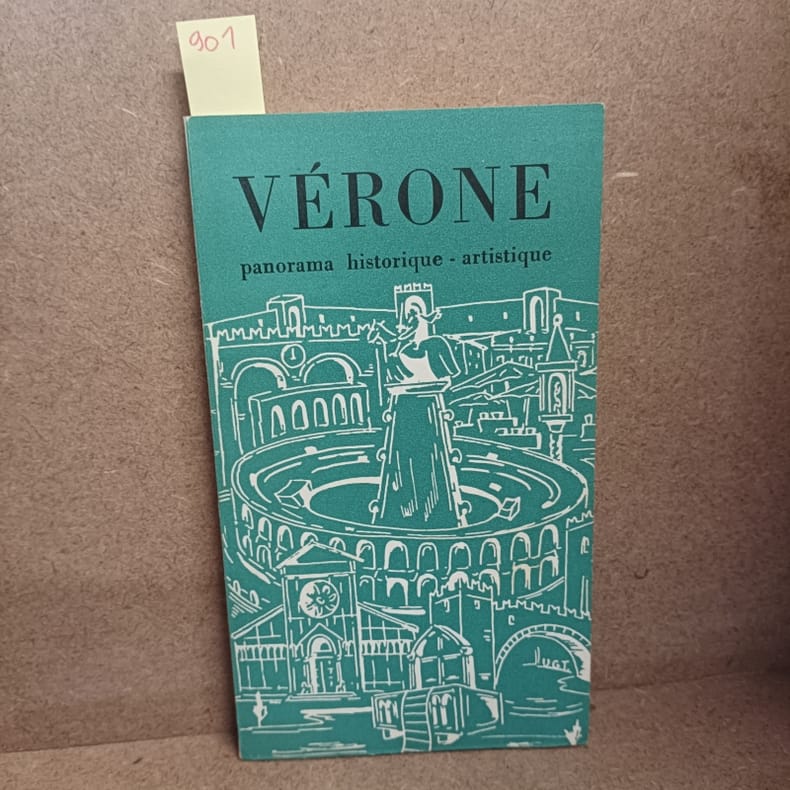
1962réf. 9011962 - broché - Edizioni di Vita Veronese - MCMLXII (1962) - In-12 (19 x 10,5 cm) broché - 101 pages - Nombreuses photographies en noir et blanc - Une carte dépliante in fine - Traduction de Delia Frigo Ragnolini - Titre complet : Vérone. Panorama historique / artistique
réf. SONG0719840996Used: Good unknown
réf. 104.452Lausanne, La Guilde du Livre, 1957 22 x 28, 92 pp., très nombreuses illustrations (photos en N/B), cartonnage souple d'édition + jaquette rempliée, papier cristal d'origine parfaitement conservé, très bon état.
réf. DADAX1588290107New unknown
2006réf. 500327456Milan Jeunesse 2006 25 8x2x18 2cm. 2006. Relié. Ce livre guide les enfants dans leur première découverte des Alpes présentées comme un immense terrain de jeux. Il les emmène à la rencontre de la faune (chamois bouquetins) de la flore des paysages (villages pistes de ski mer de Glace) et des métiers de la montagne à travers des textes instructifs et des activités
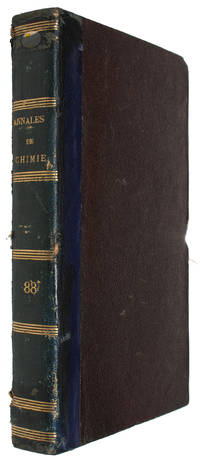
1813réf. 43081Paris, J. Klostermann, 1813. Contemp. hcalf. Spine gilt. A few scratches to binding. In: ""Annales de Chimie, ou Recueil de Mémoires concernant la Chemie"" Tome 88. - 336 pp. (the entire volume offered). Pp. 304-310, 311-318, 319-321 a. 322-329. Scattered brownspots.
1813réf. 43081Paris J. Klostermann 1813. Contemp. hcalf. Spine gilt. A few scratches to binding. In: "Annales de Chimie ou Recueil de Mémoires concernant la Chemie" Tome 88. - 336 pp. the entire volume offered. Pp. 304-310 311-318 319-321 a. 322-329. Scattered brownspots. First printing of this paper announcing the discovery of Iodine. Courtois found this substance which he suspected to be a new element while burning algae in order to obtain sodium and potassium compounds. Although Courtois discovered the element in 1811 the announcement of it was not made until two years later after he had turned it over to Charles Desormés and Nicolas Clément."The first publication on iodine are somewhat confusing. Courtois's research is found in a paper attributed to him the paper offered but actually the work of Clément. was followed by an anonymous article the second paper offered. Gay-Lussac. who repeated and extended Courtios's work was responsible for this paper. Courtois himself published nothing. These two articles were immediately followed by short contributions of Gay-Lussac and Humphry Davy on the new element third and fourth paper offered. Gay-Lussacs views none too flattering to Davy on the history ofthe discovery of iodine appeared in his "Mémoire sur l'iode" 1814."DSB III p. 455. - Weeks "Discovery of the Elements" pp. 257-262.The volume contains further importent papers in chemistry Guyton de Morveau "Sur la chaux maigre" "Sur le dissolvant des pierres biliaires" an importent paper by Chevreul on animal fats "Recherches chimiques sur plusieurs corps gras et particulierement sur leurs combinaisons avec les alcalis" Berzelius's papers "Mémoires sur la compositions des fluides animaux" first edition in French Suite first edition Parmentier etc. etc. unknown
réf. 9646Quatre années dans la Guyane Française 1877-1891. Petit in folio broché, couverture et dos illustrés. Faux-titre, frontispice (L’auteur) sous serpente, titre orné d’une vignette, 614 pages, 98 gravures dans le texte et à pleine page, une grande carte dépliante, en couleurs, en fin de volume. Edition originale. Envoi manuscrit autographe de l’auteur. Librairie Hachette & Cie 1893 rousseurs en début et fin de volume, couverture légèrement frottée, sinon bon exemplaire. Peu courant
réf. 142In 12 carré broché,78 pages, illustrations photographiques hors texte, Edition de la nouvelle revue critique sans date.
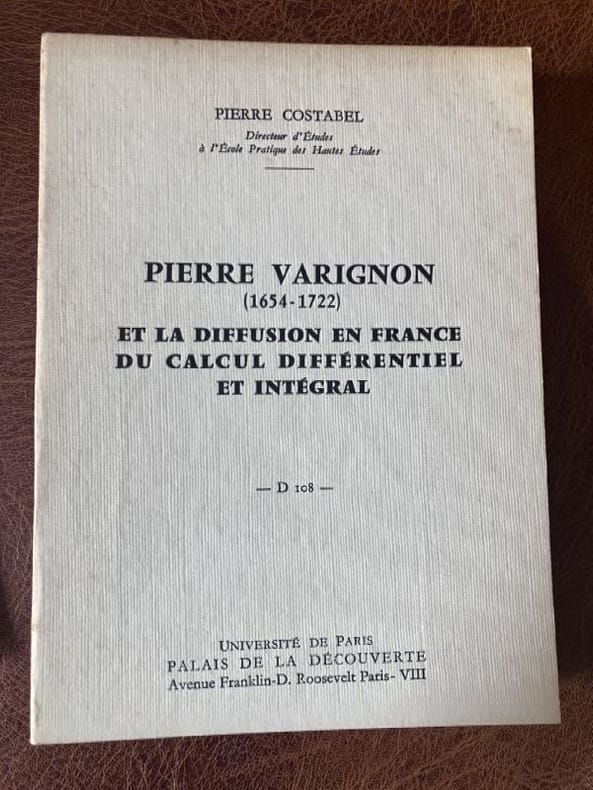
1967réf. 21411967 Paris Université de Paris Palais de la découverte 1955 Un volume in°12 broché 19 pages LR30
1967réf. 21351967 Paris Université de Paris Palais de la découverte 1965 Un volume in°12 broché 28 pages LR30
1993réf. 8602France Loisirs 1993 120 pages 8x20x10cm. 1993. Relié. 120 pages. Henri Cosquer plongeur et inventeur de la grotte éponyme raconte dans ce livre les cinq années de sa vie consacrées à la découverte et à l'exploration de cette grotte sous-marine ornée d'œuvres préhistoriques. Il relate les péripéties de ses recherches les dangers encourus et le moment inoubliable de la découverte
réf. DADAX0879695072New unknown
réf. DADAX0313232075New unknown