Jean ClottesLivre Rare Book

2015réf. VOY4435MRelié, 96 pages, paru le 10 juin 2015 chez Actes Sud, livre en très bon état général.
1983réf. 100148054La Découverte 1983 in8. 1983. Broché.
in-8 carré (22 cm), 108 pages, abondante iconographie, broché. Excellent etat - VG+++ [SO-9]
1869réf. 59086Paris Gauthier-Villars 1869. 4to. In: "Comptes Rendus Hebdomadaires des Séances de L'Academie des Sciences" Tome 68 No 7. Pp. 349- 408. Entire issue offered. Janssen's paper pp. 367-376. First printing of the paper in which Janssen announced the discovery of a new element. On August 18 1868 Janssen managed to do just that. He became the first person to observe helium an element never before seen on Earth in the solar spectrum. At the time though Janssen didn’t know what he’d seen"just that it was something new""Helium the second most abundant element in the universe was discovered on the sun before it was found on the earth. Pierre-Jules-César Janssen a French astronomer noticed a yellow line in the sun's spectrum while studying a total solar eclipse in 1868. Sir Norman Lockyer an English astronomer realized that this line with a wavelength of 587.49 nanometers could not be produced by any element known at the time. It was hypothesized that a new element on the sun was responsible for this mysterious yellow emission. This unknown element was named helium by Lockyer." unknown
1878réf. 44231Paris G. Masson 1878. 8vo. Contemp. hcalf raised bands gilt spine. Light wear along edges. Small stamps on verso of titlepage. In: "Annales de Chimie et de Physique" 4e Series - Tome 15. 512 pp. a. 3 folded engraved plates. The entire volume offered. Janssen's memoir: pp. 414-426. First appearance of this milestone paper in chemistry physics and astronomy announcing the discovery of the helium lines in the spectrum of the sun. It was Lockyer in the same year that named it 'helium' for Helios the Greek God of the Sun. Helium was not discovered on the earth before 1895 by William Ramsay and it was Crookes who established its identity with the helium Janssen and Lockyer observed in the spectrum of the sun."He Janssen met immortality by travelling to India in 1868 to study the total eclipse. It was then that he observed the helium line and forwarded the spectral data to ockyer. He also noted the size of the solar prominences. The day after the eclipse he attempted to take their spectra again and succeeded despite the absence of the obscuring moon. he then announced jubilantly that it was the day after the eclipse that was the real eclipse day for him. Lockyer also reported this method of studying prominences without an eclipse.Like Lockyer he lived to see his observation of the helium line vindicated by Ramsay's discovery of that element on earth."Asimov."This the discovery of helium lines in the sun by Lockyer was announced on the same day by the French astronomer Janssen who was in India observing a total eclipse. As a result the French government some ten years later struck a medallion showing the heads of both scientists.By that time the two men had made a much more dramatic discovery at the same time this time in cooperation. Janssen studying the spectrum ofthe sun during the eclipse had noted a fine line he did not recognize. he send a report on this to Lockyer an acknowledges expert on solar spectra. Lockyer compared the reported position of the line with lines of known elements concluding that it must belong to a yeat unknown element possibly not even existing on the earth. He named the element from the Greek word for the sun."Asimov.Parkinson "Breakthroughs" 1868 A. - The volume contains other notable papers by Dumas Berthelot et al. hardcover
réf. 61128aafAmsterdam, Scheltens & Giltay, n.d., in-4to, 240 p. + photogr. plates, orig. clothband.
1970réf. 6631970 - broché - Editions François Maspero - Collection La Découverte - 1970 - Fort in-8 (24 x 16 cm) broché, couverture à rabats - 600 pages
2007réf. ART5753MPaperback, 240 pages, published by British Museum Press in 2007, very good conditions.
1831359p. + Plus engraved half title, full page engravings and a folding map, torn with an old repair. XLib. Damp stained. Age stained. 12mo. Original half leather marbled boards. Joints tender. Black library tape on lower spine. First American Edition. AFRICA/2
1836359p. + Plus engraved half title, full page engravings and a folding map. Foxed. 12mo. Disbound. AFRICA/6
1833359p. + Plus wood engraved half title, full page engravings and a folding map, on light paper. an old repair. Foxed. 16mo. 160 mm. Original Harper's printed cloth binding (with the date 1834 on the front cover), stained and worn, with old spine repairs. Good. AFRICA/6.
1523réf. 177781523 broché - 15x23.5 - 379pp - éditions FAYARD - 19991
réf. 3587pendant son voyage dans l’Inde 1828-1832 précédée d’une étude sur JACQUEMONT par CUVILLIER-FLEURY, nouvelle édition augmentée de lettres et fragments inédits et Correspondance inédite de V JACQUEMONT avec sa famille 1824-1832 précédé d’une notice biographique par V JACQUEMONT neveu et d’une introduction par Prosper MERIMEE. 2 tomes en 2 volumes in 12 demi-cuir vert,titre,filets dorés;faux-titre,pas de page de titre,XXXV,455pages,faux-titre,tire,364 pages,Calmann Levy 1885,des rousseurs.On joint Correspondance inédite de V JACQUEMONT avec sa famille 1824-1832 précédé d’une notice biographique par V JACQUEMONT neveu et d’une introduction par Prosper MERIMEE. volume 1 seul in 12 reliure identique faux-titre,titre, XVI 390 pages,Calmann Levy 1885.rousseurs."Jacquemont(1801-1832)était médecin;chargé par le Muséum d'histoire naturelle d'une mission, il visita le nord de l'Inde (Bénarès, Dehli, Agra,le Pendjab,le Cachemire)et mourut à Bombay de maladie en 1832.Cette correspondance eut un énorme succès, y compris en Angleterre;on a là une des premières descriptions modernes et réalistes de l'Inde." Sans la carte annoncé.Les trois volumes
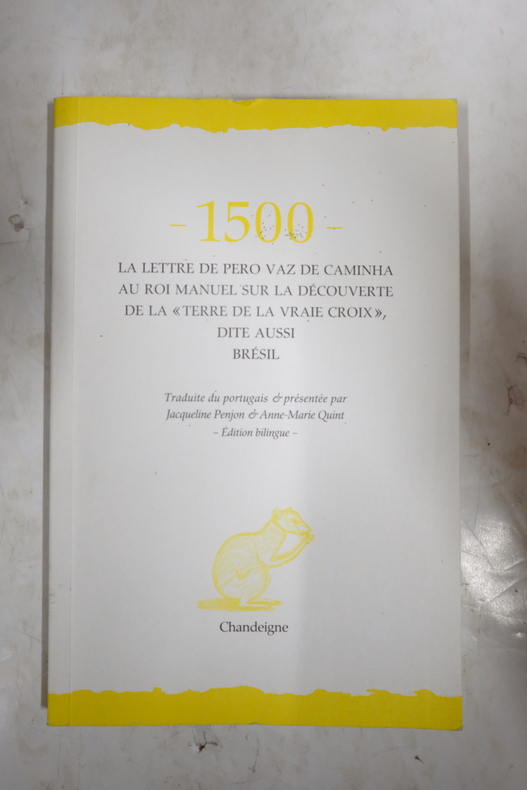
2011réf. VOY4433MBroché, 96 pages, paru en 2011 chez Chandeigne, livre en très bon état général. Nous avons d'autres exemplaires des éditions Chandeigne, retrouvez les dans notre catalogue grâce au mot-clé "Chandeigne".
réf. 3491In 8 demi-chagrin rouge à 4 nerfs et à coins,titre,fer, roulette dorés.filet à froid sur les plats,faux-titre, titre,deux parties en un volume,pagination continue, 288 pages,259 héliogravures dans le texte et pleine page.Première partie faux-titre,titre jusqu'à la page 154 deuxième partie faux-titre, titre, jusqu'à la page 288,couvertures en couleurs de Louis GARIN conservée, Arthaud 1944.rousseurs éparses,fortes à certaines pages,inexistantes à d'autres.sinon très bon état,bien relié; Pas de carte.
2007réf. 16700Michel Lafon 2007 279 pages 15x23x3cm. 2007. Broché. 279 pages. La découverte l'enquête et les preuves qui pourraient bien changer l'Histoire
1995VHS video tape in case. "A plea - particularly to prospective parents and adoption agencies in developed countries - to fully understand the complicated process of international adoption." - from case. Running Time: 1 hour. Above-average wear. Usual library markings Book
2023réf. 6808Chez l'auteur 2023 40 pages in4 a l'italienne. 2023. broché. 40 pages. Livre de dessins de Jean-Claude Vangierdegom hommage illustré à la commune de Grignan célébrant son patrimoine architectural et historique notamment le château le village et la figure de la marquise de Sévigné
réf. 1331911052.Gpaperback. Good. Access codes and supplements are not guaranteed with used items. May be an ex-library book. paperback
réf. 90616Paris, Edition G.P./Presses de la Cité, 1976. 22 x 27, 109 pp., nombreuses illustrations en couleurs, reliure d'édition carton illustré, très bon état.
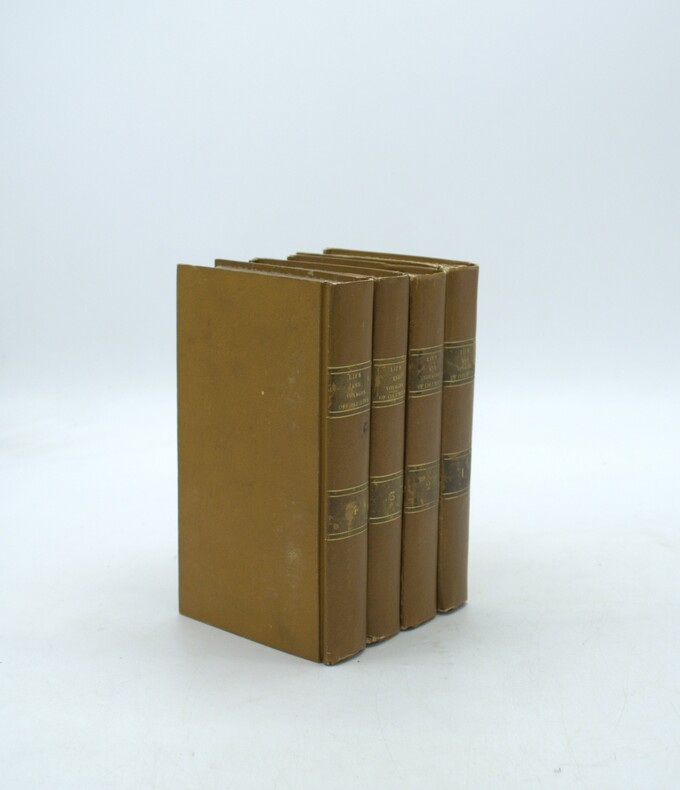
1828réf. PHO-2111Paris, Baudry, 1828. 4 volumes in-8 (18,5 x 10,5 cm), reliés plein cartonnage d’époque, dos lisse avec pièces de titre et tomaison, quelques frottements aux pièces, coins légèrement usés, très peu de rousseurs. Illustré d’une carte dépliante en frontispice du premier volume.
réf. 055088Paris Akademos 2011 in 8 (24x16) 1 volume broché, couverture à rabats illustrée en couleurs, 314 pages [2], avec 16 pages d'illustrations en couleurs in fine. Institut de France, Conférence nationale des Académies des Sciences, Lettres et Arts. Bel exemplaire
réf. 0887290280New. paperback. New. Satisfaction Guaranteed or your money back. paperback
1780réf. 53319Paris, Théophile Barrois, 1780. 8vo. Fine cont. full mottled calf, richly gilt spine and gilt titlelabel in red leather. Edges gilt. LXVIII,333,(3) pp. and 1 folded engraved plate (showing his experimental apparatus). Light browning to margins of title-page, otherwise clean and with broad margins. A fine copy.
1780réf. 53319Paris Théophile Barrois 1780. 8vo. Fine cont. full mottled calf richly gilt spine and gilt titlelabel in red leather. Edges gilt. LXVIII3333 pp. and 1 folded engraved plate showing his experimental apparatus. Light browning to margins of title-page otherwise clean and with broad margins. A fine copy. First French edition of perhaps the most important work in plant physiology. It is in this work that Ingen-Housz for the first time expounds the ideas and experiments that lead to his discovery of Photosynthesis in plant life and as such it is of fundamental importance in the economy of living things. "His Experiments upon vegetables was published in the autumn of 1779 and was at once recognized as a very important advance. In brief he showed that oxygen evolution by plant is absolutely dependent on light and that it only occurs from those parts which are green.The proof that light and green tissues are both essential for oxygen production finally cleared up the apparent contradictions and variable results of earlier experiments. Priestly was "much pleased" with Ingen-Housz's experiments and pointed immediately to the salient facts that he had established." A.G. Morton: History of Botanical Science. p. 332. Dibner: Heralds of Science No. 29. - Garrison & Morton No. 103. - Horblit No. 55. All the English edition of 1779. hardcover