2.344 Ergebnisse
Best.-Nr. 6226Paris, La Table Ronde, 1964 14 x 20, 374 pp., cartes N/B, broché, bon état
Best.-Nr. 13554aafSpezed (Bretagne), Keltia graphic, 1990, in-8°, 450 p. + 48 p. (Index), envoi manuscr. de l’auteur sur faux-titre, brochure originale illustrée.
1966Best.-Nr. 13209Presses Universitaires de France 1966 125 pages in12. 1966. broché. 125 pages. Cet ouvrage de la collection 'Que sais-je ?' présente une synthèse des connaissances sur les groupes sanguins. Il retrace leur découverte explique leur nature biochimique et sérologique et aborde leur mécanisme d'hérédité ainsi que les techniques usuelles d'immuno-hématologie
1972347 pages. Originally published in 1872. "One of the most readable and colourful early accounts of life on the Northwest Coast." - from dust jacket. Average wear. Unmarked. Dust jacket now preserved in Brodart cover. Binding tight. A sound copy. Book
1967Best.-Nr. 21341967 Paris Université de Paris Palais de la découverte 1966 Un volume in°12 broché 22 pages LR30
1929Best.-Nr. CCC000f1Mb. Edition Ancienne librairie Roger RIOU-QUERNE, 1929. Couverture souple. État : Assez bon. Broché, in-8 (18.5 X 12.5 cm), 354 pages. Scènes vécues, illustrées d'après photos saisies par l'auteur, ces dernieres sont en noir/blanc hors texte. Ancienne librairie Roger Riou-Querné. Quelques rousseurs, couverture légèrement tachée, coins cornés, ouvrage a faire relié. Photos possibles.
1958Best.-Nr. 12390BUCHET/CHASTEL 1958 295 pages in8. 1958. broché. 295 pages. L'ouvrage de Walter Brant explore la vie et la pensée des Esséniens à la lumière de la découverte des manuscrits de la Mer Morte en 1947. L'auteur pose la question des rapports entre Jésus-Christ et cette secte en tentant de répondre à des questions nouvelles et essentielles suggérées par cette découverte
Best.-Nr. 12493In 12 pleine toile rouge, titre, caissons à froid. Faux-titre, frontispice sous serpente, titre 333 pages. Pris Librairie LECOFFRE ancienne Maison PERISSE Frères LECOFFRE & Cie successeur 1869.
1964Best.-Nr. Reg5713,9 cm X 21,9 cm, 96 pp, couverture souple illustrée. 59 illustrations photographiques N&B hors le texte.
1967Best.-Nr. 21391967 Paris Université de Paris Palais de la découverte 1961 Un volume in°12 broché 45 pages LR30
1983Best.-Nr. 5935Éditions La Découverte/Maspero 1983 63 pages in8. 1983. broché. 63 pages.
Best.-Nr. 8082Promenades aux Etats-Unis et aux Antilles.In 12 demi-cuir fauve, dos lisse,longs filets à froid, filets, roulette, titre dorés ;préface de M H.H.VILLEMASSANS,titre,VIII,304 pages,Alexandre Cadot 1856,édition originale,rousseurs habituelles,principalement concentrées en marges, mouillure angle supérieur droit page 243,marge extérieure plus courte, pages 131 à 134.Relation de la tournée en Amérique de la comédienne RACHEL
Best.-Nr. 2090502113702419Not Available N.A. Soft Cover. Fine. The book is in fine condition. Not Available paperback
1923Best.-Nr. 1188821923 Editions Calmann-Lévy - 1923 - In-12, broché - 370 p.
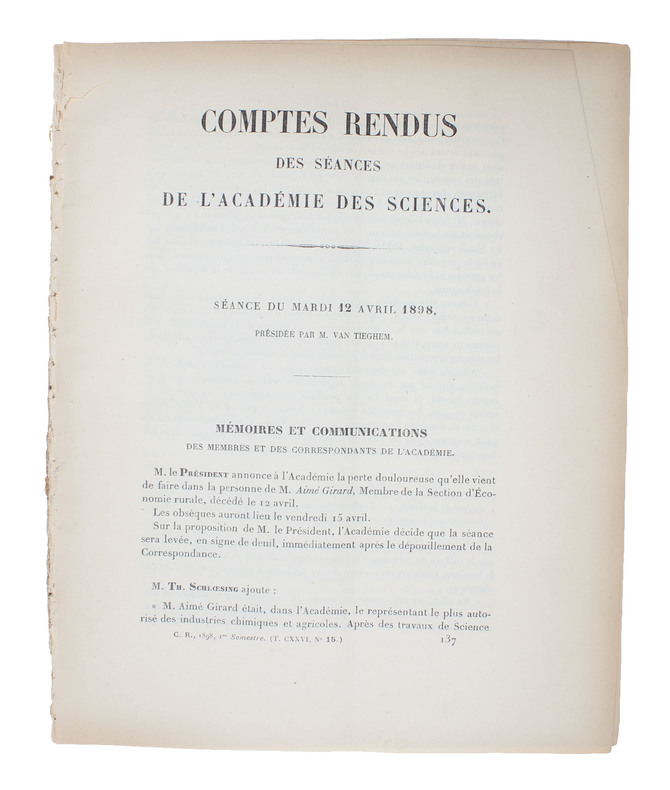
1898Best.-Nr. 46852Paris Gauthier-Villars 1898. 4to. No wrappers. In: "Comptes Rendus Hebdomadaires des Séances de L'Academie des Sciences" Tome 126 No 15. Entire issue offered. With htitle and titlepage to vol. 126. Pp. 1059-1110. Curie's paper: pp. 1101-1103. First printing of this milestone paper being the first "Note" from Marie Curie about "radioactivity". This same "Note" contains a the fundamental observation: "Two uranium ores. are much more active than uranium itself. This fact. leads one to believe that these ores may contain an element much more active than uranium." This paper gives the first proof of the fact that radiation is an atomic property."Henri Becquerel discovered 1896 that uranium salts shielded from light for several months spontaneously emit rays related in their effects to Roentgen rays. Mme. Curie became enthusiastic about this subject filled with the unknown and as she later acknowledged involving no bibliographic research.The first step in the research was to determine whether there existed other elements capable like uranium of emitting radiation. Abandoning the idea of hyperfluorescence couldn’t one calculate by electrical measurement the effects on the conductivity of air that were revealed by the gold-leaf electroscope Pierre Curie and his brother Jacques had constructed an extremely sensitive apparatus to measure weak currents; Mme. Curie employed it in testing both pure substances and various ores. In her first "Note" in the Comptes rendus"de l Académie des sciences 12 April 1898 she described the method that she followed throughout her life the method that enabled her to make comparisons through time and crosschecks with other techniques:"I employed. a plate condenser one of the plates being covered with a uniform layer of uranium or of another finely pulverized substance diameter of the plates eight centimeters; distance between them three centimeters. A potential difference of 100 volts was established between the plates. The current that traversed the condenser was measured in absolute value by means of an electrometer and a piezoelectric quartz. In general she preferred the zero method in which the operator compensates for the current created by the active material by manipulating the quartz. All of her students followed this procedure."DSB.The first results came in 1898: the measurements varied between 83 × 10-12 amperes for pitch blende to less than 0.3 × 10⁻¹² for almost inactive salts passing through 53 × 10-12 for thorium oxide and for chalcolite double phosphate of uranium and copper. Thorium would thus be "radioactive" the term is Mme. Curie’s; its radioactive properties were discovered at the same time independently by Schmidt in Germany. unknown
1898Best.-Nr. 46852Paris, Gauthier-Villars, 1898. 4to. No wrappers. In: ""Comptes Rendus Hebdomadaires des Séances de L'Academie des Sciences"", Tome 126, No 15). Entire issue offered. With htitle and titlepage to vol. 126. Pp. 1059-1110. Curie's paper: pp. 1101-1103.
196498 pages. Text in French. Features: Le miracle est devant nous; Chine - un document exceptionnel; Ma decouverte de l'oreopitheque; Ou en est le niveau de vie des Francais; Le combat desespere des Kurdes; L'existence d'une famille roumaine en 1964; Les enfants martyrs du divorce; L'objet-cathedrale par le nouveau Roman; Que se passe-t-il au chateau d'Oublaisse?; L'homme qui reconcilie l'Art et la Science; Les 10 meilleurs restaurants exotiques; Les secrets de Roger Vailland. Printed on glossy stock. Profusely illustrated in colour and black and white. Average wear. Unmarked. A sound vintage copy. Book
1949Best.-Nr. 3133033Manchester: Manchester University 1949. 38 Seiten. Gr. 8° (22,5-25 cm). Orig.-Broschur. [Softcover / Paperback].
1809Best.-Nr. 50198Paris Mad. Ve Barnard 1809. Contemp. hcalf. Spine gilt. Wear to top of spine. A few scratches to binding. Small stamps on verso of titlepage.In: "Annales de Chimie ou Recueil de Mémoires concernant la Chemie" Tome 70. 336 pp. Entire volume offered. Davy's paper: pp. 189-254. First edition in French the first English 1808 of this importent historical paper in chemistry in which Davy shows that electricity is capable of decomposing some alkalies isolating two new substances and discovering potassium and sodium. Neville in his Historical Chemical Library vol. I p.340 writes about this paper "ONE OF THE GREAT CLASSIC RESEARCHES IN CHEMISTRY in which Davy announced in this his second Bakterian lecture the isloation of metallic potassium and sodium by the electrolytic decomposition of their fused oxides.""He Davy began his own electrical experiments.The results were spectacular. On October 6 1807 the current passing through molten potash liberated a metal which Davy called potassium. The little globules of shining metal tore the water molecule apart as it eagerly recombined with oxygen and the liberated hydrogen burst into lavender flame. Davy danced about in a delirium of joy. A week later he isolated sodium from soda."Asimow. The paper offered here describes these discoveries."Humphry Davy was one of the most brilliant chemists of the early nineteenth century. His early study of nitrous oxide brought him his first reputation but his later and most importent investigations were devoted to electrochemistry. Following Galvani's experiments and the discovery of the voltaic pile interest in galvanic electricity had become widespread. The first electrolysis by means of the pile was carried out in 1800 by Nicholson and Carisle who obtained oxygen and hydrogen from water. Davy began to examine the chemical effects of electricity in 1800 and his numerous discoveries were presented in his Bakerian lecture to the Royal Society on November 20 1806. A Source Book in Chemistry p. 243. unknown
1832Best.-Nr. 44145Paris Crochard 1832. Contemp. hcalf. gilt spine light wear along edges. In: "Annales de Chimie et de Physique Par MM. Gay-Lussac et Arago." tome 50 Series 2. Entire volume offered. 448 pp. 2 folded engraved plates. Faraday's papers: pp. 5-67 a. pp. 113-162. First French editions of the 2 first memoirs of Faradays groundbreaking researches on electricity constituting the first 2 papers of his "Experimental Researches in Electricity" and containing his fundamental discovery of electromagnetic induction THE FOUNDATION OF NEARLY ALL THE ELECTRICITY IN USE TODAY. In 1820 Oersted had generated magnetism from electricity Faraday here finds the opposite effect generating electricity by magnetism. He also described the first electrical generator second paper. THESE PAPERS ARE SOME OF THE GREAT CLASSICS OF CHEMISTRY AND PHYSICS."Faraday demonstrated this theory involving the lines of force.by inserting a magnet into a coil of wire attached to a galvanometer. While the magnet was being inserted or removd current flowed through the wire. If the magnet was held stationary and the coil moved over it one way or the other there was current in the wire. In either case the magnetic lines of force about the magnet were cut by the wire.If the magnet and coil were both held motionless whether the magnet was within the coil or not there was no current.Faraday hd thus discovered electricalinduction.It was to lead to great things but this was not apparent."Asimov."Although his discovery of the electric motor and the dynamo was almost entirely identical to his theoretical discoveries it laid the foundation of the modern electrical industry - electric light and power teælephony wireless telegraphy televison etc. - by providing for the production of continous mechanical motion from an electrical source and vice versa." PMM 308.Horblit 29 - Milestones 62. - Dibner 64. - PMM 308. unknown
1832Best.-Nr. 48987Paris Crochard 1832. Contemp. hcloth gilt lettering to spine. In: "Annales de Chimie et de Physique Par MM. Gay-Lussac et Arago." tome 50 Series 2. Entire volume offered. 448 pp. 2 folded engraved plates. Faraday's papers: pp. 5-67 a. pp. 113-162. Some scattered brownspots. First French editions of the 2 first memoirs of Faradays groundbreaking researches on electricity constituting the first 2 papers of his "Experimental Researches in Electricity" and containing his fundamental discovery of electromagnetic induction THE FOUNDATION OF NEARLY ALL THE ELECTRICITY IN USE TODAY. In 1820 Oersted had generated magnetism from electricity Faraday here finds the opposite effect generating electricity by magnetism. He also described the first electrical generator second paper. THESE PAPERS ARE SOME OF THE GREAT CLASSICS OF CHEMISTRY AND PHYSICS."Faraday demonstrated this theory involving the lines of force.by inserting a magnet into a coil of wire attached to a galvanometer. While the magnet was being inserted or removd current flowed through the wire. If the magnet was held stationary and the coil moved over it one way or the other there was current in the wire. In either case the magnetic lines of force about the magnet were cut by the wire.If the magnet and coil were both held motionless whether the magnet was within the coil or not there was no current.Faraday hd thus discovered electricalinduction.It was to lead to great things but this was not apparent."Asimov."Although his discovery of the electric motor and the dynamo was almost entirely identical to his theoretical discoveries it laid the foundation of the modern electrical industry - electric light and power teælephony wireless telegraphy televison etc. - by providing for the production of continous mechanical motion from an electrical source and vice versa." PMM 308.Horblit 29 - Milestones 62. - Dibner 64. - PMM 308.The volume contains further notable papers. Elie de Beaumont "Zweiter geologischer Brief.an A.v. Humboldt über die relative Alter der Gebirgszüge" pp. 1-58 a. 2 plates one handcoloured papers by Döbereiner E. Lenz Moser Mitscherlich de Saussure J. Dumas F.E. Neumann Gay-Lussac Johannes Müller "Beobachtungen zur Analyse der Lymphe des Bluts und des Chylus" pp. 513-590. hardcover
1848Best.-Nr. 49336Paris Victor Masson 1848 a. 1851. 8vo. 2 contemp. hcalf raised bands gilt spine. Light wear along edges. Small stamps on verso of titlepages and on verso of 1 plate. In "Annales de Chimie et de Physique" 3me Series - Tome XXIV and XXXI. 6512 pp. and 2 plates 512 pp. a. 4 plates.2 entire volumes offered. Pasteur's papers: pp. 442-459 a. pp. 459-460 1 double-page folded engraved plate pp. 67-102 a. 1 plate. Some scattered brownspots to first part of the first volume not affecting P's papers. First full exposition of Pasteur's momentous and revolutionary discovery of "molecular assymetry" and founding the science of Polarimetry.The discovery was first announced by Pasteur in may 1848 by the printing of the preliminary report of only 4 short pages in order to establish priority. The announcement - 4 pages - was published in Comptes rendus hebdomadaires de l’Académie des Sciences Paris Seance of May 15 1848 26 21 535-538 Published on May 1848."In 1848.Pasteur studied the crystals of tartrates one of the substances that exhibited the now-clockwise now-counterclockwise effect under the microscope and found that the crystals were mirror images of the others. The two crystals resembled each other as a right-hand glove resembles a left-hand glove.This was a revolutionary discovery and it took some courage to announce it. A few years before the well-known chemist Mitscherlich had studies the same tartrate crystals and declared them all to be identical. Pasteur was only a twenty-sic-year-old unknown. neverthelless he announced his findings and went before Biot to repeat the separation ofthe crystals before the eyes of the aged authority in the field. Biot was convinced and Pasteur received the Rumford medal of the Royal Society for his work.Pasteur had thus founded the science of polarimetry in which the measurements of the manner in which the plane of polarized light was twisted could be used to help to determine the structure of organic substance to follow various chemical reactions and so on."Asimov. Leicester & Klickstein "A Source Book of Chemistry" p. 374-379. hardcover
1839Best.-Nr. 47232Paris Bachelier 1839. 4to. No wrappers. In: "Comptes Rendus Hebdomadaires des Séances de L'Academie des Sciences" Tome VIII No 13. Pp. 459- 504. Entire issue offered. Piria's paper: pp. 479-485. First apperance of a main paper in pharmacology describing the discovery of Salicylic acid compound giving it the empirical formula C7H6O3. It is the most successful drug in history. A trillion tablets are consumed every year. Used to treat everything from headaches to heart disease from rheumatism to cancer - scientists are still struggling to understand all its qualities. But aspirin can truly claim the title of wonder drug.Raffaele Piria 20 August 1814 - 18 July 1865 an Italian chemist from Scilla who converted the substance Salicin into a sugar and a second component which on oxidation becomes salicylic acid a major component of an analgesic drug Aspirin acetylsalicylic acid.Garrison & Morton No 1857. unknown
1831Best.-Nr. 49604Paris Crochard 1831. Contemp. hcloth. Some scattered brownspots. "Annales de Chimie et de Physique" 2. Series Tome 48. 448 pp. 1 engraved plate. Entire volume offered. Soubeiran's paper: pp. 113-157. Scattered brownspots. First appearance of an importent paper in chemistry and medicine as it for the first time relates the finding of Chloroform which some years later was proved to have anaesthetic effects and was introduced in chirurgy in 1848 by Simpson.Justus von Liebig Souberain and Guthrie independently discovered Chloroform in 1831 but Souberain was the first to publish his results. Garrison & Morton No. 1851. - Gedeon "Science and Technology in Medicine" 36.7.The volume contains other notable papers by LIEBIG DUMAS DUTROCHET WÖHLER LECANU BECQUEREL etc. hardcover
1831Best.-Nr. 43365Paris Crochard 1831. No wrappers as extracted from "Annales de Chimie et de Physique" 2. Series Tome 48. Titlepage to vol. 48. Pp. 113-157. A few brownspots but fine. Small stamps on verso of titlepage. First appearance of an importent paper in chemistry and medicine as it for the first time relates the finding of Chloroform which some years later was proved to have anaesthetic effects and was introduced in chirurgy in 1848 by Simpson.Justus von Liebig Souberain and Guthrie independently discovered Chloroform in 1831 but Souberain was the first to publish his results. - Garrison & Morton No. 1851. - Gedeon "Science and Technology in Medicine" 36.7. unknown