WOELMONT Arnold(de)Livre Rare Book

2.284 Ergebnisse
Best.-Nr. 6229in 12 broché,faux-titre,titre,265 pages,en partie non coupé.E.Plon & Cie 1883 rousseurs éparses,sinon Très bon état
Best.-Nr. 8982Nouvelle édition revue et augmentée, enrichie de notes scientifiques par M. François ARAGO et précédée d’une introduction par M. Jules JANIN Deux tomes en un volume in 8 demi-chagrin marron à nefs, titre, roulette, caissons dorés. Plats percaline, triple filet à froid en encadrement. Tome 1 : faux-titre, frontispice gravé sous serpent. Portrait de Jacques ARAGO. Titre général illustré, titre orné d’une vignette, XII, 449 pages, notes scientifiques, XXVIII et 2 pages de table des matières. Tome 2 : faux-titre, portrait gravé de François Dominique ARAGO en frontispice, sous serpente. Titre orné d’une vignette, 439 pages, XXII, notes scientifiques, 2 pages de table des matières, tranches dorées. 22 gravures hors-texte, 150 gravures dans le texte. Paris H. Lebrun éditeur, Garnier Frères sans date rousseurs éparses plus ou moins fortes, dorure éclatante
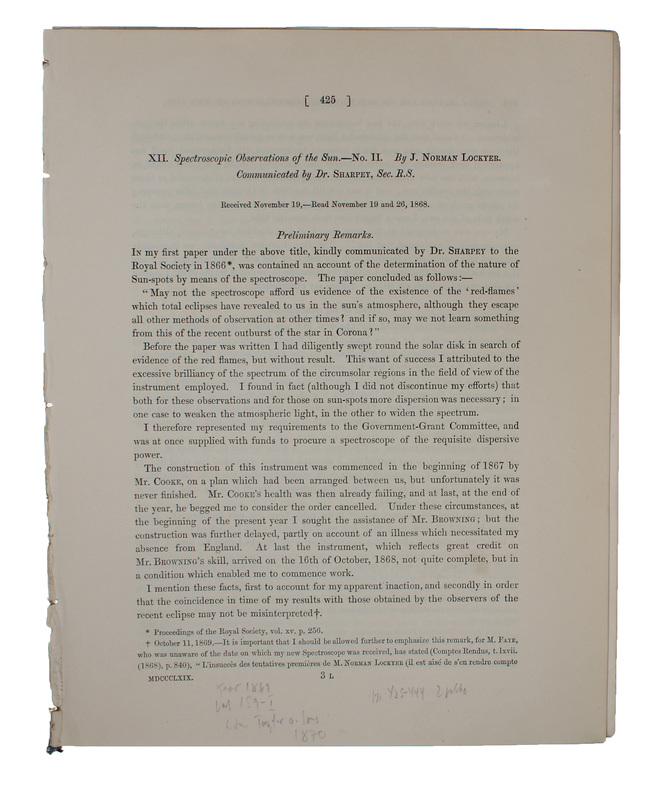
1870Best.-Nr. 42423London Taylor and Sons 1870. 4to. No wrappers as extracted from "Philosophical Transactions" 1869 Vol. 159 - Part I. Pp. 425-444 and 2 lithographed plates 1 with the spectrum of helium 1 with his spectroscope not requiring eclipses to function. Clean and fine. First appearance of this milestone paper in chemistry physics and astronomy announcing the discovery of helium in the sun and naming it 'helium' for Helios the Greek God of the Sun. In the same paper he demonstrates his invention of the spectroscope by which the prominences of the sun could be observed and studied without an eclipse by leading the light from the very edge of the sun through a prism. - Helium was not discovered on the earth before 1895 by William Ramsay and it was Crookes who established its identity with the helium Lockyer observed in the spectrum of the sun."This the last discovery was announced on the same day by the French astronomer Janssen who was in India observing a total eclipse. As a result the French government some ten years later struck a medallion showing the heads of both scientists.By that time the two men had made a much more dramatic discovery at the same time this time in cooperation. Janssen studying the spectrum ofthe sun during the eclipse had noted a fine line he did not recognize. he send a report on this to Lockyer an acknowledges expert on solar spectra. Lockyer compared the reported position of the line with lines of known elements concluding that it must belong to a yeat unknown element possibly not even existing on the earth. He named the element from the Greek word for the sun."Asimov. unknown
1870Best.-Nr. 42423(London, Taylor and Sons, 1870). 4to. No wrappers as extracted from ""Philosophical Transactions"" 1869, Vol. 159 - Part I. Pp. 425-444 and 2 lithographed plates (1 with the spectrum of helium, 1 with his spectroscope (not requiring eclipses to function)). Clean and fine.
2004Best.-Nr. G1410303799I3N10Cengage Gale 2004. Hardcover. Good. Disclaimer:Dust jacket quality is not guaranteed. Cengage Gale hardcover
1978xvi, [2], 122 pages. Footnotes, bibliography. index. Illustrated in black and white. "A landmark book in American Indian ethnology, this book presents traditional creation stories of Indian tribes and is the first to bring an American Indian point of view to the theory of the origin of human life. Draws directly on oral tradition collected by the author from Indian elders and spiritual leaders during more than two decades of travel throughout North America." - dust jacket. Contents clean, bright and unmarked. Average wear and soiling to dust jacket which bears some soiling to front panel and is now preserved in mylar. A sound copy of this valuable contribution to American Indian studies, anthropology, comparative religion, and other fields. Book
1880pp. iv, 714 + Plus portrait frontis. Numerous full page wood engravings. Foxed. Some signatures loose. Penciled ownership of Percy Schock. 8vo. Original full green cloth binding, embossed in gold and black. Binding somewhat worn and spotted. SCARCE. **PRICE JUST REDUCED! AFRICA/5
Best.-Nr. 31328Bruxelles, Office de Publicité, 1955. 17 x 24, 220 pp., broché, état neuf.
Best.-Nr. 125864780X.Gpaperback. Good. Access codes and supplements are not guaranteed with used items. May be an ex-library book. paperback
2000Best.-Nr. 25941NY: Margaret K. Mcelderry Books. Near Fine in Fine dust jacket. 2000. Hardcover. 0689839871 . Illustrated by Robert Andrew Parker. First printing. About fine in a fine dust jacket. . Margaret K. Mcelderry Books hardcover books
1990570 pages including index and numerous archival black and white photographic plates. Author's signature and inscription inside front cover. An extraordinary blend of narrative history, personal recollections, and oral testimony. Presents a panoramic history of Asian Americans. "...Effortlessly weaves the stories of thousands of Japanese, Chinese, Korean, Filipino, Indian, Vietnamese, Cambodian, and Laotian Americans into a single tale of discovery, endurance, and courage." - San Francisco Chronicle. Average wear. Contents unmarked. Light yellowing at edges. Price sticker remnants upon back cover. Book
1944Best.-Nr. 528971944 Les Editions J. Susse, collection "Grands Marins et Pionniers" - 1944 - In-8, broché couverture illustrée par R. Marmottin - 24 pages - Belles illustrations couverture et in-texte de Marmottin
1886Best.-Nr. 13894Turin Ermanno Loescher 1886 Plaquette Grand In-12 48 pp, rares rousseurs éparses, dos muet et fine coupure sans manque en tête.
1878Best.-Nr. 48210Paris Gauthier-Villars 1878. 4to. No wrappers. In: "Comptes Rendus Hebdomadaires des Séances de L'Academie des Sciences" Tome 87 No 17. Pp. 570- 616. Entire issue offered. Marignac's paper: pp. 578-581. First apperance of the paper relating Marignac's discovery of the rare earth Ytterbium Ytterbia."He began his study of the rare earths in 1840 when he was barely twenty-three years old. According to P.T. Cleve "Marignac's work on the rare earths is undoubtedly the most importent in this particular department of chemistry". In 1878 marignac heated some erbium nitrate obtained from gadolinite until it decomposed. When he extracted the resulting mass with water he obtained two oxides: a red one for which he retained the name Erbia and a colorless one which he named Ytterbia." Weeks "The Discovery of the Elements".Parkinson "Breakthroughs" 1878 C unknown
1879Best.-Nr. 47273Paris Gauthier-Villars 1879. 4to. No wrappers. In: "Comptes Rendus Hebdomadaires des Séances de L'Academie des Sciences" Tome 88 No 12. Pp. 625- 676. Entire issue offered. Nilson's papers: pp. 642-645 a. 645-648. First leaf with a tear to right margin no loss of paper. First apperance of the papers in which Nilson describes his discovery of a new element and its properties and naming it Scandium. It was the second new element found after Mendeleev's prediction of its existence as "Eka-Boron"."Mendeléeff had predicted that another element which he called eka-boron and which he said would have an atomic weight between 40 calcium and 48 titanium would some day be revealed. It was discovered in 1879 by Lars Fredrik Nilson. Nilson extracted 63 grams of the rare earth erbia from gadolinite and euxenite and converted it into the nitrate. Upon decomposing this salt by heat as Marignac had done he obtained some very pure ytterbia and to his great surprise an earth that was unknown to him.Upon thoroughly investigating this new earth he found that it contained an element whose properties concided almost exactly with those Mendeléef had predicted for ekaboron. Nilson called it scandium in honour of his fatherland."Weeks "Discovery of the Elements" pp. 219-20.Parkinson "Breakthroughs" 1879 C. unknown
1878Best.-Nr. 48210(Paris, Gauthier-Villars), 1878. 4to. No wrappers. In: ""Comptes Rendus Hebdomadaires des Séances de L'Academie des Sciences"", Tome 87, No 17. Pp. (570-) 616. (Entire issue offered). Marignac's paper: pp. 578-581.
1879Best.-Nr. 47273(Paris, Gauthier-Villars), 1879. 4to. No wrappers. In: ""Comptes Rendus Hebdomadaires des Séances de L'Academie des Sciences"", Tome 88, No 12. Pp. (625-) 676. (Entire issue offered). Nilson's papers: pp. 642-645 a. 645-648. First leaf with a tear to right margin, no loss of paper.
1808Best.-Nr. 43299Paris Chez Mad. Ve. Bernard 1808 Contemp. hcalf. gilt spine. Some scratches to binding. Verso of titlepage and plates with small stamps.In: "Annales de Chimie" Vol. 68. - 358 pp. a. 3 engraved plates. The entire volume offered. Gay-Lussac's a. Thenard's paper: pp. 169-174. First announcement of the results that they had obtaines by treating boric acid with potassium showing that acid is composed of a combustible substance and oxygen. "Before regarding their proof of the existance of a new element as complete Gay-Lussac and Thenard wished not only to decomposed boric acid but to recompose it. On November 30 of the same year they were able to state in the 'Annales de Chemie et de Physique" the paper offered that "the composition of boracid s no longer problematical. In fact said they "we decompose and we recompose this acid at will" Weeks "Discovery of the Elements" p. 160. - Parkinson "Breakthroughs" 1808 C. - Bunch 1808.The volume contains other importent paper Davy's famous paper on electrolysis in first French translations Gayton-Morveau"Description d'un hygrometre pour le gaz." d¨'Arcet "Observations sur la potasse et sur la soude préparées à l'alcool" etc. unknown
1808Best.-Nr. 43299Paris, Chez Mad. Ve. Bernard, 1808 Contemp. hcalf., gilt spine. Some scratches to binding.. Verso of titlepage and plates with small stamps.In: ""Annales de Chimie"" Vol. 68. - 358 pp. a. 3 engraved plates. (The entire volume offered). Gay-Lussac's a. Thenard's paper: pp. 169-174.
1837Best.-Nr. 48086Paris Crochard et Comp. 1837. Orig. printed wrappers. No backstrip. In: "Annales de Chimie et de Physique Par MM. Gay-Lussac et Arago." tome 64 Cahier 2 Fevrier 1837. Pp. 113-224. Entire issue offered with printed wrappers. Wöhler a. Liebig's papers: pp. 185-209 a. pp. 209-217. First appearance of this classic paper in organic chemistry in which Wöhler and Liebig showed how Amygdalin could be decomposed by a vegetable emulsion the first example of a glycoside. The papers were issued at the same time in "Annalen der Physik und Chemie"."The conclusions which you have drawn from the investigation of bitter-almond oil" wrote Berzelius to Liebig and Wöhler "are certainly the most importent which have so far been reached in the domain of vegetable chemistry and give promise of shedding an unexpected light over this part of the science.The facts which you have set forth inspire such reflections that they may be regarded as the dawn of a new day in vegetable chemistry."Berzelius-Wöhler Briefwechsel."During the years that Liebig was preoccupied with the ether theory and with organic acids he also carried out two importent investigations with Wöhler. In october 1836 Wöhler wrote that he had discovered a way to transform amygdalin to oil of bitter almonds and hydrocyanid acis by distilling it with manganese and sulfuric acid and he invited Liebig to join in pursuing the topic. Two days later he made a more remarkable discovery. It had occurred to him that perhaps thetransformation of amygdalin could be effected by the albumin in the almonds in a manner similar to the action of yeast in sugar.Wöhler suspected that the decomposition was an example of what Berzelius had recently defined as catalysis. Liebig and Wöhler then divided up the detailed examination of the properties and composition of amygdalin. They precipitated from the emulsion of almonds a substance which when dissolved retain its action. They named the active substance "emulsion". Its effectiveness in very small quantities confirmed that it acted like yeast."DSB VIII p. 342. unknown
1837Best.-Nr. 48086Paris, Crochard et Comp., 1837. Orig. printed wrappers. No backstrip. In: ""Annales de Chimie et de Physique, Par MM. Gay-Lussac et Arago."", tome 64, Cahier 2 (Fevrier 1837). Pp. 113-224. (Entire issue offered with printed wrappers.). Wöhler a. Liebig's papers: pp. 185-209 a. pp. 209-217.
Best.-Nr. M18052Couverture souple Brest, edition Géorama, 2001n in8 broché, 132pp, illustrations couleur. Langue: Français
Best.-Nr. 10744Un siècle après BONAPARTE, préface de M. Le Maréchal F. d’ESPEREY. In 8 broché, faux-titre, titre, VIII, 368 pages, non coupé, 1 page d’errata 11 croquis, XVI photos hors-texte sur papier couché. Paris Société d’éditions géographiques Maritimes et coloniales.2 avril 1932, très bon état
1900Best.-Nr. 51313Paris Gauthier-Villars 1900. 4to. No wrappers. In: "Comptes Rendus Hebdomadaires des Séances de L'Academie des Sciences" Tome 130 No 15 a. No 18. Pp. 962- 1044 a. pp. 1145- 1220. Entire issues offered. Villard's papers: pp. 1010-1012 a. 1178-1182 textillustrations. Clean and fine. First apperance of Villard's two papers in which he announced and described the discovery of a new type of radiation more powerfull and penetrating than alpha-and beta rays. The new type of rays was named by Rutherford as gammarays. unknown
1900Best.-Nr. 48207Paris Gauthier-Villars 1900. 4to. No wrappers. In: "Comptes Rendus Hebdomadaires des Séances de L'Academie des Sciences" Tome 130 No 15 a. No 18. Pp. 962- 1044 a. pp. 1145- 1220. Entire issues offered. Stamp on first pages. A few tears to margins. Poor paperquality fragile. Villard's papers: pp. 1010-1012 a. 1178-1182 textillustrations. First apperance of Villard's two papers in which he announced and described the discovery of a new type of radiation more powerfull and penetrating than alpha-and beta rays. The new type of rays was named by Rutherford as gammarays."His Villardexperiments in radioactivity led to the unexpected discovery of gamma rays in 1900. Villard recognized them as being different from x rays because the gamma rays had a much greater penetrating depth. He had discovered they were emitted from radioactive substances and were not affected by electric or magnetic fields. These came to be called gamma rays by another scientist Ernest Rutherford. It wasn't until 1914 that Rutherford showed that they were a form of electromagnetic EM like light only with a much shorter wavelength than x rays. Now we know that gamma rays are a form of EM radiation similar to x rays. Gamma rays tend to have a higher energy and a shorter wavelength than x rays do. However the dividing line between these two forms of radiation is not clearly defined. Scientists typically apply the term gamma ray to EM radiation with energies above several hundred thousand electron volts." Hps - Healt Physics Society. - See Sigmund Brandt "The Harevst of a Century" Episode 6 p. 24 ff.The issues contains other importent papers HENRI BECQUEREL "Note sur la transmission du rayonnement du radium au travers des corps" pp. 979-984 and "Sur la transparance de l'aluminium pour le rayonnement du radium" pp. 1154-57. P. CURIE et G. SAGNAC "Électrisation négative des rayons secondaires produits au moyen des rayons de Röntgen" pp. 1013-1016. unknown