2,538 results
1848ref. 49456Paris Bachelier 1848. 4to. No wrappers. In: "Comptes Rendus Hebdomadaires des Séances de L'Academie des Sciences" Tome 26 No 21. Pp. 529- 548. Entire issue offered. Pasteur's paper: pp. 535-538. Clean and fine. First appearance of the announcement of Pasteur's momentous and revolutionary discovery of "molecular assymetry" and founding the science of Polarimetry.The discovery was first announced by Pasteur in may 1848 by the printing of the preliminary report of only 4 short pages in order to establish priority the paper offered. A more full exposition was published the same year in "Annales de Chimie et de Physique" 3me Series - Tome XXIV."In 1848.Pasteur studied the crystals of tartrates one of the substances that exhibited the now-clockwise now-counterclockwise effect under the microscope and found that the xcrystasls were mirror images of the others. The two crystals resemmbled each other as a right-hand glove resembles a left-hand glove.This was a revolutionary discovery and it took some courage to announce it. A few years before the well-known chemist Mitscherlich had studies the same tartrate crystals and declared them all to be identical. Pasteur was only a twenty-sic-year-old unknown. neverthelless he announced his findings and went before Biot to repeat the separation ofthe crystals before the eyes of the aged authority in the field. Biot was convinced and Pasteur received the Rumford medal of the Royal Society for his work.Pasteur had thus founded the science of polarimetry in which the measurements of the manner in which the plane of polarized light was twisted could be used to help to determine the structure of organic substance to follow various chemical reactions and so on."Asimov. Leicester & Klickstein "A Source Book of Chemistry" p. 374-379. unknown
1848ref. 47149Paris Bachelier 1848. 4to. No wrappers. In: "Comptes Rendus Hebdomadaires des Séances de L'Academie des Sciences" Tome 26 No 21. Pp. 529- 548. Entire issue offered. Pasteur's paper: pp. 535-538. First appearance of the announcement of Pasteur's momentous and revolutionary discovery of "molecular assymetry" and founding the science of Polarimetry.The discovery was first announced by Pasteur in may 1848 by the printing of the preliminary report of only 4 short pages in order to establish priority the paper offered. A more full exposition was published the same year in "Annales de Chimie et de Physique" 3me Series - Tome XXIV."In 1848.Pasteur studied the crystals of tartrates one of the substances that exhibited the now-clockwise now-counterclockwise effect under the microscope and found that the xcrystasls were mirror images of the others. The two crystals resemmbled each other as a right-hand glove resembles a left-hand glove.This was a revolutionary discovery and it took some courage to announce it. A few years before the well-known chemist Mitscherlich had studies the same tartrate crystals and declared them all to be identical. Pasteur was only a twenty-sic-year-old unknown. neverthelless he announced his findings and went before Biot to repeat the separation ofthe crystals before the eyes of the aged authority in the field. Biot was convinced and Pasteur received the Rumford medal of the Royal Society for his work.Pasteur had thus founded the science of polarimetry in which the measurements of the manner in which the plane of polarized light was twisted could be used to help to determine the structure of organic substance to follow various chemical reactions and so on."Asimov. Leicester & Klickstein "A Source Book of Chemistry" p. 374-379. unknown
1895ref. 49284London arrison and Sons 1895. - Paris Gauthier-Villars 1895. 8vo. and 4to. Later full cloth gilt lettering to spine Ramsay and without wrappers Cleve. In "Proceedings of the Royal Society" Ramsay Vol. 58. Entire vol. offered. And in "Comptes Rendus Hebdomadaires des Séances de L'Academie des Sciences" Cleve Tome 120 No 15. Pp. 797- 850. Entire issue offered. Ramsay's papers: pp. 65-67 and pp. 81-89. - Cleve's paper: p. 834. Stamps tp edges and a few corners a bit bumped on vol. 58 otherwise clean and fine. First printing of both papers in which Ramsay and Cleve - independently - announced their discovery of Helium on the Earth. Although Ramsay announced the discovery of Helium before Cleve had completed his research the Swedish chemist was independent discoverer of the element.Helium was discovered in the sun already in 1868 by Jules Janssen and independently by Lockyer the same year. Janssen discovered helium in the sun when he observed a total eclipse in India by studying the spectra of the suns chromosphere and Lockyer also by spectroscopy found that the new line in the spectrum did not belong to any element then known and he named it Helium for the sun.In the same volume as Ramsays paper there are 5 papers by NORMAN LOCKYER dealing with the discovery of Helium on the earth examining Ramsay's and Cleve's findings.Parkinson "Breakthroughs" 1895. hardcover
1836ref. 43417Leipzig Johann Ambrosius Barth 1836. Without wrappers. In "Annalen der Physik und Chemie. Hrsg. von J.C. Poggendorff" Band 38 No. 6 = Zweyte Stück. Titlepage to Vol. 38. Pp. 241-450 a. 3 engraved plates.Entire issue offered Heft No. 6 Bd. 38. Schwann's paper: pp. 358-364. Clean and fine. First appearance of an importent paper in the history of biology in which Schwann describes his discovery and isolation of pepsin the substance in the stomach that aids digestion of eggwhite. It is the FIRST KNOWN ANIMAL ENZYME. The paper appeared at the same time in "Archiv für Anatomie Physiologie und Wissenschaftliches Medicin"Theodor Schwann 1810-1882 was a great German physiologist pathologist and experimenter. One of the founders of the cell doctrine and of the idea of the living nature of yeast. Born at Neuss near Düsseldorff. A catholic educated in the Jesuit Gymnasium in Cologne. Intended for the church but took to medicine. He was a pupil of Johannes Müller and a collegueand lifelong friend of J. Henle the anatomist. In Berlin Schwann was Johannes Müller's assistent for five years and it was then that he discovered pepsin in 1836 the paper offered.Parkinson "Breakthroughs" 1836 B.The issue contains other importent papers by Seebeck Matteucci Marchand G. Magnus "Ueber die Wirkung des Ankers auf Elektromagnete und Stahlmagnete" Schönbein J. Müller "Ueber die Structur und die chemischen Eigenschaften der thierischen Bestandtheile der Knorpel und Knochen" Nachtrag. Forchhammer "Der kopaische See und seine unterirdischen Abzugskanäle." with a map. unknown
1900ref. 51313Paris Gauthier-Villars 1900. 4to. No wrappers. In: "Comptes Rendus Hebdomadaires des Séances de L'Academie des Sciences" Tome 130 No 15 a. No 18. Pp. 962- 1044 a. pp. 1145- 1220. Entire issues offered. Villard's papers: pp. 1010-1012 a. 1178-1182 textillustrations. Clean and fine. First apperance of Villard's two papers in which he announced and described the discovery of a new type of radiation more powerfull and penetrating than alpha-and beta rays. The new type of rays was named by Rutherford as gammarays. unknown
ref. DADAX0205651585New unknown
ref. DADAX0444501142New unknown
ref. 67796aafRoma, 1869, in-4to, 50 gravures (planches) non reliées, brochure originale, non reliée, pages un peu cornées sinon bel exemplaire.
ref. DADAX015500963XNew unknown
1831ref. 49604Paris, Crochard, 1831. Contemp. hcloth. Some scattered brownspots. ""Annales de Chimie et de Physique"", 2. Series, Tome 48. 448 pp., 1 engraved plate. (Entire volume offered). Soubeiran's paper: pp. 113-157. Scattered brownspots.
1831ref. 49604Paris Crochard 1831. Contemp. hcloth. Some scattered brownspots. "Annales de Chimie et de Physique" 2. Series Tome 48. 448 pp. 1 engraved plate. Entire volume offered. Soubeiran's paper: pp. 113-157. Scattered brownspots. First appearance of an importent paper in chemistry and medicine as it for the first time relates the finding of Chloroform which some years later was proved to have anaesthetic effects and was introduced in chirurgy in 1848 by Simpson.Justus von Liebig Souberain and Guthrie independently discovered Chloroform in 1831 but Souberain was the first to publish his results. Garrison & Morton No. 1851. - Gedeon "Science and Technology in Medicine" 36.7.The volume contains other notable papers by LIEBIG DUMAS DUTROCHET WÖHLER LECANU BECQUEREL etc. hardcover
ref. DADAX1843914085New unknown
1837pp. xliv, 479, (6) [Genealogies] + 18 Facsimiles, plates and maps. The frontis and engraved title may not have been issued with this large paper first edition. First fly leaves damp stained. Plates and some other leaves at end are also damped. The bulk of the text is brilliant white with extra wide margins. Large paper copy. Top edge gold gilt. Deckle edges. Early inked ownership of R. H. Lanerned(?). Early manuscript margin notations, and translation. Folio. Original full embossed morocco leather binding. Spine gold lettered with raised bands. Hardbound. "The pioneer and fundamental work on the Norse voyages to America, on which most of the subsequent literature has been based. This large folio contains the original text of the sagas in old Icelandic and translations into Danish and Latin, followed by critical discussions in Latin; extracts from ancient Icelandic geographical writings, descriptions of European relics in Greenland; descriptions and discussions of supposed Norse relics in New England and an elaborate identification of localities. A summary of the evidence and conclusions is given in English. Rafn was an enthusiast on this subject, and his enthusiasm make him over hasty and credulous in accepting the various alleged relics of the Northman." - Larned #750. "It is one of the most important contributions ever made to the study of the history and geography of our continent." (North American Review, No. xcviii, pp. 161-62.)." - Sabin 67470; Howes R13. First Edition of a landmark book. Our original price was $1250.00 **PRICE MUCH REDUCED! VOYAGES BOX 1
ref. DADAX0674212401New unknown
1895ref. 42221(London, Harrison and Sons, 1895). 4to. No wrappers as extracted from ""Philosophical Transactions"", Vol. 186 - I, Series A. Pp. 187-241 a. 8 textillustrations (apparatus). Fine and clean.
1895ref. 42221London Harrison and Sons 1895. 4to. No wrappers as extracted from "Philosophical Transactions" Vol. 186 - I Series A. Pp. 187-241 a. 8 textillustrations apparatus. Fine and clean. First printing of this importent paper in the history of chemistry Lord Rayleigh's most famous discovery announcing the discovery of this new gas the first finding of one of the rare gases inert gases having unusual properties and forming a distinct group in the periodic table and all with zero valency."The original paper in the "Philosophical Transactions" will undoubtly rank as a classic the investigation having been a particularly brilliant ine." Ernst von Meyer in History of Chemistry. For this discovery Lord Rayleigh and W. Ramsay received the Nobel Prize 1904.After having made several measuring of the densities of gases "Rayleigh came across a curious puzzle. With oxygen he always obtained the same density regardless of how the oxygen might be produced whether from one particular compound from a second compound or from the air. The situation was different with nitrogen. The nitrogen he obtained from air constantly showed a slightly higher density than the nitrogen he obtained from any of various compounds. Rayleigh could think of several ways in which the nitrogen obtained from air might be contaminated but none of the possibilities checked out experimentally. He was so frustrated that he went so far as to write to the journal "Nature" asking for suggestions. Ramsay a brilliant Scottish chemist asked permission to tackle the problem and received it. The upshot was that a new gas somewhat denser that nitrogen was discovered to exist in the atmosphere. It was named argon and it was the first of a series of rare gases of unusual properties whose existence had never been suspected."Asimow.Dibner Heralds of Science No. 50 - Neville Historical Chemical Library vol. II p.358. unknown
ref. DADAX0300041055New unknown
1781ref. 1099761781 Un volume In-16 (9,5 x 16cm environ), reliure pleine peau, filets, et fleurons dorés au dos, tranche marbrées en couleurs, reprenant le motif des gardes - Cinq ouvrages reliés en un volume intitulé "Recueil II" à l'aide d'une pièce de titre au dos, répartis comme suit : (1) A Amsterdam; et se trouve à Paris, Chez Méquignon l'aîné, Librairie, rue des Cordeliers - M. DCC. LXXIX. 1779 - 46 pages - (2) A Berlin, et se trouve, à Paris, Chez l'Auteur , Barrière de Reuilly; Fauxbourg Saint-Antoine. Et Chez Belin, Librairie, rue Saint-Jacques - M DCC LXXIX. 1779 - 35 pages - (3) A Paris, Chez l'Auteur, rue Croix des Petits-Champs, Maison de M. Bourdet, Chirurgien-Dentiste du Roi. et Chez Blaizot, Librire du Roi, rue Satory, à Versailles - Avec Approbation et Permission - M. DCC. LXXXI. 1781- 139 pages - Cul-de-lampe - (4) A Amsterdam; et se trouve à Paris, Chez Bastien, Libraire, rue du Petit-Lion, Fauxbourg Saint-Germain - M. DCC. LXXIV. 1774 - 56 pages - (5) A Paris, Chez Saugrain, Libraire, Quai des Augustins, près de la rue Pavée - M. DCC. LXXXI. 1781 - 116 pages
ref. 115667London Royal Society 1909. . First edition; 4to; 43 plates original red buckram-backed boards spine fade small stamps to foot of title a very good copy; vii 274 pp. From the library of Professor Otto Nordenskjöld 1869-1928 the distinguished Swedish Antarctic explorer and scientist. Nordenskjöld was on the Swedish scientific expedition to the Antarctic 1901-1903 and would have had a particular interest in the results of the Discovery expedition. The volume includes an appendix comparing magnetic observations in the Antarctic and the Arctic. Rosove 288-11.A1; Spence 841; Taurus 48. London, Royal Society, 1909. hardcover
1744ref. 9470Genève, Herit. Cramer et Frères Philibert, 1744 ; in-4 ; plein veau fauve marbré, dos à nerfs décoré et doré, pièce de titre havane, tranches rouges (reliure de l'époque) ; XXII pp., (1) f. bl., 348 pp., 1 planche dépliante ; les 2 dernières pages sont un catalogue de livres du libraire.
ref. 142881aafBasel, Buchdruckerei von C. Schultze, 1864, in-8vo, Heft 1 bis 12 komplett. (Neuntes und zehntes Heft in einem Band). Illustriert mit 12 Farb-Lithographien im Frontispiz (Imp. Lemercier, Paris). 3-seitig unbeschnitten u. teilweise unaufgeschnitten, illustrierte Original-Broschüre.
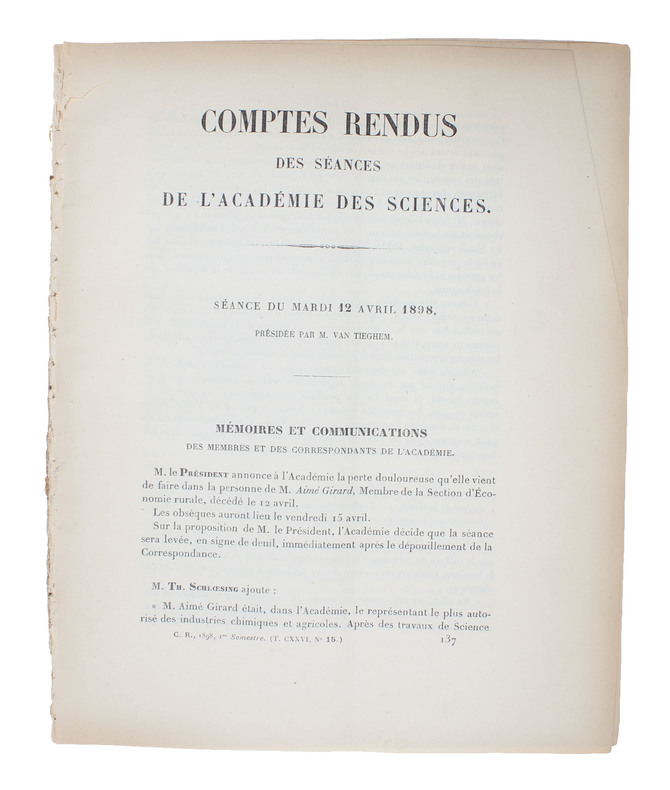
1898ref. 46852Paris, Gauthier-Villars, 1898. 4to. No wrappers. In: ""Comptes Rendus Hebdomadaires des Séances de L'Academie des Sciences"", Tome 126, No 15). Entire issue offered. With htitle and titlepage to vol. 126. Pp. 1059-1110. Curie's paper: pp. 1101-1103.
1835ref. 47003Philadelphia, Fraklin Institute, 1835. 8vo. Later full green cloth. Tome-and titlelabels in leather with gilt lettering on spine. In: ""Journal of the Franklin Institute of the State of Pennsylvania... Edited by Thomas P. Jones"", Vol. XV. New series. Engraved frontisp. (2),446 pp., 2 folded engraved plates and 2 folded engraved maps. (Entire volume offered). Henry's announcement: pp. 169-70. A stamp to verso of frontispiece (Library of Congress duplicate stamp).
1836ref. 45406Berlin, G. Eichler, 1836. In ""Archiv für Anatomie, Physiologie und Wissenschaftliches Medicin Herausgegeben von Johannes Müller"". Jahrgang 1836. Pp. 66-89 a. pp. 90-139. The entire volume offered in its 6 parts (in 5), all 5 issues uncut with orig. printed warppers. (2),CCXXIV,390 pp. and 15 engraved plates. The 2 first issues with a faint dampstain to lower part of leaves and plates.
1861ref. 53357(Paris, Mallet-Bachelier), 1861. 4to. No wrappers. In: ""Comptes Rendus Hebdomadaires des Séances de L'Academie des Sciences"", Tome 52, No 8. Pp. (321-) 368. (Entire issues offered). Pasteur's paper: pp. 344-347. Minor marginal brownspots.