THIERCELIN (Louis) .Livre Rare Book

6218 resultados
ref. 230478Paris, Hachette et cie, 1866 2 vol. in-12, 352 pp. et 376 pp., demi-basane brune, dos lisse orné de filets dorés (reliure de l'époque). Dos frotté avec épidermures. Chocs sur une coupe au tome I. Rousseurs.
18304to, 8vo [33.5 x 26.5 & 23 x 14.5 cm]; 3 volumes including plate volume, xlviii, 536; iv, 332, clxxix pp,with large folding map, 92 plates including 10 finely hand-colored aquatints, large folding plan, music notation, other maps, tables, index. original red cloth with title lettering on front cover or spine, plate volume spine worn, mostly lacking, light foxing on some plates, heavier on a few, colored plates clean with tissue guards, text volumes bit faded but near fine, plate volume very good. First printed in 1817 in only 900 copies with only 66 plates, this edition being expanded to 92 plates and map. The plates are reputed to be by William Daniell. The author travelled extensively on the island. Abbey Travel 554; Tooley 391; Hill I, 245. According to Abbey, the atlas of plates was published separately for the second edition which was published in 1830 and printed in only a small number. Bastin p. 5: 'The book was got together with considerable haste and was published in 1817 in two quarto volumes. . .a total of 900 copies were published. Apart from its originality. . .the outstanding feature of the book is its 66 plates, ten or which are coloured aquatints illustrating Javanese life and costume and the Papuan boy who accompanied Raffles to England in 1816'. The plates of this edition include all the plates of the first edition plus additional plates of Javanese antiquities and topography. Prideaux: 'a monumental work. . . still a standard book'. Von Hunersdorff: 'An influential work valued for the author's firsthand observations on the customs and condition of the Javanese under his administration as Governor General during the British occupation of the Dutch East Indies'. The text volumes printed in 1830 have a great deal of data, much in tabular form including statistics, populartion, vocabularies, etc. with much of the author's text describing the people and country in great detail. from natural history and anitiquities to musical instruments, hunting methods, literature, games of skill, language, etc. All of the plates are present according to the plate list.
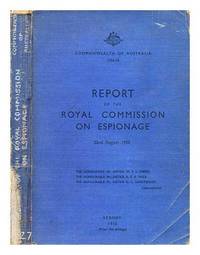
1955ref. 343835Sydney : A. H. Pettifer Govt. Printer for New South Wales 1955. Paperback edition. Softcover. Provenance: BBC copy. Near fine paperback copy; edges very slightly dust-dulled. Remains particularly well-preserved overall; tight bright clean and especially sharp-cornered. Physical description; v 483 pages : illustrations facsimiles ; 23 cm. Subjects; Diplomatic and consular service Soviet Australia. Espionage Soviet Australia. Espionage Australia. Espionage Russian Australia. Petrov Vladimir Mikhalovich 1907-1991. Sydney : A. H. Pettifer, Govt. Printer for New South Wales paperback
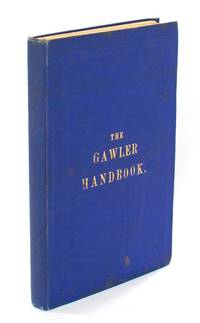
1880ref. 104186Adelaide: Goodfellow & Hele almost certainly the author: James Dally was convinced 1880. First Edition. Hardcover. Very Good. Adelaide Goodfellow & Hele almost certainly the author: James Dally was convinced 1880. Octavo 182 30 advertisements pages plus 6 lithographed plates of farm machinery by James Martin & Co. and 17 albumen paper carte de visite photographs individually mounted on tipped-in captioned leaves. Blind-decorated blue cloth lettered in gilt on the front cover; cloth slightly rubbed and bumped at the extremities a little marked and bubbled and lightly sunned on the spine; some mounts lightly creased a production flaw; a few trifling signs of use; a very good copy but internally fine with the photographs in superb condition. Ferguson 11744; Holden 70. Holden's entry is more accurate and informative although the photographs may vary slightly between copies. The photograph facing page 17 in this copy is of the 'Gawler Institute' showing the Institute building and Town Hall rather than 'Frankel's Hotel' as called for in Holden. These variations notwithstanding two separate editions were produced: one in wrappers with advertisements on the verso of the front cover and on both sides of the rear cover without photographs but with the lithographs not noted by Ferguson; the other in gilt-lettered cloth without the cover advertisements containing 17 mounted photographs plus the lithographs. Both contain 30 pages of advertisements at the rear. Rare in any state and in our view the version on offer is one of the more important and interesting photographically illustrated books produced in Australia. 'The handbook is illustrated with a number of views by Mr J. Taylor the local photographic artist representing the most important edifices and establishments in town' Holden quoting a contemporary review. The frontispiece is a portrait of John McKinlay 1819-1872; there are 14 pages devoted to him he married a Gawler woman in the early 1850s and was based in the town until his death. Justice is not done to the other photographs in describing them prosaically as 'the most important edifices and establishments in town'. Without exception signs of life and day-to-day activities flesh out the images and most of the businesses - butcher shop photographic studio cordial factory furnishing warehouse music emporium - feature well-stocked windows or yards and numerous staff members or customers. Holden reproduces two interesting ones including perhaps the best the butcher shop captioned merely 'Hodgson & Clements' but there are wonderful vignettes in many others. Not least of these are the horse-drawn tram in front of the 'Commercial Bank' and the ornate hearse outside 'F. Fowler's Furnishing Warehouse'. While we are on the subject of death one chapter stands out. Among those to be expected say on 'Horticultural and Agricultural Progress. Gardens around Gawler' or 'The Humbug Society. Flam! Bam! Sham!' or 'The Streets - Number of Businesses - Description of Hotels' there is Chapter XI: 'The Neville and Adamson Tragedy'. Its thirteen pages describe in great detail the events surrounding the double suicide 'and its romantic accomplishment' of Neville and his partner Adamson. 'It is universally believed that Neville was the leading spirit in the suicide and so strong was Adamson's affection love friendship or whatever it may be termed for his companion that he consented to take that final leap in the dark in the wine cellar with him to visit that "bourne whence none return"'. Provenance: J. Cluny Harkness Federal President of the Chamber of Manufactures in the 1950s according to Trove with his pictorial bookplate on the front pastedown. Goodfellow & Hele [almost certainly the author: James Dally was convinced] hardcover
1863ref. 80169Adelaide: W.C. Cox Government Printer 1863. First Edition. Hardcover. Fine. Adelaide W.C. Cox Government Printer 1863. Octavo 54 pages plus a large folding map and an errata slip tipped in on the contents page; the map 890 × 650 mm is of the Northern Territory itself and shows the 'exploration tracks' of Stuart Sturt A.C. Gregory McKinlay and Leichardt sic. Contemporary full morocco with decorative gilt borders front and rear and the title in gilt on the front cover a most attractive colonial binding; extremities slightly rubbed; leather slightly dusty; the map has tiny holes nibbled by silverfish along the fold of two blank panels and short splits to four intersecting folds insignificant blemishes; a fine copy. 'On 16 July 1863 the Crown annexed to South Australia "until We think fit to make other disposition thereof the Territory now known as the Northern Territory"'. Responsibility was transferred to the Commonwealth on 1 January 1911. The book reprints the Letters Patent and the relevant Acts and Regulations 20 pages together with lengthy extracts from Earl's 'Handbook for Colonists in Tropical Australia' printed earlier the same year at the 'Pinang sic Gazette' Press in the Straits Settlement 22 pages. The last section 'Interior of the Country' 12 pages is largely extracted from the journal of Stuart and the report of Waterhouse naturalist to his expedition. Ferguson 13458 the wrappers here are not stiffened and the title page is also printed within a border. Provenance: The Honorable Henry Ayers CMG with his armorial bookplate. Sir Henry Ayers 1821-1897 legislator and businessman was at the time South Australian Chief Secretary under whose command the 'Northern Territory Land Regulations' and 'Appointment of Officers' printed in the book were proclaimed. Ayers has underlined in ink six lines in the Northern Territory Act relating to land orders. W.C. Cox, Government Printer hardcover
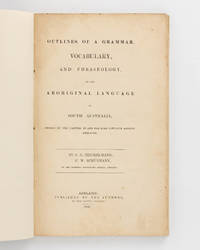
1840ref. 81903Adelaide: 'Published by the Authors at the native location' and printed by Robert Thomas and Co. Hindley Street Adelaide 1840. First Edition. Paperback. Very Good. Adelaide 'Published by the Authors at the native location' and printed by Robert Thomas and Co. Hindley Street Adelaide 1840. Octavo vi fourth and fifth pages blank sixth page errata iv-viii ii sectional half-title verso blank 24 ii sectional half-title verso blank 76 pages. Nineteenth century plain blue wrappers identical to the material used for the original plain wrappers; title page very lightly foxed and dusty; a few minor corner creases; small inkspot to one page; an excellent copy. A rare and important early Adelaide publication and among the earliest and extensive works of its kind; the vocabulary and phraseology run to 76 pages. Ferguson 3102 with slight variations to the preliminary pagination but definitely in error in omitting the 26 pages of grammar. 'Published by the Authors at the native location' [and printed by Robert Thomas and Co., Hindley Street, Adelaide] paperback
1880ref. 19039Adelaide: E Spiller 1880. First Edition. Contemporary full green morocco. Very good. 8vo xi 3 3 - 139 1 pp. 6 full page plates in text. Christina Smith nee Menzies 1809-1893 was the first white woman to settle in the district of Rivoli Bay South Australia in 1845. She established a home for Aborigines in Mt Gambier in 1865. She was a teacher and missionary known for her support of Aborigines in particular the Booandik Buandig or Buandik people whose numbers were diminishing due to European aggression disease and land depredation. In 1864 under her married name Mrs Smith she published as a pamphlet Memoir of Wergon an Australian Aborigine of the Reedy Creek tribe South Australia born in 1836; died in 1850. In 1865 she profiled a Booandik woman known as Mingboaram or Caroline in a 31-page pamphlet titled Caroline and her family or The Conversion of Black Bobby. It tells how the woman who is aware she is dying asked Mrs Smith to care for her two young children.At the request of the Booandik people Smith recorded in detail their customs legends and social relationships while her son Duncan compiled a Booandik vocabulary. In 1880 under the pen name Mrs James Smith she wrote The Booandik Tribe of South Australian Aborigines: A Sketch of Their Habits Customs Legends and Language. It is an account of their rites of passage songs and language with brief biographies of fourteen christian converts. The Australian Dictionary of Biography describes it as an influential ethnography blending scholarly observation with personal narrative it was a unique window onto an Aboriginal-settler frontier. Smith wrote in the foreword that she lamented the loss of this once large and powerful tribe as a result of cruel practices of the early settlers of the colony and considered it her duty to record Booandik characteristics customs habits language and legends for future historians antiquarians and philologists. Ferguson #15823. E Spiller unknown books
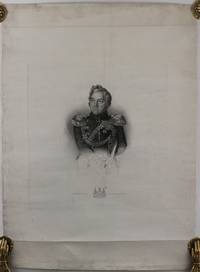
ref. R60Steel engraving print size 39x345 cm on a large sheet 655x485 cm. “B.R. Davies direxit. J. Thomson sculpt.” underneath the image. With an engraved title in Russian and Lazarev’s coat of arms engraved on the lower margin. Blank margins with minor repaired tears creases on the upper and lower blank margins not affecting the images overall a very good print. Official portrait of Admiral Mikhail Petrovich Lazarev 1788-1851 Russian naval officer circumnavigator and the discoverer of Antarctica. The print engraved in England on the special order of the Russian Naval Ministry shows Lazarev in his late years as the Chief of Staff of the Black Sea Fleet since 1832; the Admiral is depicted waist length dressed in uniform with all his regalia and holding a spyglass under his left arm. His name under the portrait is adorned with the coat of arms of Lazarev noble family. ‘‘Lazarev first circumnavigated the globe in 1813-1816 aboard the vessel Suvorov; the expedition began at Kronstadt and reached Alaska. During this voyage Lazarev discovered the Suvorov Atoll. As a commander of the ship Mirny and Fabian Gottlieb von Bellingshausen’s deputy on his world cruise in 1819–1821 Bellingshausen commanded Vostok Lazarev took part in the discovery of Antarctica and numerous islands. On January 28 1820 the expedition discovered the Antarctic mainland approaching the Antarctic coast at the coordinates 69°21’28’’S 2°14’50’’W / 69.35778°S 2.24722°W / -69.35778; -2.24722 and seeing ice-fields there. In 1822-1825 Lazarev circumnavigated the globe for the third time on his frigate Kreyser conducting broad research in the fields of meteorology and ethnography’’ Wikipedia. Later Lazarev took part in the Battle of Navarino 1827 part of the Greek War of Independence 1821-32; was in charge of the naval units of the Baltic Fleet 1830 and became the Commander of the Black Sea Fleet the Black Sea ports and military governor of Sevastopol and Nikolayaev since 1833. unknown
1914ref. 010886Sydney: Angus & Robertson 1914 First edition dated July 1914 from the publishers 31 page catalogue at the rear RARE and scarce in the wrapper May Gibbs earliest 'Gumnut' style illustrations The dust jacket has edge wear and chipping and some short tears the front fold in flap is missing both the pasted on illustrations with May Gibbs art are present and intact these pasted on paper plates are also present on the book cover and spine book is tidy with small ink inscription to fep dated 1918 very slight foxing to closed edges colour frontspiece and four other full page black and white plates all by May Gibbs. x 228pp 31pp publisher's catalogue decorated cloth. First Edition. Decorative Cloth. Very Good/Fair. Illus. by May Gibbs. 8vo - over 7 - 9 tall. Angus & Robertson hardcover
1847ref. 048653London: T. & W. Boone 1847. xx 544pp frontispiece and 6 other b/w plates 1 folding 7 text illustrations 1 small advertisement bound in. Contempory marbled boards with leather spine. Spine rebacked retaining original spine several related clippings late 19th & early 20th century laid onto endpapers and rear blanks prev owner armorial bookplate on front pastedown name on verso of frontis narrow damp mark to margin of frontis not affecting image foxing to plates but text pages clean occasional pencilled notes. Minor rubbing to boards. Some black tape remains from old hinge repair but a proper repair has been performed. A nice copy of this scarce explorer's journal. The 3-sheet map issued separately is NOT present. First Edition. Hard Cover. Very Good. 8vo. T. & W. Boone Hardcover
17894to [30.5 x 23.5 cm]; xxix, [ii, errata, directions leaf], 360, 47 pp, 22 plates and maps including 6 folding maps and charts, tables, with the half title page (often lacking). contemporary leather backed marbled boards, gilt spine title lettering, joints rubbed, corners worn round, some light staining to about 5 plates at rear, mostly marginal, generally clean and unmarked, very good, a tall copy with wide margins. A picture of Two ships, the King George commanded by Portlock and the Queen Charlotte, commanded by George Dixon, visited the Falkland Islands, made a long stay at Hawaii, then proceeded to survey the American coast, to more accurately map the coast and to establish a British presence in the region's fur trade. National Maritime Museum 140: 'Dixon discovered Queen Charlotte Island, named after his ship'. Buck 35. Sabin 20364. Howes D365. Wickershaam 6574. Lada-Mocarski 43. Hill 352: 'This expedition set out to establish a trade in furs in North America. Dixon visited Hawaii three times in the course of the voyage. . .discovered Queen Charlotte Islands, Port Mulgrave, Norfolk Bay, Dixon Entrance and Archipelago while continuing down the coast and trading with the Indians.. . . Dixon's contribution to the work also includes the valuable maps. The accounts of this expedition relate to the geography, ethnology, and natural history of the American coast from Nootka Sound northward'. The fine plates including many views, birds, portrait, etc. One of the detailed appendices is on the natural history encountered. Dixon had earlier sailed with Cook on the Resolution
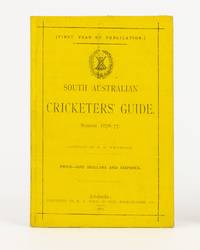
1877ref. 144575Adelaide: E.S. Wigg & Son 1877. First Edition. Hardcover. Near fine. Adelaide E.S. Wigg & Son 1877. Octavo vi 60 pages plus advertising on the outside rear cover. Original flush-cut yellow cloth with the full title page details repeated on the front cover with the addition of a vignette illustration and ruled border; first and last page tanned; later ownership details on the front pastedown with the name repeated on the dedication page; a near-fine copy. 'First Year of Publication' and rare especially in this condition. A second volume 'The South Australian Cricketers' Guide and Footballers' Companion. Season 1877-78' appeared the following year; a third and final volume 'The South Australian Cricketers' Guide. Season 1884-85' was published in 1885. Padwick 3375. E.S. Wigg & Son hardcover
1849ref. 119606London: T. and W. Boone 1849. First Edition. Hardcover. London T. and W. Boone 1849 first edition slightly later issue. Octavo two volumes x iv 5-416 8 publisher's advertisements pages with 12 illustrations plus 8 plates 2 tinted 2 hand-coloured a folding map with rivers and Sturt's tracks in three colours and an advertising slip for Stokes tipped in after page x; and vi 308 92 4 prospectus for Siborne 8 publisher's advertisements pages with 6 illustrations plus 8 plates 2 hand-coloured and an advertising slip for Leichhardt tipped in on page 1. The woodcut illustrations on page 158 in the first volume and on pages 195 and 195 in the second volume are not noted in the plate list; the hand-coloured plates three of birds and one of Mus conditor 'The Building Rat' are from original artwork by John Gould and Henry Richter. Original blind-stamped green ribbed cloth the primary binding rebacked not professionally but more than adequately retaining the original backstrips and endpapers; cloth a little worn at the extremities stained and sunned on the spines with minor loss at the foot of the second one; the first volume has the front inner hinge reinforced the bottom corner of the free endpaper torn away slight loss near the foot of the front hinge the rear free endpaper removed and the rear pastedown stained; the second volume has slight loss to the restored front inner hinge and a few light stains to both endpapers; tidemarks to some plates not the hand-coloured ones and minor in all cases except the first frontispiece; brown stain to the bottom corner tips of some leaves in each volume most of them from pages 71-100 including a plate in the first volume and from pages 141-164 in the second volume but touching the text on one leaf only and rarely larger than a thumbnail elsewhere; short sealed tears to the leading margin of pages 27-52 in the appendix to the second volume; minimal signs of age and use including a partially erased word on one page and some words offset onto the last page of advertising in the first volume; overall a very decent set. Provenance: George Woodroofe Goyder with the pastedown of each volume inscribed in his hand 'Hill Side Cottage Medindie April 1858'. George Woodroofe Goyder 1826-1898 South Australia's surveyor-general for thirty-three years is best remembered for the eponymous Goyder's Line 'the line of demarcation between that portion of the country where the rainfall has extended and that where the drought prevails' a line of reliable rainfall that separates agricultural from pastoral lands. 'Goyder joined the Department of Lands as chief clerk in January 1853. In quick stages he rose from second assistant to assistant surveyor-general in January 1857. In April he took charge of an exploration to report on country north of pastoral settlement. He was amazed to find Lake Torrens full of fresh water and its flourishing eastern surroundings very different from the desert described by Edward Eyre in 1839. His exuberant report persuaded the surveyor-general Captain Sir Arthur Freeling to examine the area in September. No more rain had fallen but hot winds had killed the vegetation and turned the lake into a bed of mud. Freeling returned to criticize Goyder for mistaking flood for permanent water being misled by mirage and misconceiving the value of the northern country. Although Goyder had proved that Eyre's horseshoe of salt lakes was penetrable and thereby opened the way to further exploration he was too conscientious to ignore his blunder and in 1859 at his own request led survey parties to triangulate the country between Lakes Torrens and Eyre and to sink wells. When Freeling resigned Goyder was recalled from the north to become surveyor-general on 19 January 1861' 'Australian Dictionary of Biography'. Goyder married in 1851; by 1856 the family with four children moved from rented accommodation in North Adelaide 'a short distance across the parklands to Medindie . into a "neat cottage" with six rooms a garden and a vineyard . Named Hillside the cottage was located on a private road now Hawkers Road close to Robe Terrace overlooking the parklands' Janis Sheldrick: 'Nature's Line. George Goyder - Surveyor Environmentalist Visionary' 2013. It is intriguing to discover that Goyder acquired a set of Sturt's account of his 1844-46 Central Australian expedition in search of an inland sea in April 1858 the year after his own expedition to Lake Torrens. 'The expedition started by following the Murray and Darling both to settle any doubt about the confluence of the two rivers and to avoid the "horseshoe" of Lake Torrens which had halted Eyre's progress a few years before' Wantrup and confounded Goyder himself in 1857. Wantrup 119 noting the point that distinguishes the first issue an inserted advertisement for Melville immediately following the text in the first volume: 'this leaf was suppressed shortly after publication of Sturt's book'. 2 items. T. and W. Boone hardcover
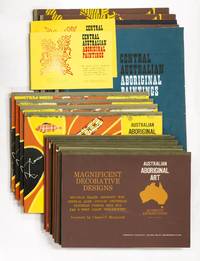
1967ref. 138977Melbourne: Newcraft Publicity 1967. First Edition. Paperback. Very Good. Melbourne Newcraft Publicity 1967 to 1969. Seventeen portfolios in various formats see below each containing a page or two of text and 5 colour serigraphs printed on card unless otherwise stated and interleaved with tissue-guards. Thick card covers with cloth spines; minor blemishes to some covers; minor damage to a bottom corner of portfolio B Volume 4 see below with loss of the corner-tip to the last three plates; overall the contents are in excellent condition. Two volumes are bound in portrait format; the others are presented in landscape format albeit with the spine along the top edge. The National Library of Australia catalogue states that this material was 'Available only in set of 24 portfolios at $310.00 . "Authentic reproductions ready for framing". Edition limited to 200 numbered copies' we have not traced the original source of this information. However we have incorporated below a number of pertinent details gleaned from Trove; in particular we found the relevant catalogue records provided by the State Library of Victoria to be the most informative. A Magnificent Decorative Designs. Melville Island Abstract - Map Central Aust. - Pintubi Churingas - Victorian Possum Skin Rug - Far N. West Coast Phallocrypt 375 × 505 mm; #13/116. B Australian Aboriginal Art. Primitive Traditional Decorative four volumes each 403 × 550 mm and all numbered #095; together with three larger-format volumes each approximately 550 × 795 mm respectively #1/086 #2/090 and unnumbered. The third volume without the subtitle 'Primitive Traditional Decorative' contains seven plates reproducing ones that appear in the smaller-format volumes; six are printed on paper the seventh is printed on the inside rear card cover. C Cave Paintings of Arnhemland Volumes 1 2 3 and 5; each approximately 385 × 500 mm; all #126. The title of the fifth volume is 'Ceremonial Cave Paintings of Arnhemland "Amazing Anthropomorphic Figures"'. D Central Australian Aboriginal Paintings. Brilliant Abstract Designs of the Pitjantjatjara two volumes bound portrait-format each 750 × 550 mm respectively #66 and #2/100. The first volume has a brown cover decorated in ochre and lettered in black; the second volume has a blue cover decorated in white and lettered in black. Both volumes contain seven plates. E Magnificent Bark Paintings of Arnhemland and the Islands Volumes 1 2 and 4; each approximately 380 × 500 mm; respectively #1/126 #2/116 and #101. The title of the fourth volume is 'Magnificent Bark Paintings of Arnhemland'. Offered together with three plates mounted as issued on thick card; these also appear in the volume of duplicated plates noted in B above. Also included are two copies of another Newcraft Publicity item 'Central Australian Aboriginal Paintings' by Winifred Hilliard wrappers oblong quarto with 7 colour plates; the second copy is numbered 153. Although the lengthy subtitles are different 'The Pitjantjatjara Abstracts. Designs in Vibrant Colours from Ancient Mythological and Totemic Motifs by Aboriginal Artists at Ernabella in the Musgrave Ranges' and 'Ancient Mythological and Totemic Motifs in Vibrant Colors by Finke River Aboriginal Artists' the contents are the same albeit in a different order and with minor variation to the introductory text. To complicate matters even more the same contents appear in the first very much larger-format volume in D above. We have identified five portfolios not present in this run cross-referenced with the descriptions above: A Magnificent Decorative Designs. Volume 1 Churinga Patterns Ground and Rock Paintings; C Cave Paintings of Arnhemland. Volume 4; E Magnificent Bark Paintings of Arnhemland. Volume 3: Oenpelli Portfolio; Australian Aboriginal Art: Bark Paintings - Angurugu Groote Eylandt Gulf of Carpentaria; and Australian Aboriginal Art: Decorated Shields of North Queensland. The SLV also identifies one related item we do not have: 'Australian Aboriginal Art' Melbourne Newcraft Publicity 1969. It is described as being a single volume 750 mm tall containing 'Colour prints on paper of items of aboriginal art miniaturised from the series of authentic reproductions of bark and cave paintings in the Newcraft collection of 23 portfolios'. 22 items. Newcraft Publicity paperback
ref. 17344They are drawn mainly on Adelaide banks and business houses in the 1860s and 1870s with payees generally in the Clare region including Clare Mintaro Spalding Yatina Watervale Auburn Rhynie Broughton and Bungaree. All are bank-stamped. Recognisable payees' signatures written on both sides of the notes include Benno Seppelt Albion Tolley George Wood and Philip Santo. Local well-known businesses represented include Simpson James Martin Faulding Wills William Morgan Fowler Harris Scarfe and Duncan Fraser. Offered together with 50 or more similar but lesser items from mainly the 1910s. Over 200 items. unknown
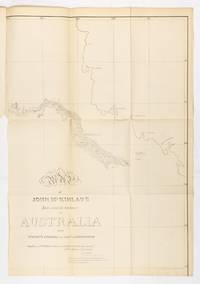
1862ref. 140416Adelaide: W.C. Cox Government Printer 1862. First Edition. Hardcover. Very Good. Adelaide W.C. Cox Government Printer 1862 first edition. Foolscap folio drop-title 56 pages plus 4 large folding maps respective maximum sheet sizes and printed surface areas are 754 × 545 mm and 739 × 521 mm; 757 × 545 mm and 724 × 520 mm; 756 × 542 mm and 730 × 517 mm; and 758 × 556 mm and 724 × 525 mm. Recent cloth lettered in gilt on the front cover; maps lightly foxed in a few spots with a few tiny tears expertly sealed and a few tiny chips to some top and leading edges; an excellent copy. South Australian Parliamentary Paper Number 12 of 1862. The earliest printing of McKinlay's journal of his Burke and Wills Relief Expedition and a rarity. 'The South Australian House of Assembly chose John McKinlay to lead the South Australian relief expedition in August 1861. Setting out from Kapunda with a well-equipped party he reached Cooper's Creek in October. From his depot at Lake Buchanan he made numerous excursions into the surrounding country and found what he believed to be the grave of one of the Burke party. Coming to the conclusion that all of Burke's men had died he sent back for instructions. When his instructions arrived he learned that Howitt had already discovered King and that Burke Wills and Gray were indeed dead. McKinlay proceeded to examine the land to the north of Lake Eyre discovering much useful pastoral and grazing land. In December he set out for the Gulf of Carpentaria to rendezvous with the Northern Relief Expedition under Commander Norman. His crossing was made difficult by diminished stores and his position was critical in May 1862 when he arrived with his men at the Albert River where he expected to find relief only to discover that the "Victoria" had already sailed. Sensibly he decided to make for the Queensland coastal settlement at Port Denison 500 miles to the east. After a difficult trip of over three months McKinlay brought all his men into Port Denison by the end of August. When he reached Adelaide in October 1862 McKinlay handed his journal to the South Australian Government. It was printed soon afterwards in the South Australian parliamentary papers. The text of his journal was later published for general distribution in the colonies by two Melbourne publishers' Wantrup. Only the first public account published by Baillière in 1863 contained maps 'three large folding maps loose in a back endpocket' but it is 'virtually unprocurable in fine clean condition owing to the poor quality of the paper used' Wantrup. This first edition large-format parliamentary paper is far superior in every respect. McLaren 12963; Wantrup 2023 pages 317-18. W.C. Cox, Government Printer hardcover
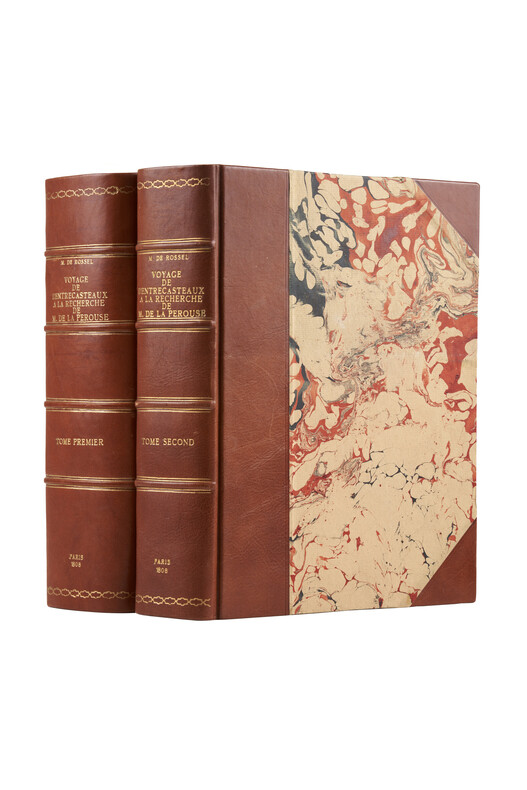
1808ref. PHO-1626Paris, Imprimerie impériale, 1808. 2 grands et forts volumes in-4 (32x24), lvi, 704 p., 33 pl. ; viii, 692 p., relié demi basane et coins moderne, dos avec auteur, titre, tomaison, lieu et date, exlibris en page de garde, non rogné, tome 2 non coupé, petite mouillure au tome 2, petites rousseurs aux illustrations du tome 1. Exemplaire sur papier bleuté, complet de son illustration mais sans son atlas de cartes
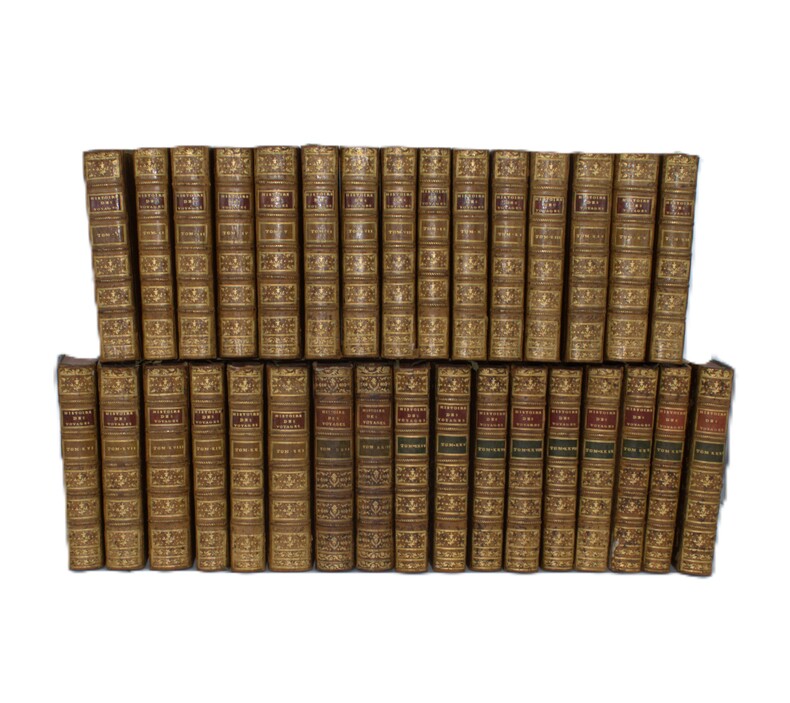
1780ref. PHO-2387Paris, Hôtel de Thou, Laporte, Moutardier, 1780/1801, 32 volumes in-8, basane époque, guirlande sur les plats, dos ornés, pièces de titre rouge et pour les tomes 22 à 32 ; pièces de tomaison vertes, triples filets aux plats, tranches rouges, fleurons légèrement différents pour les tomes 22 et 23. Quelques accidents aux coiffes, quelques épidermures au supplément, légers manques de matières sur quelques tomes, mouillure très claire sur quelques feuillets (2 tomes), le tout sans gravité. Ex-libris du Comte de Farcy de la Villedubois au dos du premier plat. Belle édition de l’Abrégé de l’Histoire des Voyages, elle se compose des 21 premiers volumes de 1780 publiés par La Harpe à l’Hôtel de Thou, des 2 volumes publiés en 1786 consacrés au troisième voyage de Cook et formant les volumes 22 et 23, chez Laporte, et des 9 volumes de suppléments publiés entre 1798 et 1801 par Delpuech-Comeiras et imprimé chez Moutardier. L’illustration est formée de l'atlas complet des 74 (+1 en double) cartes dépliantes des diverses parties du monde, dont la Carte dépliante de l'hémisphère austral montrant les routes des navigateurs les plus célèbres par James Cook, une carte de Tahiti, d'autres du Kamtchatka, du Spitzberg, des îles Antilles, etc, et de 4 cartes pour les tomes 22 à32 ainsi que 101 planches dont certaines dépliantes, les cartes et gravures en très bel état.
17794to [29 x 24.5 cm]; [ii], xxiii, [i, errata], 388, 13, [i, directions] pp, engraved frontis portrait, plus 32 engraved plates, maps and charts including 20 folding. orig full tree calf, rebacked with orig gilt decorated spine, gilt title lettering on orig red spine leather label, wear at corners & spine ends, armorial bookplate of Robert Austen, marbled endpapers, interior clean, crisp & fine with only slight foxing. Taylor 401. Cox i, 301. Hill p. 108: 'Forrest sailed from Balembangan, in the 'Tartar', a native prahu of about ten tons burden, with two English officers and eighteen Malays, towards the Moluccas. He pushed further east than any of his company predecessors, eventually reaching Geelvink Bay in New Guinea. The voyage was one of examination and enquiry . . . the tact with which he conducted his intercourse with the natives, and the amount of work done in a small boat, deservedly won him credit as a navigator'. They explored the Gilolo Passage between New Guinea and the Moluccas, then sailed to Mindanao, examining the Sulu Archipelago, Mandiolo, Batchian and Waygiou, and reaching the Malay peninsula A vocabulary of the Magindano tongue is added at the end of the book. There is much on the native people, their customs, manners, activities. The book is famous for its fine engraved plates and maps.
ref. 136727aafGenève, Imprimerie de Jules-Guillaume Fick, 1868, in-8vo, 268 p. + 20 photogr. d’après les dessins de MM. G. Liquier et D. (d’après les indications de l’auteur) (10 à plein page de scènes rurales et avec aborigènes + 10 plus petites in-texte (animaux et curiosités (e.a. pyramides de pierres géantes d’Australie), reliure en d.-veau d’époque, dos à cinq nerfs orné or, pièce de titre.
1837ref. PHO-2283Paris, A. Bertrand, 1837. 2 volumes in-8 (21,5x13,5 cm), xv, [1], 574 ; [4], 520, vii pp., illustré de 4 gravures et une carte dépliante, relié demi chagrin époque, traces de réparations à la reliure, cachets répétés, rousseurs et brunissures.
ref. 63186Gill's titles are 'Cradling Forest Creek 1852' 'The Claim Disputed' 'Mustering Cattle' 'Native Sneaking Emus' and 'The Bushranger Pursued'. Hamilton's titles in which the horse naturally enough features prominently are 'The Lost Bushman' 'The Found Bushman' 'Bushmen in Danger' 'Australian Bushmen' and 'The Bushman'. Unpublished but circa 1890 and based on original sketches from upwards of fifty years earlier. The images are printed in brown ink on light brown arch-topped backgrounds printed surface 150 × 205 mm on uniform sheets of cream paper 200 × 275 mm. This set is in fine condition in a modern custom-made portfolio covered in brown cloth lettered in gilt on the front panel 'Scenes of Australian Country Life'. The invaluable 'Dictionary of Australian Artists. Painters Sketchers Photographers and Engravers to 1870' edited by Joan Kerr has only this to say: 'MAY E.C. lithographer signed nine lithographs celebrating life in the bush and on the goldfields c.1855-60 ML. He may have been the May who was in partnership with George Walker q.v. at Melbourne in the early 1870s'. At least he appears on their radar . We have established the following facts. Edgar Charles May 1867-1920 was born at North Adelaide on 27 May 1867; his name later appeared in the local Sands and McDougall's directories with his occupation listed as artist. One published example of his work not noted at all by Kerr and not attributed to May by Ferguson is '14 Views of Old Adelaide from Sketches in 1840-1849 by S.T. Gill F.R. Nixon S. Calvert and O. Korn' Adelaide E.S. Wigg 1890; oblong quarto 19 leaves all rectos blank comprising the gilt-pictorial title page signed in the image by E.C. May 14 full-page tinted lithographic views with tissue-guards the 3-page list of 181 subscribers and the key to plate 5 between plates 4 and 5'. This is Ferguson 9924e which is essentially the same item as Ferguson 9807 apart from the different publishers. We have inspected numerous copies of 9924e the Wigg version and the odd Galbraith one and it is clear that the original Galbraith imprint is masked by the gold blocking carrying the later Wigg imprint. The nature of the contents reworked material from well-known earlier artists the medium tinted lithographs printed in brown and the style of the work leave us in no doubt that May is responsible for all the material in '14 Views of Old Adelaide'. We suggest that the ten lithographs offered here were prepared by him with the intention of putting out a companion volume to '14 Views of Old Adelaide'. The change of publisher after that book was printed leads us also to suggest that Galbraith or May or both lost money on the venture and who knows perhaps the Wigg issue was not a commercial success either. In any event one could see how enthusiasm for a sequel might be considerably diminished. All of these plates are rare; complete sets of them are exceptionally rare on the open market even Kerr's dictionary refers to only nine of them. Until now they have been poorly documented in the literature; fortunately some of them have survived to tell their own worthy tale. unknown
1880ref. 104852Adelaide: Goodfellow & Hele almost certainly the Author - James Dally was convinced 1880. First Edition. Hardcover. Very Good. Adelaide Goodfellow & Hele almost certainly the Author - James Dally was convinced 1880. Octavo 182 30 advertisements pages plus 6 lithographed plates of farm machinery by James Martin & Co. and 17 albumen paper carte-de-visite photographs individually mounted on tipped-in captioned leaves. Blind-decorated maroon cloth lettered in gilt on the front cover with a later gilt-lettered cloth title-label along the spine originally untitled; cloth a little flecked slightly sunned on the spine and a little rubbed and bumped at the extremities; some mounts lightly cockled as ever a production flaw; a few trifling signs of use; basically an excellent copy internally fine with the photographs in superb condition. A rare and desirable item attested to by the provenance of this copy: it has the armorial bookplate of Charles Glover on the pastedown and the blind-stamp of Sir Thomas Ramsay on the flyleaf 'T.M.R. Library of T.M. Ramsay'. Ferguson 11744; Holden 70. Holden's entry is more accurate and informative although the photographs may vary slightly between copies. The photograph facing page 16 in this copy is a portrait of Dr Nott rather than 'Frankel's Hotel' as called for in Holden facing page 17. Two other photographs are less-common variant images of the same subject: these are 'Fotheringham's Cordial Factory' facing page 57 and 'Stewart's Music Emporium' facing page 96. These variations notwithstanding two separate editions were produced: one in wrappers with advertisements on the verso of the front cover and on both sides of the rear cover without photographs but with the lithographs not noted by Ferguson; the other in gilt-lettered cloth without the cover advertisements containing 17 mounted photographs plus the lithographs. Both contain 30 pages of advertisements at the rear. Rare in any state and in our view the version on offer is one of the more important and interesting photographically illustrated books produced in Australia. 'The handbook is illustrated with a number of views by Mr J. Taylor the local photographic artist representing the most important edifices and establishments in town' Holden quoting a contemporary review. The frontispiece is a portrait of John McKinlay 1819-1872; there are 14 pages devoted to him he married a Gawler woman in the early 1850s and was based in the town until his death. Justice is not done to the other photographs in describing them prosaically as 'the most important edifices and establishments in town'. Without exception signs of life and day-to-day activities flesh out the images and most of the businesses - butcher shop photographic studio cordial factory furnishing warehouse music emporium - feature well-stocked windows or yards and numerous staff members or customers. Holden reproduces two interesting ones including perhaps the best the butcher shop captioned merely 'Hodgson & Clements' but there are wonderful vignettes in many others. Not least of these are the horse-drawn tram in front of the 'Commercial Bank' and the ornate hearse outside 'F. Fowler's Furnishing Warehouse'. While we are on the subject of death one chapter stands out. Among those to be expected say on 'Horticultural and Agricultural Progress. Gardens around Gawler' or 'The Humbug Society. Flam! Bam! Sham!' or 'The Streets - Number of Businesses - Description of Hotels' there is Chapter XI: 'The Neville and Adamson Tragedy'. Its thirteen pages describe in great detail the events surrounding the double suicide 'and its romantic accomplishment' of Neville and his partner Adamson. 'It is universally believed that Neville was the leading spirit in the suicide and so strong was Adamson's affection love friendship or whatever it may be termed for his companion that he consented to take that final leap in the dark in the wine cellar with him to visit that "bourne whence none return"'. Goodfellow & Hele [almost certainly the Author - James Dally was convinced] hardcover
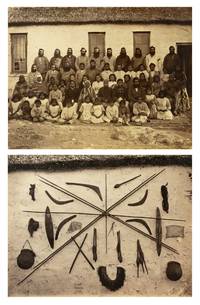
ref. 125425Original sepia-toned albumen paper photographs both 158 × 208 mm unmounted as issued; short sealed tear to the bottom corner of the photograph of weapons; essentially in fine condition. Captain Samuel White Sweet 1825-1886 sea captain surveyor and photographer: after he was censured when his ship ran aground in 1875 he 'retired from the sea opened a photographic studio in Adelaide and concentrated on landscapes. With his horse-drawn dark room he travelled through South Australia taking hundreds of skilful pictures of the outback stations and homesteads. The colony's foremost documentary photographer of the 1870s in the early 1880s he was one of the first to use the new dry-plate process' 'Australian Dictionary of Biography'. 'Point McLeay Mission was founded on the shores of Lake Alexandrina in 1859 by the Aborigines' Friends Association for the Aboriginal people of the Lower Lakes. George Taplin the Congregational minister was its first administrator. Following Government administration from 1916 Point McLeay was returned to the Ngarrindjeri people in 1974 and renamed Raukkan in 1982' State Library of South Australia. The group portrait depicts 55 Indigenous men women and children posed in five rows in front of one of the thatch-roofed residential cottages at Point McLeay. 'Sweet Adelaide 463' is inscribed in the negative; 'Native Mission Station Ponindie sic' is written in pencil and in error on the verso. The photograph of weapons and artefacts is inscribed 'Sweet Adelaide 462' in the negative and has an early caption in pencil on the verso 'Native Ornaments & Weapons'. The objects numbered 1 to 17 in the negative are displayed against a whitewashed wall of one of the cottages. We have traced only one example of the latter photograph in Trove in the National Library of Australia and none of the group portrait. 'Captain Sweet's Colonial Imagination - The Ideals of Modernity in South Australian Views Photography 1866-1886' by Karen Magee a 2014 University of Adelaide doctoral thesis accessible online notes that Sweet visited Point McLeay in 1878 and 1880. She reproduces the latter photograph in her extensive catalogue see number 811 '"Ngarrindjeri weapons and hunting implements" 1878 Point McLeay. Private Collection' but does not record the group portrait. 2 items. unknown