6212 risultati
1937rif. 132767Adelaide: The Collotype Co. Commercial Printers for the Adelaide 5th Pioneer Reunion Club 1937. First Edition. Hardcover. Very Good. Adelaide The Collotype Co. Commercial Printers for the Adelaide 5th Pioneer Reunion Club 1937. Quarto 116 pages with 19 full-page plates plus 2 folding maps. Blue cloth lettered in black on the front cover along with the battalion's colour patch a rectangle white around purple - here blue; cloth a little marked and rubbed and lightly bumped at the extremities; top edge and endpapers a little foxed; endpapers offset; trifling signs of handling; an excellent copy of a very rare book. The book includes a five-page Honor Roll and a preface by Lieutenant-Colonel Herbert Gordon Carter DSO 1885-1963 the Battalion's Commanding Officer from August 1916 to the end of the war. The editor was 'late Sergeant "D" Company'. He states in the introductory paragraph to his foreword that he is 'keenly sensible of the fact that probably a book three times larger could have been written had it been possible to get in touch with the men of the Battalion who were in a position to know well the activities of their various Companies. The story such as it is is correct as to salient facts and this is entirely owing to the fact that Colonel Carter soon after his return to Australia wrote a complete Diary of the Battalion's movements and operations from the early days in Egypt to the Armistice'. Herbert Gordon Carter was a very interesting man: consult the 'Australian Dictionary of Biography'. Dornbusch 338; Fielding and O'Neill page 235; Trigellis-Smith 303. The Collotype Co., Commercial Printers [for the Adelaide 5th Pioneer Reunion Club] hardcover
1937rif. 127709Adelaide: The Collotype Co. Commercial Printers for the Adelaide 5th Pioneer Reunion Club 1937. First Edition. Hardcover. Fine. Adelaide The Collotype Co. Commercial Printers for the Adelaide 5th Pioneer Reunion Club 1937. Quarto 116 pages with 19 full-page plates plus 2 large folding maps. Blue cloth lettered in black on the front cover along with the battalion's colour patch a rectangle white around purple - here blue; cloth lightly marked; endpapers offset; essentially a fine copy of a very rare book. The author was 'late Sergeant "D" Company'. Dornbusch 338; Fielding and O'Neill page 235; Trigellis-Smith 303. The Collotype Co., Commercial Printers [for the Adelaide 5th Pioneer Reunion Club] hardcover
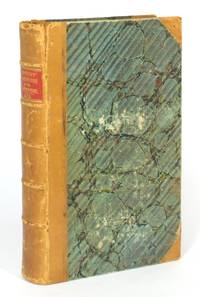
1841rif. 104249London: John Richards & Co 1841. 3rd Edition. Hardcover. Very Good. London John Richards & Co. 1841 'Third edition revised and corrected to the present time'. Octavo ii title leaf xviii 476 civ appendix and index pages. Early half tan calf and marbled papered boards with a contrasting leather title-label on the spine; covers a little rubbed and scuffed with the head of both joints slightly cracked but firm; endpapers and adjacent leaves offset mainly from the leather turn-ins; minimal scattered light foxing; early marginal emphases in pencil and rarely in ink in particular to the later sections relating to the institutions and processes of government; related annotations on several pages; overall an excellent copy. Western's apparent aim was to demonstrate the superiority of the English constitution over all other forms of government. In that context the parochial provenance of this copy is hard to beat. The ownership signature of 'J.F. Burton Adelaide 1850' appears at the head of the title page and on the front free endpaper without the place-name. The latter is also signed in pencil 'J.H. Fisher' James Hurtle Fisher around which George Fife Angas has written 'Sept 21 1853. Presented by JHF to G.F. Angas'. The full name of George Fife Angas is also written there in pencil in what we recognize as a later secretarial hand indicating in our experience that the book came originally from Angas's library. Sir James Hurtle Fisher 1790-1875 'was one of the most important pioneers of South Australia': a lawyer he was appointed first Resident Commissioner of South Australia and arrived in the colony on the 'Buffalo' with the Governor's party. He eventually became a leader of the South Australian Bar 'Australian Dictionary of Biography'. Angas needs no introduction; suffice to say the provenance takes some beating. We know little about Burton other than that he was an Adelaide solicitor; he is mentioned as such occasionally in the local newspapers of the day. John Richards & Co hardcover
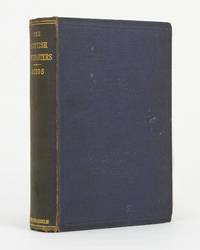
1861rif. 139478Edinburgh: Edmonston and Douglas 1861. 3rd Edition. Hardcover. Very Good. Edinburgh Edmonston and Douglas 1861 third edition. Quarto xii 390 last blank iv 'Critical Notices' pages. Original morocco-grain cloth; spine lettered and ruled in gilt sides bordered in blind; cloth a little marked and rubbed and bumped at the extremities with the spine lightly worn and sunned; edges uncut and unopened from page 349; scattered foxing generally light; a few other mild signs of age and handling; a very good copy. Provenance: George Fife Angas with his signature in full in pencil at the head of the title page and with his occasional pencilled emphases and two references on the rear free endpaper. As in several other works we have handled from Angas' personal collection these annotations speak to his thinking about government and religion in particular to the relationship between colony and metropole. The final chapter which deals explicitly with these questions in its examination of the British Empire since the revolution of 1688 has the greatest concentration of Angas' emphases and it is hard not to see in this his concern for the liberties and moral character of the early colony of South Australia. The final lines of the book appear to have impressed Angas: 'Our empire has not half accomplished her mission. Heaven's light points the way and a Voice from the cloud proclaims "O Britain! continue to be the nurse of Freedom! THE MIGHTY MOTHER OF FREE COLONIES AND OF THE FUTURE FREE EMPIRES OF THE WORLD!"'. Loosely inserted is a slip of paper giving details of later provenance of the book. Edmonston and Douglas hardcover
rif. 808351 A manuscript personal promissory note 90 × 167 mm dated Adelaide 24 October 1840 - 'Three months after date pay to my order Thirty Pounds value received. F.W. Allen. To C.W. Stuart Esqre'. Stuart has written across it 'Accepted Payable at the Bank of South Australia'. It was subsequently stamped by the Bank of South Australia Adelaide when it was paid on 27 January 1841. The verso is endorsed by F.W. Allen C. Crispe and 'For the Bank of South Australia Edwd Stephens Manager'. Apart from two vertical creases and a tiny spike hole it is in fine condition. 2 A printed Bank of South Australia cheque 80 × 180 mm printed by Batho and Bingley London with manuscript insertions - 11 February 1841 from C.W. Stuart to Harry Lechahdee for 3 pounds. A bank stamp on it indicates it was paid out in Adelaide on 15 February 1841. It is endorsed on the verso by Robert Champlay an indecipherable signature and three small Xs. It is lightly creased with a tiny spike hole; on the verso there is a discoloured band denoting the outer surfaces when the item was originally folded; basically in excellent condition. It goes without saying that these are utterly rare ephemeral items dating from when the colony was barely four years old. However because of this we are able to identify most of the signatories thus giving these trifles much greater weight. Edward Stephens 1811-1861 was appointed cashier and accountant of the South Australian Company in 1836; he arrived in the 'Coromandel' on 17 January 1837 at Holdfast Bay. 'There he set up his office in a tent but at first business was slight. He was induced to sign a letter to Governor Sir John Hindmarsh asking for a public meeting to reconsider the site of Adelaide. Although in February the meeting decided in favour of Colonel William Light's choice Stephens did not hesitate to buy eight city acres 3.2 ha when they were auctioned and later became very friendly with Light. Stephens fell foul of Hindmarsh and was rebuked by George Fife Angas for dabbling in politics' 'Australian Dictionary of Biography'. In 1840 he became the Adelaide manager of the Bank of South Australia. Charles William Stuart ~1811-1891 arrived in the colony in 1836 and became Acting Police Commissioner during Alexander Tolmer's extended absences on overland gold escort duties in 1852-53. Tolmer's dismissal in November 1853 was in part due to his involvement 'in demeaning disputes with his subordinates' not least Stuart. Frederick William Allen 1813-1850 arrived on the 'Buffalo' and became a publican. Clement Crispe ~1804-1857 arrived in 1837 on the 'John Renwick' and was a butcher and farmer. Robert Champlay was married in Adelaide on 30 January 1840. Most of the biographical details have come from the 'Biographical Index of South Australians 1836-1885'. We have not yet traced Harry - there are some intriguing possibilities. 2 items. unknown
1899rif. 29277London: Reinhold Thiele and Co. 66 Chancery Lane 1899. London Reinhold Thiele and Co. 66 Chancery Lane possibly 1899. A vintage albumen paper photograph 250 × 195 mm laid down on the printed mount of the photographer. The photograph has slight surface silverfish damage not affecting the figure; original mount slightly foxed; recently matted ready for framing visible image size 335 × 280 mm. This full-length portrait features Howell with a cricket ball grasped firmly in his right hand standing alongside a wicket in the practice nets at Lord's in 1899. Displayed in a window cut into the rear of the modern mount is his bold ink surname signature. Howell toured England in 1899 1902 and 1905: he took all 10 for 28 against Surrey in his first match in England in 1899. A rare and impressive item. Reinhold Thiele and Co., 66 Chancery Lane unknown
1882rif. 112707Adelaide: Printed by Webb Vardon and Pritchard for the Author 1882. First Edition. Hardcover. Very Good. Adelaide Printed by Webb Vardon and Pritchard for the Author 1882. Octavo ii title page verso blank vi preface last blank 9-343 pages. Original olive-green cloth lettered in gilt on the spine and ruled and decorated in blind on the sides; cloth a little marked flecked and rubbed with light wear to the extremities and minimal conservation to the spine; front board slightly bowed; edges a little marked; textblock reinserted in the binding with the original endpapers retained and reinforced along the inner hinges with cloth of a similar colour; the front flyleaf has a short sealed tear and some residual glue on the recto it had been stuck fast to the pastedown and now has a tendency to curl a little and there are a few numerical annotations and the early ownership signatures of Carl D. and C.O. Lundberg; minimal signs of use and age internally; a very good copy of a great rarity. 'Essential; an important regional novel and nearly a comic masterpiece' states Depasquale 'A Critical History of South Australian Literature 1836-1930'; 'a rambling episodic undisciplined novel part romance part satire part detective novel and . part didactic religious novel'. The five-page introduction by the anonymous author is instructive as are the five pages Depasquale devotes to the work. The novel is set in the mid-north of South Australia; the author notes that Emu Flat the place at which the story begins is 'about four miles S.W. of Clare'. The verso of the front flyleaf carries the later inkstamp of Tyrrell's Bookshop Gawler Place Adelaide. Printed by Webb, Vardon, and Pritchard [for the Author] hardcover
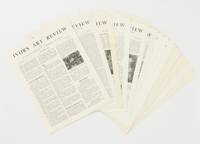
1956rif. 147666Adelaide: Ivor Francis 1956. Very Good. Adelaide Ivor Francis 1956 to 1960. Quarto 40 issues each one comprising a single leaf printed recto and verso with on average an illustration per issue. Drop-title; short closed tears to the top margin of two issues; occasional trifling signs of age and handling including a small pencilled tick in the top left-hand corner of each issue; most issues with two horizontal creases where folded for posting; overall in excellent condition. The two missing issues are Volume 1 Number 1 November 1956 and Volume 1 Number 3 January 1957. We have only handled two other sets of this periodical; both sets came from the estate of the editor and both contained photocopies for completeness five in one set ten in the other. This set comes from the estate of the local artists Ruth Tuck and Mervyn Smith. The last issue gives an indication why complete sets are rare in its hard-hitting 'Announcement. It is with regret that we have to tell our remaining eighty subscribers that with this issue . we cease publication. It requires one hundred subscribers to pay the monthly . bills once in our heyday we totalled 120 subscribers for just one month. "I.A.R." never achieved what we hoped it would. Our chief enemy has been that attitude of mind fortunately now dying which believes nothing in art can be important or succeed unless it belongs interstate or overseas and that Adelaide is for amateurs'. 40 items. Ivor Francis unknown
rif. 27343An original and probably vintage albumen silver photograph 103 × 150 mm mounted on thin card captioned in pencil on the verso 'The first mission to the Mission Station'. There is a light 30 mm oblique crack to the surface of the image near the centre of the left-hand side and a thin blue ink line in a similar position on the right-hand side about the same length overall extending some 20 mm on to the image; a few other light marks and creases to the mount do not detract from what is essentially very good condition all round. The party consisted of Missionaries Johann Goessling and Ernst Homann and two lay-helpers Hermann Vogelsang and Johann Jacob. They set out from Langmeil Tanunda church on Tuesday 9 October 1866 with two large covered wagons and seven horses. This image along with the full details of the epic journey and the first attempt to establish a mission among the Dieri Diyari in the Coopers Creek area appears in 'A Work of Love and Sacrifice. The Story of the Mission among the Dieri Tribe at Cooper's Creek' by Pastors E.H. and H.F.W. Proeve Tanunda 1952 and in 'White Man's Dreaming. Killalpaninna Mission 1866-1915' by Christine Stevens Melbourne Oxford University Press 1994. A copy of both books is included in the lot. 3 items. unknown
rif. 130007May's series was unpublished but dates from circa 1890; it was based on original sketches by Gill and Hamilton five each from upwards of fifty years earlier. May's ten plates were printed in brown ink on light brown arch-topped backgrounds printed surface 150 × 205 mm on uniform sheets of cream paper 200 × 275 mm; they were not coloured. Gill's titles are 'Cradling Forest Creek 1852' 'The Claim Disputed' 'Mustering Cattle' 'Native Sneaking Emus' and 'The Bushranger Pursued'. Hamilton's titles in which the horse naturally enough features prominently are 'The Lost Bushman' 'The Found Bushman' 'Bushmen in Danger' 'Australian Bushmen' and 'The Bushman'. Offered here is one print after Gill 'The Bushranger Pursued' and one after Hamilton 'The Bushman'. The invaluable 'Dictionary of Australian Artists. Painters Sketchers Photographers and Engravers to 1870' edited by Joan Kerr has only this to say: 'MAY E.C. lithographer signed nine lithographs celebrating life in the bush and on the goldfields c.1855-60 ML. He may have been the May who was in partnership with George Walker q.v. at Melbourne in the early 1870s'. At least he appears on their radar . We have established the following facts. Edgar Charles May 1867-1920 was born at North Adelaide on 27 May 1867; his name later appeared in the local Sands and McDougall's directories with his occupation listed as artist. One published example of his work not noted at all by Kerr and not attributed to May by Ferguson is '14 Views of Old Adelaide from Sketches in 1840-1849 by S.T. Gill F.R. Nixon S. Calvert and O. Korn' Adelaide E.S. Wigg 1890; oblong quarto 19 leaves all rectos blank comprising the gilt-pictorial title page signed in the image by E.C. May 14 full-page tinted lithographic views with tissue-guards the 3-page list of 181 subscribers and the key to plate 5 between plates 4 and 5'. This is Ferguson 9924e which is essentially the same item as Ferguson 9807 apart from the different publishers. We have inspected numerous copies of 9924e the Wigg version and the odd Galbraith one and it is clear that the original Galbraith imprint is masked by the gold blocking carrying the later Wigg imprint. The nature of the contents reworked material from well-known earlier artists the medium tinted lithographs printed in brown and the style of the work leave us in no doubt that May is responsible for all the material in '14 Views of Old Adelaide'. We suggest that the full series of ten lithographs was prepared by him with the intention of putting out a companion volume to '14 Views of Old Adelaide'. The change of publisher after that book was printed leads us also to suggest that Galbraith or May or both lost money on the venture and who knows perhaps the Wigg issue was not a commercial success either. In any event one could see how enthusiasm for a sequel might be considerably diminished. Complete sets of these plates are exceptionally rare on the open market even Kerr's dictionary refers to only nine of them; until now they have been poorly documented in the literature. Individual plates are rarely offered for sale either. These two uniformly matted framed and glazed have been professionally hand-coloured at a later date but probably five decades or more ago which serves to present May's work to best advantage. 2 items. unknown
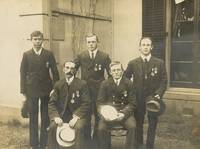
1913rif. 134415Adelaide: Unknown Photographer 1913. Adelaide Unknown Photographer 1913. A gelatin silver photograph image size 152 × 206 mm on the original cardboard mount external dimensions 188 × 240 mm. Slight silvering-out and minor surface blemishes visible in a raking light; small chip near the top right-hand corner; mount slightly bowed unevenly trimmed around the edges slightly bumped at the corners with minor surface blemishes; overall a very presentable item. It is highly likely the name of the photographer was on the portion of the bottom margin that has been cut away. The SS 'South Africa' laden with 4486 cases of explosives caught fire while moored at the North Arm Port Adelaide on the afternoon of 21 August 1910. With much of the crew abandoning ship it was left largely to the firefighters police and boatmen of Port Adelaide to extinguish the fire before the dynamite in the hold exploded. The men in this photograph are almost certainly the crew of South Australia Marine Board Motor Boats 'President' and 'Controller' who assisted with firefighting efforts. All five wear the Sea Gallantry Medal and three also wear the special medal presented by the citizens of Port Adelaide. While official gallantry medals had previously been awarded to the fire crews and police the boat crews were not acknowledged until 1913. The presentation of the medals at Government House Adelaide where this photograph was likely taken is described in the Adelaide 'Register' for 16 May 1913 albeit misidentifying the medal being presented. 'His Excellency the Governor Sir Day Bosanquet . said: "It is with great pleasure that I today present the King's police medals to the volunteers of Port Adelaide who in August 1910 went out to the burning vessel 'South Africa' and undeterred by the fact that she was laden with dynamite and gelignite and remained at their post until the fire was extinguished and all danger of the explosion which might have occurred at any moment was over. Such deeds thrill us with admiration and pride. The names of G.W. Justice coxswain. G.W. Krueger driver and Charles McArtney deckhand of the launch 'President' and Thomas S. Hughes coxswain and R. Justice driver of the launch 'Controller' will be ever remembered and go down to posterity as those of heroes who put aside all fear of personal danger and thought only of the performance of their duty." Sir Day pinned the medals on the coats of the recipients who were wearing the bronze medals and gold watches presented to them by the people of Port Adelaide in recognition of their heroic conduct. "I think your's sic was a piece of magnificent bravery" he added "and I am sorry your names were not sent in earlier. I congratulate each of you on having received the medal though late in the day and wish you success in your future careers"'. We have found no other example of this image. Unknown Photographer unknown
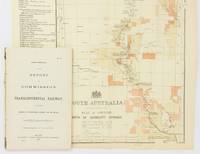
1887rif. 146789Adelaide: E. Spiller Government Printer 1887. First Edition. Paperback. Very Good. Adelaide E. Spiller Government Printer 1887. Foolscap folio xvi 62 28 pages with 4 illustrations plus 9 full-page plates and a large folding colour map 'Plan of the Country North of Herrgott sic Springs': 420 × 855 mm plus a detailed key running the full length of the left-hand margin. A minor printer's error of no great moment at the time has matured with age - the legend has the symbols for Railways Built and Railways Under Construction swapped around!. The map includes average mean rainfall and temperature at stations across the region. Title-wrappers; pinholes and small notches in the left-hand margin where previously bound now disbound with some inoffensive glue and paper residue on the spine; folding map slightly proud of the bottom edge; in excellent condition. South Australian Parliamentary Papers Numbers 34 and 34A of 1887; only 720 copies of each paper printed. Written at the height of the expansion of South Australia's rail network the reports contain detailed discussions about the proposed construction of the OTHER Transcontinental Railway. The plates are uncommon photolithographs from photographs by an engineer R. Ballard of low-level bridges - some under construction others under water - in Queensland. The appendices to the final report are most interesting; they include the full text reprinted from 'The Advertiser' of 'The Far North Country' by Simpson Newland and 'The Northern Territory with a Glance at the East' by J.L. Parsons Government Resident in the Northern Territory from 'The Register' report of a lecture he delivered in Adelaide in May 1887. E. Spiller, Government Printer paperback
1912rif. 80313Adelaide: R.E.E. Rogers Government Printer 1912. First Edition. Hardcover. Very Good. Adelaide R.E.E. Rogers Government Printer 1912 and 1913. Foolscap folio 66 pages plus a folding chart 3 large folding plans or charts describing a typical plan of a lock and weir and charting the effects of certain reservoirs on navigation and a large folding map of the Murray 555 × 910 mm the 'section between Swan Reach and Wentworth . showing locations of lock-sites' with a very large inset map of the entire length of the river and 32 pages plus a folding map 'Proposed improvements in the vicinity of the mouth of the River Murray' 537 × 518 mm. Contemporary full morocco lettered in gilt on the front cover 'Captain Johnston's River Murray Reports'; the original spine is missing and has been replaced with a fairly pedestrian piece of cloth giving it a quarter cloth look; extremities rubbed bumped and a little worn; title pages a little marked with the second one a little foxed along the top margin; neat repairs to a few trifling tears to the folding plans with a tape-stain to an old repair along one fold of the last map; slight nicks to the bottom edge of some leaves in the first paper; overall in very good condition. The ownership signature of Arthur Searcy 1913 is written in pencil on each title page. Arthur Searcy 1852-1935 was Controller of Harbors from July 1911 and Chairman of the Harbors Board Committee until his retirement at the age of 65 information from the Searcy scrapbooks in the State Library of South Australia. He was the older brother of the more well-known Alfred 1854-1925. Loosely inserted are retained duplicate typescripts of two letters in all four pages foolscap from Searcy as Chairman of the Board to the Minister of Marine regarding proposed works at Victor Harbor one page and Goolwa three pages. The letters are signed and dated at the head by Searcy August and September 1922 respectively; the one on Goolwa raises numerous objections to Johnston's scheme. Three related contemporary newspaper cuttings one printing a lengthy letter from Simpson Newland are also present. The September 1928 ownership signature of E.H. Bakewell is written in pencil on the recto of the front free endpaper. Bakewell was managing director of the South Australian Reinforced Concrete Company which makes sense in this context. R.E.E. Rogers, Government Printer hardcover
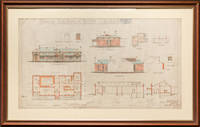
1907rif. 122957Adelaide: English & Soward Architects Cowra Chambers Grenfell Street 1907. First Edition. Hardcover. Very Good. Adelaide English & Soward Architects Cowra Chambers Grenfell Street 1907. A series of 13 architectural drawings 11 of them hand-coloured and several rough pencilled sketches overall visible image size 540 × 975 mm matted and behind glass in a later wooden frame external dimensions 755 × 1190 mm. The thick cartridge paper has a short 28 mm closed tear to the left-hand edge a semi-circular onlay of opaque drafting cloth over a large chip to the top edge covering most of the word 'Committee' and a few pinholes top and bottom; trifling signs of handing; overall a very attractive item in excellent condition. The main drawings in black ink and up to six different watercolours comprise the Front Elevation West South Elevation Ground Plan Back Elevation and Cellar; there are also four sections and a number of minor details. It has been signed by the contractor A.E. Kauffmann and dated 8 July 1907 and witnessed by Adelaide architect George Klewitz Soward who has also added elsewhere 'English & Soward Architects Cowra Chambers Grenfell Street Adelaide'. The fine building still stands in Tanunda today serving the same purpose for which it was constructed. The Tanunda Club dates back to the last months of 1891 when 'there was a move to initiate discussion on how the local townspeople could best achieve convivial society as well as promote the products of the region. From its very beginning the club was a social centre for people from all walks of life where its members could relax partake of refreshments and enjoy discussions in the company of others. By May 1906 the Club's finances were in a very healthy state. It was perhaps with a sense of pride in the Club's achievements that Mr Adolph Schulz addressed a general meeting and mentioned that "according to the financial standing of the Club we might build a substantial front and proposed that a general meeting be called to test the feeling of the members". There was a spirit of prediction in Schulz's words. By October rough sketches for the proposed edifice had been prepared and were quickly approved - the grand new Clubhouse was underway! In January 1907 tenders for the proposed building were accepted after Mr Juncken had explained every detail of the work from the materials to be used to the dimension of the rooms. By December 1907 new furnishings for the rooms were being purchased. The building itself was to be a credit not only to the Club but to the whole town of Tanunda. It was of fairly simple rectangular design topped by a roof with Dutch gables. The MacDonnell Street facade was plain yet superb. A steeply pitched verandah ran the entire length. It had turned wooden posts beautiful lacework at the timber joins and an impressive low fence and magnificently worked wrought-iron gateway. Above this verandah running like a ribbon down the facade was a rendered parapet. It had gables at either end and a central rounded feature with the words CLUBHOUSE inserted in large gold letters. The building's substantial size prominent position and fine construction made it one of Tanunda's outstanding features. It could be looked upon as an enormous asset. In one sense it changed the face of both the Club and its importance in the community' Rob Linn: 'The Tanunda Club - a Centenary History' 1991. English & Soward, Architects, Cowra Chambers, Grenfell Street hardcover
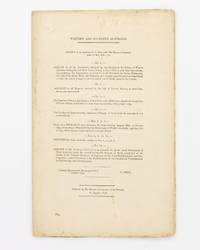
1838rif. 131290London: 'Ordered by the House of Commons to be Printed' 1838. Very Good. London 'Ordered by the House of Commons to be Printed' 1838. Foolscap folio 21 1 docket pages with numerous tables. Uncut and sewn as issued; outer pages slightly dusty; light foxing throughout; an excellent copy. Great Britain and Ireland Parliamentary Paper Number 685 of 1838. The bulk of this important paper pages 4-19 is given over to 'Nos. 5 6 7. Copy of a Despatch from Governor Sir James Stirling bearing Date 15 October 1835 forwarding a Memorial from the Inhabitants of Western Australia; together with a Copy of the Answer which has been returned thereto'. It is somewhat more than that. Stirling's covering letter explains that 'The signatures attached to this memorial . belong to about one-third of the adult male population of the settlement and represent also about one third of its property in land and capital. The grievances under which the memorialists consider themselves and their fellow colonists to labour are five in number'. The five grievances are well-aired; all signatories are identified; there are five pages of lists of lands reserved for public purposes individuals or 'Assigned to or Reserved for Civil Naval and Military Officers from commencement of the Colony in June 1829 to 6 October 1835'. The second and third lists provide name rank or situation where applicable number of acres district assigned or reserved - and when and remarks. A sample record for an individual is that pertaining to Robert Ramsay for whom an 'uncertain' number of acres was reserved at Plantagenet on 12 April 1831: 'Master of brig "Britannia". On south shore of Princes Royal Harbour reserved 18 months to form a whaling establishment and then resumed on failure of conditions'. The last four pages in this section contain Lord Glenelg's thoughts on the matter as of 7 March 1837. The limited information relating to the fledgling colony of South Australia occupies only pages 20 and 21. Ferguson 2511. Provenance: the signature 'C.A.S. Hawker' is written in pencil at the head of the first page. Charles Allan Seymour Hawker 1894-1938 politician and pastoralist: his grandfather George Charles Hawker arrived in Adelaide with his brother Charles in September 1840. They settled on land at Bungaree near Clare in December 1841; C.A.S. Hawker he was born there. He was seriously wounded on several occasions at the Western Front losing one eye and 'his legs were in surgical irons to the end of his life'. He was a minister in the Lyons Government from 1932 until he 'was killed on 25 October 1938 when the aircraft "Kyeema" crashed into Mount Dandenong in Victoria. His untimely death was sharply felt. He had been an outstanding and respected figure in the Federal parliament whom some of his own party would have supported as prime minister. John Curtin the Opposition leader believed he had been on the threshold of great achievements' 'Australian Dictionary of Biography'. 'Ordered, by the House of Commons, to be Printed' unknown
1877rif. 111805Adelaide: E.S. Wigg & Son 1877. 2nd Edition. Hardcover. Very Good. Adelaide E.S. Wigg & Son 1877 second edition. Duodecimo 132 4 index 8 advertisements pages. Original quarter contrasting red and green cloth lettered in gilt on the spine and front cover; covers flecked lightly marked and lightly worn at the extremities edges lightly foxed front endpaper a little marked first and last pages offset; a very good copy internally excellent. A rarity: we have handled only four copies in over 46 years and this is a parochial publication. Ernst Bernhard Heyne 1825-1881 botanist and horticulturist 'was a prodigious writer. Though overshadowed by von Mueller his botanical and horticultural work greatly contributed to the early development of the two colonies' of Victoria and South Australia 'Australian Dictionary of Biography' making a rare error in not recording accurately this edition. Ferguson 10397; Crittenden 53 with a lengthy commentary on its importance. The first edition was published as 'The Fruit Flower and Vegetable Garden' in 1871 Ferguson 10396 recording only one copy; Crittenden 47 'not sighted'; Trove records four copies. E.S. Wigg & Son hardcover
1877rif. 107647Adelaide: E.S. Wigg & Son 1877. 2nd Edition. Hardcover. Very Good. Adelaide E.S. Wigg & Son 1877 second edition. Duodecimo 132 4 index 8 advertisements pages. Original quarter contrasting red and green cloth lettered in gilt on the spine and front cover; covers a little rubbed and bumped at the extremities with minor restoration to the joints and slight wear to the head of the spine; cloth a little marked and flecked; front flyleaf a well-matched replacement; first and last leaves offset; occasional light scattered foxing; a very good copy. A rarity: we have handled only four copies in over 46 years and this is a parochial publication. Ernst Bernhard Heyne 1825-1881 botanist and horticulturist 'was a prodigious writer. Though overshadowed by von Mueller his botanical and horticultural work greatly contributed to the early development of the two colonies' of Victoria and South Australia 'Australian Dictionary of Biography' making a rare error in not recording accurately this edition. Ferguson 10397; Crittenden 53 with a lengthy commentary on its importance. The first edition was published as 'The Fruit Flower and Vegetable Garden' in 1871 Ferguson 10396 recording only one copy; Crittenden 47 'not sighted'; Trove records only 15 copies of all five editions from the first of 1871 to the facsimile reprint of the third of 1979. E.S. Wigg & Son hardcover
1924rif. 114265London: Macmillan and Co. Limited 1924. First Edition. Hardcover. Fine. London Macmillan and Co. Limited 1924. Octavo xii 184 pages plus 90 plates on 41 pages and a folding map 325 × 275 mm. Gilt-pictorial cloth lightly marked and rubbed with the rear cover lightly scuffed; top edge lightly foxed; stitching slightly cracked at one opening with a few adjacent gatherings now slightly proud of the edges; essentially a fine copy. The 'country the habits and customs as well as the beliefs of the Wonkonguru and their neighbours east of Lake Eyre . For the last eight or nine years Mr Aiston has dwelt at Mungeranie although more than twenty years he has spent in aborigines' haunts . Above all an incalculable debt of gratitude is due to Sir Baldwin Spencer who not once but several times read through and corrected the manuscript'. Provenance: Sir John Burton Cleland 1878-1971 with his contemporary ownership signature in pencil J.B. Cleland on the front flyleaf. Cleland pathologist and naturalist began 'a systematic study of what must be one of the largest series of meticulous autopsy examinations ever conducted by one person - over 7000. Cleland regarded each post-mortem examination as a voyage of discovery and never wearied continuing to do routine autopsy work into his mid-80s . He had an unrivalled experience in macroscopic morbid anatomy and histopathology and often diagnosed rare conditions almost at a glance. With each further 1000 autopsy records amassed he would analyse and epitomize his findings and publish them in the "Medical Journal of Australia" or the Royal Adelaide Hospital's "Medical and Scientific Archives" which he founded and edited in 1921-48' 'Australian Dictionary of Biography'. Macmillan and Co., Limited hardcover
1880rif. 63126Adelaide: Government Printer 1880. Very Good. Adelaide Government Printer 1880. Foolscap folio 9 pages plus a large folding map 'Plan shewing Country north east of Eucla examined by Mr James W. Jones with the view to decide upon boring operations for water' 555 × 705 mm. Drop-title sewn as issued; minimal expert infill to the bottom corner of the first leaf; small blank corner piece of the map slightly creased; an excellent copy. The map embraces the entire extent of the Nullarbor Plain within South Australia covering 'an area of 16500 square miles . with a complete description of the country from the coast to the route taken by Mr Ernest Giles on his exploration trip to Perth'. It also includes 'Professor Tate's track shewn in red' presumably relating to Ralph Tate's travels there resulting in his lengthy paper The Natural History of the Country around the Head of the Great Australian Bight in the 'Transactions . of the Philosophical Society of Adelaide South Australia for 1878-9': see McLaren 15803. The journal 'gives a minutely detailed description of the country passed over . It will be seen that this hitherto comparatively unexplored country has been thoroughly examined. I found that in many important particulars the surmises in previous reports respecting this country were not borne out'. No less interesting is the account of the discovery of the waggon and last campsite of Fairie and Woolley who died of thirst north of Eucla two years earlier. South Australian Parliamentary Paper Number 191 of 1880; the quantity printed is not stated but around 700 copies was usual and this item is rarely encountered on the open market. McLaren 10540. Government Printer] unknown
1874rif. 64356Adelaide: W.C. Cox Government Printer 1874. First Edition. Hardcover. Fine. Adelaide W.C. Cox Government Printer 1874. Foolscap folio 5 pages plus a folding map 356 × 503 mm. Recent cloth with lettering on the front cover; a fine copy. South Australian Parliamentary Paper Number 67 of 1875; the subtitle is 'Memo. - This Journal and the Plan accompanying it was placed at the disposal of the Government by the Hon. Thos. Elder MLC at whose expense the exploration was made'. The 'Australian Dictionary of Biography' gives details of Ross' interesting life: born in 1817 he joined Charles Bonney in the first cattle drive from the Goulburn River to Adelaide; after numerous adventures he was appointed leader of the advance exploration party for the overland telegraph line becoming in the process only the second to complete the crossing of the continent through the centre. 'At 57 Ross was engaged by Elder to lead an expedition to explore west of the Peake and to go on to Perth. Struggling against sandhills and mulga scrub he reached the South Australian border but barren country and brackish water forced him back'. His last words in this published account are: 'One drink or rain to give the horses one drink would have saved the expedition'. Ross died in poverty in Adelaide in 1903. McLaren 7953 and 14715 not noting the dimensions of the map. W.C. Cox, Government Printer] hardcover
1893rif. 141827'Sunnyside' Orpington Kent: George Allen 1893. First Edition. Hardcover. Very Good. 'Sunnyside' Orpington Kent George Allen 1893 first edition. Quarto xii 261 pages with 14 illustrations plus 15 plates 4 in colour with all artwork by John Ruskin. Contemporary full vellum 'Bound by Stoakley late Hawes' and stamped in gilt with the coat of arms of the University of Cambridge; inner gilt dentelles top edge gilt others uncut; marbled endpapers; vellum a little discoloured; boards slightly bowed; tiny light tide-mark to the top margin of a small number of plates and leaves of text; minimal signs of age and use; overall in excellent condition. Offered together with a companion volume by Ruskin bound to match and in excellent condition: 'The Seven Lamps of Architecture' 'Sunnyside' Orpington Kent George Allen 1886 fifth edition/ 1849; quarto ii xiv 222 pages plus 14 plates featuring artwork by John Ruskin. 'When George Allen 1832-1907 joined John Ruskin's evening drawing classes at the Working Men's College in 1854 he was working as an apprentice carpenter for his uncle in Clerkenwell London. Enthused and encouraged by Ruskin who saw in him an "innate disposition to art" Allen declined employment with William Morris' decorative arts firm in order to devote himself to Ruskin's service as his assistant and most reliable engraver. From 1870 he also became Ruskin's publisher and in 1874 he built "Sunnyside" a large house in Orpington Kent which acted as a storage area for Ruskin's past works and future publications up to the "Library Edition" of 1903-12 completed by Allen's family' online information from an exhibition commemorating George Allen held at Lancaster University. Provenance: Bishop Arthur Nutter Thomas 1869-1954 Anglican Bishop of Adelaide from 1906 until 1940. The front flyleaf in each volume is inscribed in ink: 'Jeremie Septuagint Prize: December 1892 Arthur N. Thomas Pemb: Coll: Camb.' The 'Australian Dictionary of Biography' records that 'At Pembroke College University of Cambridge B.A. 1893; M.A. 1895; D.D. 1906 he gained a first in the classical tripos 1891 and won the Jeremie Septuagint 1892 and Carus Greek Testament 1893 prizes; he was also an active sportsman'. 2 items. George Allen hardcover
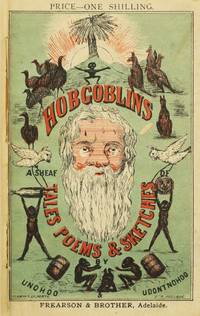
1873rif. 145566Adelaide: Frearson & Brother Publishers 1873. 2nd Edition. Hardcover. Fair. Adelaide Frearson & Brother Publishers 1873 'second edition'/ 1873. Duodecimo 70 10 advertisements pages later extra-illustrated with 3 steel engravings and an unrelated leaf from another publication; one leaf of advertisement misbound in the middle of the volume and several others likely lacking. Colour-lithographed pictorial front wrapper by Penman & Galbraith included in the pagination present but lacking the rear wrapper. Later cloth subsequently rebacked both amateur efforts with the title 'Hobgoblins' in black ink on the front cover with a decorative flourish and within simple ruled borders; front wrapper cropped at the top edge; some marks tanning small chips and other signs of age and handling but a decent copy nevertheless. A unique association copy of this rare South Australian Christmas gift book. It comes from the collection of one of the authors Adelaide journalist and satirical writer Spencer John Skipper who identifies himself on the title page as Unohoo and his co-author Udontnohoo as 'D. Magill'. He has annotated each contribution to the volume with the initials of the respective author including his own verses in the advertisements. Unohoo was one of the numerous pen names used by Skipper but this appears to be the first identification of Udontnohoo as Daniel Magennis Magill his colleague at the 'South Australian Register'. This publication was '. proudly announced as "thoroughly South Australian" in content and production. It can still be read with pleasure and includes some good-humoured prose satire written with a deft touch and some pleasant even affecting poems' Paul Depasquale: 'A Critical History of South Australian Literature' page 113. This 'second edition' appears to be simply a reissue of the first edition sheets with the addition of the colour lithographed front cover and further advertisements the text 'Second edition' is here cropped from the top of the front wrapper. The 'craft' binding would appear to be the handiwork of Skipper himself. Ferguson 17602. Frearson & Brother, Publishers hardcover
1879rif. 138110Adelaide: E.S. Wigg & Son 1879. Hardcover. Very Good. Adelaide E.S. Wigg & Son 1879 first thus. Octavo xliv 316 pages plus 8 tinted lithographs with tissue-guards. Original green ribbed cloth; spine and front cover blocked in gilt with the cover design repeated in blind on the rear cover; covers lightly rubbed and flecked with some short splits at the head and foot of the spine; infrequent light foxing; a few minor signs of age and use; an excellent copy. An early compendium here in the preferred binding of elaborately gilt-blocked green cloth of works already scarce at the time; the lithographs and the lengthy 34-page introduction by Woods were new to this edition. Not commonly known is that Taplin's substantial contribution 'The Narrinyeri' 156 pages plus 6 preliminaries is the text of the revised edition of 1878 see his informative preface dated 12 April 1878 at page xliii. The Wyatt contribution was not previously published as such; the text here was 'principally extracted from his official reports' stemming from his relatively short and unhappy time as the third South Australian Protector of the Aborigines from 1837 to 1839 'Australian Dictionary of Biography'. The contributions by Meyer Schuermann Gason and Bennett first appeared in 1846 1846 1874 and 1869 respectively. Ferguson 13095 noting blue sand-grain cloth and another binding in half leather but not an unillustrated edition we have identified. E.S. Wigg & Son hardcover
1941rif. 09120299Angus & Robertson Sydney Australia 1941. First Edition. Hardcover. Good/Reproduction Dust Jacket. Hardcover. 221 pages. PUBLISHING DETAILS: Angus & Robertson Sydney Australia 1941. First Edition. CONDITION: The book itself is in good condition and comes in reproduction dust jacket dust jacket. Quantity Available: 1. Category: Biography & Autobiography; Australiana; Inventory No: 09120299. Angus & Robertson hardcover
1837rif. PHO-2143Paris, Arthus Bertrand, 1837, 1 volume (3) grand in-4° (30x24,5cm), VIII pp., 742 pp., demi basane époque, dos lisse avec auteur, titre et tomaison, frottements au dos, quelques rousseurs, défaut à la coiffe sup., de la bibliothèque de Cayrol avec son cachet et signature manuscrite.