6 444 résultats
1845réf. 036628London: T. And W. Boone 1845. xi 243pp 7 engraved plates map. Or cloth boards decorated in blind titled in gilt with gilt kangaroos to base of spine. Cloth splitting along rear spine edge front board starting to separate at top hinges starting. Ex- Mines Department library with usual stamps etc quite heavy foxing to map plates and title page. Corners bumped. Text pages generally clean. Scarce early account of the early settlement of Moreton Bay and New South Wales from Port Macquarie north. A great deal on the Aborigines. First Edition. Hard Cover. Good. 8vo. Ex-Library. T. And W. Boone Hardcover
1790réf. 0032791790 A Paris, Chez Letellier, 1789-1790. Deux ouvrages reliés en un volume in-8 (131 X 200) basane fauve, double filet doré en place des nerfs, pièce de titre maroquin ocre, tranches mouchetées en rouge (reliure de l'époque) ; (1) f. blanc, titre, (1) f. d'avis préliminaire, 213 pages ; (1) f. blanc, VIII pages (dont faux-titre et titre), 266 pages, (1) f. blanc. Cernes de mouillures claires à certains feuillets, plus marqués aux premiers feuillets du volume. Manque de papier à l'angle inférieur des feuillets 153/154 et 169/170 de l'ouvrage de Tench, avec perte d'une lettre ("e" final de "espac[e]") au second feuillet. Quelques rares rousseurs. Minimes restaurations à la reliure.
1833réf. PHO-1811Paris,1833, in-folio, demi-reliure basane rouge, dos lisse, muet (rel. mod.), illustré avec 1 portrait en frontispice, lithographié par Lemercier d'après A. Maurin, [1] f. (titre gravé avec vignette), 20 planches disparates (8 cartes gravées sur acier dont 6 doubles, 11 vues reliées (dont 5 coloriées) et 15 planches en feuilles, papier des plats gondolé, quelques rousseurs aux planches libres avec défauts en marges.Recueil réunissant : 1 carte générale ; 1 carte de Nouvelle-Zélande (côte partielle); 1 carte du Pacifique; 1 de Nouvelle-Guinée; 1 de l'Archipel des îles Viti; 1 de l'île Tonga-Tabou; 1 des îles Vanikoro; 1 de Nouvelle-Zélande (nord); des vues de paysages; de personnages locaux (dont 7 coloriées).
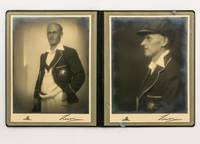
1934réf. 144537London 28 George Street Hanover Square W.1.: Lenare 1934. First Edition. Hardcover. Very Good. London 28 George Street Hanover Square W.1. Lenare 1934. Two large-format gelatin silver photographs each 351 × 264 mm signed by the photographer in the negative with his studio inkstamp and manuscript reference number on the versos. Some silvering-out mainly around the edges; tiny creases to the corners of the white margins of one print; overall in excellent condition loosely inserted in the original cloth portfolio lettered in gilt on the padded front panel in excellent condition albeit with a spot of surface wear near the middle of the spine. Clarrie Grimmett the NZ-born Australian Test cricketer was one of the finest leg-spinners of his time. He is photographed in two different poses: head-and-shoulders from the side wearing his cap and blazer; and three-quarter length from the front wearing pullover and blazer with cap in hand. Lenare was the professional name of Leonard George Green 1883-1946; he specialised in society portraits at his London studio. Provenance: Clarrie Grimmett originally purchased at the Christie's auction of the Clarrie Grimmett Collection sold in Melbourne on 13 May 1998. Grimmett played 37 Tests between 1924 and 1936 taking 216 wickets at an average of 24.21. His record for the fastest bowler to take 200 wickets in Tests achieved in his 36th match stood for 82 years and was broken only in 2018. His first-class record of 1424 wickets in 248 matches between 1911 and 1941 includes 513 wickets in his 79 Sheffield Shield matches. He was a Wisden Cricketer of the Year in 1931 along with Don Bradman. He was posthumously inducted into the Australian Cricket Hall of Fame in 1996 as one of the ten inaugural members and in 2009 he was inducted into the ICC Cricket Hall of Fame. 2 items. Lenare hardcover
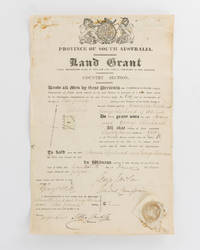
réf. 120374Folio approximately 353 × 232 mm a single leaf trimmed from a standard form a bifolium with the centrefold blank and the last page merely docketed now mounted on plain paper 360 × 228 mm with a small hand-coloured diagram of the block showing the orientation of the land and a paper-over-wax impressed seal signed by George Gawler as Resident Commissioner 19 January 1841. Other signatories are the Private Secretary George Hall; the Treasurer John Alexander Jackson; and Alfred Reynell brother of John patriarch of the eponymous wine family. The document has a few horizontal creases where originally folded; the mounted document has been rolled up at some stage and is a little curled; a short sealed tear to the right edge; a few minor blemishes near the top edge and the bottom portion of the seal and some light overall fading these are possibly a legacy from having been framed at some stage overall a very presentable example of a very rare colonial document. Land Grant Number 639 is for 'Eighty-two acres numbered "903" in the Provincial Survey' purchased by 'James Warland and George Warland of Adelaide' for the sum of £2. Elizabeth Warburton in 'The Paddocks Beneath. A History of Burnside from the Beginning' 1981 makes short work of locating the land in question in this leafy suburb about eight kilometres from the Adelaide GPO and paying the brothers Warland their due. 'There can hardly be a family with deeper roots in Burnside than the Warlands who settled there in 1838. James Warland 1796-1875 with his brothers from Wimborne in Dorset took assisted passages to South Australia in 1837. Their first leaseholding was on Section 904 Clifton; then in 1840 having paid two pounds down they were in nominal possession of Section 903 on the other side of Greenhill Road bounded on the west by today's Wyatt Road. After his retirement Henry Warland built here on land inherited from his father George a pleasant stone farmhouse named "Wimborne" which his grandson Eric Warland maintains at 6 Wyatt Road' page 24. George Gawler 1795-1869 was South Australia's second governor. 'Disputes between the first governor Captain Sir John Hindmarsh and the resident commissioner Sir James Fisher over their respective jurisdictions had retarded the colony's development so the two offices were combined in Gawler. Thus as governor he became representative of the Colonial Office in the province and as resident commissioner representative of the non-governmental Colonization Commission which was responsible for the control of land sales for applying the proceeds to the emigration of labourers and for raising loans until such time as the colony had sufficient revenue to support itself. On 12 October 1838 Gawler with his wife and five children arrived in Adelaide in the "Pestonjee Bomanjee" and found conditions far worse than he had been led to expect. The most urgent necessity he believed was to promote rural settlement. He persuaded Charles Sturt to accept the post of surveyor-general and until he could assume office Gawler himself took charge of the Survey Department reorganizing it and conducting preliminary explorations. He also hired every available surveyor including some of Light's former officers. In October 1839 to his dismay he was ordered to dismiss them. The commissioners had appointed Lieutenant Edward Frome as surveyor-general and sent him out with a party of sappers. Gawler solved the problem by amalgamating the two forces feeling justified by the increasing volume of land sales. In 1839 over 170000 acres 68797 ha were sold'. Gawler produced results: within twelve months 200000 acres had been surveyed and by May 1841 mapping of 7000 square miles had been completed and over 500000 acres divided into sections. This rare land grant is evidence of Gawler's energy and zeal. Unhappily for him history was about to repeat itself: his 'major weakness was his complete failure to understand political realities. His recall and his successor Captain Sir George Grey arrived together on 10 May 1841' 'Australian Dictionary of Biography'. unknown
1638réf. 110770Paris: Chez Rolet Boutonné 1638. 2nd Edition. Hardcover. Paris Chez Rolet Boutonné 1638 second edition/ 1630. Octavo 170 × 105 mm four parts bound as one volume xvi 280; 64 last blank; 63-106 12 index last three blank; and 39 1 blank pages with woodcut printer's devices on the four title pages and 84 illustrations throughout approximately 80 woodcut illustrations and a few type-set diagrams. There are five leaves missing from the 'Troisième Partie' F4 F5 G1 G4 and G5: pages 85-90 95-96 and 101-104. Nineteenth century half calf and marbled boards now lacking the leather corner-pieces revealing earlier full vellum boards underneath; covers a little worn; light tidemark to the bottom inner corner of the text block throughout; a little worming to the top blank margin of the first 25 leaves; insect damage to the bottom edge extending at most a few millimetres into the wide blank bottom margins; first title leaf dusty and a little soiled; the five missing leaves notwithstanding overall a very presentable copy. The second edition of Claude Mydorge's expanded edition and critique of this popular early work of recreational mathematics first published in 1624 and usually attributed to Jean Leurechon. Each of Leurechon's mathematical problems is reprinted here in roman type with Mydorge's explanatory notes and criticism following in italic. The third part albeit relatively insubstantial only 44 well-illustrated pages is devoted exclusively to fireworks and their construction which probably explains the few missing leaves. The subtitle is: 'Composée d'un receuil de plusieurs plaisantes & recreatives inventions de feux d'artifice plus la maniere de faire toutes sortes de fuzées tant simples que doubles avec leur composition le tout representé par figures sic' Comprising a collection of several pleasant and recreative inventions of fireworks plus the manner of making all sorts of rockets both single and double with their composition all represented in figures. This third part together with the second made its first appearance in a 1628 edition of 'Récréations Mathématiques' published by Charles Osmont at Rouen. Their authorship has not been established HEEFER Albrecht: 'Récréations Mathématiques 1624 A Study on its Authorship Sources and Influence' revised 7 October 2004. The fourth part 'Nottes sic sur les Recreations .' is by D.H.P.E.M. Denis Henrion Professeur ès Mathématiques. Claude Mydorge 1585-1647 French mathematician was a friend of René Descartes with whom he shared a strong interest in optics and the nature of vision. 'Mydorge's first major work was the "Examen du livre des Récréations mathématiques" published in 1630. As the title suggests it was a work on recreational mathematics and was effectively a critique of Laurechon's sic book on the theme 'Récréations mathématiques' by the French Jesuit Jean Leurechon writing under the pen name of van Etten first appeared in 1624. However it was through his work on conic sections that Mydorge made the greatest scientific impact' The Cambridge Descartes Lexicon online. Provenance: a 1713 signature on the first page; an early ownership inscription 'Michael Hutchins His Book' on a preliminary page; 'G.S. Kingston Sept 1834' on the front pastedown: Sir George Strickland Kingston 1807-1880 the South Australian pioneer engineer and politician deputy-surveyor-general under Colonel William Light co-discoverer of the River Torrens first Speaker in the House of Assembly. Chez Rolet Boutonné hardcover
1853réf. 100379Adelaide: W.C. Cox Printer 1853. First Edition. Hardcover. Very Good. Adelaide W.C. Cox Printer 1853. Octavo 46 pages. Relatively recent quarter morocco and buckram by the Law Bindery Melbourne; title leaf a little foxed with minimal light scattered foxing to a few other leaves; an excellent copy with most interesting provenance see below. The author Clerk of the Executive Council of South Australia was on board the vessel; this is his account of the first successful navigation of the Murray as far as Swan Hill by Captain Francis Cadell. Fellow-passenger James Allen also published his version of events. Captain William Randell and his paddle-steamer 'Mary Ann' left Goolwa at the Murray mouth ahead of Cadell and travelled much farther up the Murray but Cadell overtook him en route and reached Swan Hill first. However both men deservedly earned the bonus of 2000 pounds offered by the South Australian Government 'for each of the first two steamers to travel up the Murray as far as the Darling junction' 'Australian Dictionary of Biography'. We have noted previously the manuscript correction page 5 line 4 'largest' to 'longest' river and presume it is in Kinloch's hand. At the head of the title page of this copy is the pencilled ownership name possibly his signature of Robert Wadsworth over-written in red ink by the subsequent owner 'John Shillinglaw from Robert Wadsworth 1854'. Shillingworth has annotated the text in both pencil and red ink three and seven pages respectively. The pencilling identifies the 'gentleman's son' working as a shepherd as 'old "Bigodd Macdonald"' and asks elsewhere of a sentence nine lines long 'what does this wretched twaddler mean' he's got a point too!. Robert Wadsworth was eventually Clerk of the Victorian Executive Council from 1875 to 1889; of passing interest to bibliophiles his son Arthur 1864-1931 was the first Commonwealth Parliamentary Librarian having 'charge of the Commonwealth library for over twenty-six years while also being titular head of the Victorian State parliamentary library' ADB. John Joseph Shillinglaw 1831-1905 public servant and historian was the eldest son of the librarian of the Royal Geographical Society. 'He was to study under Captain John Washington eminent maritime surveyor and in 1852 he migrated with his father and brothers to Victoria arriving in October. From November he was chief clerk of petty sessions at Williamstown and in 1854 was appointed inspector and sometime acting superintendent of the Water Police. He was also secretary to the Steam Navigation Board until December 1857. In 1856-69 he was shipping-master for the Port of Melbourne and registrar of seamen; he helped to found the first Sailors' Home and did much to improve the working conditions of seamen'. It is hardly surprising that he should be given a copy of this book soon after its publication. He held various public service positions over the years; from 1885-94 he 'was secretary to the royal commission on vegetable products. He was also secretary to the Board of Viticulture. Shillinglaw was an enthusiast in whatever department he worked; however he is remembered for his association with colonial literature and history'. He was the author of numerous books and on his death his estate 'included a vast collection of papers and rare books' presumably including this item ADB. Ferguson 11196. W.C. Cox, Printer hardcover
1843réf. 139446London: Printed by J.C. Hailes 1843. First Edition. Hardcover. Very Good. London Printed by J.C. Hailes 1843. Octavo 30 9 pages plus a folding map 'Plan of part of South Australia 1843' 216 × 171 mm and 2 folding survey plans 'Plan of the Two Special Surveys on the River Light 1843' 341 × 185 mm and 'Plan of the Special Survey on the River Murray 1843' 245 × 193 mm. Original brown cloth lettered in gilt on the front cover and extensively decorated and ruled in blind on both sides; covers a little marked and rubbed with the spine sunned and a little worn at both ends; some faint offsetting to the maps; hinges cracked but firm; a few other minor signs of age and handling; a very good copy internally in excellent condition. The first section comprises a 'Statement of the Proceedings of the Directors for the Information of the Proprietors' with the final unpaginated section consisting of a statement of accounts for the surveys of the River Light and the River Murray. The 'Arms of South Australia' are printed on the front pastedown; they feature Britannia extending a hand in greeting to an Indigenous man holding a spear with a rocky cliff and a kangaroo in the background. This emblem was later used on the South Australian flag between 1876 and 1904. Ferguson 3706. Printed by J.C. Hailes hardcover
réf. 82561First Edition. Hardcover. Foolscap folio; uniformly and handsomely bound in quarter morocco and buckram with contrasting title-labels on the spines 'Early Port of Adelaide Parliamentary Papers 1869-1878' and 'Early South Australian Ports. Parliamentary Papers 1869-1880'; typed title leaves signed by Ingleton and lists of contents are bound in. The first volume contains eleven Parliamentary Papers in all 98 pages plus 7 plans or charts plus a printed broadside and 11 manuscript documents totalling 19 pages. The documents all dated 1878 include a proof copy of the Report of the Board of Advice one page foolscap folio signed in ink by the State Treasurer and third-time Premier James Boucaut with a few minor corrections in pencil by Captain Frederick Howard Chairman of the Board; a four-page draft report on Largs Bay - Semaphore Jetty Beach Boats with a cover note initialled by Boucaut; and a two-page draft 'Report on probable effect of sea outlet for sewerage sic of Adelaide' by Howard. It also contains a large broadside 570 × 295 mm printed in four columns recto only headed 'Outer Harbour at Marino. Public Meeting at Brighton. "South Australian Register" August 31 1878'. The most substantial Parliamentary Paper is 'Report of the Select Committee . on Holdfast Bay Pier and Railway Bill 1869-70 SAPP 209 of 1870; vi 53 pages plus a small plan of Sandridge Old Pier. The best of the maps are Goalen's 1875 'Port Adelaide' 610 × 870 mm and 'Plan of Proposed Harbour at Marino' 330 × 540 mm. The second volume contains twelve Parliamentary Papers five of them duplicates of those in the first volume in all 216 pages plus 2 maps and a plan but lacking the 3 plans from one duplicated paper 'Ocean Steamer Accommodation' SAPP 108 of 1878; 3 pages plus an additional leaf printed later and not present in the first volume. The most substantial paper is 'Report of the Select Committee . into the Desirability of forming an Outer Harbor' SAPP 113 of 1876; viii 122 pages. The other maps are a folding 'Plan of Port Adelaide 342 × 251 mm and 'Marino Bay with Proposed Breakwater' 400 × 555 mm. Most of the maps and charts are detached and some have a few tears; there is sporadic foxing to the printed material but overall the condition is excellent. Further details are available on request. hardcover
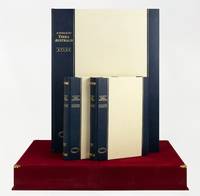
réf. 144538Adelaide: Government Printer 1989. Hardcover. Near fine. Adelaide Government Printer 1989 facsimile edition/ 1814. Large quarto two volumes of text plus the elephant folio atlas containing 18 charts and 10 plates; some relevant ephemera is loosely inserted. Half dark blue calf and cream cloth; cloth on the front cover of the atlas slightly marked in one small spot; a near-fine set in the near-fine dark red felt-covered wooden storage box lightly scuffed and marked. A superb production limited to only 500 numbered sets this set is number 131. The storage box is designed with a matching two-door lid opening at the centre and attached to the base with piano hinges. About a third of the edition was issued in these boxes as originally advertised; this set is one of them. Apparently the successful tender was paid in full before the job was completed - not all the lids were supplied or fitted - and the box-maker was last seen heading for the hills overseas with the money and a big smile! The problem with the majority of the boxes was 'solved' by commissioning clear perspex lids which fitted snugly over the custom-made bases. Government Printer hardcover
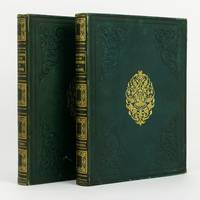
1839réf. 87631London: Fisher Son & Co 1839. First Edition. Hardcover. Fair. London Fisher Son & Co. 1839 and 1840. Quarto two volumes iv xxxvi 84 pages plus a map 46 full-page plates including an unlisted plate facing page 54 'Ancient Archway of Cavern in the Balkan Mountains' and an engraved vignette title page; and iv 100 pages including the cumulative index plus a double-page map 48 full-page plates and an engraved vignette title page. Most plates have the original tissue-guards. Matching full dark green morocco the spines lettered and decorated in gilt in compartments all sides decorated in gilt and blind; all edges gilt; covers a little bumped and lightly worn at the corners; leather a little scuffed and marked; scattered foxing and minor signs of handling more so in the first volume which is inexpertly reinserted in its binding with a rear endpaper that would be greatly improved by removing and replacing it and a front free endpaper that appears to be original but salvaged from the rear and amateurishly lined with tissue; overall a decent set which certainly presents well on the shelf. Provenance: John Michael Skipper 1815-1883 artist solicitor and South Australian pioneer with his ownership initials on the engraved title page of the first volume and his signature and most interesting inscription of the front free endpaper of the second volume: 'J M. Skipper from Mrs. Thomas March 14th. 1841' his mother-in-law. Skipper was born in Norwich the son of a solicitor; 'he was intended for the law but was more interested in art in which he was encouraged by his uncle. In 1833 he abandoned his studies to become a midshipman in the East India Co.'s "Sherbourne" bound for Calcutta. On his return deciding to migrate he arranged to be articled to Charles Mann the new South Australian advocate-general and sailed in the "Africaine" arriving at Holdfast Bay on 6 November 1836. He sketched scenes on the voyage and met Frances Amelia eldest daughter of Robert Thomas; he married her on 28 December 1839' 'Australian Dictionary of Biography'. Accordingly these volumes not only date from the foundation years of British settlement in the colony they also come from two of the first settlers. They are offered together with a copy of 'The Diary and Letters of Mary Thomas 1836-1866. Being a Record of the Early Days of South Australia. Edited by Evan Kyffin Thomas' Adelaide 1925 revised and enlarged third edition/ 1915. It is an account of the Thomas family's journey to South Australia on the 'Africaine' in 1836 and the fascinating early years of colonization as described in Mary's letters to her brother in England. Her husband Robert was the first newspaper publisher in South Australia and important details of the practical difficulties involved in the printing business are included. This is one of 300 unbound copies of the original 1925 edition discovered in the family attic in 1985; the entire cache has now been attractively bound in full reconstituted morocco. It comes in a slipcase with a fine copy of the first edition of a companion family volume 'Maisie. Her Life in her Letters from 1898 to 1902' edited by Joan Kyffin Willington Adelaide 1992. Each book in this 'collectors' duo' contains a numbered certificate of authenticity signed by Joan Kyffin Willington Maisie's granddaughter and Mary's great-great-granddaughter. 4 items. Fisher, Son & Co hardcover
réf. 74984aafMelbourne, George Robertson, Imprimeur MDCCCLXXXII (1882), pt. in-8vo, 87 p., nom ms. sur titre ,de Gottrau 1883’, brochure originale imprimée. Bel état.
réf. DADAX0471029971New unknown
réf. Z1-Q-024-03155National Library of Australia. Used - Good. Ships from UK in 48 hours or less usually same day. Your purchase helps support Sri Lankan Children's Charity 'The Rainbow Centre'. Ex-library so some stamps and wear and may have sticker on cover but in good overall condition. 100% money back guarantee. We are a world class secondhand bookstore based in Hertfordshire United Kingdom and specialize in high quality textbooks across an enormous variety of subjects. We aim to provide a vast range of textbooks rare and collectible books at a great price. Our donations to The Rainbow Centre have helped provide an education and a safe haven to hundreds of children who live in appalling conditions. We provide a 100% money back guarantee and are dedicated to providing our customers with the highest standards of service in the bookselling industry. National Library of Australia unknown
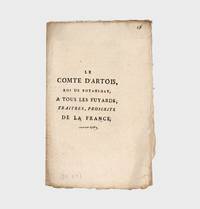
1789réf. 365069Paris 1789. 19 1pp. 8vo. Self-wrappers contemporary ink inscription on title "Aoust 1789. 19 1pp. 8vo. A rare satirical pamphlet written under the guise of the Count of Artois later King Charles X styled here as the 'King of Botany Bay'. The author through the voice of the count entreats all those who fled France during the Revolution and their supporters in France and England to join the future king of France in the penal colony of Botany Bay. He goes on to imply that these traitors to France are no better than the lowliest of English convicts being transported by the British government to what he considers 'a new country made especially for them' 'le vaste continent des Terres Australes leur offre un pays nouveau asyle fait pour eux.'. COPAC lists only two copies unknown
1789réf. 365069Paris 1789. 19 1pp. 8vo. Self-wrappers contemporary ink inscription on title "Aoust 1789. 19 1pp. 8vo. A rare satirical pamphlet written under the guise of the Count of Artois later King Charles X styled here as the 'King of Botany Bay'. The author through the voice of the count entreats all those who fled France during the Revolution and their supporters in France and England to join the future king of France in the penal colony of Botany Bay. He goes on to imply that these traitors to France are no better than the lowliest of English convicts being transported by the British government to what he considers 'a new country made especially for them' 'le vaste continent des Terres Australes leur offre un pays nouveau asyle fait pour eux.'. COPAC lists only two copies unknown books
1930réf. 25919Melbourne: Produced by Northfield Studios and J.E. Hackett 1930. Very good condition. Color lithograph travel poster depicting a mother koala with a cub clinging to her back in the top of a gum tree by the noted Australian illustrator James Northfield. Signed in the image at the lower right. Northfield 1887 - 1973 was the subject of the 2006 volume by the National Library of Australia Michelle Hetherington titled 'James Northfield and the Art of Selling Australia'. Northfield's work is prized for its draftsmanship & design and a distinctly Australian sense of color and light. Window card size 13 1/2 x 19 1/2". One small mark in margin only upper left corner left by old sticky tape. OCLC: 910601564 locates one copy only at the Library of Congress same image larger format. Trove 54841871 locates one copy at the National Library of Australia same image larger format. Produced by Northfield Studios and J.E. Hackett unknown
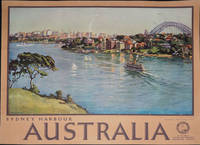
1935réf. 18842Australian National Travel Association 1935. Very good overall. Travel poster illustrated by Sydney Harbour centered on the harbour with a ferry and sailboats with the Sydney Harbour Bridge in the top right background. A color lithograph 20 x 24.75" 50.8 x 62.25 cm. Further text; "Painting by Will Ashton R.0.I. W.T. Baker & Co Ltd. Engravers and printers. Australian National Travel Association." Crinkles and some light creases with a couple of light marks in the sky above the Bridge. Australian National Travel Association unknown
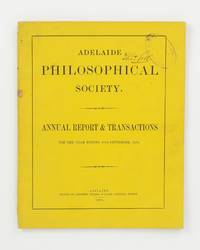
1871réf. 144583Adelaide: Printed by Andrew Thomas & Clark at the 'Register' 'Observer' and 'Journal' Offices 1871. First Edition. Paperback. Very Good. Adelaide Printed by Andrew Thomas & Clark at the 'Register' 'Observer' and 'Journal' Offices 1871. Quarto 42 pages with a diagram plus 7 plates 2 showing sunspot observations the remainder meteorological graphs numbered 1-5. Printed yellow wrappers lightly creased and marked with minor loss to the ends of the spine; small burst with minor loss to one leaf affecting a few words in a handful of lines of text in one column recto and verso; small light stains to the bottom edge of the five meteorological graphs at the rear; a few creases marks and other signs of age and handling; overall in excellent condition. The pamphlet comprises a title page list of office-bearers and members and the report for the year each one leaf verso blank followed by 11 papers read at the society's meetings during the year. The papers are: 'Irrigation' by C.S. Hare 2 pages with a small diagram; 'The Camel in South Australia' by J.S. Lloyd 4 pages; 'The Use and Properties of Plants. No. II' by Richard Schomburgk 2 pages; 'The Currents of the Air and the Ocean. No. III' by Benjamin Herschel 3 pages; 'The Importance of Silk Culture as a Branch of Colonial Industry' by T.S. Reed 2 pages; 'Remarks on Sun Maps' by D.B. Adamson 1 page plus 2 plates; 'Light Railway Construction' by R.C. Patterson 6 pages; 'The Influence of Forests on Climate' by Richard Schomburgk 2 pages being the leaf with minor loss; 'Light Railway Construction' by A.F. Lindsay 5 pages; 'The Cause of Disease in Silkworms' by Richard Schomburgk 1 page; and 'Some Observations on the Rainfall at Adelaide and the Connection between Meteorological Changes and the Yield of Wheat' by Benjamin Herschel 3 pages plus 5 plates containing meteorological graphs. Loosely inserted is a lengthy newspaper clipping from 'The Register' 19 May 1858 on 'Camels in Australia' based heavily on information supplied by Arthur Horrocks brother of the ill-fated explorer John Ainsworth Horrocks. The Adelaide Philosophical Society was founded in 1853 and in 1880 became the Royal Society of South Australia. This annual report lists the name of the 73 current members: the president His Excellency Sir James Fergusson 12 'Honorary and Corresponding Members' and 60 ordinary members. The final paragraph of the short report will sound familiar to anyone who has served on a committee: 'The Council wish to impress upon members the necessity of paying their subscriptions punctually; during the past year out of sixty-seven ordinary members it appears only thirty-nine have paid their annual subscriptions'. These extremely small numbers let alone the passage of 150 or more years must account for the utmost rarity of this publication. Provenance: Thomas Gill 1849-1923 the South Australian historian and bibliographer with his ownership signature on the front cover; later the Royal Geographical Society of Australasia South Australian Branch with its stamp ditto. 'Gill was also a governor of the Public Library Museum and Art Gallery of South Australia from 1896 until his death and a member of the Library Association of Australasia. He wrote "The History and Topography of Glen Osmond" 1905 for the Glen Osmond Institute. Gill was treasurer of the South Australian branch of the Royal Geographical Society of Australasia from its inception in 1885 until his death. The society's acquisition of the valuable York Gate Library was largely due to his energy and enthusiasm. His library was sold to the society for £300 as his will directed' but numerous items from his collection mainly duplicates of existing holdings in the RGSSA library were later sold. Printed by Andrew, Thomas, & Clark, at the 'Register,' 'Observer,' and 'Journal' Offices paperback
1845réf. 109128Adelaide: Andrew Murray Printer Rundle-Street Sold by C. Platts Bookseller Hindley-Street . 1845. First Edition. Paperback. Adelaide Andrew Murray Printer Rundle-Street Sold by C. Platts Bookseller Hindley-Street . 1845. Octavo xii last blank 106 pages plus a folding etching but lacking the folding frontispiece map noted by Ferguson. Original bright green wrappers with the full title page details repeated on the front cover with the date of publication now added; wrappers a little marked but expertly conserved the front cover is now lined on the verso stabilizing a long tear and filling in some minor loss to the edges; title page a little marked; occasional chips and dog-ear creases to the uncut edges; trifling signs of age and use but essentially a very agreeable copy. The State Library of South Australia has a copy of this item with the map and it's a beauty - a hand-coloured lithograph 322 × 213 mm produced in 'Goodwood nr Adelaide' in 1845. However reading between the lines a case may be made for stating that not all copies were issued with the map. Its absence here notwithstanding this is by any account a very rare publication and worthy of serious consideration on at least two counts. The folding plate is an etching paper size approximately 220 × 280 mm of 'Ridley's Reaping Machine. S. Australia' signed and dated in the plate 'NRF 1845'. The artist is Frederick Robert Nixon circa 1817-1860 who arrived in Adelaide in May 1838 to take up a position as assistant surveyor. In 1845 he published 'Twelve Views in Adelaide and its Vicinity South Australia. Drawn etched and printed by F.R. Nixon'; it was the earliest South Australian plate book. He was a self-taught artist who 'had to manufacture all his machinery for preparing and pressing his etchings . they are superior as works of art and accurately as well as pleasingly depict the scenes which they represent 'The South Australian' 21 February 1845. Nixon left Adelaide in May 1846 bound for Mauritius where he died in 1860. Kerr's 'The Dictionary of Australian Artists' 1992 records that the Ridley etching was the only other one he is known to have produced. There is a lengthy chapter 10 pages on the Aboriginal inhabitants and the chapter on horticulture contains seven pages on vines and wine-making with the information credited to M. Vaillant see page 58. Ferguson 4014. Andrew Murray, Printer, Rundle-Street (Sold by C. Platts, Bookseller, Hindley-Street ...) paperback
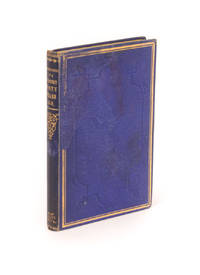
1880réf. 80022Adelaide: J. Williams Printer for the Author 1880. 2nd Edition. Hardcover. Very Good. Adelaide J. Williams Printer for the Author 1880 second edition/ 1879. Octavo viii 84; 80; and 23 pages plus 3 albumen paper photographs of 5 drawings on 3 unnumbered leaves. Blue cloth lettered in gilt on the spine with both sides ruled in gilt and decorated in blind; covers a little bumped and rubbed at the extremities with minor wear to the corners; spine unevenly sunned; light stains to the front cover removing some of the gilt from the left-hand border; rear free endpaper replaced with near-matching paper tanning the last page a blank; overall a very good copy internally excellent. A presentation copy inscribed in ink on the front free endpaper 'From G. Hamilton to Capt Dashwood with the Author's best wishes 22 Dec 1880'. George Frederick Dashwood 1806-1881 arrived in South Australia in the early 1840s; in 1843 he 'was appointed one of the four non-official nominees in South Australia's first Legislative Council. From 1847 to 1852 he was commissioner of police' 'Australian Dictionary of Biography'. George Hamilton 1812-1883 succeeded him in that role in 1867 retiring the year before his death. He arrived in Adelaide in 1839 when he overlanded cattle along Charles Bonney's southern route. A most satisfying association copy presented from one significant pioneer to another in the twilight of their lives. The particulars of the photographs match those given in Holden where the discrepancy in the number of plates present as against listed is explained. The plates are of drawings by Hamilton; he contributed similar sketches to the published journals of Grey and Eyre. The first edition was not photographically illustrated. Ferguson 10184 inadequately describing the plates; Holden 49. J. Williams, Printer [for the Author] hardcover
1853réf. 78787Adelaide: W.C. Cox Printer 1853. First Edition. Hardcover. Very Good. Adelaide W.C. Cox Printer 1853. Octavo 46 pages. Antique-style quarter calf and marbled papered boards; title page slightly dusty and a trifle marked with two tiny closed tears to the top edge; a few pencilled emphases to the margins; light vertical crease down the centre of the last six leaves; an excellent copy. The author Clerk of the Executive Council of South Australia was on board the vessel; this is his account of the first successful navigation of the Murray as far as Swan Hill by Captain Francis Cadell. Fellow-passenger James Allen also published his version of events. Captain William Randell and his paddle-steamer 'Mary Ann' left Goolwa at the Murray mouth ahead of Cadell and travelled much farther up the Murray but Cadell overtook him en route and reached Swan Hill first. However both men deservedly earned the bonus of 2000 pounds offered by the South Australian Government 'for each of the first two steamers to travel up the Murray as far as the Darling junction' 'Australian Dictionary of Biography'. W.C. Cox, Printer hardcover
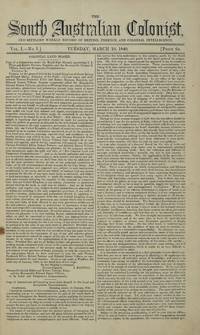
1840réf. 80314London: 'Printed for the Proprietor by William Cecil Huttmann' 1840. First Edition. Hardcover. London 'Printed for the Proprietor by William Cecil Huttmann' 1840. Folio 352 pages 16 pages each issue. Early binder's cloth recently rebacked retaining the top two-thirds of the original spine; cloth marked and mottled with some neat restoration to the corners; edges a little marked; very light tidemarks to the leading edge of the front flyleaf and an initial blank; leading edge of the first few leaves of Number 22 slightly chipped; bottom left-hand corner piece missing from the last leaf with the loss of about 15 words of text and a small amount of the colophon which is the same in each issue; overall an excellent run of the first 22 issues of this very rare weekly newspaper which ceased publication with Volume 1 Number 29 on Tuesday September 22 1840. The prospectus appears on pages 7 and 8 of the first issue; the proprietors' object is 'not mercenary but patriotic . they are not the organs of any party . they will offer a fearless and uncompromising opposition to every deviation from the self-supporting principle on which South Australia is founded'. Their aim in part 'is to present an impartial record of the colonial intelligence . 1st from the colonial papers; 2ndly from direct correspondents in the colony and other exclusive sources'. Accordingly it contains much original material. The editor was John Stephens 1806-1850; 'about 1838 George Fife Angas employed him to write emigration propaganda. Stephens's first notable work was "The Land of Promise" republished in 1839 as "The History of the Rise and Progress of the New British Province of South Australia". In that year his exposure of absurdities in T. Horton James "Six Months in South Australia" London 1839 ran to three editions. He also edited the "South Australian Colonist" on which Angas lost heavily; it was replaced in 1841 by the monthly "South Australian News" at a cheaper rate' 'Australian Dictionary of Biography'. The ownership signature of Robert Kyffin Thomas is pencilled onto the front flyleaf and the blindstamp of the 'Register & Observer Office Adelaide' appears on an early blank leaf. Sir Robert Kyffin Thomas 1851-1910 the grandson of Robert Thomas who arrived on the 'Africaine' at Holdfast Bay in 1836 with a printing press was himself an influential newspaperman in the state. 'In 1877 he became the principal joint proprietor of the "South Australian Register" and as chief of staff he also edited the "Adelaide Observer". A parliamentary reporter he was in charge of the Hansard branch until 1882 when he became general manager of the "South Australian Register" which became the "Register" in 1901' ADB. Ferguson 3082. 'Printed for the Proprietor, by William Cecil Huttmann' hardcover
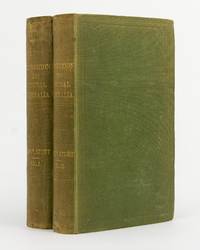
1849réf. 147230London: T. and W. Boone 1849. First Edition. Hardcover. Very Good. London T. and W. Boone 1849 first edition later issue. Octavo two volumes x iv 5-416 pages with 12 illustrations plus 8 plates 2 tinted 2 hand-coloured a folding map with rivers and Sturt's tracks in three colours; and vi 308 92 pages with 6 illustrations plus 8 plates 2 hand-coloured. As usual this later issue does not include the advertisements. Original blind-stamped green sand-grain cloth stamped in gilt and blind; edges uncut; recased with some minor restoration at the extremities; covers a little sunned and rubbed; ink ownership signature on the recto of each frontispiece see below bleeding through; edges roughly opened in places resulting in some minor edge loss to the margins of a few leaves; one opening spotted; occasional scattered light foxing elsewhere; occasional finger marks and other minor signs of age and handling; overall a very good set. 'The geographical results of Sturt's last expedition the first into the heart of the continent were significant. He determined the confluence of the Darling and the Murray settled speculation about a vast inland sea found no evidence of a large central river and determined that there was no central dividing range. The expedition was also responsible for major discoveries especially the discovery and exploration of Coopers Creek the Stony Desert and the Simpson Desert. For his labours in the cause of Australian discovery Sturt was awarded the gold medal of the Royal Geographical Society in 1847 and was honoured as a national hero' Wantrup 2023 page 252; see also 199a. The wood-engraved illustrations on page 158 in the first volume and on pages 194 and 195 in the second volume are not noted in the plate list; the hand-coloured plates three of birds and one of Mus conditor 'The Building Rat' are after John Gould and Henry Richter. The folding map 'Sketch Map of Captain Sturt's Tracks & Discoveries on his Various Expeditions into South Eastern & Central Australia' is by John Arrowsmith and contains text advertising the larger version of the map which was available for purchase separately in a matching case. Provenance: With the ownership signature of 'D. Woodfield Adelaide 1888' in each volume. This is likely the mining speculator Donald Woodfield a speculator in the 1880s minerals boom at Broken Hill who also appears to have had an address at Prospect. Sturt named the Barrier Ranges and Broken Hill during this last expedition which may explain Woodfield's interest. Wantrup: 'Thomas & William Boone's Library of Australian Travels' pages 109-110; this copy conforms to his variant E with a plainer binding 'This appears to be a remainder issue'. 2 items. T. and W. Boone hardcover
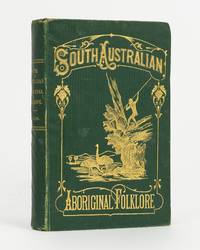
1879réf. 144271Adelaide: E. Spiller Acting Government Printer 1879. First Edition. Hardcover. Very Good. Adelaide E. Spiller Acting Government Printer 1879. Octavo viii 174 2 24 'The Grammar of the Narrinyeri Tribe' xii lithographed 'Facsimiles of Letters Written by Aborigines' one leaf folding 2 25-28 index pages including a page of lithographed music plus 9 lithographs from drawings by Aboriginal artists and 7 original albumen silver photographs 3 are approximately 105 × 145 mm; 4 are approximately 115 × 95 mm mounted on captioned leaves. Original green cloth attractively blocked in gilt on the front board and in blind at the rear; spine ruled and lettered in gilt; covers a little worn and marked with the binding a little shaken; acidic paper tanned with the folding facsimile document splitting at one fold; mounts a little cockled; trifling loss to the corner-tip of one photograph; page 29 printed close to the right-hand edge an imposition error during production; a few mild signs of age and handling; a very good copy of a rare and important work with the photographs in excellent condition. An early ownership signature on an initial blank is proving difficult to decipher Ruppard Sheppard. The original photographs that illustrate the book are almost certainly the work of Captain Samuel Sweet see Robert Holden: 'Photography in Colonial Australia. The Mechanical Eye and the Illustrated Book' 1988. We have handled a number of copies of this work and this copy conforms with what we suggest might be called the first and most desirable issue of these photographs. The substance of the book was derived from a 48-question circular compiled by George Taplin and 'distributed to all the keepers of aborigines' depots throughout the colony and to all persons who are known to be acquainted with the manners customs and languages of the aborigines'; the value of the work may be judged by the editor's remark in the introduction 'that much information has been elicited and that most of the papers show that the writers have used their powers of observation in an intelligent manner'. The untimely death of Taplin in June 1879 at the early age of 47 may account for the failure of further volumes in the series to materialize. Ferguson 16711; Holden 105 and pages 49-51. E. Spiller, Acting Government Printer hardcover