STUART, John McDouallBiblio.com
6 530 résultats
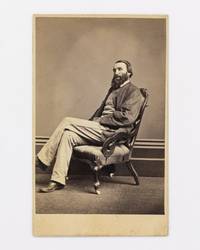
1866réf. 135300Adelaide: Townsend Duryea 1866. Adelaide Townsend Duryea printed circa 1866; original negative circa 1863. An albumen paper photograph 90 × 59 mm mounted on the original card 102 × 62 mm with 'T. Duryea Photographer to His Excellency 66 King William St. Adelaide' printed on the verso under the Vice-Regal Coat of Arms. 'Townsend Duryea began making cartes de visite in late 1862 or early 1863 and was advertising his "new" style of carte in May 1863' Bob Noye AGSA website. The portrait taken in Duryea's Adelaide studio shows Stuart after his epic crossing of the continent of Australia: he is visibly depleted - emaciated even - with his injured hand positioned awkwardly in his lap. The accident that caused this permanent injury occurred on 25 October 1861 the day the main party of the successful sixth expedition departed Adelaide. Stuart later described it in a letter to Charles Sturt: 'the accident I received from one of the horses being in a state of strangulation and endeavoured to release him reared up struck me in the temple knocked me senseless and springing again with his hind feet on my right hand has disabled me for life' Ian Mudie: 'The Heroic Journey of John McDouall Stuart' 1968 page 171. It is a most evocative image of the great explorer towards the end of his life. The negative number 18592/3 is inscribed in ink on the verso below Duryea's imprint. This particular imprint dates to around 1866 see Noye and the negative number is consistent with this date. Noye notes that 'A carte with a number belonging to a much earlier number range would be a reprint from an old negative held in storage'; this suggests that this photograph is not printed from the original negative perhaps lost damaged or destroyed. This further suggests that this photograph is printed from a negative produced by rephotographing an existing print of the portrait of Stuart taken earlier by Duryea. This would explain why Stuart has what appears to be his left hand in his lap: the image is printed in reverse. It was likely produced after news of the explorer's death in London on 5 June 1866 had reached Adelaide. A small item of local news 'Mr T. Duryea's Studio' in the 'South Australian Register' on 23 November 1866 lends weight to this possibility: 'A visitor to Adelaide may spend a very pleasant and profitable half-hour in Mr Duryea's photographic studio where a number of elegant photographs in every style of art are displayed. Mr. Duryea also exhibits some superior examples of photographs worked up in water-colours which are soft and some of them exquisitely finished. Amongst these there is a fine portrait of the late J.M. Stuart the explorer'. This carte de visite is clearly not that exhibition piece but it is most definitely a fine portrait. Townsend Duryea unknown
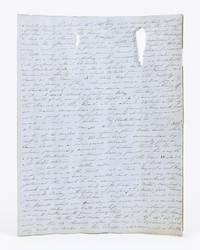
réf. 135288Fair. Quarto 12 pages last two blank. A saddle-sewn gathering of blue paper; two holes to each leaf apparently insect damage with some minor loss to the text; some marks and short edge tears; nevertheless an extraordinary relic in decent condition overall. The first nine pages closely written in ink in a single hand which we know to be that of pastoralist Alfred Barker 1812-1880 contain a version of Stuart's journal for the period from 31 March the beginning of the expedition to 17 May 1859 with some significant variation from the published versions. Importantly the final half-page of text is unmistakably in the hand of John McDouall Stuart himself. This passage - an addendum written in pencil and comprising material not included in published versions of the journal - describes the extent of Stuart's claims of pastoral land at Chambers Creek. The journal is accompanied by a loose bifolium containing manuscript directions to Chambers Creek quarto 2 pages also in Barker's hand with a small diagram of Hummock Hill. The journal ends after the entry for 17 May 1859. Published accounts of the expedition indicate that Stuart spent the following three days in camp finalising his report on the survey of Chambers Creek which was sent back to his patrons James and John Chambers and William Finke on 20 May by way of one of the expeditioners Campbell. The specific nature of the variations from the published versions leads us to conclude that Stuart sent with this material an edited version of his field journal to that date the originals of both manuscripts are now lost. Barker brother-in-law and business partner of the Chambers brothers would have copied the present manuscript directly from Stuart's original manuscript. It pays scant attention to the daily happenings of the expedition but records detailed information about the country with a particular regard to its suitability for pastoral use precisely the information most valuable to patrons intent on building a pastoral empire. Stuart's manuscript addendum to Barker's copy of his report must have been written in the short period between his return on 3 July 1859 and the departure in August of the same year of his third expedition into the interior. He had given John Chambers power of attorney in relation to his claims on the runs at Chambers Creek where he had claimed a staggering 1500 square miles of land. The matter had still not been settled at his departure and Stuart's precise description of the extent of his claim were evidently intended to allow his patrons to consolidate it in his absence. The detailed manuscript text on the separate bifolium also supports a date from the middle of 1859. It gives a set of straightforward directions to Chambers Creek via the crucial series of waterholes that Stuart had identified as well as some details of the surrounding country. Barker was soon to follow this route north to stock Stuart's empty cattle runs the explorer lacking the resources to do so himself. While these instructions are in Barker's hand they must have been prepared in consultation with Stuart in preparation for the cattle drive north. Returning from his third expedition Stuart was pleased to find Barker's cattle thriving on the saltbush on his land. After great difficulty and scandal the grant was finally made for an unprecedented area of 1000 square miles but many suspected that the beneficiary of the vast territory would be Chambers and Finke not the explorer Barker's contribution going unremarked in newspaper accounts of the time. This would be borne out in the coming years. The textual history of the journal of Stuart's second expedition makes the survival of this document all the more important. In her introduction to the edition of the journal published by the Friends of the State Library of South Australia 2002 Valmai Hankel writes: 'This expedition is the only one for which no manuscript diary or fair copy survives. As it was regarded as a private venture unlike the five other expeditions its results were not reported to Parliament so its journal was not published as a parliamentary paper. The only known versions are those published in the "Journal" of the Royal Geographical Society RGS vol.31 1861 pp.65-83 and in "Explorations in Australia. The Journals of John McDouall Stuart during the years 1858 1859 1860 1861 & 1862" edited by William Hardman London: Saunders Otley 1864 .'. The RGS and Hardman versions of the text are generally more discursive but both are the result of editing by third parties and would have been based on fair copies of the journals. Hardman in particular was an unsympathetic editor 'Stuart seems to be almost an illiterate person .' and often redrafted Stuart's matter-of-fact observations to fit more closely the mould of a Victorian travel narrative. Our manuscript on the other hand is not only contemporaneous with the expedition but also likely closer in content to the lost field journals before editorial intervention and judicious redaction and revisions for political and commercial considerations. A full transcription of the journal is available as are a list of variations from the published version. One example will suffice to indicate the significance of this manuscript. Hankel's introduction states that 'The expedition's main aims were to survey the Chambers Creek lease and to prospect for gold . Stuart's major discovery was more links in the chain of springs later known as mound springs which Warburton and Babbage had found in 1858. Hergott found the first on 13 April; although Stuart named them after their discoverer he does not say so in either version of his journal' page x. The manuscript states that 'on the 13th Hergott after finding St Stephens Pool dry and no water in the Range - discovered a batch of Springs South of the Pool - abundance of Water - distance from this camp to Hergotts Springs 30 Miles - Native Cucumbers found here'. These documents were purchased together with an important archive relating to Alfred Barker's pastoral properties offered separately and now sold. The archive contains letters that substantiate serious irregularities in the handling of Stuart's pastoral lease at Chambers Creek which when read in conjunction with the above material make the story of his final years even more distressing. Copies of the relevant letters are included with the manuscript. unknown
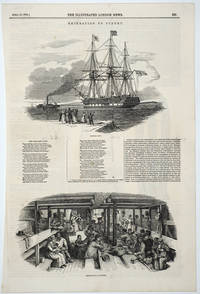
réf. 28182A valuable reference collection of images and articles that shaped perceptions of Australia to the wider world in the 19th century. This is a collection of over 800 woodcut illustrations and articles from the 19th century from the Illustrated London News The Graphic and The Illustrated Times & other less successful periodicals. The images of the ILN and Graphic are a comprehensive and systematic collection of Australian related images and articles from 1842 ILN and 1870 Graphic through the end of 1899. This collection was started in London in the late 1970s. It was our intention to create a comprehensive reference of every woodcut image of Australian interest in the two major British periodicals from their start date to 1900. We were living in North London not too far from Omniphil Limited a company based in Chesham Bucks. They were the preeminent dealers in woodcut images from British periodicals in the 1970s and 80s. We visited their premises repeatedly and sat and turned the pages of every single volume of their reference set noting the images related to Australia and purchasing a copy of those images. Another component of the collection is an assemblage of Australian images from lesser-known periodicals such as the Illustrated Times the Pictorial Times The Illustrated News of the World Gleason's Pictorial Drawing Room Companion Harper's Weekly Canadian Illustrated News and a few singletons from the Illustrated Family Paper l'Opinion Publique and the Australasian Sketcher. An important component of this collection is the associated Excel listing of the prints & text. These are indexed by year month & day image title print size associated text and folder number. The total collection is housed in nine A3 folders with fixed sleeves. Early years have 2 sheets per sleeve; later years are sometimes grouped together to fit into the available room in the album. The folders are approx. 12 ½" x 17" x 1". They were manufactured in England by Rexel Nyrex with the following label in the back inside cover "Rexel / Nyrex / PFV / A3 / 24 Made in Gt. Britain." The company still manufactures plastic products. We have not been able to ascertain if these are archival but the prints have been in the folders for at least 43 years and there has been no degradation. The only exception to the completeness of the collection is ship prints which were quite expensive at the time we assembled the collection. The collection is organized in three parts: Part I - The Illustrated London News 1842-1899; Part II - The Graphic 1870-1899; Part III - The Illustrated Times the Pictorial Times and other British & North American periodicals 1845-1883. Combined these original woodblock prints and articles are a valuable reference collection that shaped perceptions of Australia to the wider world in the 19th century a collection which would now be all but impossible to assemble. Part I Australian images from The Illustrated London News British periodical from its start in 1842 thru 1899. A comprehensive collection of Australian related images & articles from this groundbreaking periodical - the world's first illustrated weekly news magazine; the first periodical to employ special war correspondents and illustrators; the first to publish color supplements. The Australian material begins in the first publication on May 14 1842 and runs through the last article in the century in June 1899 and has approximately 467 images and 29 substantial articles. Australia is mentioned in the text of the first issue with an article "Sheep Farming in Australia" on p.15 about 4 column inches from the Inverness Courier. On the verso is an amusing illustration of a publicity stunt of the publishers. The founder Herbert Ingram paid hundreds of men to carry large sign boards in the streets reading "The Illustrated London News 30 Engravings Price 6D." The highly exaggerated drawing shows the sign bearers stretching as far as the eye can see on London footpaths. The caption reads "The 'Illustrated London News' Published Every Saturday. Thirty Engravings. Price Sixpence. The above engraving represents the public announcement of this paper on Friday last. Two hundred men paraded the streets of London to proclaim the advent of this important publication." Below the rule is printed "London: Printed by R. Palmer at the Office of Palmer & Clayton 10 Crane-court; and published by J. Clayton at 320 Strand. - Saturday May 14 1842." The first image of an Australian subject is in the December 23 1843 issue "New Government House Sydney" with text. The revenue stamp appears at the bottom left of the page. The discovery of gold in Australia is announced in a long article on the cover on Sept. 6 1851 entitled "Another El Dorado" in an article 15 column inches long. The last image is from June 1899 the Australian cricketeers in London- "The Australian Cricket Team / The Team up-river: leaving Boulter's Lock / The Test match at Lords Between England and Australia: Trumper and Hill at the Wickets". The ILN collection is housed in six A3 folders with fixed sleeves. Early years have 2 sheets per sleeve; later years are sometimes grouped together to fit into the available room in the album. Folder 1 - 1842-1852; 68 images & 12 articles Folder 2 - 1852-1854; 70 images & 13 articles Folder 3 - 1855-1861; 50 images & 1 article Folder 4 - 1862-1864; 55 images & 1 article Folder 5 - 1865-1884; 90 images & 2 articles Folder 6 - 1886-1899; 135 images Although Gale subscription service has a digitized resource titled the "Illustrated London News Historical Archive 1842-2003" this collection is invaluable as it is composed of the actual period woodblock prints and articles accessible in six A 3 folders. Part II Australian images from The Graphic British periodical from its start in 1869 thru 1899. Australian related images from The Graphic the British weekly illustrated newspaper first published on 4 Dec 1869 which was set up as a rival to the Illustrated London News. The Australian images begin in March 1870 and runs through 1899 approximately 242 images. There are 13 double page images 2 full weekly issues for the Sydney & Melbourne Exhibitions with the continuing supplements; 1 color Christmas issue; 74 full page and 39 half page illustrations. Highlights include images of bush and settlers' lives Tichborne case cricket Victorian gold the Kelly gang black trackers wool shipping ostriches a shearing dispute. The first Australian related image in The Graphic was published on the cover of the March 12th 1870 edition "Picnic in Australia To the Officers of the Flying Squadron." The last image for the 19th century is dated July 1899. The Graphic is housed in two folders are A3 approx. 12 ½" x 17" x 1". Part III Australian images from The Illustrated Times the Pictorial Times and other British periodicals as well as North American periodicals including Gleason's Pictorial Drawing Room Companion Harper's Weekly and others. London; New York; Boston; Canada: Various publishers 1845-1883. A collection of some of the scarcer woodcut images of Australian related images from various shorter-lived illustrated periodicals published in England and North America. These include The Pictorial Times The Illustrated Times The Illustrated News of the World Gleason's Pictorial Drawing Room Companion Harper's Weekly Canadian Illustrated News and a few singletons from the Illustrated Family Paper l'Opinion Publique and the Australasian Sketcher. These are scarcer publications than the market-dominating Illustrated London News & The Graphic. The collection starts in March 1870 and runs through 1899 approximately 107 images. Of particular interest is a series in the Illustrated Times entitled "England Versus Australia" illustrated by Florence Claxton. Claxton was an English artist who spent part of her adolescence in Sydney NSW in the 1850s. Throughout 1863 and early 1864 Miss Claxton drew imagined comparisons between the two environments not uniformly biased towards either country. In the first "Daughters Here" has a group of gentlewomen sitting in a lovely drawing room making lace playing piano or gazing in the mirror. "Sons There" shows the men doing the laundry mending and cooking. "Governesses Here" shows a gaggle of governesses seemingly subject to the whims of a butler; "Want of Governesses There" shows a home with the mother distraught the children causing absolute pandemonium & the father sitting and reading the paper. In another "Needlewomen Here" the seamstresses work themselves to exhaustion in a dark room with one light; "A Modiste There" shows a prosperous woman with many customers. We did not have access to a reference set for these smaller publications so these images are an assemblage not a comprehensive and consistent collection. The Pictorial Times. 1843-1848 Opened by Henry Vizetelly his brother and Andrew Spottiswoode. Eventually it was purchased by Ingram owner of the ILN and merged with The Lady's Newspaper. Unfortunately this newspaper did not date their issues but sometimes dates are to be found in text. The Illustrated Times. 1855-1862. A rival to the ILN edited by Henry Vizetelly who had left the ILN to open it. Vizetelly campaigned in the 1850s for the repeal of the Stamp Act. Its eventual repeal was a great boon allowing the new paper to be published at the low price of two pence. The Illustrated News of the World 1858-1864. This was published by John Tallis famed for his atlases with maps adorned with views. According to OCLC: 7091980 It started in Feb. 1858 and ceased in Aug. 1864 . Gleason's Pictorial Drawing-Room Companion was a 19th-century illustrated periodical published in Boston Massachusetts. The magazine was founded by Frederick Gleason in 1851. According to OCLC: 10261386 it ran from 1851 - 1854. The publication name was changed to Ballou's Pictorial Drawing-Room Companion in 1855 after managing editor Maturin Murray Ballou bought out the interest of Gleason. Unfortunately this newspaper did not date their issues but sometimes dates are to be found in text. Harper's Weekly A Journal of Civilization was an American political magazine based in New York City. Published by Harper & Brothers from 1857 until 1916 it featured foreign and domestic news fiction essays on many subjects and humor alongside illustrations. It carried extensive coverage of the American Civil War including many illustrations of events from the war. During its most influential period it was the forum of the political cartoonist Thomas Nast. This collection is housed in one A3 folder approx. 12 ½ x 17" x 1" with fixed sleeves. The prints & text are indexed by newspaper and thence by year month & day image title print size & associated text including some artists and folder number. A collection of primary source documents revealing the perceptions and attitudes towards Australia in the 19th century. hardcover
réf. 22311Conservé dans trois boîtes en carton
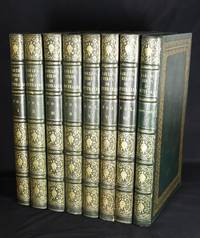
1869réf. 29221London: by the author printed by Richard and John E. Taylor 1840-_ 1869. First edition. A FINE COPY OF GOULD'S MOST IMPORTANT WORK which was issued in 41 parts over 30 years and occupied more than half of his career. In the original publishers' full morocco gilt stamped binding. Provenance: Presented to the Right Reverend Mathew Blagden Hale by the members of the Church of England and other Denominations of Christians of Western Australia Perth October 28th 1876. With large presentation label printed in gold dated in each volume. Mathew Blagden Hale 1811-1895 was the first Bishop of Western Australia and founder of Hale School. Gould started work on the Birds of Australia in 1837 but ceased this effort when he found he did not have enough material to work from in England. He and his family departed for Australia where his wife had two brothers and remained there for 18 months collecting new specimens in New South Wales and Tasmania. John Gilbert was sent to collect specimens from Western Australia Queensland and South Australia. As Gould had introductions to the explorers working at the time he also received contributions of specimens from Sturt and Grey. As a result of this intensive effort 300 new species were claimed by Gould. AUSTRALIAN EXPLORERS' CONTRIBUTION TO GOULD'S BIRDS OF AUSTRALIA In May 1838 Gould his wife Elizabeth John Gilbert their zoological collector one of their sons a nephew & two servants sailed for Australia. On their 27 montsh stay in the Colonies they received assistance from all sides ~ the Colonial Governors and most importantly the early explorers of Australia's interior. In Tasmania the Goulds were looked after by the Governor Sir John Franklin of later Arctic fame and Lady Franklin who were greatly interested in the flora and fauna of the country. Gould and Gilbert explored much of Tasmania and the Bass Strait islands. In February 1839 John Gilbert departed for an eleven month stay in the Swan River Colony. Gilbert made further explorations to the Northern Territory with Ludwig Leichhardt but during Leichhardt's overland expedition in 1845 from Brisbane to Port Essington was tragically killed by aboriginals. Book - Journal of an Overland Expedition in Australia. 1847. In June of 1839 Gould began a journey with Captain Charles Sturt from Adelaide to "the Murray Scrubs" the Mallee returning to Adelaide in July from where he visited Kangaroo Island before returning to Hobart. Books- Two Expeditions into the Interior of Southern Australia. 1833 & Narrative of an Expedition into Central Australia. 1849. Contributions of specimens & information came from all quarters. George French Angas contributed eggs and information about the Yellow- eared Black Cockatoo. Book- South Australia Illustrated one of the great Australian topographical view books. In the course of his hydrographical voyage on the H.M.S. Rattlesnake John MacGillivray contributed information about the Great Palm Cockatoo. Book- Narrative of the Voyage of H.M.S. Rattlesnake commanded by the late Captain Owen Stanley. 1852 Cape York area. T.L. Mitchell surveyor general of New South Wales supplied descriptions of the Leadbeater's Cockatoo commonly known as the "Major Mitchell". Books- Three Expeditions into the Interior of Eastern Australia.1838 & Journal of an Expedition into the Interior of Tropical Australia.1848. The last voyage of the "Beagle" was in Australian waters from 1837 to 1843. In 1841 Capt. Wickham suffering ill-health was relieved of his command by Lieut. John Lort Stokes Book - Discoveries in Australia; with an account of the Coasts and Rivers explored and surveyed during the Voyage of H.M.S. Beagle In the Years 1837- 1843. 1846. The task of the expedition was to survey those parts of the northern coast of Australia not already charted by Flinders or King. Accompanying them on this trip was the young lieutenant George Grey whose duty it was to explore the land in Australia's northwest with a view to establishing a permanent settlement there. Book - Journals of Two Expeditions of Discovery in North-West and Western Australia. 1841 The scientific appendices in volume two of Grey's "Journals" include one on birds by John Gould ~ " Mr. Gould kindly forwarded the following enumeration of the species which have come under his notice as inhabiting that part of the country Western Australia." There follows a 7 pp listing of birds of W.A. "Officers of the Beagle" are credited by Gould's "Handbook to the Birds of Australia" as supplying information on the Rose-breasted Cockatoo. To conclude the history of Australia's inland exploration is inextricably bound up with Gould's masterwork The Birds of Australia. It was an extremely fertile and productive time in Australia ~ Sturt Mitchell & Angas in eastern & southern Australia; Leichhardt MacGillivray Stokes & Grey in the north & west. Reading the letter-press that accompanies each color plate of Gould's Birds bears witness to the combined efforts of Gould and the explorers and settlers of Australia ~ Gould constantly refers to specimens and information on the birds' customs and habitat sent to him by various explorers. Many times this spirit of cooperation overflows into the naming of the bird itself. Gould was the touchstone who pulled together the contributions of Australia's explorers into the foundation work on Australia's ornithology. This combined with Gould's work with Darwin interpreting the specimens from the famous "Beagle" voyages takes Gould's Birds of Australia out of a strictly natural history realm and places it firmly alongside the great scientific discovery expeditions of the 19th century. GOULD'S CONTRIBUTION TO DARWIN'S THEORY OF EVOLUTION Before the Goulds' plans for the work on the Birds of Australia came to fruition John Gould became involved in a co-operative project with another scholar - Charles Darwin. In October 1836 Darwin returned to England from his 5 year circumnavigation on the H.M.S. Beagle on which John Lort Stokes served for 18 years- rising from midshipman in 1825 to commander in 1841. Darwin needed expert help in the description & identification of the preserved birds insects rocks shells & insects for his production of the Zoology of the Voyages of H.M.S. Beagle. Darwin had heard of Gould's books from Thomas Campbell Eyton a naturalist friend from Cambridge days who had bought Gould's Toucan prints. They were expensive he wrote but of good value as he had since been offered a higher price! Through the Zoological Society where Gould had established his reputation as a premier taxidermist Darwin initially made contact with Gould about a special Rhea seen during his travels in Northern Patagonia. This Rhea was an ostrich of dark mottled color with shorter legs than the Common Rhea. Conrad Martens the artist on the Beagle expedition shot one for food and it was cooked and eaten before Darwin realized that it was a less-known species. Fortunately the head neck feathers & skin had been preserved and were sent to the Zoological Society where it was put together and a nearly perfect specimen made for display. Gould classified the Rhea as a new species "Rhea Darwinii". The third volume of the "Zoology of the Voyage of the H.M.S. Beagle" contained fifty bird plates which was advertised by Darwin as "taken from sketches made by Mr. Gould himself and executed on stone by Mrs. Gould". When Gould & Darwin were examining the birds brought from the Galapagos Islands they were fascinated by a group of about thirteen finches of the same species which had curiously different-sized beaks. These modifications occurred on different islands and it was the investigation of this and other scientific data accumulated over a long period that led to Darwin's theories of evolution by adaptation formulated many years later. Frank Sulloway Harvard University 1982 has investigated Gould's part in Darwin's theory of evolution and shows that Gould astutely realised the basic peculiarities of these birds thus paving the way for Darwin's first notes on the "Transmutation of Species". Gould presented descriptions of the Galapagos finches and mockingbird specimens at the Zoological Society in January 1837. However he was unable to finish his work for Darwin. Due to the rush before the Goulds' departure to Australia parts of his manuscript were left unresolved and the work was completed by George Robert Gray of the British Museum. As Gould only published 250 sets of "The Birds of Australia" the number of complete copies which could possibly come on the market is significantly diminished by many factors ~ the work was issued in parts and not all copies were bound which would contribute to their demise over time. Many of the sets that survive are in institutional hands and unlikely to come onto the market. Over the last 20 years at least 10 copies have been "broken up" and sold as plates. This loss of a number of complete sets will certainly lead to a complete and undisturbed Gould attracting a premium by virtue of its increasing scarcity. 8 imperial folio volumes including supplement 2 pp list of subscribers 681 hand-colored lithograph plates including 3 double-page by John and Elizabeth Gould or by Gould and H.C. Richter. Printed by Hullmandel and Walton. Occasional minor spotting. Uniformly bound in publisher's green period full green morocco sides with gilt borders spines gilt in 6 compartments gilt edge by Clyde. The books are presently in the UK. Nissen IVB 370; Anker 174 and 179; Fine Bird Books p. 78; Wood p. 365; Zimmer pp 255-6 and 259; Sauer 9 and 18; Ferguson 4773 & 10032a. Bibliography: Lambourne Maureen Wm. McEvoy & Dr. Gordon Sauer. "John Gould - BIRD MAN" London 1987 Wantrup Jonathan "Australian Rare Books 1788-1900" Sydney 1987. by the author, printed by Richard and John E. Taylor, (1840-_ unknown