[South Australia]Biblio.com
6 212 résultats
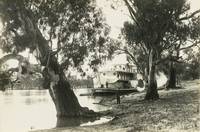
1910réf. 137365Near Kingston: Unidentified Photographer 1910. Very Good. Near Kingston Unidentified Photographer circa 1910s. A gelatin silver photograph 207 × 307 mm with one short tear to the top edge expertly sealed; in excellent condition. '2343 Near Kingston River Murray' is written in red pencil on the verso. The State Library of South Australia has a poor-quality reproduction of this image in its Kingston-on-Murray Collection B 31442 dated 'Approximately 1870'. This is clearly incorrect as PS 'Marion' wasn't built until 1897. [Unidentified Photographer unknown
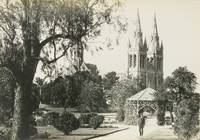
1917réf. 137366Adelaide: Unidentified Photographer 1917. Very Good. Adelaide Unidentified Photographer circa 1917. A gelatin silver photograph 220 × 310 mm with two tears to the top edge expertly sealed; in excellent condition. '2790 Pennington Park' is written in red pencil on the verso; ''& Cathedral' has been added later in lead pencil. The State Library of South Australia has a damaged smaller-format example of this photograph in its Searcy Collection 'St. Peter's Cathedral North Adelaide PRG 280/1/18/356' 15 × 20 cm approximately 1917. [Unidentified Photographer unknown
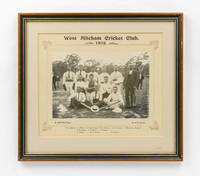
1902réf. 122144Adelaide: N. Netter Photo. 45 & 47 Arcade 1902. Fine. Adelaide N. Netter Photo. 45 & 47 Arcade 1902. A gelatin silver photograph 143 × 209 mm on the original captioned mount now matted visible image size 223 × 267 mm and behind glass in a period-style wooden frame external dimensions 319 × 354 mm. The frame is a little scuffed; the photograph and mount are in fine condition. A wonderful image of a parochial cricket team in the field: it should even appeal to the collector of photographs who has no interest at all in cricket. N. Netter, Photo., 45 & 47 Arcade unknown
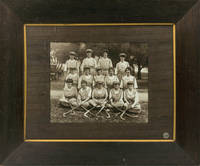
1924réf. 123086Gawler: Marchant's Studio 1924. Fine. Gawler Marchant's Studio circa 1924. An original gelatin silver photograph behind glass in the original blackwood frame with gilt fillet and wood-veneer mat visible image size approximately 238 × 288 mm external dimensions approximately 480 × 580 mm. The photograph is in fine condition; the frame is in excellent condition albeit slightly scuffed and marked. A small Marchant's Studio paper label is mounted on the mat; a considerably larger label mounted on the verso states it has been 'Established Sixty Years'. Davis and Stanbury 'The Mechanical Eye in Australia' suggest this occurred in 1864. 'The game of hockey was brought to Australia by British Naval officers stationed around the country in the late 1800s. By 1900 according to Hockey Australia the game was being played in private girls' schools. Being a non-contact team sport it was considered ideal for women. The first women's hockey association was formed in New South Wales in 1908. Two years later women's clubs from Tasmania Victoria and South Australia were competing alongside clubs from New South Wales at an interstate tournament at Rushcutter's Bay and from this tournament came the establishment of the Australian Women's Hockey Association in July 1910 - fifteen years before the Australian Hockey Association AHA was formed in 1925. State hockey associations for men had been formed in South Australia 1903; Victoria and New South Wales 1906; Western Australia 1908; and Queensland 1920s. This division in the administration of men's and women's hockey continued in subsequent years. The Australian Women's Hockey Association affiliated with the All England Women's Hockey Association and joined the International Federation of Women's Hockey IFWH in 1927' Australian Women's Archives Project online. Accordingly this item is tolerably early as well as being a fine piece of portraiture. Marchant's Studio unknown
1870réf. 112789Adelaide: The Adelaide Photographic Company 1870. Adelaide The Adelaide Photographic Company circa 1870. An albumen paper photograph 94 × 61 mm mounted as issued on the printed card 104 × 63 mm of The Adelaide Photographic Company. A few tiny surface scrapes to the bottom millimetre or so of the photograph and slight surface loss to the plain section of the mount adjacent to it but overall the condition is excellent. There is an example of the same image in the State Library of NSW a gift from a family member John Howard Johnson dated January 1870. The 'Australian Dictionary of Biography' has this to say about Angas: 'although his prominence in the foundation of South Australia has been somewhat exaggerated . he deserves full credit for the capital and settlers that he introduced into the new colony'. He emigrated with his family in 1851 and spent the rest of his life in the colony. The Adelaide Photographic Company unknown
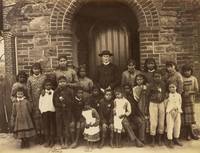
réf. 141099Original sepia-toned albumen paper photograph 158 × 210 mm unmounted as issued; in fine condition. Captain Samuel White Sweet 1825-1886 sea captain surveyor and photographer: after he was censured when his ship ran aground in 1875 he 'retired from the sea opened a photographic studio in Adelaide and concentrated on landscapes. With his horse-drawn dark room he travelled through South Australia taking hundreds of skilful pictures of the outback stations and homesteads. The colony's foremost documentary photographer of the 1870s in the early 1880s he was one of the first to use the new dry-plate process' 'Australian Dictionary of Biography'. 'Sweet Adelaide ' is inscribed in the negative the three-digit reference number is cropped but it appears to be 442 or 443; 'Poonindie native mission school' is written in pencil on the verso. The Art Gallery of South Australia and the State Library of Victoria also have an example of this print. There are several differences between all these three examples: they are different enlargements; the AGSA example does not have the photographer's credit in the negative; the SLV example does but the negative is printed in reverse. 'Captain Sweet's Colonial Imagination - The Ideals of Modernity in South Australian Views Photography 1866-1886' by Karen Magee a 2014 University of Adelaide doctoral thesis accessible online records that Sweet visited Poonindie in 1884. Magee reproduces the AGSA photograph in her extensive catalogue see number 820. unknown
réf. 127212Very Good. An albumen paper photograph 159 × 205 mm; tiny quarter-round indentations to the bottom corners a legacy of having been tipped in on a mount at some stage; slight fading around the edges; now unmounted and in excellent condition. The photograph shows the eastern side of a fairly quiet King William Street; the clockless tower of the Town Hall has a prominent position to the right of the image. Captain Samuel White Sweet 1825-1886 was a sea captain surveyor and photographer: after he was censured when his ship ran aground in 1875 he 'retired from the sea opened a photographic studio in Adelaide and concentrated on landscapes. With his horse-drawn dark room he travelled through South Australia taking hundreds of skilful pictures of the outback stations and homesteads. The colony's foremost documentary photographer of the 1870s in the early 1880s he was one of the first to use the new dry-plate process' 'Australian Dictionary of Biography'. unknown
réf. 127215Very Good. An albumen paper photograph 158 × 208 mm mounted on card a little tanned; in excellent condition. The photographer's credit and reference number 'Sweet Adelaide 526' is scratched in the negative. The photograph was taken from on top of the Kent Town Brewery looking west along Rundle Street across the parklands taking in all to the right north as far as the old Royal Adelaide Hospital and the dome of the Palm House in the Adelaide Botanic Gardens. Captain Samuel White Sweet 1825-1886 was a sea captain surveyor and photographer: after he was censured when his ship ran aground in 1875 he 'retired from the sea opened a photographic studio in Adelaide and concentrated on landscapes. With his horse-drawn dark room he travelled through South Australia taking hundreds of skilful pictures of the outback stations and homesteads. The colony's foremost documentary photographer of the 1870s in the early 1880s he was one of the first to use the new dry-plate process' 'Australian Dictionary of Biography'. unknown
réf. 115751George Taplin 1831-1879 missionary and teacher began his work with the Ngarrindjeri in April 1859; the 'site he chose for a settlement on the shores of Lake Alexandrina was a traditional camping ground called Raukkan The Ancient Way known to Europeans as Point McLeay. Keenly interested in Ngarrindjeri culture and society he learned their language used it in preaching and translated and published Bible tracts. He published invaluable anthropological studies which were much superior to contemporary work on South Australian Aboriginals. Despite his sympathy with the people and their traditions Taplin adhered to the contemporary view that Christianity and Europeanization should be adopted and Ngarrindjeri civilization abandoned; as a result he assisted in undermining their government and social structure further weakened traditional discipline and morale within the confederacy and provoked strong opposition from conservative tribal members. But they had been dispossessed and persecuted before his arrival and by helping them become literate and numerate and to acquire trades he enabled them to survive and flourish briefly in European society. Today hundreds of their descendants remain in various districts of Australia; their durability can largely be attributed to Taplin. He was a compassionate Christian and a courageous fighter. Exhausted he died of heart disease at Raukkan on 24 June 1879 survived by his wife and six children. He was buried in the village cemetery' 'Australian Dictionary of Biography'. The photograph 163 × 220 mm shows the newly-installed headstone which was 'Erected By The Aborigines'. It is on the original mount captioned along the bottom margin 'S.W. Sweet Photo. Flinders Street Adelaide'. The acidic mount is discoloured lightly stained and unevenly trimmed; the top right-hand corner is broken away taking with it a small triangular piece of the photograph approximately 10 × 45 mm of the sky; the sepia-toned print is a little speckled confined mainly to the left and right margins but overall it is a very arresting image. The only example recorded in Trove in the State Library of SA appears to be of better quality but it is not for sale and more importantly the photographer is not identified. This significant fact may now be added to the record. Captain Samuel White Sweet 1825-1886 was a sea captain surveyor and photographer: after he was censured when his ship ran aground in 1875 he 'retired from the sea opened a photographic studio in Adelaide and concentrated on landscapes. With his horse-drawn dark room he travelled through South Australia taking hundreds of skilful pictures of the outback stations and homesteads. The colony's foremost documentary photographer of the 1870s in the early 1880s he was one of the first to use the new dry-plate process' 'Australian Dictionary of Biography'. unknown
1980"Marianne North was one of those intrepid Victorian Lady Travellers, most renowned for her brilliant botanical paintings, displayed in specially designed Gallery in the Botanical Gardens at Kew. This book uses extracts from her autobigraphical account of her travels ("Recollections of a Happy Life. Being the Autobiography of Marianne North". Edited by Her Sister Mrs. John Addington Symonds. Two volumes. 1894) and is beautifully illustrated with her paintings, many reproduced for the first time. The book was published in collaboration with The Royal Botanic Gardens, Kew. Preface by J P M Brenan, Director of the Royal Botanic Gardens. Foreword by Anthony Huxley. Biographical note by Brenda E Moon. 240p. illus (col) maps on endpapers. A nice book to send as a gift ! Book
1962réf. 138331Adelaide: Public Library of South Australia 1962. Hardcover. Very Good. Adelaide Public Library of South Australia 1962 facsimile edition/ 1846. Duodecimo v viii 188 pages with several illustrations. Synthetic cloth; endpapers lightly tanned; edges a little marked; an excellent copy. Peade SA22: one of only 49 copies of this xerographic facsimile published with the text bound from fan-fold paper printed on one side only uncut and unopened along the leading edges. Pages 73-134 relate to South Australia. Public Library of South Australia hardcover
1894réf. 64343Adelaide: J.L. Bonython & Co. 'The Advertiser' Office 1894. First Edition. Paperback. Very Good. Adelaide J.L. Bonython & Co. 'The Advertiser' Office 1894. Octavo iv 147 pages. Original wrappers acidic and brittle slightly marked and a little chipped and cracked with a little loss lacking most of the spine three corners and small pieces near the hinges; title-page and the last page discoloured; a very good copy. The author was 'Professor of Laws at the University of Adelaide'; perhaps not surprisingly this copy has the small circular rubber-stamp of then-Chief Justice Sir Samuel Way on the front cover and the title-page. J.L. Bonython & Co., 'The Advertiser' Office paperback
1962réf. 144061Adelaide: Libraries Board of South Australia 1962. Hardcover. Very Good. Adelaide Libraries Board of South Australia 1962 facsimile edition but see our footnote/ 1844. Octavo 212 pages this edition printed one side only on leaves uncut along the leading edge. Synthetic cloth slightly marked; edges endpapers and first leaf a little foxed; an excellent copy. Peade SA40: one of only 51 copies. Rare even in facsimile form and not generally recognized as being an important variant. Not even the authorised bibliography by Peade records the fact that the original from which this facsimile edition was produced contained often on interleaved blanks extensive manuscript additions attributed to Schurmann. Libraries Board of South Australia hardcover
1998réf. 037457Sydney: Hordern House 1998. 37pp bibliography bw ills 164pp. Or marbled boards with leather spine quarter leather. White mark along leather on front. Edition limited to 950 copies of which this one of 900 hand bound in quarter cherry Scottish calf. Originally published in 1793. Limited Edition. Hard Cover. Very Good. 8vo. Hordern House Hardcover
1991réf. 037454Sydney: Hordern House 1991. 149pp bw ills. Or marbled boards with leather spine quarter leather. Edition limited to 750 copies of which this one of 675 hand bound in quarter maroon Scottish calf. Mary Parker was Australia's first tourist and this the first published account of the colony by a woman. Originally published in 1795. Limited Edition. Hard Cover. Near Fine. 8vo. Hordern House Hardcover
17894to [30.5 x 23.5 cm]; xxix, [ii, errata, directions leaf], 360, 47 pp, 22 plates and maps including 6 folding maps and charts, tables, with the half title page (often lacking). contemporary leather backed marbled boards, gilt spine title lettering, joints rubbed, corners worn round, some light staining to about 5 plates at rear, mostly marginal, generally clean and unmarked, very good, a tall copy with wide margins. A picture of Two ships, the King George commanded by Portlock and the Queen Charlotte, commanded by George Dixon, visited the Falkland Islands, made a long stay at Hawaii, then proceeded to survey the American coast, to more accurately map the coast and to establish a British presence in the region's fur trade. National Maritime Museum 140: 'Dixon discovered Queen Charlotte Island, named after his ship'. Buck 35. Sabin 20364. Howes D365. Wickershaam 6574. Lada-Mocarski 43. Hill 352: 'This expedition set out to establish a trade in furs in North America. Dixon visited Hawaii three times in the course of the voyage. . .discovered Queen Charlotte Islands, Port Mulgrave, Norfolk Bay, Dixon Entrance and Archipelago while continuing down the coast and trading with the Indians.. . . Dixon's contribution to the work also includes the valuable maps. The accounts of this expedition relate to the geography, ethnology, and natural history of the American coast from Nootka Sound northward'. The fine plates including many views, birds, portrait, etc. One of the detailed appendices is on the natural history encountered. Dixon had earlier sailed with Cook on the Resolution
1854réf. GT875London: Society For The Promotion of Christian Knowledge 1854. 1st Edition . Hardback. Fine. 12mo. iv 161 iii pub. list; frontispiece. A very rare Mid -Victorian childrens book with no copy traced in Copac at auctiuon or on-line. Original cloth binding with black quarter leather spine and gilt embossed titles. A fine woodcut frontis. view of Maderia and a full page engraving of John Adam's house. A fine copy with no foxing wear marks or fading. The journey 'of a vessel called The Arrow'.with Captain Campbell. 14x10cms. Society For The Promotion of Christian Knowledge hardcover
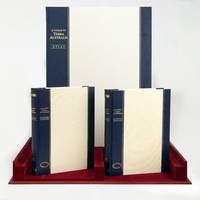
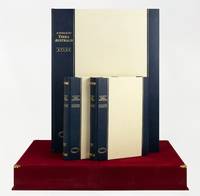
réf. 147425Adelaide: Government Printer 1989. Hardcover. Fine. Adelaide Government Printer 1989 facsimile edition/ 1814. Large quarto two volumes of text plus the elephant folio atlas containing 18 charts and 10 plates. Half dark blue calf and cream cloth; essentially a fine set in the custom-made base of the dark red felt-covered wooden storage box and fitted perspex lid the base a little sunned and lightly worn around the extremities the lid a little scuffed. The publisher's printed cardboard box is also present. A superb production limited to only 500 numbered sets this is number 261. The storage box was designed with a matching two-door lid opening at the centre and attached to the base with piano hinges. About a third of the edition was issued in these boxes as advertised. Apparently the successful tender was paid in full soon after the job began and the box-maker was last seen heading for the hills overseas with the money and a big smile! The problem was 'solved' by securing clear perspex lids which fitted snugly over the custom-made bases. Government Printer hardcover
réf. 144538Adelaide: Government Printer 1989. Hardcover. Near fine. Adelaide Government Printer 1989 facsimile edition/ 1814. Large quarto two volumes of text plus the elephant folio atlas containing 18 charts and 10 plates; some relevant ephemera is loosely inserted. Half dark blue calf and cream cloth; cloth on the front cover of the atlas slightly marked in one small spot; a near-fine set in the near-fine dark red felt-covered wooden storage box lightly scuffed and marked. A superb production limited to only 500 numbered sets this set is number 131. The storage box is designed with a matching two-door lid opening at the centre and attached to the base with piano hinges. About a third of the edition was issued in these boxes as originally advertised; this set is one of them. Apparently the successful tender was paid in full before the job was completed - not all the lids were supplied or fitted - and the box-maker was last seen heading for the hills overseas with the money and a big smile! The problem with the majority of the boxes was 'solved' by commissioning clear perspex lids which fitted snugly over the custom-made bases. Government Printer hardcover
17794to [29 x 24.5 cm]; [ii], xxiii, [i, errata], 388, 13, [i, directions] pp, engraved frontis portrait, plus 32 engraved plates, maps and charts including 20 folding. orig full tree calf, rebacked with orig gilt decorated spine, gilt title lettering on orig red spine leather label, wear at corners & spine ends, armorial bookplate of Robert Austen, marbled endpapers, interior clean, crisp & fine with only slight foxing. Taylor 401. Cox i, 301. Hill p. 108: 'Forrest sailed from Balembangan, in the 'Tartar', a native prahu of about ten tons burden, with two English officers and eighteen Malays, towards the Moluccas. He pushed further east than any of his company predecessors, eventually reaching Geelvink Bay in New Guinea. The voyage was one of examination and enquiry . . . the tact with which he conducted his intercourse with the natives, and the amount of work done in a small boat, deservedly won him credit as a navigator'. They explored the Gilolo Passage between New Guinea and the Moluccas, then sailed to Mindanao, examining the Sulu Archipelago, Mandiolo, Batchian and Waygiou, and reaching the Malay peninsula A vocabulary of the Magindano tongue is added at the end of the book. There is much on the native people, their customs, manners, activities. The book is famous for its fine engraved plates and maps.
19278vo [21 x 14.5 cm]; xxxi, [i], 212 pp, frontis, 2 double-page plates, double page map, 2 facsimiles of title pages from original edition, table. original cloth, rubbed at edges, signature on endpaper, very good. A picture of this book is available upon request by email. Hill p 38; Sabin 9108, Borba de Moreaes p 133. The Voyage describes the loss of the Wager, a transport in Anson's squadron which was wrecked in the Golfo de Penas on the Chilean coast. Following the wreck, a mutinous split occurred, resulting in this voyage of one of the factions to Rio de Janeiro in the long boat. An account of the sufferings of the officers left behind was later published by John Byron. There were later editions published in 1752 and 1757. The introduction by Arthur D. Howden Smith provides an historical perspective. The first edition was 1743 with several printings in the eighteenth century. This is the third edition, and not reprinted since 1757.
19681st edition. Hardback in a protected dust jacket. VG/G++ (price clipped). 18083. eng
1787Incisione inserita nell'opera "A New, Royal, Authentic and Complete System of Universal Geography, Ancient and Modern: Including All the Late Important Discoveries Made by the English, and Other Celebrated Navigators .. History and Description of the Whole World... Likewise the Essence of the Voyages of the Most Enterprising Navigators..." edita a Londra da J. Cooke nel gennaio del 1787
1914réf. 048471London: Methuen & Co 1914. viii 374pp 29pp publishers catalogue at rear; bw ills 3 maps. Or red cloth no jacket. Spine a bit faded prev owner stamp and name on front free endpaper bookseller label on front pastedown page edges toned. A woman's travels and observations in Australia New Zealand New Guinea Philippines China and on the Trans Siberian Railway in the early 19th century. Scarce title. First Edition. Hard Cover. Very Good/No Jacket. 8vo. Methuen & Co Hardcover
1993réf. 141489Vancouver: University of British Columbia Press 1993. Hardcover. Near fine/Fine. Vancouver University of British Columbia Press 1993 first Canadian edition/ 1993. Quarto xxxii 624 pages with 36 illustrations 20 tables and 10 maps plus 20 pages of plates comprising 45 illustrations from photographs. Papered boards; bottom edge very lightly shelf-marked; bottom corner of the front free endpaper lightly creased; a near-fine copy with the near-fine dustwrapper. One of the Miegunyah Press series first published by Melbourne University Press earlier the same year. 'Material originally collected in the 1940s now appears for the first time in this intricate study of an Aboriginal people who inhabited some of the richest country in Australia at the time of European colonisation'. University of British Columbia Press hardcover