6 213 résultats
réf. 75053Offered together with a copy of MARSDEN Susan: Working Lines. A History of Robe Electric Telegraph Station and Post Office 1987; card covers octavo i 34 pages with 20 illustrations. This booklet gives details of the introduction of intercolonial telegraphy. An example of a slightly later version of this form is reproduced on page 13; among other changes it no longer states that 'The Government will not be answerable for errors caused by indistinct writing'. unknown
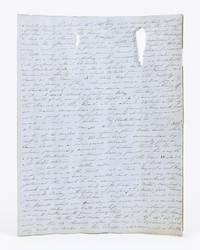
réf. 135288Fair. Quarto 12 pages last two blank. A saddle-sewn gathering of blue paper; two holes to each leaf apparently insect damage with some minor loss to the text; some marks and short edge tears; nevertheless an extraordinary relic in decent condition overall. The first nine pages closely written in ink in a single hand which we know to be that of pastoralist Alfred Barker 1812-1880 contain a version of Stuart's journal for the period from 31 March the beginning of the expedition to 17 May 1859 with some significant variation from the published versions. Importantly the final half-page of text is unmistakably in the hand of John McDouall Stuart himself. This passage - an addendum written in pencil and comprising material not included in published versions of the journal - describes the extent of Stuart's claims of pastoral land at Chambers Creek. The journal is accompanied by a loose bifolium containing manuscript directions to Chambers Creek quarto 2 pages also in Barker's hand with a small diagram of Hummock Hill. The journal ends after the entry for 17 May 1859. Published accounts of the expedition indicate that Stuart spent the following three days in camp finalising his report on the survey of Chambers Creek which was sent back to his patrons James and John Chambers and William Finke on 20 May by way of one of the expeditioners Campbell. The specific nature of the variations from the published versions leads us to conclude that Stuart sent with this material an edited version of his field journal to that date the originals of both manuscripts are now lost. Barker brother-in-law and business partner of the Chambers brothers would have copied the present manuscript directly from Stuart's original manuscript. It pays scant attention to the daily happenings of the expedition but records detailed information about the country with a particular regard to its suitability for pastoral use precisely the information most valuable to patrons intent on building a pastoral empire. Stuart's manuscript addendum to Barker's copy of his report must have been written in the short period between his return on 3 July 1859 and the departure in August of the same year of his third expedition into the interior. He had given John Chambers power of attorney in relation to his claims on the runs at Chambers Creek where he had claimed a staggering 1500 square miles of land. The matter had still not been settled at his departure and Stuart's precise description of the extent of his claim were evidently intended to allow his patrons to consolidate it in his absence. The detailed manuscript text on the separate bifolium also supports a date from the middle of 1859. It gives a set of straightforward directions to Chambers Creek via the crucial series of waterholes that Stuart had identified as well as some details of the surrounding country. Barker was soon to follow this route north to stock Stuart's empty cattle runs the explorer lacking the resources to do so himself. While these instructions are in Barker's hand they must have been prepared in consultation with Stuart in preparation for the cattle drive north. Returning from his third expedition Stuart was pleased to find Barker's cattle thriving on the saltbush on his land. After great difficulty and scandal the grant was finally made for an unprecedented area of 1000 square miles but many suspected that the beneficiary of the vast territory would be Chambers and Finke not the explorer Barker's contribution going unremarked in newspaper accounts of the time. This would be borne out in the coming years. The textual history of the journal of Stuart's second expedition makes the survival of this document all the more important. In her introduction to the edition of the journal published by the Friends of the State Library of South Australia 2002 Valmai Hankel writes: 'This expedition is the only one for which no manuscript diary or fair copy survives. As it was regarded as a private venture unlike the five other expeditions its results were not reported to Parliament so its journal was not published as a parliamentary paper. The only known versions are those published in the "Journal" of the Royal Geographical Society RGS vol.31 1861 pp.65-83 and in "Explorations in Australia. The Journals of John McDouall Stuart during the years 1858 1859 1860 1861 & 1862" edited by William Hardman London: Saunders Otley 1864 .'. The RGS and Hardman versions of the text are generally more discursive but both are the result of editing by third parties and would have been based on fair copies of the journals. Hardman in particular was an unsympathetic editor 'Stuart seems to be almost an illiterate person .' and often redrafted Stuart's matter-of-fact observations to fit more closely the mould of a Victorian travel narrative. Our manuscript on the other hand is not only contemporaneous with the expedition but also likely closer in content to the lost field journals before editorial intervention and judicious redaction and revisions for political and commercial considerations. A full transcription of the journal is available as are a list of variations from the published version. One example will suffice to indicate the significance of this manuscript. Hankel's introduction states that 'The expedition's main aims were to survey the Chambers Creek lease and to prospect for gold . Stuart's major discovery was more links in the chain of springs later known as mound springs which Warburton and Babbage had found in 1858. Hergott found the first on 13 April; although Stuart named them after their discoverer he does not say so in either version of his journal' page x. The manuscript states that 'on the 13th Hergott after finding St Stephens Pool dry and no water in the Range - discovered a batch of Springs South of the Pool - abundance of Water - distance from this camp to Hergotts Springs 30 Miles - Native Cucumbers found here'. These documents were purchased together with an important archive relating to Alfred Barker's pastoral properties offered separately and now sold. The archive contains letters that substantiate serious irregularities in the handling of Stuart's pastoral lease at Chambers Creek which when read in conjunction with the above material make the story of his final years even more distressing. Copies of the relevant letters are included with the manuscript. unknown
1948réf. 146571Adelaide: 'Printed for private circulation' at The Hassell Press 1948. First Edition. Hardcover. Very Good. Adelaide 'Printed for private circulation' at The Hassell Press 1948. Octavo vi 71 pages plus 2 plates from portrait photographs. Quarter green cloth and textured cream papered boards lettered in green; textured paper a little tanned; a few other trifling signs of age and handling; an excellent copy. Geoffrey William Hassell was killed in action off the coast of Norway on 5 April 1945 at the age of 20 while piloting a RAAF Bristol Beaufighter. This private memorial volume printing a selection of Geoffrey's letters sent during training and on active service was produced by his parents Fred and Minnie Hassell at their Hassell Press. Their personal 'With Compliments' card is mounted on the front pastedown. The book is rare in our experience and the edition was presumably a very limited one. 'Printed for private circulation' at The Hassell Press hardcover
1906réf. 011636Sydney: Angus & Robertson 1906 blue cloth rubbed to edges and joints starting to fray at spine ends lower joint starting to split at top lacks front free end paper half title is browned/ foxed faint foxing up to about pp10 32pp adverts at rear dated November 1906 First edition of this rare title by Banjo Paterson. First Edition. Cloth. Good/No Jacket. 12mo - over 6 - 7 tall. Angus & Robertson hardcover
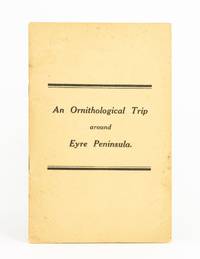
1924réf. 143019Adelaide: S.A. Ornithologist 1924. First Edition. Paperback. Very Good. Adelaide S.A. Ornithologist 1924. Octavo 46 pages with one illustration from a photograph plus a folding map. Saddle-stapled flush-cut wrappers a little foxed and very slightly worn; rubbed; mild signs of age and use; a very good copy. 'Reprinted from S.A. Ornithologist Vol. VIII Part 5 pages 118-130 1st January 1924'. The last two pages consist of another short paper from the same issue A.M. Morgan's 'The Nest and Eggs of Diaphorillas textilis myal' Eyre Peninsula Western Grasswren. S.A. Ornithologist paperback
réf. 19126An original gelatin silver photograph 110 × 90 mm mounted on stiff card 220 × 170 mm inscribed in white ink on the mount beneath the photograph 'With Christmas Greetings from Dr and Mrs Ramsay Smith' stamped on the rear 'Photo. by Dr. W. Ramsay Smith' and captioned in his hand 'At Port Vila - New Hebrides'. Ramsay Smith describes 'picture-making' at Port Vila in detail in his 1924 book 'In Southern Seas' and this image contains all the elements referred to: one's wife 'for comparison and relief to the various objects in the picture' the harbour as background to the wooded heights the ship in the distance . The corners of the mount are slightly rounded and both the image and the mount are a little foxed; overall it is an attractive item with more than the usual amount of background information. William Ramsay Smith 1859-1937 physician naturalist anthropologist civil servant soldier - and controversy was often never far away see the 'Australian Dictionary of Biography'. His entry there states that 'Believing that tribal Aborigines were dying out he recorded their folklore in "Myths and Legends of the Australian Aborigines"' London 1930. Subsequent to this being published Dr Philip Jones has also recorded in the ADB that from the early 1920s David Unaipon 1872-1967 the Aboriginal preacher author and inventor 'studied Aboriginal mythology and compiled his versions of legends . Gathered before 1930 the legends are in his surviving manuscript in the Mitchell Library: they were commissioned and published by William Ramsay Smith without acknowledgment'. unknown
1894In-8 (Cm 21 x 16,5), pp. 72, leg. ed. piena tela, tavole b.n. fuori testo. 1 carta topografica fuori testo. Legatura con leggera scoloritura, un segno di bracitura al margine alto da p. 15 a p. 18 compresa tavola alla quale manca un frammento. Carta topografica volante con strappetto. Ordinari segni del tempo. BUONO
1925réf. 111854London: Cecil Palmer 1925. First Edition. Hardcover. Very Good. London Cecil Palmer 1925. Octavo xii 252 pages with a map plus 16 pages of plates. Cloth sunned on the spine and a little mottled; top edge dusty others slightly foxed; early Argyllshire ownership details on the front pastedown; a very good copy. Loosely inserted is a handwritten letter from Harold Halewood on the letterhead of antiquarian booksellers Preston Book Company to a Mr Bonython: 'Regret each and every item you mentioned from our catalogues 177/178 had been sold: we take the liberty of sending fully on approval Griffin at 15/- Thomas at 30/- and have made an especial note to send you future catalogues by AIR. March 31'. No year is given but the ballpoint pen suggests the 1970s to us. The extended Bonython clan in Adelaide contains a number of eligible recipients of the letter. Cecil Palmer hardcover
réf. 131661Very Good. A single leaf octavo printed recto only slightly marked with a marginal crease to a top corner; two light horizontal creases where folded for posting; in very good condition. The invitation headed '9th L.H.O.C.A.' 9th Light Horse Old Comrades Association invites members to give a hearty welcome to the old commanding officer Colonel William Henry Scott 1881-1960 who 'will be in Adelaide for a few days this month on a visit to his son'. The date for the event is not given but we suggest some time in the 1920s as Scott 'rose to brigadier in 1929' 'Australian Dictionary of Biography'. Darley writes presumably as president of the association that 'it will be quite informal come along in your working clothes or anyhow you like and you need not get your hair cut for the occasion. If you clean your boots be sure to use NUGGET. Refreshments liquid only will be provided'. The ADB provides the answer to the unasked question: 'Scott contributed items to the "Bulletin" under the pseudonym of "Nugget" an ironic nickname considering his great height'. Dornbusch 384; Fielding and O'Neill page 233; Trigellis-Smith 279. unknown
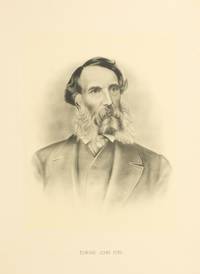
réf. 133136No Place: No Publisher. Very Good. No Place No Publisher No Date but circa 1860s. A lithograph on tinted paper artificial plate mark size 305 × 233 mm; paper size 430 × 318 mm mounted on slightly larger thick card; the caption 'Edward John Eyre' is printed in the margin below the image. Minimal foxing to the margins; slight marks around the edges of the paper a legacy of prior framing easily matted out; a superb portrait in excellent condition. 'Edward John Eyre 1815-1901 explorer and administrator emigrated to New South Wales from England when he was seventeen. Settling in Adelaide after pioneering expeditions with sheep and cattle he made several attempts to find an overland stock route from the city to the west. In January 1840 he learned that a committee was organising an expedition to find a way west. Eyre persuaded them to refocus the expedition on the north agreeing to pay for half of this bid to 'discover the inland of Australia'. Many gruelling months into the trip one of his party was murdered and the rest disappeared. Eyre and his Aboriginal colleague Wylie staggered into Albany more than a year after they had set out. In 1844 after having served as Protector of Aborigines in South Australia Eyre 'served as lieutenant governor of New Zealand 1846-53 and governor of St Vincent 1854-60. Appointed governor of Jamaica in 1864 he was recalled in 1866 after his suppression of an Afro-Jamaican uprising with over 400 executions' History Trust of South Australia. Returning to England he found the intelligentsia divided on his actions; court proceedings were three times brought against him but dismissed. In the early 1870s the government paid all his legal costs and awarded him a governor's pension; he lived in seclusion near Tavistock Devon for the rest of his life' National Portrait Gallery of Australia. The NPGA has a similar portrait a less-accomplished engraving captioned 'Edward John Eyre. Late Governor of Jamaica. Engraved by J. Brown from a Carte de Visite by H. Hering. London Richard Bentley 1867'. The State Library of South Australia has a contemporary photograph of the lithograph; the online version of the 'Australian Dictionary of Biography' reproduces it in its entry on Eyre. An example of the carte de visite by Henry Hering 157 Regent Street London on which all these versions are based is available online in The Caribbean Photo Archive reference 4892686740 where it is catalogued as 'Published by Marion & Co London UK circa 1860'. This lithograph appears to be rare if searches in the usual places are any indication. No Publisher unknown
1990réf. 116745Mead & Beckett Publishing, Darlinghurst, 1990. 288 S. ; 26,5 cm ; Pp. ;
pp. 273-332, numerous drawings in 45 full-page figs., refs. 8vo. Plain new wrs.
1986A clean, unmarked book with a tight binding. 104 pages. Many illustrations in b&w and color. "Terence Barrow explains in plain language the design motifs, the materials and construction and the everyday uses of Maori art objects. His clear explanations are illustrated with many fine photographs and drawings."
réf. 98784An attractive calligraphic testimonial visible image size 390 × 260 mm in blue ink on a two-tone blue background within a decorative gilt border was signed by nine senior members of the congregation and presented to the outgoing Honorary Secretary. It is surmounted by a large ornamental scroll a mass of wattle blossom and a large vignette illustration of a paddle steamer towing a heavily-laden barge on the River Murray. The copious amounts of dirty smoke belching forth are starkly realistic - an unexpected bonus on an otherwise routine production. The work is signed 'Niehuus & Lucy Adelaide'; we are unsure when they commenced work together but the partnership was dissolved four months after this commission was completed. Minimal foxing and light surface blemishes do not detract from this charming period piece recently mounted and matted ready for framing. unknown
1993réf. 262679PN. New. 1993. Soft Cover. Date is original print. This is a reprint edition . PN paperback
1875réf. 217697London: Sampson Low Marston Low & Searle 1875. Fourth edition. Large folding map. xv 461; xv 523 pp. 2 vols. 8vo. Green cloth stamped in black and gilt. Some very light foxing else Fine. Fourth edition. Large folding map. xv 461; xv 523 pp. 2 vols. 8vo. Sampson Low, Marston, Low, & Searle hardcover
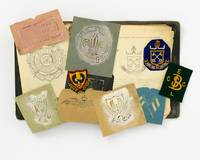
réf. 146921The collection comprises: 1 A ring-bound folder containing nearly 100 designs for cap and blazer badges including 40 with mounted examples of the finished embroidered patches. The designs are full-scale pencil drawings some coloured and most with typed or manuscript details of the colours designs and materials e.g. 'Royal Blue Cap. Badge worked all gold'. Badges for schools predominate with some of the wealthier private schools calling for multiple designs. For instance St Peters College has different designs for: Colours Junior Second First and First for prefects tennis cap regular and for prefects house and school prefects rowing cap regular and for prefects and old scholars. Also well represented are sporting clubs mainly baseball and cricket including the South Australian Cricket Association as well as a small number of youth clubs fraternities and other societies. The mount leaves are pulled at the punched holes and a little stained and torn; one leaf is defective; overall an impressive and extraordinary collection. 2 Approximately 300 hand-cut stencils paper or card used to transfer designs to the fabric where they would then be worked over by skilled embroiderers using free-motion or 'Irish' embroidery machines. The stencils include many designs not in the sample book including company logos and many other school and association badges. Of particular note are several relating to the Australian military forces in the Second World War including two for a Royal Australian Air Force pilot's wings one pricked for pouncing one a cut stencil one for what appears to be a torpedoman's shoulder patch and one for the Red Cross Transport Service. Some are dated with the earliest noted being for the West Torrens Cricket Club South Australian Cricket Association premiers 1932-33; the latest date noted is 1940. Companies represented include General Motors-Holden GM-H Amscol Mastakraft itself Howells Electric Motors Amalgamated Airways and the Simson's Electric Light Company Cricket Club. Sporting clubs include the Port Adelaide Football Club and the MCC. 3 Four loose cloth patches one for the S.A. Emergency Fire Service H.Q. Reserve. 4 Half a dozen further pencil designs on paper one relating to the Royal Life Saving Society. A large quantity. unknown
188921 pages. Plus a large fold-out colour map measuring approximately 8.5 x 23 inches (22 x 59cm). Original condition with blue wrappers, titles to front, and containing all the ads. This is a complete issue, seldom found in such good and original condition. David Lindsay was an Australian explorer and surveyor and a fellow of the Royal Geographical Society. This is an abridged account of his important journey across Australia in 1885-6, in which he passed through a large tract of previously unexplored country in the Northern Territory of South Australia, west of the Queensland boundary. This valuable and absorbing account describes his expedition of the Finke River and excursion to the western boundary of Queensland, also includes an extensive chronological report of his journey from Dalhousie to the Gulf of Carpentaria. Accompanied by a spectacular fold-out colour map illustrating the explorations and surveys in the northern territories of South Australia. The map stretches from the Gulf of Carpentaria in the north to the Truer or Macumba in the south, showing Lindsay's track, survey lines, and telegraph lines. Also included is an impressive Vocabulary list, containing some important native words with their English translations.
1988réf. 140158Adelaide: Sullivan's Cove 1988. First Edition. Hardcover. Fine/Fine. Adelaide Sullivan's Cove 1988. Duodecimo 72 pages. Cloth with a paper title-label on the front cover; a fine copy with the fine dustwrapper. Number 147 of only 175 copies. 'The little-known diary and virtually unknown despatches of Major Warburton's 1866 fifth expedition'; previously unpublished apart from some contemporary observations reprinted here from the 'South Australian Register'. Sullivan's Cove hardcover
1988réf. 144496Adelaide: Sullivan's Cove 1988. First Edition. Hardcover. Very Good/Fine. Adelaide Sullivan's Cove 1988. Duodecimo 72 pages. Cloth with a paper title-label on the front cover; front cover a little mottled and flecked; a very good copy internally fine with the fine dustwrapper. Number 41 of only 175 copies. 'The little-known diary and virtually unknown despatches of Major Warburton's 1866 fifth expedition'; previously unpublished apart from some contemporary observations reprinted here from the 'South Australian Register'. Sullivan's Cove hardcover
1878réf. 1206699Sydney, Th. Richards, 1878. Gr.-8vo. Titel, 16, 173 S., 1 zweifarb. lithograph., mehrfach gefaltetes Panorama (ca 23,5 x 168,5 cm), 1 mehrfach gefaltete Tabelle. Hlwdbd d. Zeit (etwas beschabt m. einer kl. Fehlstelle im Bezug, Stempel auf Titel, Panorama an zwei Faltstellen hinterlegt u. dort mit wenigen kleinen, teils nachgefärbten Fehlstellen, ohne die Faltkarte).
1980réf. 145347Adelaide: South Australian Department for the Environment 1980. First Edition. Paperback. Very Good. Adelaide South Australian Department for the Environment 1980. Oblong quarto xviii 278 pages with 37 figures 64 illustrations from photographs and 8 tables. Pictorial card covers a little rubbed; a few other minor signs of age and handling; a very good copy. With sections on the: climate; geology; water resources; landforms and soils; flora; fauna; population settlement and land use; and resource evaluation and mangement. South Australian Department for the Environment paperback
réf. 107917The five men four in butcher's striped aprons and one woman are standing on the unsealed road in front of the shop next to a horse-drawn delivery cart sign-written with the name 'A. Mount'. The vintage gelatin silver photograph image size 107 × 152 mm is on the original blind-stamped mount of 'McNeills 184 Rundle St Adelaide' 207 × 246 mm. Pencilled on the verso is '1907 A. Mount Woodside'; although we have been unable to verify these details most places in the Adelaide Hills in the Edwardian era probably did look like this. However what is decidedly most rare about this scene is that one of the butchers is of Indian or Afghan descent. unknown
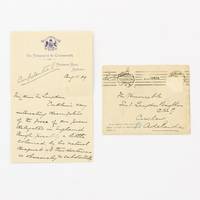
réf. 137300Fine. Octavo 4 pages a bifolium on the crested notepaper of Parliament House Melbourne in the original envelope marked 'Personal' and addressed in Deakin's hand to 'The Honourable Sir J. Langdon Bonython C.M.G. Carclew Adelaide' contemporary Melbourne postmark; stamp removed. Letter folded in half for posting; apart from a couple of ink blotches in fine condition; envelope with flap detached and with some pencilling on the verso. Deakin was sworn in as Prime Minister on 2 June 1909 after being elected leader of the Liberal Party which had recently formed from the 'Fusion' of his Protectionist Party with the Anti-Socialist Party. Sir Langdon Bonython a fellow Protectionist had sat with Deakin in the inaugural Parliament of Australia as a member for the Division of South Australia later for the Division of Barker. In this letter Deakin reflects on the difficulties confronted by his new government including preselections in South Australia but is generally optimistic about its progress. However his government would soon suffer a resounding defeat at the hands of Andrew Fisher's Labor Party in the federal election of 13 April 1910. The letter reads in full 'Aug 11.09. My dear Sir Langdon Cockburn's very interesting description of the prose of our press delegates in England though possibly a little coloured by his natural disgust at their doctrines is obviously & substantially true. It defines their attitude of old & new always the same as is proper in a party that does not change. He very clearly perceives their policy of playing to both sides & sees when they have obtained encouragement. Your allusion to the Division of Wakefield is obscure. I have not been asked to assist & have not assisted in any way in the selection of a candidate. He has been chosen entirely on your side & by your associations. When Paddy Glynn got in he found the whole matter so far advanced in making the selection in the constituency that nothing could be done. Up to date I have not been asked to endorse Foster though no doubt we shall have to do so if required. You must be aware of this though you poke fun at me. The time has not yet come for getting into touch with the constituencies. We have not discovered whom we can rely upon or at all events how far. We are making good progress here & in NSW but the other states are still out of hand or rather none have been in order. It is a long task to attempt to get an effective control of Australia. We are gradually getting it within our immediate spheres of influence. But this is written at the table during the debate to which I have to listen with one ear & half my attention. Kind regards. Yours very truly Alfred Deakin'. Deakin's entry in the 'Australian Dictionary of Biography' gives some important context to these final months of his political career. 'In May 1909 he agreed to the fusion of anti-socialists Liberal-Protectionists and Forrest's "corner" group. A bewildered Fisher was curtly dismissed. Close friends still believed in Deakin's integrity but to many others his actions seemed nothing but a naked grab for power a base move to regain office at any price by a man who thought he was indispensable. The political confusion produced some of the most dramatic scenes in Federal parliamentary history. Lyne - never a friend of Deakin and now a foe - denounced his former leader as a "Judas" a charge which the vindictive Billy Hughes believed slandered the disciple. Deakin was sworn in for the third and last time as prime minister on 2 June 1909. The Fusion government given its short span of life and the few points of agreement between the uniting parties was remarkably active . The Fusion government entered the election of April 1910 confident of victory but in the event it was routed. In a heavy poll Labor gained absolute majorities in both the House and Senate. Deakin who campaigned on a mainly negative anti-Labor platform barely escaped defeat in Ballarat. Only a handful of his personal followers survived.' Sir John Langdon Bonython 1848-1939 was an important South Australian editor newspaper proprietor philanthropist and parliamentarian. 'He became a follower of Alfred Deakin who wanted him to give his full time to politics; their friendship survived a sharp disagreement over the composition of Deakin's ministry of July 1905 and his disappointment that Deakin's recommendation of him for a K.C.M.G. in 1908 was not accepted. Bonython did not contest the 1906 election although the Labor Party proposed to grant him and other Protectionists immunity from opposition; he suspected that his party would soon be out of power and travelling to Melbourne for parliamentary sittings was becoming irksome' ADB. The Cockburn referred to at the beginning of the letter is presumably Sir John Alexander Cockburn 1850-1929 former Premier of South Australia delegate to the Constitutional Conventions unofficial ambassador in Britain and friend of Sir Langdon's ADB. unknown
réf. 115301Very Good. Small octavo one page on the mourning stationery of his home on the Isle of Wight Farringford House Tennyson had lost one of his younger sons in action and would lose another before the end of the war. Folded twice for posting; a few tiny marks; in excellent condition. The letter is brief enough to quote in full: 'Dear Lady Glenconner I am deeply distressed not only for myself but also for all of you. Of course one cannot but be very sorry for both of them. I have spoken to L. fully and he takes a really serious view now I hope; and has promised not to see her during the war. L. ought to protect her against herself. I cannot write more for I feel the thing too acutely. It was kind in you to write to me. Ever yours Tennyson'. Lionel and Clarissa married in March 1918; she was still only 21 years old at the time. They had three children before their divorce in 1928. Each was to remarry and redivorce again. Hallam Tennyson 1852-1928 eldest son of the poet laureate Alfred later 1st Baron 'had initially sought the governorship of South Australia but hesitated when it was offered to him in January 1899: Tennyson was influenced by speculation that after Federation the post might be subordinated to that of the governor-general or even abolished. He arrived in Adelaide in April and proved popular: the press and the people saw him as hardworking competent dignified and frugal. Appointed acting governor-general on 4 July 1902 after Lord Hopetoun's unexpected resignation Tennyson was confirmed in this position in January 1903 at his own request for one year only' 'Australian Dictionary of Biography'. unknown