HAWAIIBiblio.com
1 013 résultats
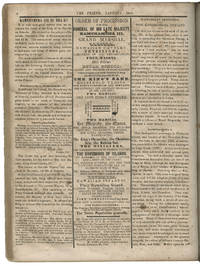
1854réf. 23745"The American Sloop-of-war SARATOGA Capt. Walker arrived at this port on the 29th ult. in 25 days from Japan which is the shortest passage ever made. The S. brings Capt. H.A. Adams U.S.N. as bearer of despatches to the Government at Washington. The point of interest in this intelligence is the fact that Com. Perry concluded a TREATY OF AMITY AND FRIENDSHIP with the EMPIRE OF JAPAN." The Friend was the mouthpiece of Congregational missionaries and reported everything from important local Hawaiian issues to international news reprinted from eastern sources. The nine months covered here feature a great deal of the news of the day ranging from war between England and Russia to lots of whaling and maritime news including shipping arrivals and departures the discovery of new sperm whaling grounds naval intelligence all peppered with a liberal dose of good old fashioned conservative proselytizing. This particular volume was sent from Sag Harbor New York to Thomas Spencer a Rhode Island sea captain who went native opening a successful ship's chandlery and marrying a local girl. HAWAII.Newspapers. Bound volume of The Friend Honolulu HI containing 22 consecutive issues dated from Feb 1 1854 through Oct 25 1855. This volume has the first report of the death of Hawaiian King Kamehameha III including the order of procession Jan 1 1855 issue and the first report of the signing of the US-Japan Treaty negotiated by Commander Matthew Perry May 6 1854 issue and an Independence Day celebration July 6 1854 issue. The Friend was a local newspaper published from 1843 to 1954. Published by and for the missionaries it is invaluable as a source of information concerning the activities experiences and accomplishments of the 19th-century Congregational missionaries to Hawaii as well as 20th-century figures and the development of the United Church of Christ in Hawaii. Today The Friend is the newsletter of the Hawaii Conference of the United Church of Christ. Thomas Spencer 1815-1884 was a whaling captain out of Warwick Rhode Island. He was stranded in the Sandwich Islands Hawaii and decided to remain there. He opened a very successful ship's chandlery in Honolulu and later purchased property on the "big" island in the village of Hilo. His brothers also joined him in Hawaii. He was a notorious celebrity well-liked by all and especially supportive of the Hawaiian royal family. He is buried in Oahu. The children of Thomas Spencer and Makaleka Margaret Robinson were Thomas Spencer Jr. and Charles Lucy Jennie Lily Helen Margaret and Kaliko Spencer.
1798réf. PHO-1092Deuxième reliure de la première édition. Édition originale in-4 sur grand papier, remise en circulation en 1841 avec un nouveau titre avec la mention fictive "nouvelle édition" (quelques exemplaires imprimés en 1798 n'avaient toujours pas trouvé preneur). Une édition octavo en six volumes a également été publiée. in-4 ,y compris l'atlas. Avec 16 (10 dépliantes) dont 15 cartes gravées, 1 planche gravée et table dépliante. - Beau demi-cuir contemp , dos lisse avec titre et tomaison , petits manques au dos , quelques mouillures intermittentes et vieille trace d’humidité (T1), déchirure carte hydrographique sans manque. xii, cxliv, 628, [3] ; xvi, 676, [2] ;[xi], 431, [1];[2],viii, 158pp.
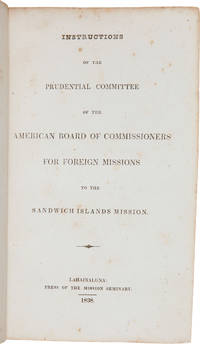
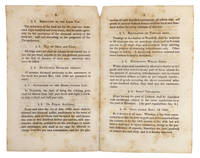
1838réf. 66226Lahainaluna: Press of the Mission Seminary 1838. Instructions for Missionaries Printed in Hawaii A collection of the original instructions issued to each of eight groups of Christian missionaries sent to Hawaii between 1819 and 1836 by the American Board of Commissioners for Foreign Missions ABCFM. It is a relatively early Lahainaluna imprint printed in an edition of 380 copies. "This work contains the Act of Incorporation of the ABCFM State of Massachusetts signed by Caleb Strong Governor and Alden Bradford Secretary of the Commonwealth 20 June 1812 together with the laws and regulations of the same body. Following this are the parting instructions given to each of the first eight companies of missionaries to the Hawaiian Islands…by Samuel Worcester Jeremiah Evarts David Greene B.B. Wisner and Rufus Anderson. A complete list of each company including the Hawaiians is found on pages 119-122.Rev. Clark's account of printing for the year ending February 28 1839 includes this work and shows a production cost of $30. The printed minutes of the 1839 General Meeting record 380 copies printed" - Forbes. The ABCFM was an interdenominational body composed primarily of New England Congregationalists and Presbyterians whose "attention.was called to the Hawaiian Islands by reports of traders and by the presence in New England of several native youth from these islands.The Protestant Christian community of New England became interested in these young Sandwich Islanders and in the possibility that they might become Christian messengers to their own people.The sending of missionaries to Hawaii followed as the next logical step" Kuykendall. This first group of missionaries sent by the ABCFM to Hawaii included two ordained ministers Hiram Bingham and Asa Thurston a physician two schoolmasters and catechists a printer a farmer; their wives and three Hawaiian youths who had been attending the Foreign Mission School in Cornwall Connecticut. In their set of instructions to this first group of missionaries the ABCFM said that it was God's ".gracious pleasure and his high command that his gospel should be preached to them the people of Hawaii; that they may be turned from darkness unto light – be baptized in the name of the Father and of the Son and of the Holy Ghost and taught to observe all things whatsoever he has commanded for their salvation and for his everlasting honor and praise." An important and uncommon text tracing the early history of the American Christian missionary movement and the ABCFM in Hawaii between 1819 and 1836 complete with the names of the missionaries sent by the ABCFM and the goals they were expected to achieve during their respective stays in Hawaii. Contemporary cloth-backed paper boards. Spine neatly repaired boards lightly soiled and rubbed. Light foxing some slight worming in gutter margin with minute loss to text. Very good. FORBES HAWAII 1086. Ralph S. Kuykendall The Hawaiian Kingdom Vol. 1 1778-1854: Foundation and Transformation Honolulu: Univ. of Hawaii Press pp.102-4. hardcover
1843réf. WRCAM55894Lahainaluna: Seminary Press 1843. 6pp. 12mo. Original printed self-wrappers. Tiny chip at top of spine tiny area of marginal loss to spine edge of first two leaves minor foxing. Very good. In a cloth chemise and green half morocco and cloth folding case spine gilt. An exceedingly rare early Hawaiian imprint. The work is a supplement to the English translation of KE KUMU KANAWAI A ME NA KANAWAI O KO HAWAII PAE AINA Forbes 1337. It contains ten laws and resolutions approved by Hawaiian King Kamehameha III and the premier Kekauluohi "at the council house at Luaehu Lahaina Maui Sandwich Islands." The laws and resolutions themselves deal with land leases taxes on land and pets the timing of the evening guns divorce whaling public auctions tonnage dues ship clearances the removal of duties on gold and silver exports and the payment of jurors. The laws had to be submitted for approval to the British commission that exercised temporary control over Hawaii between February and July 1843 and it is noted in the penultimate paragraph "All the foregoing laws.will take effect after being communicated to the British Commission and proclaimed at each of the principal islands." The resolution on "Respecting Divorced Persons" is especially interesting. This resolution allowed among other things all "divorced persons" not just men to remarry if their divorce was granted before the 1840 Constitution was adopted. The 1840 Hawaiian Constitution had placed certain restrictions on remarriage for both divorced men and women. For instance in cases of adultery the guilty party whether a man or a woman was forbidden to remarry while the former partner was alive. An absence of four years whether through criminal confinement or overseas service or some other reason was often grounds for divorce and remarriage for the party who remained in Hawaii. If a husband tried to kill his wife or vice versa the offending party was not allowed to remarry. The present resolution provided for all those who divorced before the 1840 Constitution to remarry no matter the reason for the divorce. The resolution regarding whaling ships is also notable. It allows whalers to barter or sell up to $200 worth of goods duty free "for the purpose of procuring refreshments." If a whaling ship barters or sells more than the $200 threshhold "they shall pay the customary duties." This is likely a reaction to laws or regulations set down in other Pacific ports during the golden age of the whaling industry when Hawaii was an important port of call for ships of all nations. "The edition is unknown. This is not recorded in reports of either the 1843 or 1844 General Meetings. Because of its small size it was doubtless part of the category 'small jobs ship lists government protests &c.' in the 1844 minutes" - Forbes. Forbes lists no references for the work and the location of only eight copies all in Hawaii. OCLC lists a digital record in twelve libraries which may contain some number of authentic copies and three additional copies in a separate record which appear to be the 1913 reprint by the Statute Law Book Company printed in an edition of fifty copies according to Forbes. An uncommon and elusive early Hawaiian legal work that touches upon women's issues and the whaling industry at the height of its prominence in the world economy. FORBES 1393. Seminary Press hardcover books
1843réf. 68824Lahainaluna: Seminary Press 1843. Early Hawaiian Laws Including Those Relating to Whaling and Divorce An exceedingly rare early Hawaiian imprint. The work is a supplement to the English translation of Ke Kumu Kanawai a Me Na Kanawai o Ko Hawaii Pae Aina Forbes 1337. It contains ten laws and resolutions approved by Hawaiian King Kamehameha III and the premier Kekauluohi "at the council house at Luaehu Lahaina Maui Sandwich Islands." The laws and resolutions themselves deal with land leases taxes on land and pets the timing of the evening guns divorce whaling public auctions tonnage dues ship clearances the removal of duties on gold and silver exports and the payment of jurors. The laws had to be submitted for approval to the British commission that exercised temporary control over Hawaii between February and July 1843 and it is noted in the penultimate paragraph "All the foregoing laws.will take effect after being communicated to the British Commission and proclaimed at each of the principal islands." The resolution on "Respecting Divorced Persons" is especially interesting. This resolution allowed among other things all "divorced persons" not just men to remarry if their divorce was granted before the 1840 Constitution was adopted. The 1840 Hawaiian Constitution had placed certain restrictions on remarriage for both divorced men and women. For instance in cases of adultery the guilty party whether a man or a woman was forbidden to remarry while the former partner was alive. An absence of four years whether through criminal confinement or overseas service or some other reason was often grounds for divorce and remarriage for the party who remained in Hawaii. If a husband tried to kill his wife or vice versa the offending party was not allowed to remarry. The present resolution provided for all those who divorced before the 1840 Constitution to remarry no matter the reason for the divorce. The resolution regarding whaling ships is also notable. It allows whalers to barter or sell up to $200 worth of goods duty free "for the purpose of procuring refreshments." If a whaling ship barters or sells more than the $200 threshold "they shall pay the customary duties." This is likely a reaction to laws or regulations set down in other Pacific ports during the golden age of the whaling industry when Hawaii was an important port of call for ships of all nations. "The edition is unknown. This is not recorded in reports of either the 1843 or 1844 General Meetings. Because of its small size it was doubtless part of the category 'small jobs ship lists government protests &c.' in the 1844 minutes" - Forbes. Forbes lists no references for the work and the location of only eight copies all in Hawaii. OCLC locates copies to only three institutions: Yale University University of Hawaii at Manoa and Bishop Museum Library. An uncommon and elusive early Hawaiian legal work that touches upon women's issues and the whaling industry at the height of its prominence in the world economy. 12mo. Original printed self-wrappers. Small chip at head of spine just separating at lower fold minor foxing. Very good. FORBES 1393. OCLC 862079031. unknown
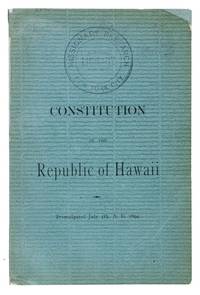
1894réf. H6TGCND412W1Honolulu 1894. Stapled leaves in publisher's original turquoise wrappers paste-paper imitating laid paper colourfully reproducing chain and laid lines with letterpress title on front. Kept in modern half morocco clamshell box. 22 x 14.5 cm. The 56-page issue plus index of the first edition of Hawaii's last constitution as a sovereign country containing 103 numbered articles. When in 1893 Queen Liliuokalani of Hawaii was overthrown she was replaced by a provisional government consisting of members of the American Committee of Safety striving to achieve annexation of Hawaii to the United States of America. When annexation was not forthcoming they set up a constitutional convention and adopted the present constitution for the Republic of Hawaii. The annexation was finally ratified four years later the transfer of sovereignty taking place in August 1898. "The present constitution is among the more important pieces of literature pertinent to these times" Streeter.Forbes notes that page 56 is unnumbered and blank "56 blank" but in this copy it is numbered and contains the last names of the members of the constitutional convention. The present copy includes the 6-page index often lacking.With a library stamp on front wrapper the spine of the wrapper reinforced. A very good copy.l Forbes 4569 55-page issue; Streeter 3766 55-page issue; cf. A.F. Lee The Hawaii state constitution: a reference guide 1993 p. 5. unknown
1850réf. 18971(Hawaii vers 1850) marie-louise et encadrement modernes
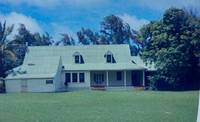
1967réf. 56001Honolulu HI & Kohala HI: Frost & Frost 1967-1972. Archive. Approx. 820 photographs 760 are 3.25 x 4.5 in. black & white silver gelatin; 40 colour photos damage to 10 or so from dampstaining at margin affecting image all photos carefully marked in black & red ink codes keyed to the film negatives also included with the archive many with photo lab stamp on verso a few with annotations on versos; more than 30 contact negative print strips; 257 strips of film photo negatives with over 1000 images majority .35 mm. film stock about 30% in colour; 70 strips of larger 4 x 5 negatives with most of those in colour nearly all preserved in original wax paper negative sleeves and almost all carefully marked in pen with numbers corresponding to the printed photos as well as manuscript annotations indicating places objects as well as some dates added in manuscript or in date codes; 8vo. 35 loose sheets held together with metal clip in pencil & ink manuscript dated 1972 diagrams illustrations some edgewear foxing to first & last leaves minor insect predation to outer leaves still VG- exemplar. This noteworthy archive consisting of over 820 original photographs and over 1000 individual negative images provides an essential visual record of the historic archaeological and architectural surveys carried out by the Frosts for the Hawaiian Mission Children’s Society beginning in 1967 in the Bond Historic District located in the Iole Ahupua’a one of the few remaining traditional land divisions in Hawaii. The Bond homestead Kalahikiola Church the Kohala Seminary and attached medical doctor’s office are all located within the Bond District and the well preserved homestead was first established by Rev. Elias Bond 1813-1896 in 1841 with the Kalahikiola Church completed in 1855 rebuilt after devastating earthquake in 2006 and the Kohala girl’s school founded in 1872. The hundreds of photos show the household objects textiles tools furnishings documents artwork books equipment and more all accumulated from 1841 through 1930 by the Bond family. Elias and his wife Ellen had sailed with the Ninth Company of Missionaries from Boston and settled at Kohala HI in the mission established by Rev. Isaac Bliss who had completed the main building before their arrival. The Bond’s immediately began adding additional buildings such as the wash house archway & walls foundations of woodshed and carpenter sheds as well as begun work on the Kalahikiola Church. Rev. Bond had founded the Kohala Sugar Co. in 1862 as “The Missionary Plantation” to support his church and schools and he refused to institute the slave-like labor conditions of other sugar growers in the Hawaiian Islands. The profits made the Kohala Sugar Co. one of the largest benefactors to other missions operating for 110 years. Many of the artifacts depicted appear to have been accumulated and used by Dr. Benjamin Bond 1853-1930 his son who finished medical school at the Univ. of Michigan in 1882 and returned to live and work on the homestead with a doctor’s office attached to the main house in 1884 for his practice. After Dr. Bond married Emma Mary Renton 1866-1951 in 1889 a wood-framed cottage was added at the East end for them. In addition a small shed was expanded to shelter a horse carriage and single horse stall for emergency medical calls. A series of photos shows the scene of the Frost’s driving to the homestead and then heading into the Bond properties. The photos meticulously document the china glassware stoneware needlepoint & embroidery samples an ABC sampler by Eliza Bond signed 1817 silver flatware bellows original photos & illustrations of homestead buildings chairs large benches and sideboards. The kitchen cooking implements cookware and equipment receive significant attention with photos showing the ancient kitchen burners hot water tank propane or oil-fired stove historic coral stone chimney dining chairs and more. Of particular interest are the extended series of images depicting the artifacts medical instruments and furnishings in Dr. Bond’s office including his book collection Chautauqua desk large safe dried medical herbs razors astronomy atlas anatomy atlas diagrams eyeglasses glass beakers pharmacy tools and much more. Also included are photos of abandoned boxes for chemical and pharmaceutical supplies in the attic. The breadth of clothing textiles toiletry items jewelry rope beds architectural elements family photos a Chinese compass art easel and more reflect the growing affluence of the family not only from Dr. Bond’s practice but also as the sugar production and mill expand however with much of the profit still being devoted to Mission Society projects. The negatives and photos also show the wagons used by the doctor and his family the extensive tools employed on the homestead to maintain not only the family holdings but also the Church and Girl’s School buildings. Photos also show a bookpress bottles sawmill equipment a rock crusher installed for road paving and more. After Dr. Bond’s death the buildings were maintained by a special trust fund which terminated in 1968 and subsequent to that time a family corporation helped finance the care of the estate. The manuscript diagrams and notes by the Frost indicate where windows were replaced from the original when electrical work was done on the property improvements to the buildings where the hallway from the shop to kitchen was located the women’s toilet pantry cupboards and rough charts and maps of locations of buildings and objects on some of the walls. For a time the Industrial Building housing 12 occupational students and one teacher continued to operate but in 1955 the school stopped functioning. For over a decade the properties were used for conferences retreats and camping grounds but eventually they became unoccupied and unused so they were in very poor condition when surveyed by the Frosts over three years. The Frosts prepared a very scarce photo album and report consisting of 6 pages of text and 12 leaves containing 82 tipped-in photos in January 1968 followed by a Feasibility Study for the Hawaiian Mission Children’s Society in 1969 but we could find no similar extant collection of these photographs or records of this historical survey. The National Register Survey was completed in 1973 and then filed in 1977 finally approved in 1978 for adding the properties to the National Register. See: Laura Souliere & Nathan Napoka Father Elias Bond District SE of Kapaau off Highway 27 National Register of Historic Places March 30 1978; Frost & Frost Report of an Inspection Visit to the Bond House Complex 1840-1968 in Kohala Hawaii January 11 & 12 1968; Land of Iole Kohala Institute 2018; Rebekah Oe-Len Kehaulani Luke My Grandfather Chong’s House Rebekah’s Studio 2011; Edward Beechert The Reverend Mr. Bond and Kohala Plantation Working in Hawaii: A Labor History 1985 pp. 71-72. Frost & Frost, hardcover
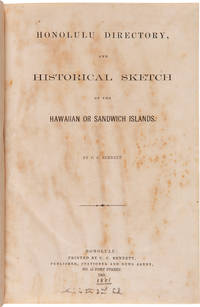
1869réf. 57593Honolulu: Printed by C.C. Bennett 1869 i.e. 1871. Revised Edition of the First Honolulu Directory The second revised edition of the first Honolulu directory printed personally by the author at his book and stationery store on Fort Street. Compared to the first edition of 1869 this 1871 edition contains an additional three pages of text which extend the historical sketch to the latter date and the directory entries are printed in a single column instead of double along with other minor adjustments. The majority of the volume is taken up by a detailed history of the islands beginning with "Discovery by Gaetano and Mendana" and featuring a "Visit by Cook" as opposed to the first edition which begins with "Discovery by Cook". The following sketch covers the reign of Kamehameha I the arrival of the first Christian missionaries and details of various political and diplomatic incidents including the arrival of Catholicism the LaPlace affair the provisional cession of 1843 a brief paragraph referencing the California Gold Rush and more. Along with historical details the author of the history who Forbes identifies as journalist Henry Sheldon provides a variety of other pieces of information including on the Bible's translation in Hawaiian the entirety of the 1852 constitution a detailed passage on Hawaiian manners and customs and a dissection of the Islands' declining population. At least one contemporary reader was unimpressed by Bennett's improvements however - H.M. Whitney reviewed the second edition in his weekly Pacific Commercial Advertiser declaring it "the worst specimen of printing in book form that has ever been given to the Honolulu public." The directory proper begins on page eighty-one and runs for the next twenty unnumbered pages. Residents and businesses are listed by name usually along with a profession and street address. At the end of the directory is an additional list of "Traders and Planters on the Other Islands." In this copy an index leaf from the first edition the second page of which is numbered 88 is bound in at the rear; interestingly despite the changes between editions the page numbers listed remain accurate. Both editions of this directory are quite scarce and this second much more so. While Rare Book Hub locates four copies of the 1869 edition at auction in the past twenty years not copy of this 1871 edition is noted since a copy at the auction of the Henry C. Carter collection at Anderson Galleries in 1908. OCLC locates only four copies at the Library of Congress University of Hawaii at Manoa American Antiquarian Society and Harvard. Forbes adds the Hawaiian Historical Society Hawaiian Mission Children's Society Library and Hawaii State Library. An uncommon and important early Hawaiian directory. Pebbled purple cloth front board stamped in gilt. Spine sunned boards lightly stained. Text lightly tanned scattered light foxing index leaves trimmed quite close at head without touching text lacking advertisement leaves. Inscription of the Library of the Hawaiian Board on front pastedown and their gilt initials on front board. A very good copy. FORBES 2890. OCLC 1091236492 71531611 191271313. hardcover
1980réf. 2080202102900002Honpo shoseki 1980. Soft Cover. Fine. Books: 14 books Honpo shoseki paperback
1833réf. PHO-2302Paris, Imprimerie Royale, Arthus Bertrand, au dépôt général de la marine, 1833-1839. 5 vol. in-8 (25,5x16,5cm) demi-chevrette rouge, dos à nerfs orné (reliure de l'époque), supplément lépidoptères broché de I. [2] ff.-xli-558-[1] pp. ; II. [2] ff.-481-[1] pp., grande carte dépliante (piqûres, coupures aux pliures sans manque) ; III. [2] ff.-510-[1] pp. ; IV. [2] ff.- 480 pp. ; V. [2] ff., 195-200 pp., Supplément Lépidoptères 30pp., 70 planches dont 61 soigneusement aquarellées. Rousseurs touchant principalement le texte et très peu les planches, mouillures claires par endroits au texte, feuillets volants pour le supplément. Sans les deux grands atlas historique et hydrographique, mais bien complet du très rare 5e volume d'histoire naturelle, paru ultérieurement qui manque presque toujours et complet des planches. Ce rarissime cinquième et dernier volume de texte, qui comporte 2 parties, renferme le rapport fait à l'Académie des sciences le 4 février 1833 sur les collections d'histoire naturelle recueillies pendant le voyage de la corvette La Favorite…, les Recherches sur les marsupiaux par Fortuné Eydoux et Laurent, la 2e partie Zoologie par Fortuné Eydoux et Paul Gervais, le supplément sur les Lépidoptères nouveaux par Feisthamel.
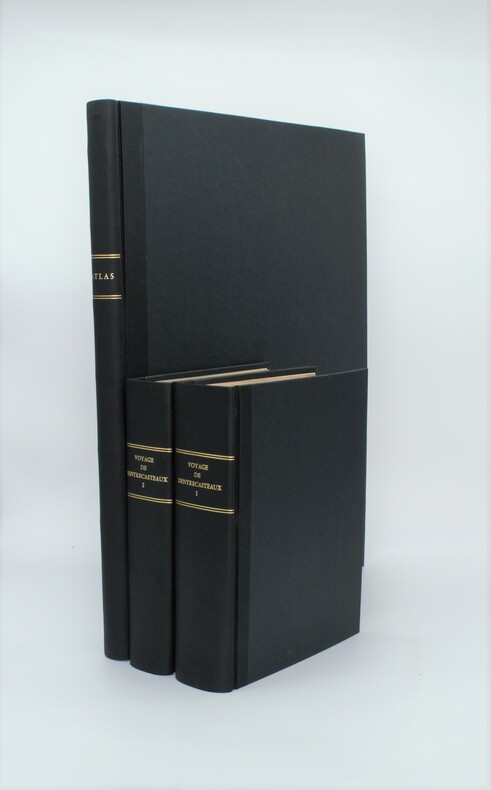
1807réf. PHO-1A Paris, Dépôt général des Cartes et Plans de la Marine et des Colonies, 1807 et De L’Imprimerie Impériale, 1808 RARE ENSEMBLE COMPLET en 3 volumes TEXTE ; 2 forts vol. in-4° ; (2)-LVI-704 pp.-32 pl. h.-t. repliées in-fine (I-XXXII)/(2)-VIII-692 pp.-1 pl. h.-t. Repliée sur papier bleuté , relié demi cuir , dos lisse avec titre et tomaison , tranches mouchetées , mouillure angulaire sur 7 planches, petites rousseurs sur les planches . ATLAS ; 1 volume grand in-folio (560x445) ,page de titre-1 fnch. (Table )-39 cartes et vues h.-t. , dont 29 à double page ,dressées par l'ingénieur hydrographe C. F. Beautemps Beaupré et gravées sur cuivre par E. Collin , relié demi cuir , dos lisse ,cachets répétés , petites rousseurs .
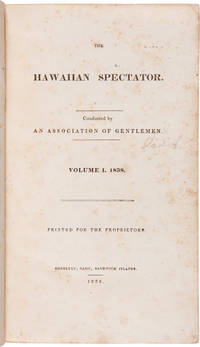
réf. 57563Honolulu: Printed for the proprietor Peter A. Brinsmade 1838-1839. Complete Run of an Early Hawaiian Periodical A complete run of "the first literary and scientific periodical published in the Hawaiian Islands" Forbes. THE HAWAIIAN SPECTATOR was a short-lived periodical based in Honolulu originally printed in parts. Two volumes of four parts each were printed; a third volume was planned for 1840 and had begun soliciting articles but never came to fruition. The SPECTATOR's proprietor was Peter A. Brinsmade a Connecticut native and the "& Company" part of Ladd & Company. Ladd & Co. was an early Hawaiian business partnership notable for establishing the first commercial sugarcane plantation on the islands. Brinsmade also traveled throughout Europe on their behalf looking for investors in an international land speculation scheme. THE HAWAIIAN SPECTATOR contains a wide array of articles related to Hawaii and the South Pacific in general. The contents by a diverse group of authors including Hiram Bingham and translated works by native Hawaiians discuss Hawaii's history geology environment medicine education literature language and more. Some pieces in the first volume include "Sketch of Christmas Island" by Capt. George Benson accompanied by an engraved map of the island made at the Lahainaluna Press a similar article on Ocean Island with a map prepared in the same fashion and "Introduction of the Gospel to Northwest America" by Hiram Bingham with a long discussion of the Whitman and Spaulding mission and featuring printed music with lyrics in English and Hawaiian. The second volume contains a similar miscellany of articles concerning Hawaii and its peoples as well as J.J. Jarves' "Overland Journey in Central America" and a description of the voyage of the French frigate L'Artemise to Hawaii and the imperialist saber-rattling by which it was accompanied. The greater part of the second volume is devoted to the serial publication of A BRIEF MEMOIR OF THE LIFE OF MR. DAVID DOUGLAS WITH EXTRACTS FROM HIS LETTERS. This is a complete reprint in effect the second edition of a work originally published by Sir William Hooker in THE COMPANION TO THE BOTANICAL MAGAZINE in 1836. Douglas of Douglas Fir fame was a distinguished botanist who made two trips to the Pacific Northwest under the sponsorship of the Horticultural Society first in 1824-27 and again in 1829-34. In 1834 he sailed to Hawaii to continue his research but shortly after his arrival he "tripped" into a pit dug to catch wild cattle and was gored to death by a bull. His collections and work laid the foundation for botanical research in the region and are justly celebrated and discussed at length in McKelvey. Wagner-Camp and McKelvey both misidentify this printing the former calling it an edition of Douglas' JOURNAL rather than the MEMOIR and the latter suggesting that it is only a partial printing rather than the complete reprint it is. A valuable piece of relatively early Hawaiian printing and an important step in the public intellectual development of the islands also including a rare edition of Douglas' journals. THE HAWAIIAN SPECTATOR is rare even in fragments - volume one in particular was printed in only 600 copies. Two volumes. 8112104217-440pp. including printed music plus two folding maps and large folding table; viii494pp. plus one plate. Modern three-quarter calf and marbled boards spines gilt. Light shelf wear. Scattered foxing more prevalent in first volume. Very good. FORBES 1099. FORBES ENGRAVED AT LAHAINALUNA pp.34-35 42 145-47. HOWES H624 note. WAGNER-CAMP 60 note but should be their 60:3. McKelvey BOTANICAL EXPLORATION OF THE TRANSMISSISSIPPI WEST pp.299-334. Coats THE PLANT HUNTERS pp.304-14. hardcover