1.052 Ergebnisse
1960Best.-Nr. 2162Honolulu Hawaii U.S.A.: Hawaii Visitors Bureau 1960. MAPS TOURIST BROCHURE. Four of the folded tourist brochures measure 6" x 3" and open to 12" x 9". Each is printed on colored paper and features tourist information on one side along with a relief map that includes an inset map of the eight major islands showing their placement in the island chain on the verso. The maps include a compass rose legend elevations major roads towns crops sports facilities hotels and topography featuring volcanic mountains forests parks beaches and more. Light age-toning at some folds the Maui brochure has a ¼" cut on one panel; all near fine. The four large brochures with maps are: Hawaii The Big Island; Kauai The Garden Island; Maui The Valley Isle; and Oahu Crossroads of the Pacific. The fifth brochure is smaller and pictures the island of Molokai it measures 6" x 3" and opens to 8 7/8" x 5 7/8". It features a table of distances to various towns and to the airport from Kaunakakai. Dating the maps is based on hotels that opened in the early 1960s and closed in the late 1960s. Hawaii Visitors Bureau unknown books
1947Best.-Nr. 219701947. Japanese-American WWII Official yearbook of the 1947 graduating class at Punahou School in Honolulu Hawaiʻi which serves as a vivid document of postwar life in a multiracial student body that included a notable presence of Japanese American students. Bound in embossed dark blue leatherette. 8.5" x 11". Heavily illustrated. Published two years after the end of World War II this year's volume shows the continued presence and leadership of Nisei students despite the hardship faced in school years prior. With numerous signed messages by students-including Japanese American classmates such as W. Kobayashi G. Ogawa and H. Takakuwa-this volume provides rare evidence of social reintegration and interracial camaraderie in the wake of a war that saw Japanese Americans subjected to mass suspicion and surveillance across the United States. While Japanese Americans in Hawaiʻi were spared the large-scale incarceration endured by their mainland counterparts they still lived under martial law from 1941 to 1944. During this time thousands were dismissed from government jobs arrested without charge or pressured to prove loyalty-conditions that deeply affected the Nisei generation. Many of the students represented here likely had family members who served in the famed 100th Infantry Battalion or the 442nd Regimental Combat Team the most decorated unit in U.S. military history. Others may have experienced community surveillance loss of employment or restricted freedoms under Hawaiʻi's military government. In this context the 1947 Oahuan is not simply a yearbook-it is a document of recovery dignity and the quiet persistence of young Japanese Americans reclaiming space in public life through scholarship athletics and social visibility. This particular copy is especially notable for its extensive endpaper inscriptions with dozens of students having signed their names in ink making this a personalized artifact of postwar student life. The volume features photographs of senior portraits student clubs athletic teams and lively candid montages with Nisei students prominently and equitably featured. Sports team photos show a remarkable ethnic diversity with surnames like Kobayashi and Koneshige appearing beside those of white and Hawaiian students. The visual presentation echoes Hawaiʻi's unique multiracial culture and hints at the relative integration of elite schools like Punahou in contrast to the segregation typical of many mainland institutions during this era. Endpapers are completely filled with original signatures. Wear to covers with some cracking at interior hinge and one corner of the pastedown torn. Overall very good condition. A rare signed witness to Nisei perseverance in a racially stratified but uniquely hybrid territory on the cusp of statehood. unknown books
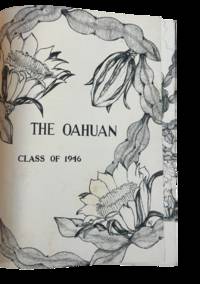
1946Best.-Nr. 219301946. Japanese-American WWII Official yearbook of the 1946 graduating class at Punahou School in Honolulu Hawaiʻi which serves as a vivid document of postwar life in a multiracial student body that included a notable presence of Japanese American students. Bound in embossed dark blue leatherette. 8.5" x 11". Heavily illustrated. Published just one year after the conclusion of World War II the yearbook offers a rare and humanizing portrait of Japanese American youth in a period when many of their families were still reeling from forced incarceration surveillance or military service. While Japanese Americans in Hawaiʻi were spared the large-scale incarceration endured by their mainland counterparts they still lived under martial law from 1941 to 1944. During this time thousands were dismissed from government jobs arrested without charge or pressured to prove loyalty-conditions that deeply affected the Nisei generation. Many of the students represented here likely had family members who served in the famed 100th Infantry Battalion or the 442nd Regimental Combat Team the most decorated unit in U.S. military history. Others may have experienced community surveillance loss of employment or restricted freedoms under Hawaiʻi's military government. In this context the 1947 Oahuan is not simply a yearbook-it is a document of recovery dignity and the quiet persistence of young Japanese Americans reclaiming space in public life through scholarship athletics and social visibility. This yearbook reflects a moment of restoration and resilience capturing a cohort of Nisei students reclaiming normalcy through education sports and extracurricular life in a territory that would not become a state for another thirteen years. The 1946 Oahuan features dozens of portrait photographs and detailed bios of Japanese American seniors-including Florence Takahashi Alice Asahina and Raymond Akana-who were active in campus life through clubs like Hui Eleu Ka Punahou and the Camera Club. The prominence of these students across social and athletic leadership roles demonstrates the partial reabsorption of Japanese Americans into Hawaiʻi's civic fabric even as anti-Japanese sentiment lingered nationally. Particularly striking is the equal treatment of Asian and white students a stark contrast to the segregated yearbooks of most mainland U.S. high schools at the time. The layout includes numerous posed group photos framed by Oʻahu's lush volcanic landscape a reminder of the local terrain that shaped these students' hybrid island identities. Minor toning and faint edgewear; overall very good condition. A poignant and timely artifact from a transitional moment in Japanese American history reflecting the endurance and reintegration of Nisei students in a society still reckoning with its wartime policies. unknown books
1947Best.-Nr. 219311947. Japanese-American WWII Official yearbook of the 1947 graduating class at Punahou School in Honolulu Hawaiʻi which serves as a vivid document of postwar life in a multiracial student body that included a notable presence of Japanese American students. Bound in embossed dark blue leatherette. 8.5" x 11". Heavily illustrated. Published two years after the end of World War II this year's volume shows the continued presence and leadership of Nisei students despite the hardship faced in school years prior. With numerous signed messages by students-including Japanese American classmates such as W. Kobayashi G. Ogawa and H. Takakuwa-this volume provides rare evidence of social reintegration and interracial camaraderie in the wake of a war that saw Japanese Americans subjected to mass suspicion and surveillance across the United States. While Japanese Americans in Hawaiʻi were spared the large-scale incarceration endured by their mainland counterparts they still lived under martial law from 1941 to 1944. During this time thousands were dismissed from government jobs arrested without charge or pressured to prove loyalty-conditions that deeply affected the Nisei generation. Many of the students represented here likely had family members who served in the famed 100th Infantry Battalion or the 442nd Regimental Combat Team the most decorated unit in U.S. military history. Others may have experienced community surveillance loss of employment or restricted freedoms under Hawaiʻi's military government. In this context the 1947 Oahuan is not simply a yearbook-it is a document of recovery dignity and the quiet persistence of young Japanese Americans reclaiming space in public life through scholarship athletics and social visibility. This particular copy is especially notable for its extensive endpaper inscriptions with dozens of students having signed their names in ink making this a personalized artifact of postwar student life. The volume features photographs of senior portraits student clubs athletic teams and lively candid montages with Nisei students prominently and equitably featured. Sports team photos show a remarkable ethnic diversity with surnames like Kobayashi and Koneshige appearing beside those of white and Hawaiian students. The visual presentation echoes Hawaiʻi's unique multiracial culture and hints at the relative integration of elite schools like Punahou in contrast to the segregation typical of many mainland institutions during this era. Endpapers are completely filled with original signatures. Wear to covers with some cracking at interior hinge and one corner of the pastedown torn. Overall very good condition. A rare signed witness to Nisei perseverance in a racially stratified but uniquely hybrid territory on the cusp of statehood. unknown books
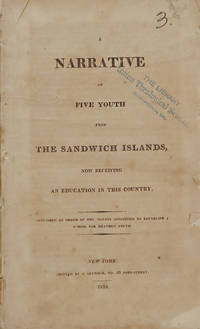
1816Best.-Nr. 68845New York: Printed by J. Seymour 1816. Inspiration for the First Mission to Hawaii A rare account of the lives of the five Hawaiian youths who would come to form a core of initial students enrolled at the new Foreign Mission School established at Cornwall Connecticut in 1816. The school formed under the auspices of the American Board of Commissioners for Foreign Missions ABCFM would serve to educate foreign students in preparation for missionary work in their native lands and elsewhere. Published in 1816 A Narrative of Five Youth from the Sandwich Islands was the first of many publications intended to raise funds and stir up popular support for the new school as well as for the first Christian mission sent to the Hawaiian Islands three years later. As such it served as part of the early efforts to bring Hawaii within the cultural and commercial orbit of the United States. By the second decade of the 19th century Hawaii had become an integral part of America's burgeoning China trade serving not only as a crucial resupply hub and convenient stopover for Yankee ships sailing between North America and China and around Cape Horn but also as a lucrative source of sandalwood which American merchants traded in exchange for Chinese silk tea and porcelain. Where American merchants saw commercial possibilities however Protestant missionaries saw opportunities for Christian conversion. In April 1809 two Hawaiian youths Henry Obookiah and Thomas Hopoo arrived in New York aboard the China trade ship Triumph in the hope of receiving an education in the United States. Shortly after their arrival the two took up residence in the New Haven home of the ship's captain Caleb Brintnall. There Obookiah quickly came to the attention of several Yale students who offered to tutor him. Soon he was invited to join the household of Yale president Timothy Dwight. As John Demos explains in his history of the Foreign Mission School where Obookiah became the star student and "the most famous Hawaiian emigrant of his time" "Dwight's home was the starting point" of an eight-year odyssey "that would take Obookiah into three states eight different towns and at least a dozen separate families scattered across the New England countryside" and which culminated in his conversion to Christianity and admission to church membership in 1814. Obookiah and Hopoo were eventually joined by three other Hawaiian youths William Tennooe John Honoree and George Prince Tamoree the son of a Hawaiian king. The stories of these five youths shared "a number of common elements. All had spent time as sailors on American trade ships. Three had served at sea in the War of 1812. Most had experienced periods of extreme hardship after reaching New England.All had sooner or later found sponsors teachers and spiritual guides. All had been moved through a kind of missionary pipeline centered in New Haven but reaching out well across the Connecticut countryside" Demos. Together the five Hawaiian youths would "become the founding nucleus of an institution unlike any previously seen on American soil" Demos. The Narrative was part of a publicity campaign designed to raise funds for the new school and for an eventual mission to Hawaii. As Demos explains the Narrative originated as "a 'manuscript account'" of the "lives and prospects" of the five Hawaiian youths "written some months before by parties unknown and circulated by hand in the interim; the agents of the school were eager to arrange its publication "for the information and excitement of the Christian public.'.it was printed in New York in the last weeks of the year 1816." Such publications "capitalized on the interest in the Sandwich Islands and the islands of the Pacific that had begun gradually with the first sales of the journals and logs from the voyages of Captain Cook the much-performed pantomime of his death and the ubiquitous commercial news that related the daily comings and goings of ships from New England to the Pacific" Arista. A New Jersey issue of the Narrative appeared in the same year; it is not known which preceded the other. The text gives biographies of each of the five youths discusses their activities and experiences in America and prints various letters written by them. According to the authors the Narrative offered "a simple and authentic statement of facts respecting the youth now under the care of the agents; with specimens of their ability and improvement." The final pages discuss the establishment of the Foreign Mission School at Cornwall and include the text of the school's constitution. As the constitution states the object of the school would be "the education of heathen youth in such a manner as that.they may be qualified to become missionaries schoolmasters interpreters physicians or surgeons among heathen nations and to communicate such information in agriculture and the arts as shall tend to promote Christianity and civilization." The Narrative Demos explains "was perfectly timed to catch a rising wave of public interest in 'heathens' abroad.Not coincidentally donations to the ABCFM would soar—from just over $12000 to nearly $30000—in the year of the Mission School's founding." Tragically in 1818 two years after the publication of the Narrative Obookiah died of typhus. His Memoirs edited by Edwin Dwight were published shortly thereafter and the success of that book inspired a wave of interest in the islands which culminated in the sailing of the first missionary bark Thaddeus for Hawaii on October 23 1819. Over the course of nearly a decade from 1817 to 1826 some 100 students from around the world passed through the doors of the Foreign Mission School at Cornwall. They included Hawaiians and other Pacific Islanders; Native Americans including Cherokees Choctaws Creeks and others; students from East Asia including China India and the Malay Peninsula; and others from Europe Mexico and throughout the United States. A rare and significant piece of Hawaiiana and part of some of the earliest efforts to bring Hawaii under the cultural influence of the United States. Dbd. Stitched gathering. A few leaves loose but holding. Text lightly foxed and toned. Small section along upper edge of final leaf torn away not affecting text. Library stamp of Union Theological Seminary Richmond Virginia in blue ink to titlepage. Good. FORBES 456. SABIN 51790. AMERICAN IMPRINTS 36725 38355. John Demos The Heathen School: A Story of Hope and Betrayal in the Age of the Early Republic New York: Alfred A. Knopf 2014 pp.22 29 31-32 38-39. Noelani Arista The Kingdom and the Republic: Sovereign Hawai'i and the Early United States Philadelphia: Univ. of Pennsylvania Press 2019 pp.61-62. unknown books
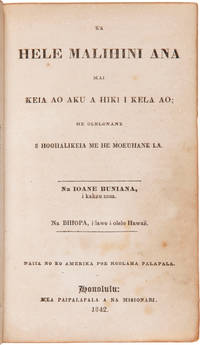
1842Best.-Nr. 63627Honolulu: Mea paipalapala a na Misionari 1842. First Edition of PILGRIM'S PROGRESS in Hawaiian in a Hawaiian Binding A significant association copy of the rare first edition in Hawaiian of Bunyan's Pilgrim's Progress and the first printing in Hawaiian of an English literary classic. This copy bears a presentation inscription on the front free endpaper to C. Blake from the Rev. Elias Bond dated at Kohala Sandwich Islands September 29 1843. Reverend Bond translated at least seven books for the Mission Press between 1859 and 1868. The Hawaiian title translates as The Traveler from This World to That Which Is to Come. In 1840 the American Tract Society in Honolulu hoped to publish an abridged edition of Bunyan if a translator could be found and in 1841 Artemas Bishop took on the task promising the Society that "it will prove one of the most popular works in the Hawaiian Language." Unfortunately for Artemas and the Society the book flopped and the 10000 copies that were printed were remaindered in unbound sheets most of which were disposed of to Chinese vegetable peddlers for wrapping produce. For copies that survived this the rate of attrition as with all early Hawaiian works of this type remained very high and the book is quite scarce today. The work failed to impact the Hawaiians as the English allusions lost all meaning when translated. The names of the extensive cast of characters became incomprehensible: Mr. Lechery became Kekowale literally lust only and Mrs. Filth became Pelapela decayed flesh. Some of the surviving unbound sheets of this book were bound into limp suede in 1910. This copy on the other hand is in a contemporary Hawaiian sheep binding of the mid-19th century complete with its distinctive triangular and diamond-shaped tooling which is most unusual and notably rare. See David Forbes' BUNIANA San Francisco 1984 for an extensive discussion of the book. An important association copy in a handsome contemporary binding. 12mo. Contemporary Hawaiian sheep boards and backstrip tooled with triangular and diamond-shaped pattern rebacked with original backstrip neatly laid down. Light rubbing and staining to boards. Contemporary presentation inscription on front flyleaf see below. Minimal scattered foxing but very clean and fresh internally. Very good. FORBES 1351. JUDD 237. DAB IX p.381. hardcover books
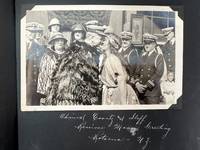
1925Best.-Nr. 239961925. U.S. Navy Pacific fleet cruise photo album documenting naval service and Indigenous encounters during Admiral Robert E. Coontz's 1925 deployment to Australia and New Zealand. The inscription "Property of J. J. Prieskop. U.S.S. Seattle band" identifies its owner as a musician associated with the fleet flagship. Following major exercises in Hawaiian waters the fleet crossed the Pacific for a voyage combining naval training with public receptions and a demonstration of American maritime reach. www.history.navy.mil At Rotorua Te Arawa hosts welcomed the visiting officers at Ohinemutu where speeches and exchanges of gifts connected MÄori hospitality with hopes for closer British-American friendship. Photo album containing approximately 260 silver gelatin photographs ranging from 2.5 x 3 to 8.5 x 5.5 inches United States and Pacific locations chiefly circa 1925 mostly mounted with corner holders on black paper leaves with numerous contemporary handwritten captions. Coontz wears a feather cloak while exchanging a hongi the MÄori greeting involving the pressing together of noses beneath "Admiral Coontz and staff receives Maori greeting Rotorua - N.Z." Samoan performers carry weapons beneath "Samoan warriors in war dance" while other scenes record sailors visiting vendors and a canoe approaching the ship. Hawaiian women perform with musicians before a commercial backdrop beneath "Hula dancers in Lahaina - 6/25." A portrait printed "'Maori' South Sea Island Belle" presents a woman holding a patu its promotional wording distinguishing commercial souvenir portraiture from the formal Rotorua reception. Sailors handle coal beneath "Coaling ship" and "In coal barge"; additional naval scenes include USS Tennessee's 14-inch gun turrets and costumed equator-crossing festivities. A band portrait dated June 1925 at Lahaina Roads Maui bears handwritten identifications of individual musicians including Prieskop while supporting scenes include horses and a rodeo captioned Oak Grove Portland Oregon. Additional photographs document encounters with Samoan communities including ceremonial performers groups of local residents and American sailors interacting with vendors. One image bears the contemporary caption "Samoan Warriors in War dance" reflecting both the cultural performance depicted and the terminology employed by American observers. Another photograph captioned "Hula dancers in Lahaina - 6/25" records Hawaiian women performing with musicians before a commercial backdrop documenting the presentation of Indigenous culture to visiting naval personnel. The album is particularly valuable for its combination of naval history and Indigenous Pacific encounters. It records the broader cultural and diplomatic dimensions of American naval expansion including the ways MÄori Samoan and Hawaiian communities received interacted with and were represented by visiting American servicemen. Visible wear includes chipped album leaves vacant mounts scattered fading and staining and tears or edge losses to some photographs. Overall good condition. A substantial and historically engaging photographic record of the U.S. Navy's 1925 Pacific deployment distinguished by its identified images of Admiral Coontz and the USS Tennessee a MÄori diplomatic greeting at Rotorua Samoan ceremonial performances Hawaiian hula dancers and named naval musicians-documenting both American maritime power and its encounters with Indigenous Pacific cultures during the interwar era. unknown books
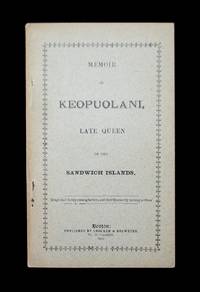
1825Best.-Nr. 69601Boston: Crocker & Brewster 1825. HAWAII. RICHARDS William author. Memoir of Keopuolani. Late Queen of the Sandwich Islands. Boston: Crocker & Brewster n.d. reprint of 1825 edition. Early reprint of the 1825 first edition. Small sixteenmo pamphlet 7 x 4 1/4 inches; 177 x 108 mm. vii 8-55 pp. With two full page engraved plates in the text. Original full printed drab gray wrappers. Staple bound. Some light toning along spine and edges of wrapper. Staples causing minor rust stains. Still about fine. An early reprint of "the first biographical account of the first Christian convert in the Hawaiian Islands and of the highest-ranking of the Hawaiian ali'i of her time" Forbes. "Memoir of Keopuolani Late Queen of the Sandwich Islands is a book written by William Richards in 1825. It is a historical account of the life of Keopuolani one of the most important figures in the history of Hawaii. Keopuolani was the wife of Kamehameha I the first king of Hawaii and the mother of Kamehameha II and Kamehameha III. The book provides a detailed account of Keopuolani's life from her childhood to her death. It describes her upbringing her marriage to Kamehameha I and her role in the unification of the Hawaiian Islands. The book also discusses her conversion to Christianity and her efforts to spread the faith throughout Hawaii. Memoir of Keopuolani Late Queen of the Sandwich Islands is an important historical document that provides insight into the life and culture of Hawaii during the early 19th century." Booksamilion. Forbes 623 for first edition. HBS 69601. $1250. Crocker & Brewster unknown books
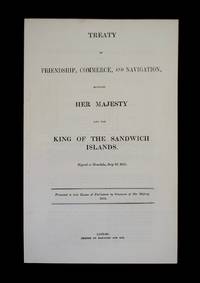
1852Best.-Nr. 69457London: Harrison and Son 1852. HAWAII. Signed at Paris June 29 1869. Presented to both Houses of Parliament by Command of Her Majesty. 1869. London: Harrison and Sons 1869. First Edition. Small folio pamphlet 12 5/8 x 8 inches; 321 x 205 mm. 4 pp. Two sheets unbound. Inner margin a bit frayed. Inked page numbers to upper right corner of both leaves. Some light foxing. Still about fine. The first pamphlet is the text of the new treaty between Great Britain and Hawaii. This treaty of friendship commerce and navigation between Kamehameha III King of the Hawaiian Islands and Victoria Queen of Great Britain and Ireland to promote relations and trade between the two nations. Drafted on July 10th 1851 and ratified on May 6th 1852. The second pamphlet is in regards to a declaration made in 1869 between the United Kingdom and the Sandwich Islands Hawaii canceling part of Article VII of the Treaty of July 10 1851 specifically regarding British whaling ships while continuing the remaining articles for seven years. Article VII stated that British whale-ships would have access to the ports of the Hawaiian Islands." Forbes 1862 HBS 69457. $2250. Harrison and Son unknown books
1941Best.-Nr. 61420Honolulu: Tongg Publishing Company 1941. First Edition. First printing. Octavo 22cm. Light brown cloth stamped in black in cream dust jacket printed in brown; yellow endpapers; 1591pp; illustrations by Ethelyn Myhre throughout. 1954 owner's name to front pastedown. Bumped at corners otherwise Near Fine. Jacket price-clipped rubbed with a few small chips and tears to edges light dustiness to rear panel generally Very Good. Children's book about life in Hawaii before the arrival of Captain Cook. #61420. Tongg Publishing Company unknown books
1995Best.-Nr. 641971995. Hawaii Reports. Supreme Court of Hawaii. Hawaiian Reports. Cases Decided in the Supreme Court of the Territory State of Hawaii. Title varies. Imprint varies. Honolulu: Hawaiian Gazette Company and others 1903-1995. Vols. 14 to 75 1902-1994. 62 books. Tan buckram with upper red and lower black spine labels. Ex-library with stamps else a good solid set. $495. unknown books
1819Best.-Nr. 377917Elizabethtown NJ: Edson Hart 1819. Second edition. Frontispiece portrait. 104 32 33 10 10 pp. Five parts in one with sectional title pages. 12mo. Contemporary mottled sheep red morocco spine label. Joints rubbed and just starting. Light foxing throughout. Very good. Second edition. Frontispiece portrait. 104 32 33 10 10 pp. Five parts in one with sectional title pages. 12mo. ʻŌpūkahaʻia c.1792-1818 came from Hawaii to New Haven Connecticut in 1807 following the death of his parents. There he met Dwight and was eventually housed and tutored by relative Timothy Dwight IV then president at Yale College and a founder of the American Board of Commissioners for Foreign Missions. Today ʻŌpūkahaʻia is best known as one of the first Hawaiians to convert to Christianity and an early translator of the Hawaiian language into English. His desire to become a missionary was among the inspirations for the opening of the Foreign Mission School in Cornwall Connecticut which published this posthumous biography. It was issued with a sermon delivered at ʻŌpūkahaʻia's funeral by Lyan Beecher and three other pieces related to the founding of the Foreign Mission School. Sabin 56429; Felcone 556 Edson Hart unknown books
Best.-Nr. 304792Meadville Pa. etc. 7 x 3-1/2 inches. Fine. 7 x 3-1/2 inches. Numbers 7578 79 80 81 82 84 85 8788 8990 919295 96 97 10157 of Keystone View Co. 76 93 94 and S 343 of Underwood & Underwood. unknown books
1885Best.-Nr. 332943Honolulu 1885. 16pp. Small 8vo. Self wrappers. Minor damage in lower margins not affecting text. 16pp. Small 8vo. "The first of the pamphlets that satirized political affairs during the Kalakaua era . Although issued anonymously it was generally known at the time that the author was Honolulu lawyer Sandford B. Dole" who later became Hawaii's Governor Forbes. Forbes 3686 unknown books
1900Best.-Nr. 332947Honolulu: Hawaiian Gazette Print 1900. 84pp. 8vo. Publisher's stapled tan wrappers. Toning wrappers a bit brittle. 84pp. 8vo. A political pamphlet relating to the election of 1900 -- the first election following admission as a U.S. Territory -- prepared by the central committee of the Republican Party concerning the land commisssion report. Not in Forbes. Scarce. Hawaiian Gazette Print unknown books
1847Best.-Nr. 332697Honolulu 1847. 12pp. 12mo. Unbound. Toned and a bit brittle some splits. 12pp. 12mo. Lists the names of the women missionaries and their children with dates of birth. Includes two children born in January 1847 and none thereafter thus ascribing the date of this listing to 1847. Forbes 1669 unknown books
1856Best.-Nr. 332946Boston: Press of T.R. Marvin 1856. First edition. 12pp. 12mo. Publisher's green wrappers. Foxing and toning. First edition. 12pp. 12mo. "In 1856 a group of special trustees assembled in Boston in order to raise an endowment of $50000 to be invested in the United States for the benefit of the school. This was the pamphlet with which they launched that appeal. It gives a resume of educational endeavors of the mission the founding of Punahou the withdrawal of the American board and the transfer of Lahainaluna to the Hawaiian government. The text describes the need for a school of higher learning for the increasing population 'of foreign origin' and claims that the school is 'essential to the development and continued existence of the Hawaiian nation'" Forbes. Scarce. Forbes 2186 Press of T.R. Marvin unknown books
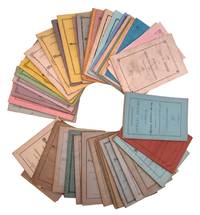
1900Best.-Nr. 329931Honolulu 1900. Nearly complete run from 1853 to 1900 lacking only the Fourteenth Annual Report from 1866. 47 vols. 12mo. Original wrappers in various colors mostly in very good condition. Nearly complete run from 1853 to 1900 lacking only the Fourteenth Annual Report from 1866. 47 vols. 12mo. "This society was formed in 1852 in the 'Old Mission School House' partly as a social organization but more specifically to lend support to the Micronesian mission then getting started . reports have excerpts from letters from Luther Halsey Gulick and several native Hawaiian missionaries stationed in Micronesia. An address by Hiram Bingham Jr. on 'the cultivation of the Missionary Spirit' is in the 1857 report. The 1858 report includes an essay by Orramel Gulick on his trip to Micronesia. The president's reports found in almost every issue have continued references to local social and religious interests in Hawaii . The birth marriage and death notices and obituaries of these missionary 'Cousins' found in issue after issue are a major source of information on missionary family histories . In the twenty-fifth annual report 1876 an essay by 'Cousin' General Samuel C. Armstrong discusses his educational work with African Americans at Hampton Virginia ." Forbes. Forbes 1942; Carter p. 81; Hunnewell p. 65 unknown books
1860Best.-Nr. 329928Honolulu 1860. Small 1p. handbill 5x4 inches. Browned. Small 1p. handbill 5x4 inches. The above text continues: ". and that Capt. Daily of the Martha 2d. and Capt. Lambert of the schooner Emerald have not even been at Ascension Island Pacific Ocean this year. For this grave error I offer Captains Faily and Lambert my deep regrets and acknowledgments of wrong and wish thus publicly to ask their pardon." Not in Forbes unknown books
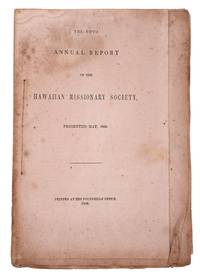
1863Best.-Nr. 332951Honolulu: American Mission Press 1863. With: 9 additional Reports of the Hawaiian Missionary Society being the Second Report and the Fifth through Twelfth Reports. 10 vols. 8vo. Original wrappers or self-wrappers. With: 9 additional Reports of the Hawaiian Missionary Society being the Second Report and the Fifth through Twelfth Reports. 10 vols. 8vo. The Hawaiian Missionary Society aimed to send missionaries from Hawaii to other Pacific islands. "The first annual report states that preparations were being made to send two missionaries Rev. Mr. Snow and Rev. Luther H. Gulick and their wives to Micronesia. A list of contributions made to the society shows the extraordinary generosity of native Hawaiian churches to this object . From this date the annual reports include excerpts from letters of the missionaries both in Micronesia and in the Marquesas. Twelve annual reports were published between 1852 and 1863 . The first three were printed at the American Mission Press; the fifth at the Polynesian office; and the remainder by the press of H.M. Whitney or the Pacific Commercial Press. This is an important source of information about missionary work by native Hawaiian missionaries in Micronesia the Marquesas and other parts of the Pacific" Forbes This group comprises the following: First Report. Honolulu: American Mission Press 1852. 12pp. Green wrappers. Second Report. Honolulu: American Mission Press 1853. 19pp. Unopened. Tan wrappers. Fifth Report. Honolulu: Printed at the Polynesian Office 1856. 24pp. Uncut and unopened. Stitched self-wrappers. Sixth Report. Honolulu: Press of H.M. Whitney 1857. 24pp. Stitched self-wrappers. Seventh Report. Honolulu: Commercial Advertiser Print 1858. 24pp. Stitched self-wrappers. Eighth Report. Honolulu: Commercial Advertiser Print 1859. 16pp. Stitched self-wrappers. Ninth Report. Honolulu: Henry M. Whitney 1860. 35pp. Stitched self-wrappers. Tenth Report. Honolulu: Henry M. Whitney 1861. 23pp. Stitched self-wrappers. Eleventh Report. Honolulu: Henry M. Whitney 1862. 24pp. Stitched self-wrappers. Twelfth Report. Honolulu: Henry M. Whitney 1863. 12pp. Stitched self-wrappers. Forbes 1877 First Report American Mission Press unknown books
1854Best.-Nr. 329930Honolulu: Mission Press 1854. 47pp. 12mo. Original blue wrappers minor browning and chipping. 47pp. 12mo. Scarce pamphlet commemorating the inauguration of Edward G. Beckwith as president of Oahu College giving a complete account of the event. The work includes a history of Oahu College also called Punahou School which was founded in 1841 by missionaries. "The minutes of the Hawaiian Evangelical Association record the edition as 500 copies" Forbes. Forbes 2042 Mission Press unknown books
1868Best.-Nr. 332700Honolulu: Paiia e Henry M. Whitney 1868. 15 1; 15 1pp. 2 vols. 8vo. Stitched. 15 1; 15 1pp. 2 vols. 8vo. The first two reports of the Sunday School Association of a series of annual reports by the Hawaiian Evangelical Association. Each includes a table in the rear listing statistics for all the religious schools on the island. Scarce. Forbes 2749 Paiia e Henry M. Whitney unknown books
1819Best.-Nr. 332862Boston: Samuel T. Armstrong 1819. 40 xvi pp. 8vo. Disbound. Foxing. 40 xvi pp. 8vo. "A sermon preached at the ordination of two missionaries just prior to their departure as members of the first 'company' of missioanries . to the Hawaiian Islands" Forbes. Includes "Instructions from the Prudential Committee of the American Board of Commissioners for Foreign Missions to the Rev. Hiram Bingham and the Rev. Asa Thurston and others . Members of the Mission to the Sandwich Islands" in the rear. Shaw & Shoemaker 48291; Forbes 499; Sabin 33794 Samuel T. Armstrong unknown books
1876Best.-Nr. 332948Honolulu 1876. 12-1/2 x 9 inches. With the full issue of The Friend New Series Vol. 25 No. 2 which includes S. C. Damon's article titled The Kings of Hawaii. 16pp plus the engraving. Small folio. Self-wrappers. Unopened. 12-1/2 x 9 inches. With the full issue of The Friend New Series Vol. 25 No. 2 which includes S. C. Damon's article titled The Kings of Hawaii. 16pp plus the engraving. Small folio. "The illustrations accompanying this number of the Friend we could wish were better executed. The plate was made in New York from the best photographs we could procure in Honolulu. The original of Kamehameha 1st was executed in 1817 by a Russian artist who accompanied Kotzebue in his voyage and may be seen by referring to the third volume of his voyage. The original of Kamehameha 2d was executed in England in 1824 in the style of the dress of George 4th's reign. We think those of Kamehameha 3d 4th and 5th are very good but not quite so good those of Lunalilo or His Majesty Kalakaua" p. 12. cf. Forbes 1726 unknown books
1861Best.-Nr. 332879Honolulu: Paiia e ka poe hoolaha 1861. Illustrated with 7 woodcut illustrations. 36pp. 12mo. Stitched. Toned. Provenance: Hawaiian Mission Children's Society Library inked stamp on last page. Illustrated with 7 woodcut illustrations. 36pp. 12mo. Includes a chronological timeline of notable events in Hawaiian history on pages 29-33. Forbes 2417 Paiia e ka poe hoolaha unknown books