(Hawaii)ABAA

1.084 Ergebnisse
1839Best.-Nr. 332695Honolulu 1839. 4pp. 8vo. Unbound. 4pp. 8vo. "Under the name of each member are listed the names and birth dates of her children . The printed minutes of the 1840 General Meeting record an edition of 250 copies" Forbes. The 1839 edition is scarce with only a single example at auction. Forbes 1180 unknown books
1853Best.-Nr. 329932Honolulu: Government Press 1853. 29pp. 12mo. Original green wrappers very minor chip at lower corner else near fine. 29pp. 12mo. The first report of the Hawaiian Mission Children's Society: "This society was formed in 1852 in the 'Old Mission School House' partly as a social organization but more specifically to lend support to the Micronesian mission then getting started." Forbes. Forbes 1942; Carter p. 81; Hunnewell p. 65 Government Press unknown books
1856Best.-Nr. 332945Boston: Press of T.R. Marvin 1856. First edition. 12pp. 12mo. Publisher's tan wrappers. Foxing and toning. First edition. 12pp. 12mo. "In 1856 a group of special trustees assembled in Boston in order to raise an endowment of $50000 to be invested in the United States for the benefit of the school. This was the pamphlet with which they launched that appeal. It gives a resume of educational endeavors of the mission the founding of Punahou the withdrawal of the American board and the transfer of Lahainaluna to the Hawaiian government. The text describes the need for a school of higher learning for the increasing population 'of foreign origin' and claims that the school is 'essential to the development and continued existence of the Hawaiian nation'" Forbes. Scarce. Forbes 2186 Press of T.R. Marvin unknown books
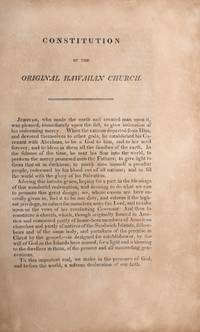
1830Best.-Nr. 329926Honolulu 1830. 4pp. Signed in print Hiram Bingham and 54 others. 8vo. Folded sheet. Browned. 4pp. Signed in print Hiram Bingham and 54 others. 8vo. "The text of this was drawn up in Boston just prior to the departure of the first American Protestant missionaries to Hawaii. Although issued without an imprint or colophon it can be dated to 1830. The last signatories on this are those of the Third Company of missionaries who arrived at Honolulu on the Ship Parthian March 20 1828" Forbes. Forbes 742 unknown books
1838Best.-Nr. 332694Honolulu 1838. 2 blank 1-5 1 blankpp. 8vo. Unbound sheets. 2 blank 1-5 1 blankpp. 8vo. Very rare circular issued to aid missionaries in detailing the goods and provisions needed and supplied. "The categories of goods include: provisions kitchen furniture iron and hardware crockery stationery men's clothing articles for ladies and children's use building materials carpenter tools and articles of trade" Forbes. Forbes locating only one copy and only a single example in the auction records. Forbes 11255 unknown books
1887Best.-Nr. 329927Honolulu: Daily Bulletin Steam Print 1887. 204pp. 12mo. Original lettered wrappers. 204pp. 12mo. Includes accounts of the celebration reminiscences and a table of the missionaries sent by the ABCFM and the Seamens' Friend Society with their date and place of birth death arrival return and descendants. Forbes 3909 Daily Bulletin Steam Print unknown books
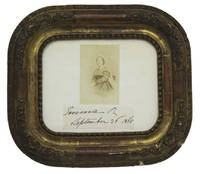
1870Best.-Nr. 303122Honolulu 1870. Photograph measuring 3-3/8 x 2-1/4 in. with the ms slip laid down beneath it. Framed and glazed measuring 9 x 10⁻¹/2 in. Photograph measuring 3-3/8 x 2-1/4 in. with the ms slip laid down beneath it. A particularly fine example of Emma's photograph and signature in a contemporary frame. She has signed herself "Emma R / September 26 1865." Born in Honolulu in 1836 she was adopted by her maternal aunt the chiefess Grace Kamaʻikuʻi Young Rooke and her husband Dr. Thomas C. B. Rooke. She married Kamehameha IV on 19 June 1856. Emma was an active queen concerned with palace affairs and was involved in the expansion of the royal library. She is best known for founding the Queen's Hospital in 1860 which was built to care for native Hawaiians who had no immunity to many of the European diseases which they encountered. The hospital exists to this day as Queen's Medical Center. Her philanthropic endeavours set a precedent for sitting queens. Although unattributed this image is likely taken by Andreas Montano the Colombian photographer who came to Hawaii in 1870 and immediately set up a studio at 87 Fort St. He photographed much of Hawaiian royalty and became Emma's official photographer. unknown books
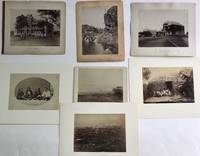
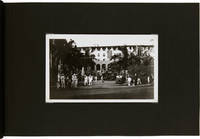
Best.-Nr. 507021 A group of four Hawaiians three women and a man eating poi sitting cross legged behind bowls in a studio setting. Oval photograph 5 1/4 x 7 1/8 inches inset on photo paper 6 1/2 x 9 inches mounted on a large board. Dated in pencil on verso "circa 1860-70." 2 Hawaiian Hotel Honolulu manuscript caption title below image. Mounted photograph 7 x 9 inches on stiff photo album leaf. Noted below image on mount in pencil "Dickson 1875." 3 Palace Honolulu manuscript caption title below image. Mounted photograph 6 7/8 x 9 1/8inches on stiff photo album leaf recto of photograph 2 above. Noted below image on mount in pencil "About 1883 Front." 4 Scene of sailing ship at anchor in Honolulu Harbor with two small native dugout canoes with outriggers on shore in fore ground ca. 1880. Mounted photograph 6 1/8 x 8 1/8 inches on thick card stock. 5 Eating Poi A group of six Hawaiians four women and two men sitting in front of a grass house before their bowls ca. 1880 by "Severin phot." Mounted photograph 6 1/2 x 9 1/4 inches on thick card stock. 6 Honolulu & Harbor from Punch Bowl ca. 1885 manuscript pencil title from verso. Mounted photograph 6 1/2 x 9 1/8 inches on thick card stock. Bird's-eye view. 7 On Kamehameha Campus manuscript title on mount below image. Mounted photograph 7 x 9 1/4 inches on thick card stock. Pencil note on verso: "The first part of the Bishop Museum on the right; bldg. On left is Kamehameha School for boys now part of the museum." 8 Punch Bowl Honolulu manuscript title in upper right corner of image. Early 20th century mounted photograph 5 3/4 x 8 3/8 inches mounted on verso of a tick photograph album leaf with: 9 Path to Kilauea Extinct Crater 4 Miles Across Kilauea in Here with arrow pointing to middle of photograph manuscript title in upper right corner of image. Early 20th century mounted photograph 5 1/8 x 8 1/2 inches mounted on one side of a photograph album leaf with 8 above. 10 Kapena Falls near Honolulu manuscript title on mount below image. Early 20th century photograph mounted on the verso of the photograph album leaf with 8 and 9 above 9 x 6 1/8 inches picturing a diver on the edge of a cliff over the pool into which the waterfall drops. unknown books
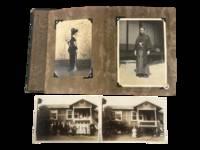
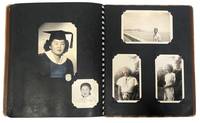
1930Best.-Nr. 227421930. Japanese-American Hawaii Japanese American military family photograph album 1930s documenting everyday life of a Nisei household in interwar Hawaii and tracing the transpacific connections linking Japanese American communities with Japan and Japanese occupied Manchuria. The photographs record family relationships social gatherings military friendships and overseas travel at a time when second generation Japanese Americans were negotiating identity within both American and Japanese spheres of influence. Handwritten captions written in the first person suggest the compiler was a Nisei man with associations to the United States Army referring to relatives and companions as "My father" "My sis Chiyo" and identifying a group of men in a tropical field as "China Souza Manuel myself Choy" further captioned "Army Buddies." During the 1930s Japanese Americans faced significant barriers to military advancement on the mainland United States yet Hawaii's National Guard accepted some Nisei soldiers prior to the Second World War due in part to the islands' large Japanese population. The album therefore documents a rare prewar moment when Japanese American military participation and family life intersected within the broader social landscape of Hawaii. Photo album compiled during the 1930s containing approximately 103 original silver gelatin photographs mounted to brown paper leaves and annotated in ink identifying individuals and locations. Bound in green pebbled boards titled "Photo Album" in gilt on the cover. Each photo measures approximately 2.5 x 3.5 inches to 5 x 7 inches. Album measures approximately 6 x 9.5 inches. The images depict family gatherings beach excursions on Oahu graduations and informal portraits of relatives and friends. Early pages include a graduation photograph of Edna Omatsu and portraits of family members including Uneiko members of the Takayama family Jeanette Ayako and a military dressed man identified as Rob Ogawa. One family group portrait shows individuals wearing leis with the caption "Honolulu - Hakada's Departure to Japan." Several photographs document military friendships and camp environments including the previously noted "Army Buddies" image. A small sequence captioned "Manchurian Trip" records the family's travels through northern China during the period of Japanese control following the establishment of the Japanese puppet state of Manchukuo in 1932 illustrating the mobility of Japanese diaspora families moving between Hawaii Japan and imperial territories across East Asia. Interwar Hawaii contained one of the largest Japanese populations outside Japan with Japanese immigrants and their American born children forming a substantial portion of the islands' workforce and social life during the 1930s. Album spine partially detached at front cover with wear to boards; photographs remain clean and crisp with mostly legible handwritten captions. Overall very good condition. Nisei communities balanced participation in American civic institutions with continuing family linguistic and cultural ties to Japan creating networks that stretched across the Pacific. This album documents those connections through scenes of leisure education military companionship and international travel shortly before the geopolitical tensions that culminated in the Pacific War. unknown books
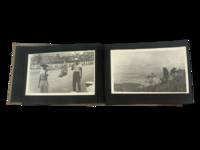
1925Best.-Nr. 227841925. SS Resolute photo archive approximately 86 photographs dating to 1925 documenting a passenger voyage through the Hawaiian Islands and broader Pacific region during a period of expanding U.S. tourism and colonial presence. The material captures volcanic landscapes urban development agricultural activity and Native Hawaiian individuals providing visual evidence of both environmental features and social life. These images record the intersection of natural geography and emerging tourist infrastructure in Hawaii during the interwar period when the islands were increasingly integrated into trans-Pacific travel networks. Approximately 86 black-and-white and color photographs each measuring about 3.5 x 5 inches mounted on black album leaves with white ink captions identifying locations such as Honolulu Hilo Waimea Bay Kilauea Crater and the Royal Hawaiian Hotel. The archive includes multiple views of volcanic activity including lava flows associated with eruptions from 1868 1901 and 1924 as well as craters at Halemaumau and Kilauea steam vents and descending lava formations. Coastal landscapes and inland terrain of Oahu and the Big Island are represented alongside urban scenes in Honolulu including hotels streetscapes and institutional buildings such as the Moana Hotel and the Mormon Temple at Laie. Agricultural images show sugarcane cultivation and rural labor environments while market scenes and portraits depict local residents in daily settings. A group of photographs includes Duke Kahanamoku posed with a surfboard marked "DUKE" alongside additional images referencing Pacific locations such as Tutuila and Upolu indicating the voyage extended beyond Hawaii. Produced during the 1920s expansion of Pacific tourism these photographs document how Hawaii and surrounding islands were visually framed for travelers within a colonial and commercial context. The combination of landscape infrastructure and human subjects reflects both the promotion of the islands as a destination and the presence of established local communities and industries. The archive supports research into tourism history Pacific colonial networks environmental documentation and Native Hawaiian cultural representation. Mild toning and occasional rippling to prints with minimal edge wear; captions remain clear; overall very good condition. A comprehensive visual record of a trans-Pacific यातà¥à¤°à¤¾ and its documentation of Hawaii and neighboring islands in the early twentieth century. unknown books
1946Best.-Nr. 230681946. Japanese-American Women's Education Postwar Hawaiʻi identified Japanese-American university school girl's photo album. Oʻahu Territory of Hawaiʻi 1946-1950 spanning the years right after World War II. Approximately 260 silver gelatin photographs documenting the daily life friendships education and civic participation of a Japanese American young woman living on Oʻahu in the immediate postwar period. The photographs are mounted in a 9" x 11" woven album with photos cornered in on black board pages. Images range from small snapshot-format prints to larger horizontal photographs. Following Pearl Harbor Hawaii was initially considered a war zone and the Japanese Americans there were subject to heavy surveillance and civil rights violations until the war ended in 1945. This album ranges 1946 to circa 1950 with one loose photograph predating the album by approximately a decade likely depicting the compiler as a child. The compiler is identified by name in captions as Reiko who also went by "Rei" Reiko was a Japanese American college student and Pre-Med Club member residing on Oʻahu. This substantial and unusually well-captioned album offers a deeply personal record of Japanese American civilian life in Hawaiʻi following the end of World War II and the lifting of martial law. The first third of the album features extensive handwritten captions frequently identifying individuals locations and events while the latter portion contains fewer annotations but continues the visual narrative of family friendship and place. Reiko's life is documented across academic social and community spheres depicting college friendships Pre-Med Club activities leisure outings and participation in Laulima a Hawaiian community support organization emphasizing mutual aid and collective responsibility. Numerous images record friendships among young women posed confidently in dresses skirts slacks and swimsuits as well as traditional Japanese dress and Hawaiian dress and leis showcasing cross-cultural identity. Family life appears alongside repeated photographs of Lorraine Nakamuta age 2½ likely a relative shown in candid domestic and outdoor scenes some in western attire and a few photos playfully dancing in a straw hula skirt. The album also serves as a visual geographic survey of mid-century Hawaiʻi with identified sites including Halemaʻumaʻu Crater sugar cane fields irrigation infrastructure such as a wooden pipe transporting water Robert Louis Stevenson's hut beaches valleys and residential neighborhoods. Public and civic life figure prominently. Several sequences document an Hawaiian beauty pageant as well as floats marching bands and crowds celebrating the Philippine Islands Independence Day Parade July 4 1946 Honolulu situating Japanese American life within Hawaiʻi's broader multiethnic and postcolonial Pacific context. These images underscore the reemergence of public celebration and civic participation after wartime restriction while highlighting interethnic solidarity and shared urban space. Taken together the album constitutes a rare large-scale vernacular record of Japanese American womanhood education and community engagement during the transitional years between World War II and Hawaiʻi's statehood era. The album remains intact and structurally sound with thick board pages and photographs securely attached using original corner mounts. A few photos loose. Minor age-related wear is present including light scuffing to covers. Handwritten captions remain largely legible throughout. Overall very good condition. This album is an exceptional primary-source document for institutional collections offering sustained visual evidence of Japanese American youth culture women's education in the sciences and everyday resilience in postwar Hawaiʻi enriched by named individuals identified locations and detailed contemporaneous annotations. unknown books
1940Best.-Nr. 222391940. Photographs of a Chinese American family in Hawaii dating primarily to the early 1940s document transpacific mobility family structure and cultural adaptation during World War II when Hawaii served as a critical military and social hub in the Pacific. The images capture multiple generations of a Chinese diaspora family in formal Western dress situating them within a community that had established significant economic and social presence in Honolulu by the wartime period. Produced in a context shaped by military buildup and shifting racial dynamics in the Pacific theater these photographs support research into Asian American history migration and family life during World War II. Archive consists of eighteen original black and white silver gelatin photographs ranging in size from approximately 3.25 x 4.5 inches to 4 x 6 inches. Several larger images depict the family posed on the deck of a passenger ship with individuals wearing flower lei garlands and formal attire indicating participation in departure or arrival ceremonies associated with transpacific travel. These shipboard photographs include men women children and elderly family members emphasizing intergenerational presence. Additional images show posed group portraits in outdoor settings such as gardens and residential yards documenting family gatherings and social presentation. A small number of later photographs extend beyond the wartime period maintaining continuity of the family group across time. These photographs were produced during a period when Chinese American communities in Hawaii occupied a distinct position within the islands' ethnic and economic structure with access to certain forms of integration not available to other groups under wartime racial policies. The presence of formal attire staged portraiture and travel imagery reflects both assimilation into American cultural norms and sustained connections across the Pacific. The shipboard scenes provide visual evidence of mobility and exchange at a moment when wartime conditions reshaped migration and identity in the region. Minor edge wear and light toning to a few photographs; images remain clear and well preserved; overall very good condition. This archive provides a focused visual record of Chinese American family life and transpacific movement in wartime Hawaii. unknown books
1944Best.-Nr. 224221944. Olson Laverne Edwin vernacular photo album circa 1944-1946 documents U.S. Navy enlisted service across the Philippines and Hawaii during the final phase of World War II and the immediate postwar occupation period providing direct visual and documentary evidence of military presence local communities and wartime social life in the Pacific Theater. The album is anchored by Olson's official U.S. Navy Certificate of Satisfactory Service confirming duty from December 18 1944 through April 23 1946 situating the material within the aftermath of the U.S. return to the Philippines following the Leyte landings and the transition into occupation and reconstruction. The photographs support research into Pacific War military infrastructure American servicemen's daily life and interactions with local populations in recently contested and strategically critical regions. Album titled "Snapshots: The Philippines and The Islands of Hawaii" compiled circa 1944-1946 contains 25 items: 23 silver gelatin photographs one wallet-sized U.S. Navy Certificate of Satisfactory Service and one Roosevelt Commemorative Birthday Ball exchange coupon dated January 30 1946. Album measures approximately 4.5 x 3.5 inches with most photographs approximately 4 x 2.5 inches. Images include candid and landscape views from the Philippines likely including Leyte depicting rural villages shoreline activity docked naval vessels and local labor such as fishing and canoe transport. One photograph shows a group of Filipino children and young men gathered along a beach while another captures men and boys navigating shallow coastal waters in a canoe. Hawaiian images include group recreation scenes and coastal landscapes reflecting off-duty life within a major U.S. naval hub. The Roosevelt Birthday Ball coupon printed with the slogan "Dance That Others May Walk" provided access to multiple Honolulu venues and connects the album to wartime charitable campaigns supporting polio treatment through organized social events. Created during the closing campaigns of the Pacific War and the first year of U.S. postwar presence in the Philippines the album situates an enlisted sailor within a broader military and geopolitical transformation that included amphibious warfare territorial reoccupation and the reestablishment of American administrative and logistical systems. The Philippines served as a critical site of both combat and reconstruction while Hawaii functioned as a central staging and support base for naval operations. The inclusion of both official documentation and leisure-related ephemera demonstrates how military service encompassed bureaucratic recordkeeping mobility across strategic locations and participation in organized morale and fundraising activities tied to the American home front. Light wear to album covers minor handling and edge wear to photographs with images remaining sharp; service certificate shows toning and wear; pages largely intact. Overall very good condition. unknown books
1943Best.-Nr. 203061943. Photographer unknown. World War II photo album 1943-1944. This album documents the daily lives of American service members and their families across multiple locations with a significant concentration of images in Hawaii shortly after the Attack on Pearl Harbor. The photographs record military personnel in uniform alongside wives girlfriends and social circles capturing leisure travel and domestic life during wartime. Scenes from Hawaii include beaches agricultural landscapes and local environments providing visual evidence of how stationed personnel experienced the Pacific setting beyond formal military activity. The material supports research into World War II social history military life outside combat and the intersection of service travel and civilian relationships during the war years. Photo album containing approximately 173 black-and-white silver gelatin photographs with 47 images loose ranging in size from 1.5 x 3 inches to 8 x 10 inches most approximately 4 x 5 inches. Album measures 9.25 x 11 inches with woven fabric covers and 62 pages. Many photographs are captioned with names ranks locations and dates. Images include men in Navy and Army uniforms posing with women in dresses and swimwear beach scenes and group outings. Hawaiian photographs depict sugar cane fields waterfalls coastal views and botanical landscapes as well as individuals hiking relaxing on beaches and interacting in social settings. Additional images show oxen plowing fields and local scenes including residents in huts and outrigger canoes. Mainland photographs include locations in Lake Michigan Florida Charlottesville Tucson and Philadelphia documenting travel and movement across the United States. Other scenes include a wedding portrait a sorority picnic and informal gatherings indicating the range of social environments captured within the album. These photographs align with broader patterns of wartime mobility and social life when military service relocated individuals across regions while maintaining connections to civilian routines and relationships. Hawaii functioned as a critical military and logistical center following the attack on Pearl Harbor while also serving as a site of recreation and daily life for stationed personnel. Personal photographic albums from this period provide primary evidence for the study of how individuals experienced wartime conditions beyond combat including leisure practices gender roles and cross-regional movement within the United States and Pacific territories. Minor wear to album covers and edges; photographs remain clear with strong contrast and legible captions. Overall very good condition. unknown books
1998Best.-Nr. 68437New York: Alfred A. Knopf 1998. First Paperback Edition. Paperback. Very Good. SIGNED. 331pp. Octavo 23 cm Pictorial wraps with moderate shelfwear to the wraps. From the publisher- "An enthralling epic narrative of nineteenth-century Hawaii from one of our major poets- the story of an attempt by the American government to seize and constrain possible victims of leprosy and one small Hawaiian family's determination not to be taken. Merwin follows the family through the perils and glories of their flight into the wilds of the island of Kauai." Signed by the author on the half title. Alfred A. Knopf paperback books
1959Best.-Nr. 9948Honolulu Hawaii: Hawaii Tourist Bureau 1959. Very Good. Featuring an image of the Island of Oahu and traditional Hulu dancer on the cover inside depicts a map of the island with mountainous regions major roadways and text providing information useful to tourists. The pocket size brochure states above the map "Territory of Hawaii" so the map is dated before statehood but after Pearl Harbor. Also indicates environmental and historical markers. Double-sided paper brochure with pictorial covers printed in dark green/light ink on green paper. Some edge wear from folding otherwise in remarkable condition. Folded: 15x8cm unfolded: 30x23cm. Hawaii Tourist Bureau unknown books
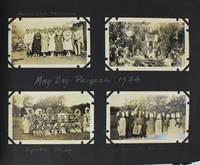
1939Best.-Nr. 4848Various locations in Hawaii 1939. Good. Two albums both oblong. Forty-seven leaves with 300 photographs plus twenty-one loose images; twenty leaves with 130 photos and eight loose images. First album original black cloth string tied. Moderate wear to extremities leaves very chipped several loose. Second album unbound gray card leaves. Light chipping and wear. Images captioned throughout most of both albums; several photos missing from mounts. Two wonderfully detailed vernacular albums documenting the life of a young Japanese-American woman in Hawaii during her high school years. The first album opens with a full-length portrait of the compiler Satsue Ueda dated June 1934. An image from the second album identifies her as "12th grade" in 1937. She goes on to document her friends family members teacher school and related activities and trips around the islands. Images include a group in front of Maui High a visit to Rainbow Gulch Haleakala Kula Manu the Kipapa School Waikiki Oahu Country Club scenes in Honolulu including the Immigration Station and more. There are several images of the school May Day Program from 1934 as well as photos of President Roosevelt's visit to Honolulu. There are also several images of Japanese-American baseball players. Throughout she has identified friends with their first names occasionally with commentary. Several images in the second album show Japanese-American men in military uniform. Others show the "New Kula Sanatorium building." A large group portrait depicts her Dramatic Class for 1937 with each member identified in the margins. There are also some images of a trip to Japan. A wonderful and dense record of one young woman's social circle and high school career. unknown books
1929Best.-Nr. 91958Honolulu 1929. Paperback. Very Good. 14p. Softcover in original wrapper. 20 cm. Rust marks from paper clips on first few pages. Inked note "Clinic - Thursday 9-10 a.m." on front cover. Many of the instructions from this military hospital seem badly dated. Here is the entire section on Crying: "a. While crying is a baby's way of showing that something dissatisfies it don't be alarmed by a moderate amount of crying. See that the baby doesn't need changing see that it isn't too hot nor to sic cold and that it is in a comfortable position. If these things are satisfactory go away and leave the baby alone. Don't pick it up nor walk the floor with it nor rock it in the arms etc. If it seems to have the colic having it lie face down with a hot water bottle beneath its abdomen is frequently all that it needs. Some of the bad habits of childhood are learned in infancy. A baby learns very quickly that it can get what it wants by crying for it. b. If your baby is plump pink in color has from 1 to 3 bowel movements a day and nurses well it can't be seriously ill. paperback books
1931Best.-Nr. 47869Washington: GPO 1931. Paperback. Very Good. iv 135p. Softcover in original wrapper. 24 cm. At head of title: United States Department of the Interior. GPO paperback books
1843Best.-Nr. 68824Lahainaluna: Seminary Press 1843. Early Hawaiian Laws Including Those Relating to Whaling and Divorce An exceedingly rare early Hawaiian imprint. The work is a supplement to the English translation of Ke Kumu Kanawai a Me Na Kanawai o Ko Hawaii Pae Aina Forbes 1337. It contains ten laws and resolutions approved by Hawaiian King Kamehameha III and the premier Kekauluohi "at the council house at Luaehu Lahaina Maui Sandwich Islands." The laws and resolutions themselves deal with land leases taxes on land and pets the timing of the evening guns divorce whaling public auctions tonnage dues ship clearances the removal of duties on gold and silver exports and the payment of jurors. The laws had to be submitted for approval to the British commission that exercised temporary control over Hawaii between February and July 1843 and it is noted in the penultimate paragraph "All the foregoing laws.will take effect after being communicated to the British Commission and proclaimed at each of the principal islands." The resolution on "Respecting Divorced Persons" is especially interesting. This resolution allowed among other things all "divorced persons" not just men to remarry if their divorce was granted before the 1840 Constitution was adopted. The 1840 Hawaiian Constitution had placed certain restrictions on remarriage for both divorced men and women. For instance in cases of adultery the guilty party whether a man or a woman was forbidden to remarry while the former partner was alive. An absence of four years whether through criminal confinement or overseas service or some other reason was often grounds for divorce and remarriage for the party who remained in Hawaii. If a husband tried to kill his wife or vice versa the offending party was not allowed to remarry. The present resolution provided for all those who divorced before the 1840 Constitution to remarry no matter the reason for the divorce. The resolution regarding whaling ships is also notable. It allows whalers to barter or sell up to $200 worth of goods duty free "for the purpose of procuring refreshments." If a whaling ship barters or sells more than the $200 threshold "they shall pay the customary duties." This is likely a reaction to laws or regulations set down in other Pacific ports during the golden age of the whaling industry when Hawaii was an important port of call for ships of all nations. "The edition is unknown. This is not recorded in reports of either the 1843 or 1844 General Meetings. Because of its small size it was doubtless part of the category 'small jobs ship lists government protests &c.' in the 1844 minutes" - Forbes. Forbes lists no references for the work and the location of only eight copies all in Hawaii. OCLC locates copies to only three institutions: Yale University University of Hawaii at Manoa and Bishop Museum Library. An uncommon and elusive early Hawaiian legal work that touches upon women's issues and the whaling industry at the height of its prominence in the world economy. 12mo. Original printed self-wrappers. Small chip at head of spine just separating at lower fold minor foxing. Very good. FORBES 1393. OCLC 862079031. unknown books
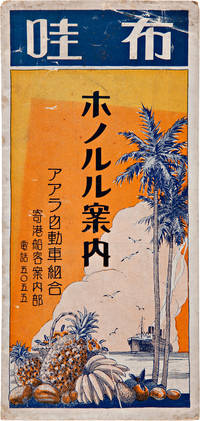
1930Best.-Nr. 57146N.p. ca. 1930. Rare Guide for Japanese Tourists in Hawaii Pre-WWII A brightly printed and well-preserved piece of Hawaii ephemera for visitors from Japan. This brochure put together by the Aala Automobile Union sometime around 1930 was given to visitors arriving by ship. It features a street map of Honolulu and brief descriptions of attractions accompanied by a photographic illustration in each panel printed entirely in Japanese. Among the attractions are the Moanalua Gardens Diamond Head Nuuanu Pali the Bishop Museum of Natural History and a bronze statue of Kamehameha I. The reverse of the city map includes a small map of the island of Oahu accompanied by some details about the geography and population and advertises tours of other attractions operated by Aala. A very rare and interesting look at Japanese tourism in Hawaii prior to World War II. OCLC records copies at the International Resource Center for Japanese Studies Nichibunken in Kyoto and at the Huntington Library. Lightly soiled minor foxing and wear near folds. Very good plus. OCLC 1020932646 1285604465. unknown books
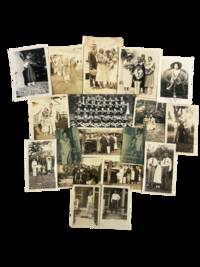
1930Best.-Nr. 62840Hawaii mostly Honolulu. ca. 1930s. Pre-WWII Hawaiian Photos and Postcards in a Traditional Hawaiian Cloth Binding An attractive album of original photographs and photographic postcards from 1930s Hawaii bound in traditional patterned Hawaiian tapa or kapa cloth. The photographs a handful of which are briefly captioned in manuscript on the verso depict a variety of scenes both natural and urban mostly in and around Honolulu. Some of the original photos include general street scenes of the town several photos of American servicemen at the "Army and Navy Y.M.C.A." Honolulu's famous palace-turned-courthouse Ali'iolani Hale and the most recent building for the city's longstanding and highly influential Central Union Church completed in 1924. The postcards mostly with the logo "KH Ltd." and often captioned in the negative depict various tourist attractions like Diamond Head and the Moanalua gardens and activities such as hula dancing surfing and shark fishing. One postcard captioned "H 152 China Clipper Ship – Pearl Harbor Oahu" shows an image of an amphibious plane resting in the harbor while American military planes fly overhead. By the 1930s the practice of making tapa fabric was beginning to wane; it was primarily seen as an emblem of traditional Hawaiian culture and so would have been an attractive choice for such a souvenir album. An appealing collection of pre-World War II Hawaiian images in an attractive tapa cloth binding. Oblong tapa cloth album tied with string. Light shelf wear three images loose in album. Photographs crisp and clean. Near fine. hardcover books
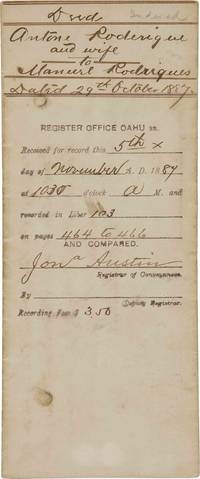
1887Best.-Nr. 67658Oahu Hawaii: October 29 1887. Hawaiian Manuscript from the Reign of King KalÄkaua An unusual manuscript deed recording the sale of land on Hawaii's Mokauea Island with the land boundaries expressed in 'Ōlelo Hawai'i the Hawaiian language and the land coordinates included in the boundary description. The land in question was sold by Antone Rodrigues to Manuel Rodrigues during the KalÄkaua Dynasty for three thousand dollars. Written in 'Ōlelo Hawai'i the deed the land being sold and its history of ownership: the land was "described in Royal Patent 1853 based on Land Commission Award 7168 to Kailio for J. Kaaukai and conveyed to me Antone Rodrigues by J. Kaaukai and Mahiaihis his wife by deed dated the 23rd day of August A.D. 1865 of record in the Hawaiian Registry of Deeds in said Honolulu in Liber 20 folios 97 and 98." Ana Kalama Rodrigues Antone's wife then releases her dower rights to the property to Manuel Rodrigues and his heirs. The document is signed with Antone's mark and Ana's full signature each followed by a seal. The document is also endorsed by the attorney who wrote the document. An additional section written and signed by the Hawaiian Registrar of Conveyances follows verifying that Ana Rodrigues was not coerced by her husband to sign away her dower rights: "the said Ana Kalama on a private examination by me separate and apart from her husband further acknowledges to me that she executed the same without any fear compulsion or restraint of her said husband." Antone Rodrigues aka Antonio Rodrigues-Gaspar was born in approximately 1830 and immigrated to Hawaii from Pico Island in the Portuguese Azores sometime before 1865 when he purchased the land in question. Antone had likely arrived as a sailor or officer on a whaling ship as had most Portuguese migrants to Hawaii prior to 1878 and married Ana Kalama in 1868. A rare administrative document created during the KalÄkaua Dynasty incorporating an 'Ōlelo Hawai'i description in addition to English. Officially marked documentation with Hawaiian language content is quite scarce outside of the islands. Narrow folio. Old folds. Light even tanning one-inch separation at right edge of lower fold line. Very good. unknown books
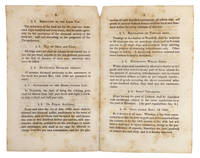
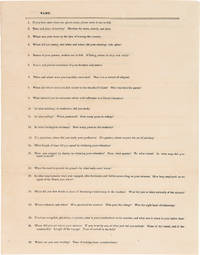
1830Best.-Nr. 63884N.p.: American Board of Commissioners for Foreign Missions ca. 1830s. Original Questionnaire for Hawaiian Missionaries A questionnaire produced by the American Board of Commissioners for Foreign Missions ABCFM directed towards new missionaries to Hawaii. The Board was founded in 1810 by graduates from Williams College and sent its first missionaries to British India in 1812. Beginning in the 1820s the ABCFM sent twelve companies of missionaries to Hawaii many of whom became instrumental figures in the public life of the Islands in the 19th century. The questionnaire consists of two conjugate leaves: the first contains twenty-two questions and is directed at the missionary. The second leaf is headed "For Females" and contains fifteen questions. In addition to personal questions such as nativity and educational background missionaries are asked to provide information about when and where they were converted licensed and ordained when they "first decided in favor of becoming a missionary to the heathen" what their role was in the mission "if not an evangelist physician or printer" and details of their vessel and journey. The questionnaire for females asks mostly similar questions but omits those related to preaching and ministry in favor of questions about children and family. This form is addressed to "J.S. Emerson & Mrs. Emerson." John S. and Ursula Sophia Newell Emerson arrived in Hawaii in 1832 as members of the fifth company of missionaries sent by the American Board of Commissioners for Foreign Missions. John S. Emerson 1800-67 was born in Chester New Hampshire and graduated from Dartmouth College and Andover Theological Seminary. In 1831 he married Ursula Sophia Newell 1806-88 of Nelson New Hampshire the couple soon thereafter embarking for Hawaii. Except for an interval at the Mission Seminary at Lahainaluna Maui in the 1840s and a return visit to the United States in 1860-61 the couple spent the rest of their lives in Waialua Oahu. There they founded a Protestant Church and established schools - John instructing the boys and Ursula instructing the girls in not only academics but in singing sewing and other domestic work. A remarkable survival from the early days of Christian missionary activity in Hawaii. Old folds lower fold just beginning to split. Very good plus. unknown books
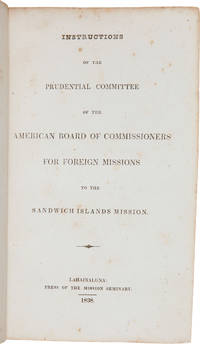
1838Best.-Nr. 66226Lahainaluna: Press of the Mission Seminary 1838. Instructions for Missionaries Printed in Hawaii A collection of the original instructions issued to each of eight groups of Christian missionaries sent to Hawaii between 1819 and 1836 by the American Board of Commissioners for Foreign Missions ABCFM. It is a relatively early Lahainaluna imprint printed in an edition of 380 copies. "This work contains the Act of Incorporation of the ABCFM State of Massachusetts signed by Caleb Strong Governor and Alden Bradford Secretary of the Commonwealth 20 June 1812 together with the laws and regulations of the same body. Following this are the parting instructions given to each of the first eight companies of missionaries to the Hawaiian Islands…by Samuel Worcester Jeremiah Evarts David Greene B.B. Wisner and Rufus Anderson. A complete list of each company including the Hawaiians is found on pages 119-122.Rev. Clark's account of printing for the year ending February 28 1839 includes this work and shows a production cost of $30. The printed minutes of the 1839 General Meeting record 380 copies printed" - Forbes. The ABCFM was an interdenominational body composed primarily of New England Congregationalists and Presbyterians whose "attention.was called to the Hawaiian Islands by reports of traders and by the presence in New England of several native youth from these islands.The Protestant Christian community of New England became interested in these young Sandwich Islanders and in the possibility that they might become Christian messengers to their own people.The sending of missionaries to Hawaii followed as the next logical step" Kuykendall. This first group of missionaries sent by the ABCFM to Hawaii included two ordained ministers Hiram Bingham and Asa Thurston a physician two schoolmasters and catechists a printer a farmer; their wives and three Hawaiian youths who had been attending the Foreign Mission School in Cornwall Connecticut. In their set of instructions to this first group of missionaries the ABCFM said that it was God's ".gracious pleasure and his high command that his gospel should be preached to them the people of Hawaii; that they may be turned from darkness unto light – be baptized in the name of the Father and of the Son and of the Holy Ghost and taught to observe all things whatsoever he has commanded for their salvation and for his everlasting honor and praise." An important and uncommon text tracing the early history of the American Christian missionary movement and the ABCFM in Hawaii between 1819 and 1836 complete with the names of the missionaries sent by the ABCFM and the goals they were expected to achieve during their respective stays in Hawaii. Contemporary cloth-backed paper boards. Spine neatly repaired boards lightly soiled and rubbed. Light foxing some slight worming in gutter margin with minute loss to text. Very good. FORBES HAWAII 1086. Ralph S. Kuykendall The Hawaiian Kingdom Vol. 1 1778-1854: Foundation and Transformation Honolulu: Univ. of Hawaii Press pp.102-4. hardcover books