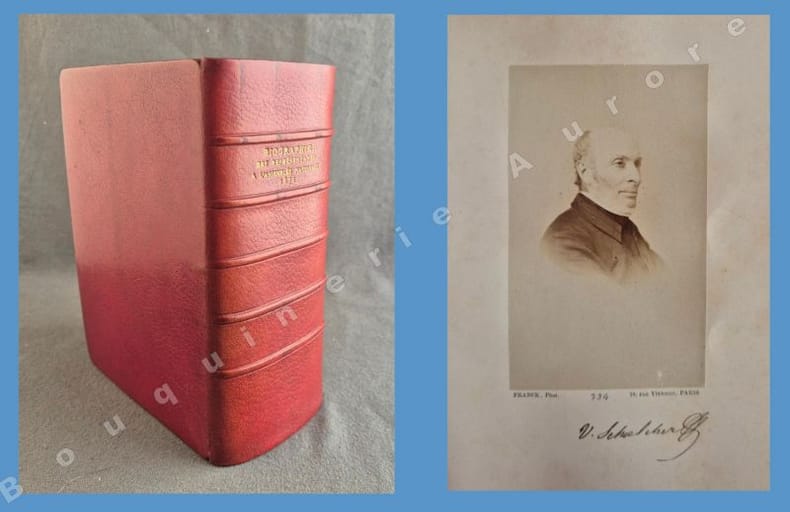
5 502 résultats
1798réf. 4709Bourg, Imprimerie Dufour et Josserand ; in-4, broché ; 4 pp.
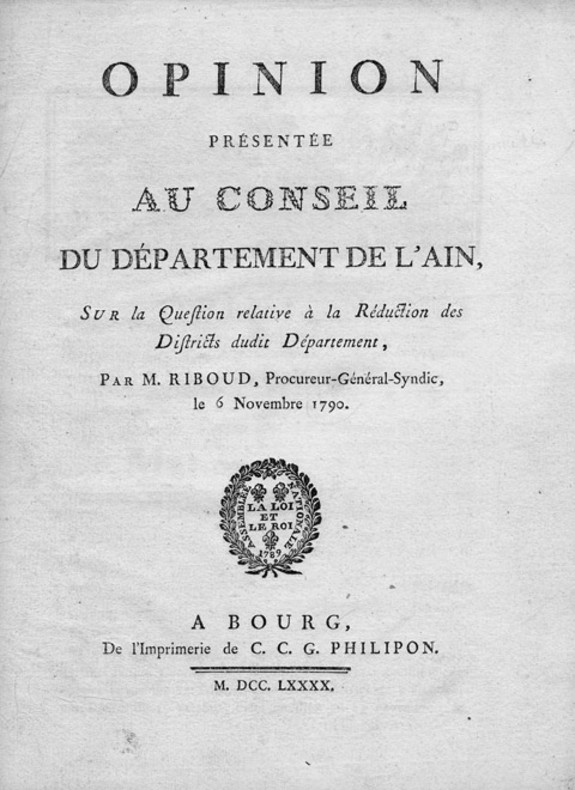
1790réf. 7344Bourg, C.C.G. Philipon, 1790. SUIVI DE : Mémoire sur les principaux objets de l’Administration dans le département de l’Ain, lu à l’Assemblée administrative, par M. Riboud, Procureur général Syndic, le 7 juin 1790, et imprimé par ordre de l’Assemblée. Bourg, C.C.G. Philipon. Deux fascicules reliés en un volume in-4 ; bradel demi-papier vert, faux nerfs dorés, pièce de titre grenat, plats de papier marbré (reliure très légèrement postérieure) ; 42 pp. ; (1) f. blanc, 38 pp., (1) f. blanc.
1868réf. 6130Paris, Michel Lévy Frères, 1868 ; in-8, broché ; (2) ff. , XVI, 419, 4 pp.
1787réf. 11954S.l. (Bourg), s.n., 1787 ; in-8, broché ; (4), 87 pp., (1 bl.), (1) f. d’errata, (1) f. blanc, couverture bleue muette.
1791réf. 11994RELIE ENSUITE : Opinion de M. Salle, député du département de la Meurthe, sur les événements du 21 juin 1791, prononcée à la tribune de l’Assemblée à la séance du 15 juillet. RELIE ENSUITE : Opinion de M. Barnave, prononcée à la séance du 15 juillet. Ensemble in-4, broché ; Bourg, Imprimerie C.C.G. Philipon, (1791) ; 16 ; 15, (1 bl.) ; 20 pp.
1844réf. 15312Lyon, Giberton et Brun ; Midam et Gourchon (Imprimerie de Marle Ainé), 1844 ; in-8, broché ; (2), 67pp., couverture crème.
1959réf. 16710Paris, Editions de Minuit, 1959 ; in-8 carré, toile grise de l'éditeur, jaquette illustrée en violet ; 199 pp. , nombreuses illustrations.
1849réf. 121101849 P., Librairie Pagnerre, 1849, 1 vol. in-18 (155 x 100) relié 1/2 chagrin vert, dos à 5 nerfs, plats en papier marbré, de 256 pp.Mouillure claire marginale, bel exemplaire bien relié par ailleurs.
1871réf. 145981871 Angers, aux bureaux de la publication, 1871, 1 vol. fort in-8° (187 x 132 mm, épaisseur 85 mm !), relié plein maroquin rouge, dos à 5 nerfs, titre doré, double filet doré sur les coupes, riche guirlande dorée encadrant les plats intérieurs, toutes tranches dorées (BELZ-NIÉDRÉE), de 340 pp.Dos légèrement insolé, rousseurs éparses, quelques épidermures de surface au papier du texte, bel exemplaire luxueusement relié par Belz Niédrée par ailleurs.
réf. GF21344IDOC-France - un volume in-8 broché de 518 pages -
réf. 6902Société d'études des Hautes Alpes In-8, broché , couverture souple non glacée , 190 pages , croquis , cartes , documents , riche , très bel exemplaire . Sommaire sur le second cliché ci-joint.
1849réf. 19877Couverture souple. Broché. 246 pages. Couverture défraîchie. Mouillure. Rousseurs. 19 x 28 cm.
1874réf. 86169Couverture souple. Broché. 771 pages. Non coupé. Dos réparé. Fortes rousseurs.
1944réf. 122038- Une feuille ronéotée. 21 x 27 cm, texte recto-verso.
réf. 15991Paris, Imprimerie Royale, 1788. 6 pieces bound in one volume. 7, (1) pp.; (8) pp.; 18 pp.; 7, (1) pp.; (4), 505 pp.; 14 pp. 4to. Modern half calf. All original editions. The Assembly of Notables was an advisory body of the Old Regime, including nearly 150 of the most prestigious nobles and public officials of France. The first Assembly of Notables, convened by Louis XVI to approve the last great reform program of the Bourbon monarchy, rejected unexpectedly the most important reforms, initiating the crisis leading to the revolution in 1789. The government's program, conceived by the controller general, C.-A. de Calonne, intended to eliminate the mounting deficit through a combination of financial and institutional reform. A new land tax and provincial assemblees were the centerpieces. Other reforms included the taille (tax on commoners, mainly peasants), a money payment replacing the corvée (peasant road service), a more equitable salt tax (gabelle), free internal trade in grain, and removal of tariff barriers within the national borders. The Notables had several reasons to oppose most of the proposed reforms and close analysis of their debates and of their role in ancien régime society helps to explain why they opposed royal reforms and why their example sparked broader opposition, which succeeded ultimately in undermining the monarchy and forcing it to convene an Estates General in 1789. The major theme in the first Assembly was the nation controlling and participating in government and from the spring of 1787 until the autumn of 1788, calls resounded for the convening of an Estates General and for extending the powers of provincial assemblees. The crown finally succumbed to financial stringency and public pressure and in August 1788 an Estates General was summoned. In the same year, 1788, a second Assembly of Notables was convened with the task of advising the king on procedures for electing the Estates General. During this session, of which the proceedings were edited by P.S. Dupont de Nemours and Hennin, the decision was made to convoke the États-Généraux in 1789 and the rules of the elections were established. The debate centered, among other things, on equal representation for each order and separate deliberation and vote by order. The public demanded the 'doubling of the Third' and 'vote by head', aimed at ensuring greater influence for the Third Estate in the Estates General. These issues dominated debates in 1789, until June, when the three orders merged into a National Assembly, marking the first victory of the Revolution.
1964réf. 047963Biblica Broché Bruges 1964 N°69 - 101 pages en format 14 - 21 cm
1965réf. 047964Biblica Broché Bruges 1965 N° 70 - 93 pages en format 14 - 21 cm
1963réf. 047965Biblica Broché Bruges 1963 N°71 - 106 pages en format 14 - 21 cm
1963réf. 047988Biblica Broché Bruges 1963 N°89 - 105 pages en format 14 - 21 cm
1964réf. 047989Biblica Broché Bruges 1964 N°91 - 109 pages en format 14 - 21 cm
1966réf. 047990Biblica Broché Bruges 1966 N°95 - 118 pages en format 14 - 21 cm
1965réf. 048047Biblica Broché Bruges 1965 N°78 - 114 pages en format 14 - 21 cm
1966réf. 048048Biblica Broché Bruges 1966 N°80 - 89 pages en format 14 - 21 cm
1968réf. 048051Les Editions Du Cerf broché Couverture Illustrée Paris 1968 103 pages en format 14 - 21 cm - dessins Exemplaire de bibliothèque
1966réf. 048056Biblica Broché Bruges 1966 N°88 - 100 pages en format 14 - 21 cm