272 risultati
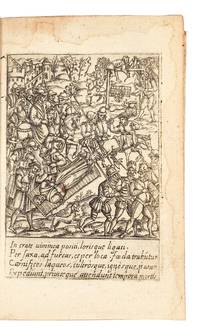
1676[4] + 77 + [3] pp. + frontispice (scène representant les 19 martyrs), 15cm., texte en Français, reliure du 19e siècle (plats marbrés, dos en cuir peu taché), feuilles de garde marbrées, texte frais, bon état, rare, [Edition à l'occasion de la béatification des martyrs de Gorcum, par le pape Clement X, en 1675], H96543
1623[xvi] + 79 + 15pp., with engraved vignette on title page (scene of some martyrs being hanged) & 15 martyrs' portraits in text + 2 other engravings ("De floculo miraculoso ad BB. Martyrum sepulchrum" & "Penses a la fin. Il faut mourir et comprendre", 15cm., 19th cy. black full-leather binding, marbled endpapers, text clean and bright with only few stains, minor defect at lower margin of first pages, good condition, [The last 15 pages contain: "Exercitium pietatis ad S.S. Martyres meditatio"], H96542
1899112 Pages. Features: Adventures of Louis De Rougemont - part IX; Holy Week Procession in Seville (includes photos of Nazarene's in costumes similar to those of Klansmen); My Texan Elopement -John H. Jones impersonates Miss Sally Steddem; A Naturalist in Cannibal-Land - adventures of Captain H. Cayley-Webster in the cannibal islands of the South Seas (with photos of Cayley-Webster); Jinkers and Jinkering - photo-illustrated article shows how buildings are moved by horses and oxen in Western New South Wales; My Klondike Mission - Lilian Agnes Oliver of Chicago set out for the Klondike to raise money to support her invalid husband - a photo-illustrated account; Through Pygmy-Land - Part I - photo-illustrated article by Albert B. Lloyd; The Heroes of Niagara - a series of graphic narratives, each illustrated by a photo of the hero and his apparatus; "Dago" - eminent actor Kyrle Bellew relates a remarkable mining incident - with photos; The Martyrs of Ku-Cheng - photo-illustrated article on the slaughter of Christian missionaries in the interior of China and the decapitating retribution; My First Leopard - by Walter H. Bone; Round the World in a Home-Made Boat - Joshua Slocum and the 'Spray'; Wolves in a Blizzard - Mr. and Mrs. E. Howard in North-West Canada; My Cycle Ride to Khiva - part II - an account of a remarkable bicycle ride across the deserts of Kara-kum and Kizil-kum by Robert L. Jefferson, F.R.G.S.; Attacked by Leeches - W. Harcourt-Bath describes a horrible jungle; Incredible photos of dozens of prisoners on treadmill in the great prison of Rangoon; Photo of dead Armenian heroes in Samsoun; and more. Average wear. Complete and intact. Few pencil markings. A sound vintage copy of this wonderful issue. Book
rif. 2062: Guilhot, Paris, 1946. Edmond Lajoux (illustrateur). Grand In-folio, lithographies originales en couleurs d'Edmond Lajoux. Etui cartonné en parfait etat , Intérieur en très bon état. L'un des "quelques" exemplaires d'artiste. Exemplaire D'artiste. DESSIN ORIGINAL DE L'ILLUSTRATEUR SUR LA DEUXIEME PAGE SIGNE AVEC LA MENTION "HOMMAGE DE L'ILLUSTRATEUR "le dessin represente un poilu chargé , vu de dos
rif. 74296Guilhot Editeur, 1946, 1 volume de 25x33 cm environ, 135 pages, demi maroquin à coins fauve et cartonnage marbré sous étui assorti, dos à 4 nerfs portant titres dorés, cuir souligné par un filet doré sur les plats, gardes marbrées. Exemplaire N° 386, un des 830 sur Vélin de Rives, illustré de lithographies originales de Edmond Lajoux. Petits frottements épars sur le dos et l'étui, bon état pour le reste.
1655rif. H96551Namurci [Namur], s.n. 1655 [xxxii +] 400pp., later hardcover binding binding (spine in leather with gilt title and decorations, some traces of use at edges of boards and corners), 17cm., text in latin, text clean and bright with only very few contemporary underlinings and annotations (in margin of text) in ink, small wormhole in margin (not in the text) of first pages, good condition, [This is a rare second Latin edition, (first edition = Douai Balthasar Bellerus 1603). Willem Estius, born at Gorcum 1542, died at Douai 1613, based his work on the eye-witness account of his brother Rutger Estius and on his own investigations afterwards ; the author felt personally involved since his uncle and some of his friends (both priests of Gorcum & Hieronymus) were among the martyrs. // Continuation of the title: "Quibus pro coronide subiuncta est, eodem Authore appendix de martyrio Guilielmi Gaudani, item Minoritae quod contigit anno 1573. Habes & aliorum quorumdam martyria, opportunis locis commemorari: nominatim Cornelii Musii Delfii theologi & poëtae."], H96551
1655[xxxii +] 400pp., later hardcover binding binding (spine in leather with gilt title and decorations, some traces of use at edges of boards and corners), 17cm., text in latin, text clean and bright with only very few contemporary underlinings and annotations (in margin of text) in ink, small wormhole in margin (not in the text) of first pages, good condition, [This is a rare second Latin edition, (first edition = Douai Balthasar Bellerus 1603). Willem Estius, born at Gorcum 1542, died at Douai 1613, based his work on the eye-witness account of his brother Rutger Estius and on his own investigations afterwards ; the author felt personally involved since his uncle and some of his friends (both priests of Gorcum & Hieronymus) were among the martyrs. // Continuation of the title: "Quibus pro coronide subiuncta est, eodem Authore appendix de martyrio Guilielmi Gaudani, item Minoritae quod contigit anno 1573. Habes & aliorum quorumdam martyria, opportunis locis commemorari: nominatim Cornelii Musii Delfii theologi & poëtae."], H96551
1927rif. 2003San Antonio: Imprenta Universal 1927. About very good. 124pp. Printed in blue ink. Original cream printed wrappers. Moderate wear spine chipped at ends corners worn. Lightly soiled. Light soiling and foxing to text mostly to outer leaves. Biographical work documenting those who died in defense of the Catholic Church during the Cristero War which followed the Mexican Revolution and constitution of 1917. During the Cristero War the secular government sought to crack down on the influence of the Catholic Church banning local religious festivities. This work comprises more than fifty entries providing date and circumstances of death of those killed in 1926 and 1927 illustrated with a portrait or other image of the victim or victims. Only a handful of copies in OCLC. Imprenta Universal unknown books
1809rif. 000087Paris Le Normant 1809
1772rif. H96552Louvain [Leuven], Drukkerye der Academie 1772 viii + 108pp., 20cm., gecart. band met lederen rug (slijtage aan randen, kleine herstelling aan rug), tekst helder, goed, zeldzaam, [SAMEN INGEBONDEN MET: 1: NN, Twee-hondert jaerigen Jubel-galm der XIX. salige Martelaren van Gorcum, met een kort verhael van hun leven, wonderheden, reliquien, ende salig-verclaeringe (Mechelen, Van der Elst, 1772, [4] + 59pp.), 2: NN, Jubel-Galm tyer gelegenheyd der twee-honderd-jaerige geheugenis en feest over den roem-ruchtigen zegenprael door de groote en wyd-vermaarde gelucksalige de gelucksalige Martelaeren, geseyd van Gorcom voltrocken ten Briele in Holland, op 9. Julii 1572 (Tot Brussel, by Franciscus t'Serstevens, 1772, 16pp., zijdelingse bladranden wat kort hersneden met verlies van enkele lettertjes van tekst) // Deze jubelvieringen n.a.v. de tweehonderdjarige herdenking van de Gorcumse martelaren vond plaats in Leuven in de kerk der Minderbroeders Recollecten, van 5 tot 20 juli 1772], H96552
1772viii + 108pp., 20cm., gecart. band met lederen rug (slijtage aan randen, kleine herstelling aan rug), tekst helder, goed, zeldzaam, [SAMEN INGEBONDEN MET: 1: NN, Twee-hondert jaerigen Jubel-galm der XIX. salige Martelaren van Gorcum, met een kort verhael van hun leven, wonderheden, reliquien, ende salig-verclaeringe (Mechelen, Van der Elst, 1772, [4] + 59pp.), 2: NN, Jubel-Galm tyer gelegenheyd der twee-honderd-jaerige geheugenis en feest over den roem-ruchtigen zegenprael door de groote en wyd-vermaarde gelucksalige de gelucksalige Martelaeren, geseyd van Gorcom voltrocken ten Briele in Holland, op 9. Julii 1572 (Tot Brussel, by Franciscus t'Serstevens, 1772, 16pp., zijdelingse bladranden wat kort hersneden met verlies van enkele lettertjes van tekst) // Deze jubelvieringen n.a.v. de tweehonderdjarige herdenking van de Gorcumse martelaren vond plaats in Leuven in de kerk der Minderbroeders Recollecten, van 5 tot 20 juli 1772], H96552
1776Folio, with 2 copper-engraved portrait frontispieces, engraved and printed titles and 38 fine copper-engraved engraved plates, some mild offsetting and age-staining as usual; contemporary full calf, back with six raised bands ruled in blind, second compartment with red leather label lettered and tooled in gilt (label worn without loss of lettering), boards moderately age-scuffed and worn, board edges and corners worn and bruised, joints cracked (but all cords and binding entirely sound, a remarkably well-preserved, crisp, clean copy. The 'Life' is complete with frontispiece and 9 plates; the 'Lives' complete with frontispiece and 29 plates. Small unobtrusive repair to bottom blank margin of Q1; p.285 of the 'Life'; wrongly numbered 286 as usual; p.345 of the 'Lives' wrongly numbered 348 as usual. AN UNUSUALLY CLEAN, SOUND AND COMPLETE COPY OF A HANDSOME AND GRAPHIC EIGHTEENTH-CENTURY EDITION IN WHOLLY UNRESTORED CONTEMPORARY BINDING.
1605rif. H119418t' Antvverpen [Antwerpen], Inde Plantijnsche Druckerije, by Jan Moerentorf 1604 (1605) 401 + [3] pp., met gegraveerd drukkersmerk op titelblad en op verso van colophon, contemporaine bruine vollederen band (intact, wat slijtage aan randen, vergulde versieringen op rug, vergulde titel is vervaagd), oud handgeschreven ex-libris op titelpagina, vaag ex-librisstempeltje op titelpagina en op verso van blanco schutblad, 19cm., tekst in het Nederlands in Gotisch schrift, tekst en papier zijn helder met uitzondering van wat vage oude vlekken, binding tussen schutblad en titelpagina wat gelost, verder in goede staat, [Eerste Nederlandstalige uitgave van Estius' Latijnse editie "Historiae martyrum Gorcomiensium etc." (Douai, 1603). Het titelblad vermeldt 1604 als uitgavedatum, maar in het colophon wordt 1605 vermeld], H119418
rif. 2308PG005E Pratticas Espirituaes. Ordenado por D.Fr. BARTHOLOMEU DOS MARTYRES Arcebispo & Senhor de Braga Primaz das Hespanhas. Para se ler nas Parroquias deste nosso Arcebispado aonde naõ ha Prégaçaõ Com a vida & morte de seu Autor que escreveo o Arcebispo de Lisboa o Senhor Dom Rodrigo da Cunha. LISBOA. Na Officina de Joaõ Galraõ M. DC. LXXXIV 1684 Com todas as licenças necessarias. In 8.º de 202x15 cm. Com xl 300 págs. Encadernação da época inteira de pele com rótulo nervos e ferros a ouro. Cortes das folhas levemente carminados. Impressão nítida em caracteres redondos com itálicos apenas no índice na Bula de Gregório XV nos títulos dos capítulos e nos títulos correntes. Exemplar com pertence de difícil leitura do século XIX - Padre Alberto de Figueiredo na folha de rosto que tem no pé uma anotação bibliográfica a lápis. Com ocasionais anotações e sublinhados a lápis e pequeno furo de traça junto ao festo no pé das páginas 127 a 170 sem afectar a mancha tipográfica. Nas folhas preliminares: Provisão do autor determinando que os membros do clero que não tivessem estudos suficientes para pregar por eles mesmos estavam obrigados a ler partes desta obra todos os Domingos e dias de guarda; Proemio; Licenças; Sumário da Vida e Morte do Illustrissimo Senhor D. Frei Bartolomeu dos Mártires escrita pelo Senhor D. Rodrigo da Cunha; Taboada do que se contem neste Cathecismo; Bula do Papa Gregório XV de 27 de Setembro de 1622 concedendo indulgencias. 11.ª Edição muito rara como todas as edições desta obra. É a terceira edição que inclui a biografia do autor escrita por D. Rodrigo da Cunha que promoveu o processo de canonização em Roma. Foram publicadas 16 edições. Depois da primeira de Braga em 1564 seguiram-se edições em Lisboa 1566 Coimbra 1574 Lisboa 1585 Lisboa 1594 Évora 1603 Lisboa 1617 Lisboa 1628 Lisboa 1656 Lisboa 1674 a presente edição Lisboa 1684 Lisboa 1764 Lisboa 1765 Lisboa 1785 Lisboa 1962 e Círculo de Leitores Lisboa 2019. A sua popularidade não se restringiu a Portugal tendo sido traduzido para castelhano em Madrid 1564 Salamanca 1602 Madrid 1653 e para latim em Roma 1735. Obra fundamental para o ensino da doutrina cristã e para a elevação do nível religioso e intelectual do clero e que é um clássico da literatura portuguesa do século XVI. A primeira edição foi logo publicada no ano seguinte a ter regressado do Concílio e destinava-se a promover uma melhor preparação teológica e espiritual do clero da diocese. O Catecismo é uma obra muito importante para o estudo das reformas implementadas por D. Frei Bartolomeu dos Mártires na diocese de Braga aplicando os decretos do Concílio de Trento para a redação dos quais ele próprio muito contribuiu. Apesar de ter sido pensado para aplicação na Diocese de Braga passou a ser usado em todo o país e no estrangeiro pela sua qualidade literária e rigor doutrinal. São Bartolomeu dos Mártires Freguesia dos Mártires Lisboa 3 de Maio de 1514 - Convento de Santa Cruz Viana do Castelo 16 de Julho de 1590 ingressou na Ordem dos Pregadores Dominicanos em 1528 e começou a lecionar teologia em 1542. Em 1551 participou no Capítulo Geral da sua ordem em Salamanca e no ano seguinte foi nomeado Mestre de D. António futuro Prior do Crato em Évora onde contactou com os Jesuítas ordem recentemente formada. Posteriormente tornou-se Prior do Convento de Benfica de 1557 a 1558 e em 1559 foi sagrado Arcebispo de Braga tendo escolhido a divisa: Ardere et Lucere - Nolite conformari huic saeculo Arder e Brilhar - Não se conforme com este mundo múnus que exerceu de forma brilhante até 1582 quando se retirou para o Convento de Santa Cruz em Viana do Castelo. A sua vida de elevada espiritualidade marcada pela tendência mística do Contemptus mundi a grande atenção aos sinais do tempo e a influência dos jesuítas contribuíram para que se consagrasse à reforma e renovação da Igreja Católica tendo participado nas sessões do Terceiro Período do Concílio de Trento entre 1561 e 1563. A sua presença foi notável e muito influente pois apresentou 268 petições que determinaram muitas das conclusões deste importantíssimo Concílio. De volta à diocese aplicou a sua visão da Igreja e os decretos reformadores do Concílio. Publicou uma obra sobre os deveres e funções episcopais Stimulus Pastorum escreveu o Catecismo para a formação do clero fundou um seminário em Braga o primeiro depois de Trento reuniu um Sínodo Diocesano em 1564 um sínodo Provincial em 1566 e realizou numerosas visitas pastorais em que percorreu várias vezes a sua extensa diocese que incluía Vila Real Bragança e Viana do Castelo. Preocupou-se muito com várias questões sociais durante a peste de 1570 e a crise económica de 1574 as suas obras de caridade foram exemplares. Foi declarado Venerável pelo Papa Gregório XVI em 1845 Beatificado pelo Papa João Paulo II em 4 de Novembro de 2001 na Basílica de S. Pedro e canonizado pelo Papa Francisco em 10 de Novembro de 2019. A sua festa litúrgica celebra-se a 18 de Julho. EN In octavo. 20.2x15 cm. xl 300 pp. Contemporary full leather binding with label raised bands and gilt tools on spine. Slightly red edges. Clear printing in round characters with italics only in the table of contents the Bull of Gregory XV the chapter headings and the current headings. Copy with hard-to-read 19th century ownership title - Father Alberto de Figueiredo on the title page with a bibliographical annotation in pencil at the foot. With occasional annotations and underlining in pencil and a small moth hole next to the inner hinge at the foot of pages 127 to 170 without affecting the text area. In the preliminary pages: Provision of the author determining that the members of the clergy who did not have sufficient studies to preach by themselves were obliged to read parts of this work every Sunday and guard days; Proemium; Licences; Summary of the Life and Death of the Illustrissimo Senhor D. Frei Bartolomeu dos Mártires. written by . Senhor D. Rodrigo da Cunha; Taboada of what is contained in this Cathecism; Bull of Pope Gregory XV of 27 September 1622 granting indulgences. 11th Edition very rare like all editions of this work. This is the third edition to include a biography of the author written by Bishop Rodrigo da Cunha who promoted the canonisation process in Rome. Sixteen editions have been published. After the first in Braga in 1564 there were editions in Lisbon 1566 Coimbra 1574 Lisbon 1585 Lisbon 1594 Évora 1603 Lisbon 1617 Lisbon 1628 Lisbon 1656 Lisbon 1674 the present edition Lisbon 1684 Lisbon 1764 Lisbon 1765 Lisbon 1785 Lisbon 1962 and Círculo de Leitores Lisbon 2019. His popularity was not restricted to Portugal having been translated into Spanish in Madrid 1564 Salamanca 1602 Madrid 1653 and into Latin in Rome 1735. Fundamental work for the teaching of Christian doctrine and for the elevation of the religious and intellectual level of the clergy and a classic of 16th century Portuguese literature. The first edition was published the year after he returned from the Council of Trent and was intended to promote better theological and spiritual preparation of the diocese's clergy. The Catechism is a very important work for the study of the reforms implemented by Bishop Bartolomeu dos Mártires in the diocese of Braga applying the decrees of the Council of Trent to the drafting of which he himself contributed greatly. Although it was intended for use in the Diocese of Braga it came to be used throughout the country and abroad due to its literary quality and doctrinal rigour. São Bartolomeu dos Mártires Freguesia dos Mártires Lisbon 3 May 1514 - Convento de Santa Cruz Viana do Castelo 16 July 1590 joined the Dominican Order of Preachers in 1528 and began teaching theology in 1542. In 1551 he took part in the General Chapter of his order in Salamanca and the following year he was appointed Master of D. António the future "Prior of Crato" in Évora where he came into contact with the Jesuits a newly formed order. He later became Prior of the Convent of Benfica from 1557 to 1558 and in 1559 he was consecrated Archbishop of Braga having chosen the motto: Ardere et Lucere - Nolite conformari huic saeculo Burn and Shine - Don"t be conformed to this world a role he performed brilliantly until 1582 when he retired to the Convent of Santa Cruz in Viana do Castelo. His highly spiritual life marked by the mystical tendency of the Contemptus mundi his great attention to the signs of the times and the influence of the Jesuits helped him to dedicate himself to the reform and renewal of the Catholic Church and he took part in the sessions of the Third Period of the Council of Trent between 1561 and 1563. His presence was notable and very influential as he presented 268 petitions that determined many of the conclusions of this very important Council. On his return to the diocese he applied his vision of the Church and the reforming decrees of the Council. He published a work on episcopal duties and functions Stimulus Pastorum wrote the Catechism for the formation of the clergy founded a seminary in Braga the first after Trent convened a Diocesan Synod in 1564 a Provincial Synod in 1566 and carried out numerous pastoral visits in which he travelled around his extensive diocese which included Vila Real Bragança and Viana do Castelo. He was very concerned about various social issues and during the plague of 1570 and the economic crisis of 1574 his charitable works were exemplary. He was declared Venerable by Pope Gregory XVI in 1845 beatified by Pope John Paul II on 4 November 2001 in St Peter's Basilica and canonised by Pope Francis on 10 November 2019. His liturgical feast is celebrated on 18 July. Referências/References: Iberian Books C39290 113066. Arouca M 148 refere seis edições no século XVII. Manuel dos Santos Bibliografia Geral II 5156. Nepomuceno 1057. Pinto de Matos 420. Inocêncio I p. 334; VIII 364. M-6-E-22 hardcover
1635rif. H96548Antverpiae [Antwerpen], Ex officina Plantiniana Balthasaris Moreti [Moretus] 1635 [8] + [XX] + [3] pp., with engraved title vignette (depicting Franciscus of Assisi receiving the Stigmata) and one full-page coat-of-arms ("Per virtutis in honoris") and engraved printer's device on last leave and 20 engravings in text some of which by A. Pauli [= Pauwels] and most probbaly some by A.v.Diepenvelle (the first one depicting "Rex martyrum Christus", the 19 others depicting each of the martyrs meeting their death), leaves printed on recto side only, bilingual: text in Latin and Dutch in parallel columns, some occasional staining in margin of text, 19th century hardcover binding (marbled boards, spine in leather with gilt title and decorations, corners bit bumped), marbled endpapers, with ex-libris "J.W.L.Smit" and ex-dono ex-libris tipped in on endpapers, good condition, rare, [contains biographical sketches of Franciscan martyrs in the Netherlands during the 16th century wars of independence against Spain. Deals with the martyrs P.F. Johannes Amicus, the six martyrs of Alkmaar, Engelbertus Terburghis, the 19 martyrs of Gorcum, Reynerus a Lintris (Roermond), Johannes Mahusius (Oudenaarde), Guilelmus Goudanus, Johannes Cuyper (Diest), Arnoldus Knapper Donaet (Amersfoort), Adrianus Beverloo, Nicolaus Delfius, Johannes Schuermans (Peer), Johannes van Amsterdam, Johannes Gray, Johannes Puteanus, Martinus Suetens, Albertus van Leiden, Thomas van Beringen & Joachim van Delft. ], H96548
1635[8] + [XX] + [3] pp., with engraved title vignette (depicting Franciscus of Assisi receiving the Stigmata) and one full-page coat-of-arms ("Per virtutis in honoris") and engraved printer's device on last leave and 20 engravings in text some of which by A. Pauli [= Pauwels] and most probbaly some by A.v.Diepenvelle (the first one depicting "Rex martyrum Christus", the 19 others depicting each of the martyrs meeting their death), leaves printed on recto side only, bilingual: text in Latin and Dutch in parallel columns, some occasional staining in margin of text, 19th century hardcover binding (marbled boards, spine in leather with gilt title and decorations, corners bit bumped), marbled endpapers, with ex-libris "J.W.L.Smit" and ex-dono ex-libris tipped in on endpapers, good condition, rare, [contains biographical sketches of Franciscan martyrs in the Netherlands during the 16th century wars of independence against Spain. Deals with the martyrs P.F. Johannes Amicus, the six martyrs of Alkmaar, Engelbertus Terburghis, the 19 martyrs of Gorcum, Reynerus a Lintris (Roermond), Johannes Mahusius (Oudenaarde), Guilelmus Goudanus, Johannes Cuyper (Diest), Arnoldus Knapper Donaet (Amersfoort), Adrianus Beverloo, Nicolaus Delfius, Johannes Schuermans (Peer), Johannes van Amsterdam, Johannes Gray, Johannes Puteanus, Martinus Suetens, Albertus van Leiden, Thomas van Beringen & Joachim van Delft. ], H96548
1925rif. 2092902141401367Not Available 1925. Soft Cover. Fine. Number of books: 5 Not Available paperback
1837rif. 104703London: Ordered by the House of Commons to be Printed 1837. The tolpuddle martyrs pardoned First edition of the official government paper pardoning the Tolpuddle Martyrs otherwise the Dorchester Labourers or Six Men of Dorset and allowing their return to England. Their sentences of transportation to Australia for forming a trade union had caused a public outcry in 1834. In England agitation against the sentences began almost as soon as they were pronounced and the outcry over the injustice of the case won the support of high-profile radical figures including Daniel O'Connell Fergus O'Connor and William Cobbett. Less than a month after the trial the men were already being referred to as "martyrs". Under pressure the home secretary Lord John Russell granted the men conditional pardons in June 1835 followed by full pardons in March 1836 although that news was not passed on to the men who remained in assigned labour long after they should have been freed. Single folio sheet 338 x 215 mm. Housed in a cloth portfolio. Dutch library stamp to outer margin and shelf mark at head. Horizontal crease where folded a little marginal chipping; a very good copy. See Printing and the Mind of Man 305. hardcover
1754rif. 2306160124xbvkSpain, 1754. Calligraphic titlepage in a handpainted watarcolour frame; 5 sheets dedication ''A LA REYNA DEL CIELO MARIA SSA. EN SU SOLEDAD DOLOROSA SA MADRE DEL AMOR HERMOSO, y delicias de la celestial Syon, aunque max grande de penas y amanguras de la gracia, que en el dura, pero o lorioso campe de la soledad ...''; 1 blank sheet; 2 sheets ''TABLA DE LAS SANTAS ANACORETAS CONTENIDAS EN ESTE SEGUNDO TOMO DEL DESIERTO DELICIOSO''; 2 sheets 'PROTESTA . . .' etc.; 334* sheets Description of the Saints. - Vellum binding of the periodover 4 raised bands with manuscript title at spine and possibly younger frangments of ribbon clasps; 4to.(ca. 24 x 19 x 6 cm; ca. 1,47 kg.).
1768rif. HCGAUF2TV4MGPorto 1768. 8vo. Antonio Alves Ribeiro Guimaraens Contemporary mottled tanned sheepskin cat's paw pattern sewn on 4 supports gold-tooled spine with the title in the 2nd compartment. 32 188 4 blank pp. Very rare second edition of a Portuguese textbook on pharmacology written as a series of questions and answers to prepare students in medicine for their examinations first published in Coimbra in 1735. The first part of the book is mainly concerned with general knowledge which the students have to know. The second part of the book consists of questions and answers on the work of the Syrian physician Masawaih al-Mardini d. 1015 in Bagdad and Cairo better known in the West as Mesue the younger the most important author for students of pharmacology. The book ends with explanations of various passages from the work of Mesue in Latin since the student would have read him in that language.With annotations on the second front endleaf and the title page. Browned throughout with a water stain on the lower corner of pp. 129-160 and a hole in the second front endleaf.l Blake p. 290; Innocencio A 1117 note; Porbase 1238756 1 copy; WorldCat 77818650 & 14335394 1 copy. EDUCATION & LEARNING EUROPE MEDICINE & PHARMACY MIDDLE EAST & ISLAMIC WORLD Medicine & Pharmacy 18th Century Pharmacy / Pharmacopaea Portugal School & Textbooks unknown
1612rif. ST20615Liège: Christian Ouwerx 1612. FIRST AND APPARENTLY ONLY EDITION. 160 x 98 mm. 6 1/4 x 4". 62 leaves four leaves of H2 and H3 mis-bound between C2 and C3. Contemporary vellum tooled in blind covers with plain rule frame small oblique fleurons at corners of inner frame central panel with larger fleuron centerpiece slightly raised bands early ink shelf location at head of spine holes for two fore-edge ties now lacking. Engraved title page with illustration in the style of a Tree of Jesse with St. Augustine as its source the martyrs on the branches offering their crowns to the Virgin and Child sitting in glory at the top and 27 PLATES DEPICTING MARTYRS many with their means of execution all by Collaert. Title page and 1r with 17th century ink ownership inscription of the Congregation of Notre Dame à Treves; title page with ink signature of "Krintinger" at foot; G8v with ink signature of Jean Chapeaville Vicaire de Liege whose printed approval for the publication of this work appears on H2r. Each life of a martyr with vellum tab at head of page near the gutter. De Theux "Bibliographie Liegeoise" 1867 p. 24; USTC 1506992. Vellum a little grubby and with a couple of small ink stains corners slightly bumped tiny chips gone at spine ends a couple of quires a bit proud but the binding solid and retaining much of its original antique appeal. Occasional minor soiling internally isolated spots of foxing or trivial paper flaws but the text and plates otherwise very appealing the impressions of the engravings being especially rich. Written by a Walloon theologian and illustrated by an Antwerp master printer this is a very rare treatise on martyrs of the Augustinian order that was once in the library of an order of teaching nuns. These 27 hagiographies of Augustinian hermits who died for the faith were written by theologian Georges Maigret 1573-1633 prior of the Augustinian monastery in Liège. He begins with St. Evode martyred in Africa in 408 and continues up to 1610 when Blessed Illephonse and Raphael de la Madre de Dios were killed while on missions in the Philippines and Sunda Islands respectively. Other near-contemporary martyrs died closer to home like Brother Gerard Ridder who was murdered by the Huguenots in the Low Countries in 1587. A full-length portrait by Adriaen Collaert illustrates the entry for each martyr with detailed background scenery giving a sense of where these Augustinians were serving at the time of their demise. Some martyrs are shown in the midst of their execution: Boniface hangs on an X-shaped cross Philippe Aymil stands pierced through with arrows Augustin du Rosaire kneels calmly before the swordsman who will behead him. The death of others is represented allegorically as in the case of Jean Sahagoune who was poisoned: he is depicted standing atop a recumbent lion while a richly dressed woman offers him a chalice containing a snake. Collaert ca. 1560-1618 came from a family of prominent Flemish engravers in Antwerp. After training with his father Hans he became a master of the artists' Guild of St. Luke in 1580. Our volume was once owned by the Congregation of Notre Dame in Trier an order of Augustinian Canonesses dedicated to educating the daughters of the poor. The order was founded in northeastern France in 1597 and soon spread to surrounding areas. Of special interest the printing of our volume was authorized by the signature of Jean Chapeauville vicar general of Liege and Inquisitor of the Faith. As a reformer historian and theologian Chapeauville 1551-1617 was a person of considerable prominence in the church of his time. To qualify for personal manuscript authorization like this the work must have had quite a small print run and copies would have additionally been destroyed through devout use. In any case the book is almost never seen for sale today. Christian Ouwerx unknown
1583rif. 5484Macerata: Appresso Sebastiano Martellini con licenza de' superiori 1583. FIRST ITALIAN EDITION the second edition overall and the FIRST ILLUSTRATED EDITION. Hardcover. Fine. Bound in 19th c. ivory vellum hinges repaired at head and foot light soiling spine label fragmentary the boards ruled in gold the spine gold-tooled with repeating floral tools. Illustrated with six engraved plates of Catholic priests being abused apprehended tortured and executed described in detail below. With a woodcut title vignette of the Crucifixion a woodcut of the Pietà on leaf D7 verso printer's ornaments and woodcut initials. The text is type-ruled throughout. The text is in very good condition aside from damp-staining in gathering B and the six plates; the title page is soiled and has a small area of restoration at the upper corner as well as a clean tear mended and a little staining in the gutter. There is a light oil stain on leaf H6 and a marginal paper flaw on leaf N5. A translation with additional material of Allen's "A briefe historie of the glorious martyrdom of XII. reuerend priests executed vvithin these tvveluemonethes for confession and defence of the Catholike faith." Rheims: J. Foigny 1582. The English edition exists in only 2 copies British Library and Westminster Cathedral Library. This edition the first edition to include the six engraved illustrations is also rare. OCLC locates copies of the Macerata edition at 7 institutions in North America. see notes below for holdings. The central figure of Allen's martyrology is the Jesuit Edmund Campion 1540-1581 who at Allen's request and along with Robert Parsons led the first Mission to England. Campion and his companions were arrested on 17 July 1581. The present work recounts the arrest trial and eventual execution of Campion as well as the priests Ralph Sherwin Alexander Briant Thomas Ford John Shert Robert Johnson William Filby Luke Kirby Lawrence Richardson John Payne and Everard Hanse; as well as the Jesuit Thomas Cottam. Included in these accounts are the transcripts of Campion's final letter to the Jesuit General Claudio Aquaviva Ralph Sherwin's letter from the Tower and Alexander Briant's letter written while imprisoned to the Jesuit fathers in England requesting admission to the Society which was granted. Allen who continued to receive material up to the time of publication appended the martyrdoms of Cuthbert Maine John Nelson and Thomas Sherwood all of whom died in 1577 and 1578 to his account of the martyrs of 1581 and 1582. The translator of the present edition added an additional account not found in the English edition of the martyrdom of 4 English priests in 1583. The Engravings: The six engravings in this work first appeared in the first edition of Robert Parson's "De Persecutione Anglicana Libellus" published by the Jesuit College at Rome in 1582. Each of the six images is accompanied by a four-line explanation in hexameter verse. "The first plate depicts priests being apprehended in private houses and marched off to prison; the second in amplification shows various priests some still in their vestments being led away either on horseback or on foot but always securely bound two gentlewomen who had sheltered them being led to the same destination. In the third a priest is being scourged while tied to the back of a cart and below in the foreground an examination is in progress as preparations are made for torture. The fourth picture illustrates a racking with three other victims lined up to await their turn. In the fifth the priests are being dragged to execution on hurdles while the instruments of death are prepared; and the final plate represents the different stages of martyrdom from the hanging to the drawing quartering and burning of entrails."Anthony G. Petti in Recusant History April 1966 pp. 288-91 Edmund Campion: "Campion was arrested with his companions on 17 July 1581. Amid scenes of violent excitement Campion was derisively paraded through the streets of his native city bound hand and foot riding backwards with a paper stuck in his hat to denote the 'seditious Jesuit'. First thrown into Little Ease at the Tower he was carried privately to the house of his old patron the Earl of Leicester; there he encountered the queen herself and received earnest proffers of liberty and preferments would he but forsake his papistry. Hopton having tried in vain the same blandishments on Campion's return to the Tower the priest was then examined under torture and was reported to have betrayed those who had harboured him. Several arrests were made on the strength of the lie. He had asked for a public disputation. But when it came off in the Norman chapel of the Tower before the Dean of St. Paul's and other divines Campion had been denied opportunity to prepare his debate and had been severely racked. Thus weakened he stood through the four long conferences without chair table or notes and stood undefeated. Philip Howard Earl of Arundel who was looking on in the flush of worldly pride became thereby inspired to return to God's service. "The privy council at its wits' end over so purely spiritual a 'traitor' hatched a plot to impeach Campion's loyalty and called in the hirelings Eliot and Munday as accusers. A ridiculous trial ensued in Westminster Hall 20 Nov. 1581. Campion pleading not guilty was quite unable to hold up his often-wrenched right arm seeing which a fellow prisoner first kissing it raised it for him. He made a magnificent defence. But the sentence was death by hanging drawing and quartering: a sentence received by the martyrs with a joyful shout of 'Haec dies' and 'Te Deum'."Catholic Encyclopedia Cardinal William Allen: "On the accession of Elizabeth and the re-establishment of Protestantism William Allen was one of those who remained most staunch on the Catholic side and it is chiefly due to his labours that the Catholic religion was not entirely stamped out in England. Having resigned all his preferments he left the country in 1561 and sought a refuge in the university town of Louvain. The following year however we find him back in England devoting himself though not yet in priest's orders to evangelizing his native county. His success was such that it attracted notice and he had to flee for safety. For a while he made himself a missionary centre near Oxford where he had many acquaintances and later for a time he sought protection with the family of the Duke of Norfolk. In 1565 he was again forced to leave England this time as it turned out for good. He was ordained priest at Mechlin shortly afterwards. "Convinced that Protestant domination of England could only be temporary and that the whole future depended on there being a supply of trained clergy and controversialists ready to come into the country whenever Catholicity should be restored Allen founded the College at Douay since identified with his name. Douay was a new university founded by Pope Paul IV under the patronage of King Philip of Spain in whose dominions it then was for the special object of combating the errors of the Reformation; and what is still more to the purpose it was already under Oxford influences. The first chancellor Richard Smith was an Oxford man as were several of the most influential members of the university at the time when Allen began. It was his ambition to perpetuate Oxford influences and traditions and to make his new college practically a continuation of Catholic Oxford. "The means of support included besides Allen's private income and other voluntary donations a yearly pension of 200 ducats from the King of Spain and later on one of 100 gold crowns a month from the Pope. The number of students grew rapidly. Often more were received than the income warranted a course rendered necessary by the urgent state of Catholic affairs which Allen met in the spirit of faith; and in the long run means were never wanting. The names of Thomas Stapleton Richard Bristowe Gregory Martin Morgan Philips and others are still well known to English Catholics and are themselves a sufficient record of the ability of Allen's early companions and of the work done at the college. Allen had the power of instilling his spirit into his followers. They lived together without written rule but in perfect mutual harmony working for the common cause. From the Douay press came forth a constant stream of controversial and other Catholic literature which could not be printed in England on account of the Penal Laws. In this Allen himself took a prominent part. His writings are distinguished by extent of learning and theological acumen. One of the chief works undertaken in the early years of the college was the preparation of the well-known Douay Bible. The New Testament was published in 1582 when the college was at Rheims." "In 1575 Allen made a journey to Rome his second where he helped Pope Gregory XIII to found another college to send missionaries to England. For this purpose possession was obtained of the ancient English hospice in the city which was converted into a seminary. Returning to Douay Allen found a storm gathering against the English and in 1578 they were expelled from the town. The collegians took refuge at the University of Rheims where they were well received and continued their work as before Allen being soon afterwards elected canon of the Cathedral Chapter. In 1579 he paid his third visit to Rome being summoned thither in order that he might use his unique personal influence to adjust the dispute between the English and Welsh students at the new college there. It was during this visit that he was appointed a member of the Pontifical Commission for the revision of the Vulgate. Up to this point the career of Allen had won the universal admiration and gratitude of English Catholics for what he himself termed his 'scholastical attempts' to convert England. Such was not however the case with his political labors to secure the same end which may be said to have begun about this time and were far less successful. The famous Bull 'Regnans in excelsis' was issued by Pius V in 1570 deposing Queen Elizabeth and releasing her subjects from their allegiance but it did not take practical shape till seventeen years later when preparations were made for the invasion of England by the King of Spain. Allen was then once more in Rome whither he had been summoned by the Pope after a dangerous illness two years before. He never left the Eternal City again but he kept in constant communication with his countrymen in England. It had been due to his influence that the Society of Jesus to which he was greatly attached undertook to join in the work of the English mission; and now Allen and Father Parsons became joint leaders of the 'Spanish Party' among the English Catholics. "At the request of King Philip Allen was created cardinal in 1587 and held himself in readiness to go to England immediately should the invasion prove successful. In estimating the number of those who would be adherents to the scheme however Allen and Parsons were both at fault. The large majority of English Catholics generously forgetting the past sided with their own nation against the Spanish and the defeat of the Armada 1588 was a subject of rejoicing to them no less than to their Protestant fellow countrymen. Allen survived the defeat of the Armada six years. To the end of his life he remained fully convinced that the time was not far distant when England would be Catholic again. . He continued to reside at the English College Rome until his death 16 October 1594. He was buried in the chapel of the Holy Trinity adjoining the college." Catholic Encyclopedia. Appresso Sebastiano Martellini, con licenza de' superiori hardcover