Livre Rare Book
5125 risultati
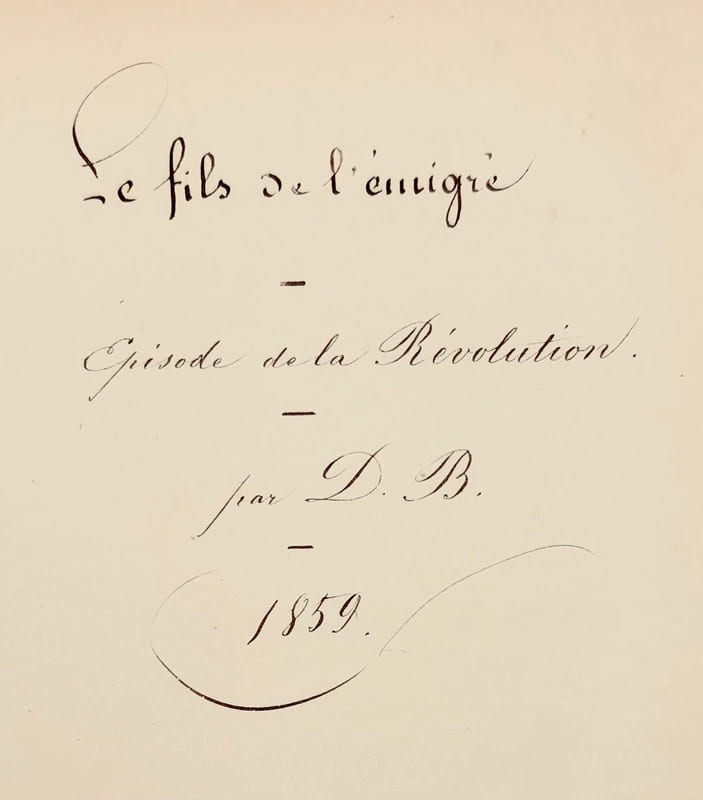
1859rif. 44901Versailles, , 1859. Manuscrit in-8 de (1)-153 pp., demi-cuir de Russie prune, dos lisse anonyme (reliure de l'époque, étiquette Étienne rue de la Paroisse n°46 Versailles).
rif. 234264Laval, Ve A. Goupil, Paris, Picard, 1907 2 vol. in-4, LXXXV-527 pp. et 485 pp., nombreuses ill. in-t., planche, demi-toile bleue (reliure de l'éditeur). Traces d'humidité et salissures sur les plats.
rif. 214995Paris, Derache, 1845 fort vol. in-4, 44 pp., XCVI pp., 735 pp., avec une grande carte dépliante et 4 planches de numismatique illustrant l'essai de Hucher, demi-basane bouteille, dos lisse orné de filets, guirlandes et larges fleurons dorés, tranches mouchetées de vert (reliure de l'époque). Renforçages maladroits aux charnières et aux coins.
1893rif. vp528L'union historique et littéraire du Maine Relié 1893 "Dix-huit volumes in-8 (16 x 25 cm), reliure demi-velin, pièces de titre rouges, les 17 premières années (1893 à 1909) de la revue ""L'union historique & littéraire du Maine"", qui devient dès la seconde annnée ""La Province du Maine"" avec en sous-titre l'ancienne dénomination ; frottements au papier reliure (plats et coupes), salissures sur le vélin (plus ou moins importantes selon le volume), quelques-unes des pièces de titre sont un peu décollées/déchirées, la reliure de la deuxième année est très abimée, par ailleurs assez bon état général pour ce rare ensemble de la tête de série. Livraison a domicile (La Poste) ou en Mondial Relay sur simple demande."
rif. 202218Paris, Chez Pagnerre, puis Amyot, 1848-1850 4 tomes en 2 volumes in-8, 364-396 pp., 377 pp., et 468 pp., demi-basane violine, dos lisse, filets dorés et à froid (rel. de l'époque). Dos un peu passé. Petit manque à la coiffe du tome 1. Bon exemplaire.
rif. 201511Le Mans, Imp. Monnoyer et Vilaire, 1942-1948 3 vol. gr. in-8, VII-344 p. et VII-725 pp., index, broché.
rif. 13958Francfort sur le Mein, sans nom [Wanberk], 1781-1782 ; 24 N° d'environ 60 pages chacun, formant 4 vol. in-12. 388 pp. - 374 pp. - 384 pp. - 374 pp. Bradel ancien recouvert de papier bleu marine, titre doré au dos. Légers frottements sur les dos et les plats. Rousseurs éparses, bon exemplaire cependant.
1890rif. 000297Paris Librairie Des Bibliophiles, Jouaust 1890
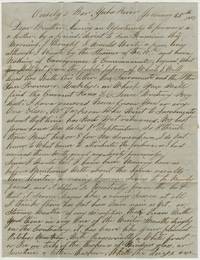
1851rif. BK0070Owsley's Bar Yuba River California 1851. 2 pp. 7 ½ x 9 ½ inches. Folded for mailing and postmarked San Francisco February 1 with red-orange circular datestamp and matching "40" rate handstamp. Minor wear with small pale spot to address panel. A Gold Rush letter from Thomas J. Dabline at Owsley's Bar on the Yuba River giving a detailed report on a dispersed community of Maine emigrants in the California diggings. Dabline names roughly a dozen acquaintances recording their locations occupations and in several cases their financial success while also describing the effects of an exceptionally dry winter on mining along the Yuba. Dabline begins by noting that he has continued mining "with about the same results" and then describes the winter season which had brought remarkably little rain. The shortage of water had begun to interfere directly with mining in the dry ravines: "The very small quantity of rain which has fallen has operated unfavorably for those who are engaged in mining in the dry ravines and hundreds who have been throwing out dirt for washing have been obliged to leave it for want of water. But should it continue as it has it will be very favorable for an early season up the mountains." He compares the weather to a pleasant October in Maine with occasional frost and thin ice and remarks on the relative health of the surrounding mining population estimating only six or eight deaths during the season among roughly 1500 to 2000 miners living within several miles. The strongest portion of the letter is Dabline's account of what he calls "the other Maine boys" who were dispersed across the northern California diggings: "I cannot tell you much about the other Maine boys. They are scattered about the country in the various diggings. I have learned that F. McLeod has gone home with about 3000 dollars and Mr. Sholl with 5000 or 6000 dollars. Fitch Demey is over on the American River in the Express business. Mr. Vinton & Upton are down on the McCormic or dry Creek. Mr. Carpenter with the two Johnsons of Waterville are over on the Feather River. Mr. G. is I believe at Sacramento City. The Trumbulls are up about Nevada City and Dr. Anderson was sometime back down at the little village of Nicholas which is about 55 miles above Sacramento." The passage offers a compact picture of a Maine migration network after its arrival in California with members spread among the Yuba American and Feather River regions Nevada City Sacramento and other settlements. Dabline records both the mobility of the group and their varying outcomes including men who had already returned home with several thousand dollars and another who had entered the express business rather than mining. He closes by mentioning current excitement over reports of a rich new discovery at Gold Bluff though adding that "very little credit is given to the tale here." A useful firsthand account of the social geography of the Gold Rush documenting a community of Maine emigrants across the mining regions while remaining connected through news of one another's whereabouts and fortunes. . unknown
1851rif. BK0070Owsley's Bar Yuba River California 1851. 2 pp. 7 ½ x 9 ½ inches. Folded for mailing and postmarked San Francisco February 1 with red-orange circular datestamp and matching "40" rate handstamp. Minor wear with small pale spot to address panel. A Gold Rush letter from Thomas J. Dabline at Owsley's Bar on the Yuba River giving a detailed report on a dispersed community of Maine emigrants in the California diggings. Dabline names roughly a dozen acquaintances recording their locations occupations and in several cases their financial success while also describing the effects of an exceptionally dry winter on mining along the Yuba. Dabline begins by noting that he has continued mining "with about the same results" and then describes the winter season which had brought remarkably little rain. The shortage of water had begun to interfere directly with mining in the dry ravines: "The very small quantity of rain which has fallen has operated unfavorably for those who are engaged in mining in the dry ravines and hundreds who have been throwing out dirt for washing have been obliged to leave it for want of water. But should it continue as it has it will be very favorable for an early season up the mountains." He compares the weather to a pleasant October in Maine with occasional frost and thin ice and remarks on the relative health of the surrounding mining population estimating only six or eight deaths during the season among roughly 1500 to 2000 miners living within several miles. The strongest portion of the letter is Dabline's account of what he calls "the other Maine boys" who were dispersed across the northern California diggings: "I cannot tell you much about the other Maine boys. They are scattered about the country in the various diggings. I have learned that F. McLeod has gone home with about 3000 dollars and Mr. Sholl with 5000 or 6000 dollars. Fitch Demey is over on the American River in the Express business. Mr. Vinton & Upton are down on the McCormic or dry Creek. Mr. Carpenter with the two Johnsons of Waterville are over on the Feather River. Mr. G. is I believe at Sacramento City. The Trumbulls are up about Nevada City and Dr. Anderson was sometime back down at the little village of Nicholas which is about 55 miles above Sacramento." The passage offers a compact picture of a Maine migration network after its arrival in California with members spread among the Yuba American and Feather River regions Nevada City Sacramento and other settlements. Dabline records both the mobility of the group and their varying outcomes including men who had already returned home with several thousand dollars and another who had entered the express business rather than mining. He closes by mentioning current excitement over reports of a rich new discovery at Gold Bluff though adding that "very little credit is given to the tale here." A useful firsthand account of the social geography of the Gold Rush documenting a community of Maine emigrants across the mining regions while remaining connected through news of one another's whereabouts and fortunes. . unknown books
1907rif. 7061907 1907 Goupil, Picard, Laval, Paris, 1907. 2 volumes in-folio pleine toile grise de travail, pièces de titre en cuir noir, plats conservés, 527 et 485 pages, nombreuses illustrations. Bel exemplaire, intérieur frais.
rif. 3466P., Henrichs, An XI (1802), un volume in 8 relié en pleine basane racinée, dos orné de fers et filets dorés, tranches jaspées (reliure de l'époque), 12pp., 402pp.
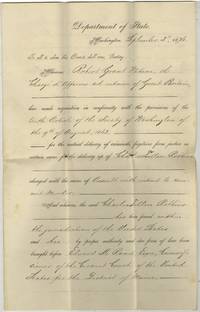
1874rif. BK0084Washington D.C.: Department of State 1874. Partly printed document completed in manuscript 2 pp. 16 ¾ x 10 ½ inches signed by Hamilton Fish as Secretary of State with embossed Department of State seal. Some small tears at folds otherwise near fine; very good plus overall. A Department of State extradition warrant arising from a violent episode aboard the British schooner Annie B and a subsequent dispute over whether the accused should be tried in Great Britain or Maine. Charles Tilton Robbins of Deer Isle boarded the vessel at Portland on May 22 1874 using the name "Dunham of St. Andrews" and taking passage for Saint John. According to the Maine Attorney General's contemporary account while the schooner was seven miles off Monhegan Light Robbins attacked the two men on deck with a revolver and then an iron bar mortally wounding mate Solomon Camp. Robbins escaped in the schooner's boat to Monhegan and then reached Rockland where he was arrested aboard the Deer Isle packet. Camp died at Rockland on May 28.1 Because the attack occurred aboard a British vessel on the high seas Great Britain claimed jurisdiction and requested Robbins's extradition under the tenth article of the Webster-Ashburton Treaty. U.S. Commissioner Edward M. Rand found the evidence sufficient to hold him pending action in Washington. In the present document Fish records that British chargé d'affaires Robert Grant Watson had made the required requisition and directs the United States Marshal for Maine or whoever had Robbins in custody "to surrender and deliver him up" to the British representative. The warrant appears to preserve a short-lived federal decision. Because Camp had died in Maine state authorities maintained that Maine itself had jurisdiction over the resulting murder. Robbins and his supporters appealed to Governor Nelson Dingley Jr. who intervened with Washington to prevent the extradition. The federal government subsequently declined to surrender Robbins and ordered him transferred to Maine authorities for trial. He was indicted in Knox County and brought to trial on September 29; after a twelve-day proceeding in which the defense was a general denial and insanity the jury found him not guilty by reason of insanity. Overall an interesting document from a notable nineteenth-century extradition dispute in which a single killing brought British maritime jurisdiction Maine criminal law and federal treaty obligations into direct conflict. 1 "In the County of Knox" Report of the Attorney General of the State of Maine. 1874 Sprague Owen & Nash 1875 5. . Department of State unknown
1874rif. BK0084Washington D.C.: Department of State 1874. Partly printed document completed in manuscript 2 pp. 16 ¾ x 10 ½ inches signed by Hamilton Fish as Secretary of State with embossed Department of State seal. Some small tears at folds otherwise near fine; very good plus overall. A Department of State extradition warrant arising from a violent episode aboard the British schooner Annie B and a subsequent dispute over whether the accused should be tried in Great Britain or Maine. Charles Tilton Robbins of Deer Isle boarded the vessel at Portland on May 22 1874 using the name "Dunham of St. Andrews" and taking passage for Saint John. According to the Maine Attorney General's contemporary account while the schooner was seven miles off Monhegan Light Robbins attacked the two men on deck with a revolver and then an iron bar mortally wounding mate Solomon Camp. Robbins escaped in the schooner's boat to Monhegan and then reached Rockland where he was arrested aboard the Deer Isle packet. Camp died at Rockland on May 28.1 Because the attack occurred aboard a British vessel on the high seas Great Britain claimed jurisdiction and requested Robbins's extradition under the tenth article of the Webster-Ashburton Treaty. U.S. Commissioner Edward M. Rand found the evidence sufficient to hold him pending action in Washington. In the present document Fish records that British chargé d'affaires Robert Grant Watson had made the required requisition and directs the United States Marshal for Maine or whoever had Robbins in custody "to surrender and deliver him up" to the British representative. The warrant appears to preserve a short-lived federal decision. Because Camp had died in Maine state authorities maintained that Maine itself had jurisdiction over the resulting murder. Robbins and his supporters appealed to Governor Nelson Dingley Jr. who intervened with Washington to prevent the extradition. The federal government subsequently declined to surrender Robbins and ordered him transferred to Maine authorities for trial. He was indicted in Knox County and brought to trial on September 29; after a twelve-day proceeding in which the defense was a general denial and insanity the jury found him not guilty by reason of insanity. Overall an interesting document from a notable nineteenth-century extradition dispute in which a single killing brought British maritime jurisdiction Maine criminal law and federal treaty obligations into direct conflict. 1 "In the County of Knox" Report of the Attorney General of the State of Maine. 1874 Sprague Owen & Nash 1875 5. . Department of State unknown books
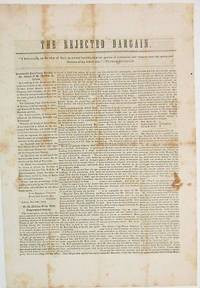
1844rif. 34352Kennebunkport Maine 1844. Folio broadsheet 11" x 16" printed in four columns recto and verso. Light scattered foxing old folds else Very Good. On July 4 1844 Maine's Democratic Party Convention was held in Alfred. Joshua Herrick a farmer was Maine's Democratic Congressman for its First Congressional District during the 1843-1845 Session. He sought renomination. But he was challenged by Judge William Alen Hayes. Hayes's campaign manager was future Supreme Court Justice Nathan Clifford whose manipulations aroused deep resentment over lawyers' control of the democratic process. This broadside reflects those class divisions emerging within the Democratic Party. Hayes who "is without doubt the richest man in the District-- has all the monied institutions at his control or in his interest-- all the aristocracy a queer idea in a dem. party but nevertheless true all or nearly all the Lawyers. Now what has Col. Herrick to go against this tremendous influence He is what we call self-made. has comparatively but little property but he has the confidence of the yeomanry of the District." Despite this appeal Herrick abandoned his effort to secure the Party's renomination and withdrew his name from consideration. He ran without the nomination and lost. Not located on OCLC or the online site of AAS. Not in Williamson American Imprints or Sabin. unknown
1844rif. 34352Kennebunkport Maine 1844. Folio broadsheet 11" x 16" printed in four columns recto and verso. Light scattered foxing old folds else Very Good. On July 4 1844 Maine's Democratic Party Convention was held in Alfred. Joshua Herrick a farmer was Maine's Democratic Congressman for its First Congressional District during the 1843-1845 Session. He sought renomination. But he was challenged by Judge William Alen Hayes. Hayes's campaign manager was future Supreme Court Justice Nathan Clifford whose manipulations aroused deep resentment over lawyers' control of the democratic process. This broadside reflects those class divisions emerging within the Democratic Party. Hayes who "is without doubt the richest man in the District-- has all the monied institutions at his control or in his interest-- all the aristocracy a queer idea in a dem. party but nevertheless true all or nearly all the Lawyers. Now what has Col. Herrick to go against this tremendous influence He is what we call self-made. has comparatively but little property but he has the confidence of the yeomanry of the District." Despite this appeal Herrick abandoned his effort to secure the Party's renomination and withdrew his name from consideration. He ran without the nomination and lost. Not located on OCLC or the online site of AAS. Not in Williamson American Imprints or Sabin. unknown books
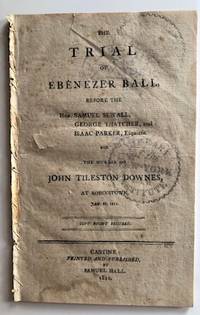
rif. 15686MAINE MURDER 1811. The Trial of Ebenezer Ball before the Hon. Samuel Sewall . . . For the murder of John Tileston Downes at Robinstown Jan. 28 1811. Castine: By Samuel Hall 1811. 40 p. Removed from a bound volume. Old library stamps minor overall browning and foxing. Very good. John Tileston Downes was shot and killed by Ebenezer Ball in Robbinston Maine while attempting to arrest Ball on suspicion of forgery. Ball was found guilty and was hanged in what was the first legal hanging for murder in Eastern Maine. See W. L. Welch "Hanging Ebenezer Ball" Maine History 45 2010 pp. 151-167. Shaw and Shoemaker 24056; Skillin Bibliography of Maine Imprints 11-09; McDade Annals of Murder 65. unknown books
1802rif. 85218Henrichs | Paris An XI (1802) | 13.50 x 21 cm | broché
rif. jj4219Malassis Le Jeune Relié "Quatre volumes in-12°, relié, plein veau, dos à 5 nerfs peu saillants, pièces de titre et de tomaison, caissons ornés, tranches rouges, tome I : XVJ pp. + 448 pp. + 40 pp. ""coutumes générales du Pays et Duché d'Anjou"" + 15 pp. (1777), tome II : 546 pp. + 41-63 pp. ""coutumes générales du Pays et Duché d'Anjou"" + 15 pp. (1778), tome III : 511 pp. + 16 pp. + 65-91 pp. ""coutumes générales du Pays et Duché d'Anjou"" (1778), tome IV : 508 pp. + 12 pp. + 93-119 pp. ""coutumes générales du Pays et Duché d'Anjou"" (1779) ; reliures légèrement frottées par endroit, quelques épidermures, manque la coiffe supérieure des tomes II et IV, manque la coiffe inférieure du tome I, très petits trous de vers, intérieur frais avec de très rares rousseurs, par ailleurs bel exemplaire Livraison a domicile (La Poste) ou en Mondial Relay sur simple demande."
rif. MC00C-00188Chez Henrichs. Collectible - Acceptable. Paris: Chez Henrichs 1802. 1st edition. Sm 8vo hardcover. Contemporary brown calf-backed mottled blue boards with red morocco spine label. viii402pp. French. Fair book. Boards quite worn and insected. Front joint split. Some bumping and shelfwear to the head and foot of the spine. Dampstaining to rear board and a few pages at the rear. In polypropylene bag. From the collection of John Gach 1946-2009 a bibliophile and a nationally known bookseller who specialized in rare books devoted to the human sciences. Thought Thinking Philosophy Books in French Inquire if you need further information. Chez Henrichs hardcover
1902rif. mon0003335558J.H. Stuart & Co. South Paris M 1902T. hardcover. Acceptable. . 1890 edition. Ex-library copy with usual markings. Cover shows minor wear and soiling binder's tape around all the edges. Facsimile title page bound-in to replace missing original page. Pages tanned and clean. J.H. Stuart & Co. South Paris, M hardcover
1850rif. #299Broadside 14" x 8" double column signed in type by three selectmen with attestation by town clerk at end. Folded in quarters with several tiny holes no loss a number of creases minor stains one short marginal tear etc. but overall quite sound. Comprised of 19 Articles proscribing certain types of behavior the unique broadside specifies fines or other punishments for lawbreakers. Most interesting is Article 4: "No boy or other person shall be allowed to play at the game of bat and ball in the public streets of the village. Any person offending against this article shall forfeit and pay fifty cents for each offence." In addition to the obvious like public drunkenness these include: riding horses at a gallop in town or more than a walk on the covered bridge; "any boy or other person" who hangs onto a sleigh or carriage; anyone "causing dogs or any other animals to fight" in the streets; "Any person wantonly exposing himself sic naked in sight of any dwelling house"; a person injuring an ornamental tree on any street; anyone mutilating or pulling down signs or public notices or throwing dirt or setting off firecrackers or sliding down hills in the public streets &c. &c. According to internet resources Biddeford Maine passed a city charter and adopted a mayoral form of government in 1855. Not recorded in OCLC.
1850rif. #299Broadside 14" x 8" double column signed in type by three selectmen with attestation by town clerk at end. Folded in quarters with several tiny holes no loss a number of creases minor stains one short marginal tear etc. but overall quite sound. Comprised of 19 Articles proscribing certain types of behavior the unique broadside specifies fines or other punishments for lawbreakers. Most interesting is Article 4: "No boy or other person shall be allowed to play at the game of bat and ball in the public streets of the village. Any person offending against this article shall forfeit and pay fifty cents for each offence." In addition to the obvious like public drunkenness these include: riding horses at a gallop in town or more than a walk on the covered bridge; "any boy or other person" who hangs onto a sleigh or carriage; anyone "causing dogs or any other animals to fight" in the streets; "Any person wantonly exposing himself sic naked in sight of any dwelling house"; a person injuring an ornamental tree on any street; anyone mutilating or pulling down signs or public notices or throwing dirt or setting off firecrackers or sliding down hills in the public streets &c. &c. According to internet resources Biddeford Maine passed a city charter and adopted a mayoral form of government in 1855. Not recorded in OCLC. books
1920rif. 41267Washington D.C.: Published by the United States Coast and Geodetic Survey 1920. Large folding nautical chart printed on heavy paper stock. Uncolored. A rare original coastal survey of Blue Hills Bay in Maine including Ellsworth Surry Tremont Southwest Harbor Swans Island Blue Hill and Acadia National Park. Established by President Thomas Jefferson in 1807 as the Survey of the Coast the U.S. Coast and Geodetic Survey was the United States' first civilian scientific agency. This agency has followed its mission to survey the U.S. coastline create nautical charts of the coast and help increase maritime safety since its founding and has often played fascinating roles in significant chapters of U.S. history. It served in all theaters of the Civil War in the service of the Union Army and Navy pioneered acoustic exploration in the wake of the sinking of the Titanic and during WWI it worked to detect enemy submarines. In addition this agency worked to survey and produce detailed maps and renderings of the U.S. coast. These nautical survey maps commonly referred to as "T-sheets" provide fascinating insights into the history of the United States coastline which has and will continue to shift. These maps are the most important data source for understanding the physical and ecological characteristics of the U.S. shoreline. The present map is a highly detailed and accurate sea chart of Blue Hills Bay and an important historical view of developing Maine. Published by the United States Coast and Geodetic Survey unknown
1920rif. 41267Washington D.C.: Published by the United States Coast and Geodetic Survey 1920. Large folding nautical chart printed on heavy paper stock. Uncolored. A rare original coastal survey of Blue Hills Bay in Maine including Ellsworth Surry Tremont Southwest Harbor Swans Island Blue Hill and Acadia National Park. Established by President Thomas Jefferson in 1807 as the Survey of the Coast the U.S. Coast and Geodetic Survey was the United States' first civilian scientific agency. This agency has followed its mission to survey the U.S. coastline create nautical charts of the coast and help increase maritime safety since its founding and has often played fascinating roles in significant chapters of U.S. history. It served in all theaters of the Civil War in the service of the Union Army and Navy pioneered acoustic exploration in the wake of the sinking of the Titanic and during WWI it worked to detect enemy submarines. In addition this agency worked to survey and produce detailed maps and renderings of the U.S. coast. These nautical survey maps commonly referred to as "T-sheets" provide fascinating insights into the history of the United States coastline which has and will continue to shift. These maps are the most important data source for understanding the physical and ecological characteristics of the U.S. shoreline. The present map is a highly detailed and accurate sea chart of Blue Hills Bay and an important historical view of developing Maine. Published by the United States Coast and Geodetic Survey unknown books