8 866 résultats
1933réf. 34571New York: Street & Smith Publications Inc. 1933-1949. Tanning to pages of all some minor losses throughout front and back covers present bindings are bright with the exception of volumes 10-13 which are quite faded. All issues trimmed for binding. Overall the magazines are very good to nearly fine. The complete list report upon request. Note for shipping extra funds required. 34571. Octavo thirty-two volumes pictorial wrappers uniformly bound in green cloth. A complete file of 181 issues in bound volumes. Doc Savage was a precursor to the modern super hero. Clark "Doc" Savage Jr. was trained from birth with a rigorous regimen resulting in extraordinary strength and intelligence. He never killed unless necessary he had scientific gadgets a headquarters and a secret base a fortress of solitude. The stories combined mystery adventure and some science fiction. He also had a team of five experts in various fields to assist in his adventures. His stories were extremely popular during the pulp era and then found a new audience in the 1960s-70s when the series was reprinted in paperback. The novels were written using the house pseudonym of Kenneth Robeson the main author was Lester Dent who wrote nearly 80% of the novels. Other author contributors as Robeson included William Bogart Alan Hathway Harold Davis Laurence Donovan and W. Ryerson Johnson. There were many excellent contributors to the short stories which rounded out the magazine with authors such as Steve Fisher E. Hoffman Price Q. Patrick John D. MacDonald Bruno Fischer Frank Herbert William Lindsay Gresham to name a few. Street and Smith publishing executive Henry Ralston and editor John Nanovic established the initial idea for Clark "Doc" Savage Jr. - .a brawny 'superman' a master of many fields-surgeon mineralogist engineer inventor linguist. His skin was a glowing bronze.his hair was a matching hue and so too his eyes resembling gold flake. He would be known as the Man of Bronze."- Server Encyclopedia of Pulp Fiction Writers p.81. "Doc Savage was intended to be an adventure character but under Lester Dent's imaginative manipulations he became something more - the first superhero and an inspiration for countless pulp comic-book and television characters." - Cook Mystery Detective and Espionage Magazines pp. 521-527. "The enormously wealthy Doc Savage – headquartered in a fantasticated New York with his five sidekicks who specialize in various crafts and sciences at the borderline of sf – devotes his life to combating criminal conspiracies almost all masterminded by the kind of charismatic villain later given definitive form by Ian Fleming in the James Bond books. Doc Savage himself clearly influenced the creation of Superman." - SFE online. A note on artists Walter Baumhofer contributed the initial look to the character with his striking cover painting through late 1936. Other artists include Robert George Harris Emery Clarke Modest Stein and George Rozen. An ideal collection for an institution. Reference: Tymm and Ashley Science Fiction Fantasy and Weird Fiction Magazines pp. 183-185. Street & Smith Publications, Inc. unknown
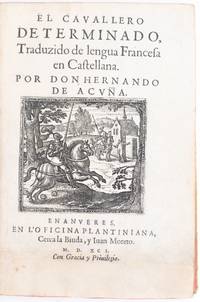
1591réf. 1521En Anveres Antwerp: En l’Oficina Plantiniana Cerca la Biuda Iuan Moreto widow of Plantin and Jan Moretus 1591. First Plantin edition. In contemporary limp vellum. Title on spine lettered in ink. Edges tinted in red. Roman type. 20 verse lines and headline. Large floriated and historiated woodcut initials ornamental tailpieces printer's device at the end. A few stains on the binding rear panel rubbed at lower left corner. Title page artistically restored at the lower margin with no effect on the text. Last leaf O4 cut the residual part mounted on pastedown. Inside clean illustrations are sharp the margins wide. An attractive copy in fine condition. Illustrated with an engraved title vignette of a knight on horseback with background and 20 full-page etchings attributed to Pieter van der Borcht. Illustrated with an engraved title vignette of a knight on horseback with background and 20 full-page etchings attributed to Pieter van der Borcht. First Plantin edition. In contemporary limp vellum. Title on spine lettered in ink. Edges tinted in red. Roman type. 20 verse lines and headline. Large floriated and historiated woodcut initials ornamental tailpieces printer's device at the end. 8º: –8 A–N8 O4 O4 blank its residual part mounted to pastedown; 32 208 8 p. Scarce illustrated Spanish edition the first by Plantin of La Marche’s allegorical work Le chevalier délibéré. A beautiful 16th-century edition of this popular allegory with the suite of twenty-one splendid etchings attributed to Pieter van der Borcht. Translated into Spanish by Hernando de Acuna c.1520–1580 the much-esteemed poet and translator of the Spanish Golden Age. Le chevalier délibéré is the most important poetic work of Olivier de La Marche 1422–1502 the Burgundian courtier poet and chronicler “a didactic poem describing a knight's search for salvation through the vehicle of a quest. At first he is impulsive leaving his house par une soudaine achoison on the spur of the moment. He is started along the way by Thought who brings him to a realization of his soul's unprepared state and who acquaints him with the encounters he must face with the henchmen of Atropos Goddess of Death: Accident and Debility. The knight as Author is befriended by the hermit Understanding and eventually arrives at the house of Study where Fresh Memory begins his real instruction.” Caroll 1999. USTC 440151; Imhof M-5; Brunei 111:782; Hollstein Dutch 111:106 473–493; Palau VII 130356. Bibliography: Caroll C. W. ed.: Olivier de La Marche. Le Chevalier delibere The Resolute Knight. Medieval & Renaissance Texts & Studies. Volume 199. Tempe: Arizona Center for Medieval and Renaissance Studies 1999. p. 4. Imhof D.: Jan Moretus and the Continuation of the Plantin Press. A Bibliography of the Works published and printed by Jan Moretus I in Antwerp 1589–1610. Vol. I. A–M. Leiden: Brill 2014. pp. 437–438. . En l’Oficina Plantiniana, Cerca la Biuda, Iuan Moreto [widow of Plantin and Jan Moretus] unknown
1504réf. 5444Venice: Giovanni Battista Sessa June 1504. THIRD OR FOURTH EDITION of the two editions of 1504 priority has not been determined. THE FIRST TO BE EDITED BY LUCA GAURICO. Hardcover. Fine. Bound in modern vellum. Title with large woodcut showing the author in his study surrounded by books lecturing his students one of whom takes notes. Sessa's cat-and-mouse printer's device appears on the same leaf.The text is illustrated with 77 woodcut diagrams. A very fine copy crisp and bright. There is a very light stain on the title page a bit of soiling in the gutter of leaf A3 and a discreet paper repair to the fore-edge of the final leaf. "The 'Perspectiva communis' was the most widely used of all optical texts from the early fourteenth until the close of the sixteenth century and it remains today the best index of what was known to the scientific community in general on the subject" DSB. It was first printed in Milan around 1482 then in 1503 it was included in a collection by Thomas Bradwardine "Praeclarissimum mathematicarum opus"Valencia. This 1504 edition the first edited by Luca Gaurico can be considered the third although another edition of the pre-Gaurico version was also published in 1504 at Leipzig. A mathematician from Naples and teacher of Scaliger Gaurico who also edited the works of Archimedes and Ptolemy completely revised the text. "The work on which Pecham's fame has chiefly rested is the Perspectiva communis probably written between 1277 and 1279 during Pecham's professorship at the papal curia. In the first book Pecham discussed the propagation of light and color the anatomy and physiology of the eye the act of visual perception physical requirements for vision the psychology of vision and the errors of direct vision. In book II he discussed vision by reflected rays and presented a careful and sophisticated analysis of image formation by reflection. Book III was devoted to the phenomena of refraction the rainbow and the Milky Way. "The central feature of Pecham's optical system and the dominant theme of book I of the 'Perspectiva communis' is the theory of direct vision. Here as elsewhere Pecham endeavored to reconcile all the available authorities-Aristotle Euclid Augustine al-Kindi Ibn al-Haytham Ibn Rushd Grosseteste and Bacon. Following Ibn al-Haytham Pecham argued that the emission of visual rays from the observer's eye is neither necessary nor sufficient as an explanation of sight; the primary agent of sight is therefore the ray coming to the eye from a point on the visible object. But in an attempt to follow Aristotle al-Kindi and Grosseteste as well Pecham argued that visual rays do nevertheless exist and perform the important but not always necessary function of moderating the luminous rays from the visible object and making them "commensurate with the visual power." Thus Pecham like Bacon resolved the age-old debate between the emission and intromission theories of vision in favor of a twofold radiation although to be sure priority was given to rays issuing from the visible object. "The rays issuing from points on the visible object fall perpendicularly onto the cornea and penetrate without refraction to the sensitive ocular organ the glacial humor or crystalline lens; nonperpendicular rays are weakened by refraction and therefore can be largely ignored. Since only one perpendicular ray issues from each point of the visible object and the collection of such perpendicular rays maintains a fixed order between the object and the eye a one-to-one correspondence is established between points on the object and points on the glacial humor and unconfused perception of the visual field is thus achieved. Vision is not "completed" however in the glacial humor. There is a further propagation of the rays or species through the vitreous humor and optic nerve to the common nerve where species from the two eyes combine and eventually to the anterior part of the brain and the "place of interior judgment." "Pecham's optical system included significantly more than a theory of direct vision. He briefly discussed the doctrine of species; treated at length the propagation of rays; and developed a theory to explain how solar radiation when passing through noncircular apertures gives rise to circular images. He expressed the full law of reflection and applied it to image formation by plane spherical cylindrical and conical mirrors; in this analysis he revealed an implicit understanding of the nature of the focal point of a concave mirror. Although he did not possess a mathematical law of refraction he successfully applied the general qualitative principles of refraction to the images that result from refraction at plane and circular interfaces between transparent media of various densities. In his discussion of the rainbow Pecham again attempted to reconcile different theories. He argued that all three kinds of rays rectilinear reflected and refracted concur in the generation of the rainbow. "Pecham's 'Perspectiva communis' is still extant in more than sixty manuscripts and went through twelve printed editions including a translation into Italian between 1482 and 1665. It was used and cited by many medieval and Renaissance natural philosophers including Dominicus de Clavasio Henry of Langenstein Blasius of Parma Lorenzo Ghiberti Leonardo da Vinci Albert Brudzewski Francesco Maurolico Giambattista della Porta Girolamo Fabrici Johannes Kepler Willebroad Snellius and G. B. Riccioli. It was lectured upon in the late Middle Ages at the universities of Vienna Prague Paris Leipzig Cracow Würzburg Alcala and Salamanca."DSB. Giovanni Battista Sessa, June hardcover
1944réf. 28504New York: Scribner's 1944. SIGNATURE GUARANTEED AUTHENTIC Personally SIGNED BY RAYMOND CHANDLER & DATED on Blank Endpapers Hollywood MARCH 30 1944 IN FRONT OF BOOK Written BY BEN HECHT A Guide for the Bedeviled Chandler also added "From // Dr. Sam Hirshfeld" on Endpapers BOOK Written BY BEN HECHT HARDBACK NODustjacket NOJACKET BK GOOD CONDITION 1944 SIGNED BY RAYMOND CHANDLER & DATED Hollywood MARCH 30 1944 IN FRONT OF BOOK BY BEN HECHT A Guide for the Bedeviled GREEN CLOTH LIGHT RUB WEAR Hirshfeld was a Hollywood physician active in the 1940's and a good friend of Hecht's & CHANDLER - he is mentioned in "Harpo Speaks" as attending a Marx dinner with Hecht and Hecht gave his funeral oratory. The cloth boards are worn and the dust jacket is missing. Interior sound. BOOK Written BY BEN HECHT . Signed by Author. Hard Cover. Good/No Jacket. New York: Scribner's hardcover
5 voll. in-4, pp. XL, 296; VII, 312; VII, 340; VII, 296; VIII, 303, bella leg. m. perg. coeva, c. dec. ai piatti, tass. al d. e tagli spruzzati. Rara opera che si ferma al V tomo (tutto il pubblicato). Rara opera presente in sole 15 biblioteche italiane secondo l'indice ICCU. Lozzi II n. 3592: scrive dal catalogo Bocca "Opera rara anzi rarissima pregevole e assai ricercata". [030]
2 gr. voll. in folio, pp. XXIII, 472; (4), 356, CXIX, bella leg. cart. rust. coevo con tit. mss al d. Tagli spruzzati. Con una tav. in rame ripiegata al primo front. raff. l'arco romano di Fano dis. e inc. da A. Magini. Lozzi 1560. Biblioteca Picena, p. 102. Splendido e marginoso esempl. [223]
2 gr. vol. in folio, pp. XXIII, 472; (4), 356, CXIX, leg. cart. alla rust. coevo. Importante storia di Fano molto lodata dal Ranghiasci anche per le notizie storiche sulle località e città vicine. Lozzi 1560. Raro. Lievi gore e qualche traccia di umidità ma ottimo esempl. a larghi margini in barbe. [361]
Quattro grossi volumi di cm. 26, pp. 2.000 ca. complessive. Con moltissime illustrazioni e tavole f.t. incise in rame. Legature coeva in mezza pelle, dorsi lisci con fregi e titoli in oro su tasselli. Esemplari spesso slegati e con qualche traccia d'uso alle legature, ma internamente ben conservati e completi. Importante testimonianza del lavoro che Olivieri degli Abbati compì come storico, soprattutto di cose pesaresi. La presente raccolta fu composta nel settecento e vi compaiono varie note manoscritte che spesso rivelano una certa, erudita competenza e sono poste a correzione e completamento del testo. Allegati pure vari fogli manoscritti di mano coeva. Non ci azzardiamo ad ipotizzare che il tutto appartenesse proprio all'Aolvieri degli Abbati, ma sicuramente ad uno storico marchigiano del tempo. Fra le opere presenti: Memorie della Badia di S. Tommaso in Foglia nel contado di Pesaro; Memorie di Alessandro Sforza Signore di Pesaro; Memorie di Gradara Castello di Pesaro; Memorie del porto di Pesaro; Memorie di Novilara; Memorie per la storia della chiesa pesarese del secolo XII; Dell'antico battistero della Chiesa pesarese; Della zecca di Pesaro; della fondazione di Pesaro; ecc...
2 volumi in folio (mm 320x220), pp. VIII, XXIII, (1), 472; (4), 356, CXIX, (1); legatura coeva piena pergamena, titoli manoscritti ai dorsi. Le "Memorie" sono narrate in ordine cronologico dalle origini al 1751, si concludono con una appendice contenente l'Elenco di tutti i vescovi della città di Fano, una "Raccolta di tutte le bolle, brevi, diplomi, lettere, privilegi, instrumenti, che si citano, distribuita per ordine cronologico" e una raccolta di "Iscrizioni antiche trovate in diversi tempi nella città di Fano, e nel suo Distretto, con alcun'altre, che alla medesima appartengono". Prima edizione di questa non comune storia di Fano, fornisce interessanti notizie anche sulle località limitrofe. Bell'esemplare fresco e marginoso.. .
1963réf. List918Washington 1963. Felt pennant measuring 11 ½ x 23 inches. A particularly fine example with two small chips to white felt at border and slightest rubbing to the "f" in "for all" else fine. Fine. A striking large and apparently unrecorded pennant from the 1963 March on Washington with Lincoln's profile under the Capitol dome and the caption "Let's All Join for Equality Now For All Americans / They Shall Not Have Died in Vain."Various banners were produced for the event we find a single record Swann Galleries African-Americana sale 2562 lot 163 of this particular version which is larger than any others and to our knowledge the only one with Lincoln's likeness. unknown books
in 8°, (19x13) cm, rilegatura coeva in piena pergamena, titolo in oro incorniciato al dorso; p. (16), 672. Complessivamente 70 tavole di cui: antiporta, 3 grandi carte geografiche più volte ripiegate e 66 belle incisioni di vedute di città ripiegate più volte fuori testo. Bell'esemplare raro da trovarsi completo di tutte le tavole
in folio, ccnn 6, cn 78, leg. ottocentesca m. pelle con carta dec. ai piatti e tit. oro mss al d. Bel front. a due colori entro elaborata e ricca cornice xilogr. Lozzi 311: "Questa edizione rara secondo il Manzoni è da considerarsi come princeps per le importanti 'Additionibus' e trovasi esattamente descritta dal Raffaelli...". Restauro parziale perfettamente eseguito al verso del front. Belliss. esempl. marginoso e ottimamente conservato. [222]
Animata veduta della cittadina di Ascoli Piceno, nelle Marche. L'opera è attribuita a Fabre Francois Xavier (1766 - 1837) che già da giovanissimo si dimostrò particolarmente dotato nel campo delle arti. Nel 1781, a soli 15 anni si mise in luce all'Exposition de Montpellier, Costeau, il suo primo maestro, lo raccomandò a Vien e a David e proprio nei loro ateliers continuerà i suoi studi. Sarà "pensionnaire du Roi" a Roma, e dopo aver trascorso un anno a Napoli si trasferirà in Firenze dove divenne Professore della Scuola di Belle Arti, sarà questo il periodo in cui eseguì il maggior numero di lavori.Rif: Benezit, "Dictionnaire des Peintres Sculpteurs Dessinateurs...", vol IV, p. 237
gr. vol. in folio, pp. (10), 148, bella leg. p. pelle coeva con nervi e fregi al d. Antip. allegorica inc. in rame da P. Masini su dis. di P. L. Ghezzi. Front. a due colori con gr. vignetta in rame raffigurante veduta prospettica della città di Urbino. Dedicat. a Giacomo III con gr. testat. in rame con lo stemma araldico. Capilett. e gr. final. in rame. Con 146 tavv. numerate e una tav. non numerata raff. la topografia del territorio di Urbino. Manca il ritratto. Ediz. orig. Lozzi 5717: “Ranghiasci ne dice autore Annibale Albani e ne celebra la munificenza dell’edizione e ne loda i pregi storici....”. Ranghiasci p. 283.1. Manca a Moranti, Bibliografia Urbinate. Fossati Bellani III, 3624 cita una copia senza ritratto e carta topografica. Legg. tracce di usura alla pelle della leg. Bell’esempl. a larghi margini e su carta forte. [302]
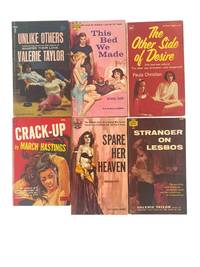
1960réf. 225421960. LGBTQ Lesbian Pulp Lesbian pulp novels published between 1960 and 1965 a crucial phase in the emergence of lesbian literature in American pulp publishing. These authors wrote about queer experience at a time when lesbian representation was largely dominated by heterosexual male writers and constrained by censorship that required publishers to present same sex desire through salacious marketing and "moralizing" tragic or heterosexual endings. Valerie Taylor Velma Nacella Young Paula Christian Yvonne MacManus and March Hastings Sally Singer were among the small group of queer women producing lesbian novels that treated relationships between women with greater emotional complexity and personal insight exploring themes of lesbian identity and the social consequences of living as an open or closeted gay woman. Several titles by these authors were later identified by lesbian bibliographer Barbara Grier as "A" tier works in The Lesbian in Literature indicating major lesbian thematic content and sympathetic narrative treatment. Archive includes: 1 Valerie Taylor Pen name of Velma Nacella Young. Stranger on Lesbos. Greenwich CT: Fawcett Crest 1960. First Crest printing February 1960. One of Taylor's most enduring works centering on Frances a discontented wife whose encounter with a vibrant lesbian social circle leads her to confront her own desires. A landmark title in Grier's A tier for its substantial lesbian content and refusal to deliver a purely punitive ending. 2 March Hastings Pen name of Sally Singer. Crack-Up. Chicago: Newsstand Library 1961. First printing. Subtitled on the cover: "The torment of a woman-frustrated in marriage-torn between desire and compassion." Hastings one of pulp's most prolific lesbian authors explores emotional collapse and the redemptive possibilities of same-sex love with more psychological nuance than the genre typically allowed. 3 Artemis Smith Pen name of Annselm Morpurgo. This Bed We Made. Derby CT: Monarch Books 1964. First Monarch edition originally published 1961. Greenwich Village-set tale of Elaine Perkins who marries to satisfy societal expectations but is drawn into a relationship with Nicole an artist's model. Back cover tagline: "Wife or Lesbian" 4 Valerie Taylor Pen name of Velma Nacella Young. Unlike Others. New York: Midwood-Tower 1963. First edition. From the author of Whisper Their Love and Stranger on Lesbos Unlike Others follows women whose relationships defy convention and societal approval. Known for infusing pulp conventions with emotional depth Taylor was one of the few openly lesbian pulp authors of her time. 5 Morgan Ives Pen name of Marion Zimmer Bradley. Spare Her Heaven. Derby CT: Monarch Books 1963. First edition. The story of Kathara a stage performer worshiped as the "Goddess of the Temple of Joy" whose allure draws both men and women into a cult-like world of pleasure. While framed through pulp's "devil or angel" dichotomy Ives weaves subversive notes of female autonomy into the sensational plot. 6 Paula Christian Pen name of Yvonne MacManus. The Other Side of Desire. New York: Paperback Library 1965. First printing. "Is it lust or love when one woman desires another woman" Carrie risks her marriage children and reputation for an affair with Kim only to find herself enslaved to "forbidden sex." The significance of these novels lies in their authorship and perspective. During the 1950s and 1960s lesbian pulp fiction formed one of the few widely distributed literary spaces where queer women could encounter representations of same sex relationships even when those narratives were sensationalized by commercial marketing. Writers such as Taylor Christian and Hastings expanded the thematic range of the genre by incorporating elements drawn from lived queer experience including emotional partnership internal conflict and the pressures of secrecy. Six volumes total. Standard mid century mass market paperback format. Moderate handling wear consistent with newsstand distribution including light edge wear and toning. Overall very good condition. unknown
in-4 antico, pp. (36), 328, leg. p. perg. coeva con tass. e tit. oro al d., tagli spruzzati. Bell'antip. inc. in rame con stemma araldico. A pag.1 una tav. con bel ritr. dell'A. inc. in rame. Fregi, iniziali e testat. xilogr. Rara prima e unica ediz. di importante fonte per la storia civile ed ecclesiastica della città di Ascoli, pubblicata postuma dai nipoti di Sebastiano Andreantonelli (1594-1643), erudito storico e accademico ascolano. I primi tre libri raccolgo pagine di storia cittadina, l'ultimo le biografie di uomini illustri ascolani. Sappiamo che molti esemplari dell'opera, in seguito alla revisione operata dai nipoti, recano delle censure o alterazioni al testo, poche sono le copie con il testo originale integrale: la nostra è una di queste. Lozzi 189. Ranghiasci p.7, nota a: "... siccome bullivano allora nella città di Ascoli le Fazioni [...] che si sopprimessero tutti quegli esemplari che fosse stato possibile ritirare affine di nuovamente adulterarli. Quindi è che in una gran parte di essi furono affatto tolte le pagine 9-10-15-16-17-18-23-24 e con frode altrettante vennero sostituite [...] e questa storia si può riporre tra le rarissime, particolarmente gli esemplari meno viziati". Lieviss. gore marginali sulle prime e ultime cc. Bell'esempl. [091]
1963réf. List919Washington 1963. First Edition. Paper pennant measuring 10 1/16 × 16 7/16 inches. Tip detached and toned but easily restorable some wear and small amount of loss at shortest side very good minus condition overall. Very Good. One of only a few known copies of this American flag-themed pennant from the March on Washington notable for its incorporation of the American flag motif. Adaptations of the flag design were common in political graphics of the nineteenth century though the tradition dwindled in the twentieth century. The forty three stars shown appear to have no significance nor do the seventeen stripes. As many of the items created for the March on Washington were made by different groups attending the event most ephemeral items do not survive in any quantity. This pennant is featured in "For Whom it Stands: The Flag and the American People" by Michelle Joan Wilkerson 2015 Reginald F. Lewis Museum for Maryland African American History and Culture p. 22 and 61 and a copy is held at the National Museum of African-American Culture. unknown books
réf. 3718Wien Feige 1913 220S m 70 Bildnissen Ohlw leichte Gebrauchspuren - Anthologie unter Ausschluss aller jüdischer Autoren v. Altenberg bis St. Zweig. Kosel 474 f. unknown
1953réf. 013812New York Ace Books, Inc. - Collection « Ace double books » D-15 1953 In-12 broché, couverture illutrée Signé par l'auteur
Carta geografica tratta dal rarissimo Itinerarium Europae Provinciae edito a Colonia tra il 1579 e il 1588. Conosciuto anche come Itinerarium Orbis Christiani, questo atlante fu pubblicato anonimamente a causa dei problemi politici e religiosi che caratterizzavano il periodo storico, come spesso succedeva aal'epoca per sfuggire alle persecuzioni cattoliche contro i protestanti. L'opera fa parte degli atlanti editi dalla cosidetta scuola Cartografica di Colonia, durata per circa mezzo secolo (1570-1620 ca.), e formata principalmente da rifugiati fiamminghi ed olandesi tra i quali spiccano lo stesso Matthaeus Quad e Frans Hogenberg, che ne fu il fondatore. Le mappe sono attribuite alcune a Jan Matal ed altre a Michael von Eitzing. Jan Matal o Metellus, francese di nascita ed attivo a Louvaine ed a Colonia, dove si rifugia prprio per sfuggire alle persecuzioni dei regnanti cattolici e dove muore nel 1597. Fu tra i maggiori cartografi del tempo e, insieme al Quad e al Hogenberg stesso, il principale esponente della scuola coloniese. Alcune delle mappe del Matal sono poi successivamente incluse nelle successive pubblicazioni postume, e recano il testo al verso. Dal punto di vista cartografico le mappe sono una derivazione e basate sulle carte pubblicate ad Anversa da Abraham Ortelius, per la prima volta nel 1570; le incisioni delle mappe sono invece attribuite a Frans Hogenberg. La grandissima rarità dell'opera, insieme alla scarsità di informazioni sulle opere "carbonare" edite a Colonia, contribuisce al fascino di questa importante mappa, caposaòdo di ogni collezione cartografica. Incisioni in rame, magnifica coloritura coeva, in buono stato di conservazione. Opera di incredible rarità, mancante in praticamente tutte le collezioni. Esemplare di primo stato, avanti il numero. 13 aggiunto in basso a sinistra e prima dle testo al verso Map from the very rare Initerarium Europae Provinciae, published in Cologne between 1579 and 1588. Also known as Itinerarium Orbis Christiani, this atlas was published anonymously due to the political and religious problems that characterized that particular period, i.e., the persecutions suffered by the Protestants who were threatened by the Catholics. The work belongs to the atlases published by the so called Cartographic school of Cologne, whose works were published along fifty years (1570-1620). The school was mainly made of Flemish and Dutch refugees among which Mattheaus Quad and Frans Hogenberg, the founder of the institution. The maps have been ascribed to Jan Matal and Michale von Eitzing. Jan Matal, or Metellus, was born in France and worked in Louvaine and Cologne, where he fled to escape the Catholic persecution and where he died in 1597. He was considered one of the greatest cartographers of his time and one of the most important artists of the school of Cologne, together with Quad and Hogenberg. some of his maps have been afterwards included in some posthumous works with the text on verso. From a cartographic point of view, the maps derive from those published by Abraham Ortelius in Antwerp in 1570; the engravings instead have been ascribed to Frans Hogenberg. The rarity of this work, together with the lack of information on the secret works published in Cologne confer a particular charm to this map, a bench mark for every collector. Copper engravings, magnificent contemporary colours, in very good condition. Extremely rare work, not present in any collection. Example in the first state, before the number was added. Meurer Atlantes Colonienses Die Kolner Schule der Atlas Kartographie 1570-1610; Meurer IOC 8; F. Mariano - A. Volpini, "Le Maeche nella Cartografia. XVI-XIX secolo", p. 30, 5.
in folio, 1 cb, pp. 374, 2 cb, leg. p. perg. coeva con tit. mss al d. Iniziali e final. xilogr. Con alcune incis. in legno n.t. Con una splendida tav. f.t., ripiegata e inc. in rame da pietro Galand, raffigurante la Sacra Casa di Loreto con la città di Recanati sottostante, e i Santi Flaviano e Vittore, incisione quasi sempre mancante. Rara ediz. orig. della storia della marca d'Ancona e in particolare di Recanati in cui l'A. (Recanati 1635 - Messina 1713) passa in rassegna la storia dei vescovi e personaggi illustri, dei cavalieri dell'Ordine di Malta, con note storico artistiche su conventi, monasteri e chiese. Fu stampata a Messina dove il Calcagno insegnò al Collegio dei Gesuiti. Lozzi 3975: "Rarissima, segnatamente così completa, mancando quasi sempre e quella e questa". Nota manoscritta sulla prima cb di mano coeva "Ex dono D. Bonfran.ci Calcanei Auctoris Negotis die 29 Martij 1735 mihi Jo. Philippo Angelita". Completo dell'Errata finale. Splendida copia fresca e genuina. [197]
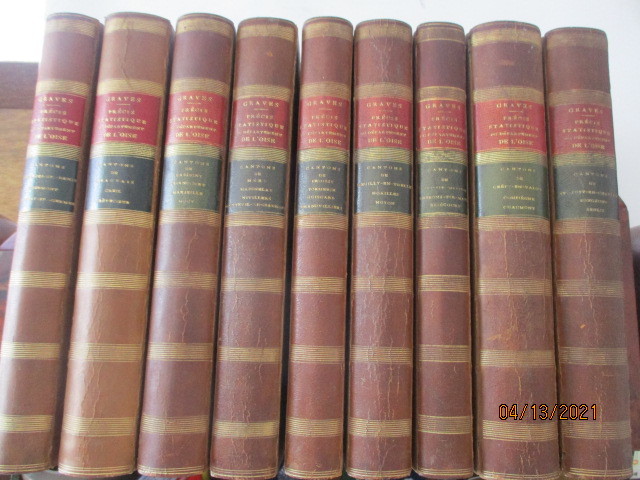
réf. 19654Annuaires 9 Volumes 1830, 1837, 1851 - Reliure 1/2 veau blond de l'époque uniforme - In-8 - Dos lisse à filets dorés - Pièces de titre rouge et verte -1 grande carte dépliante pour chaque canton + 3 cantons brochés - quelques mouillures sèches et rousseurs -Malgré les défauts mentionnés, bel ensemble - Envoi rapide et soigné
2 gr. voll. in folio, pp. (38), 593; 421, (26), 52, bella leg. p. perg. muta coeva con d. (rifatti con perg. antica) a 5 nervi. Tagli spruzzati. Antip. in rame con l'immagine della casa di Loreto sorretta dagli angeli e altra tav. con bel ritr. di Papa Clemente XII cui l'opera è dedicata, inc. in rame da R. Pozzi. Con 6 tavv. in rame di cui 5 su doppia pag. Al fine del secondo vol. Appendice: Particola dell'istoria della citta d'Ancona, scritta a penna dal dottore M. Lando Ferretti. Rara opera. Lieviss. brun. su alcune pp. ma belliss. esempl. a larghi margini. [279]
In -4°, 8 cc. Raro documento originale che appalta la riscossione delle tasse al banchiere Zanchini. Le riscossioni sono dettagliate per luoghi, confraternite, categorie, etc. etc. A rare original document in which the tax gathering is given to Zanchini banker. Gatherings are specified by places, cathegories, etc.
1971réf. 63136Museum. As New. Paperback. FREE UPGRADE to Courier/Priority Shipping Upon Request – – IN STOCK AND IMMEDIATELY AVAILABLE FOR SHIPMENT - AS NEW THE TEXT BLOCK IS PRISTINE CLEAN UNMARKED AND IN EXCELLENT CONDITION - - 16 pp. With 9 pls. 21 x 21 cm. -- with a bonus offer-- . 1971. Museum paperback