Olivier De La MarcheBiblio.com
11 432 résultats
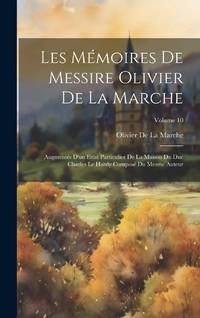
réf. ria9781020011795_inpHardcover. New. New Book; Fast Shipping from UK; Not signed; Not First Edition; Les mémoires de Messire Olivier de la Marche sont un témoignage précieux de la vie de cour et de la guerre au XVe siècle sous le règne des ducs de Bourgogne. Cette édition comprend également un état particulier de la maison du duc Charl hardcover
réf. 0259424374.Gpaperback. Good. Access codes and supplements are not guaranteed with used items. May be an ex-library book. paperback
réf. 0266465900.Ghardcover. Good. Access codes and supplements are not guaranteed with used items. May be an ex-library book. hardcover
réf. 0332250474.Ghardcover. Good. Access codes and supplements are not guaranteed with used items. May be an ex-library book. hardcover
réf. 0259803537.Gpaperback. Good. Access codes and supplements are not guaranteed with used items. May be an ex-library book. paperback
réf. 133328487X.Gpaperback. Good. Access codes and supplements are not guaranteed with used items. May be an ex-library book. paperback
réf. 0332012026.Ghardcover. Good. Access codes and supplements are not guaranteed with used items. May be an ex-library book. hardcover
réf. 0364541814.Ghardcover. Good. Access codes and supplements are not guaranteed with used items. May be an ex-library book. hardcover
2010réf. 130392010 Edité par PUF, Collection SOURCES, 2010 fort volume in8, demi toile, éditeur, vouverture illustrée, 493 pp avec illusttations en couleurs, bel exemplaire de ces 3 fac similés
1755in-4, pp. VI, 94, bella leg. m. perg. coeva con carta dec. ai piatti. Dettagliate notizie sul dazio del frumento nelle varie provincie della Marca: Ancona, Pesaro e Urbino. Lozzi 3526: "Raro". [217]
1700Quattro grossi volumi di cm. 26, pp. 2.000 ca. complessive. Con moltissime illustrazioni e tavole f.t. incise in rame. Legature coeva in mezza pelle, dorsi lisci con fregi e titoli in oro su tasselli. Esemplari spesso slegati e con qualche traccia d'uso alle legature, ma internamente ben conservati e completi. Importante testimonianza del lavoro che Olivieri degli Abbati compì come storico, soprattutto di cose pesaresi. La presente raccolta fu composta nel settecento e vi compaiono varie note manoscritte che spesso rivelano una certa, erudita competenza e sono poste a correzione e completamento del testo. Allegati pure vari fogli manoscritti di mano coeva. Non ci azzardiamo ad ipotizzare che il tutto appartenesse proprio all'Aolvieri degli Abbati, ma sicuramente ad uno storico marchigiano del tempo. Fra le opere presenti: Memorie della Badia di S. Tommaso in Foglia nel contado di Pesaro; Memorie di Alessandro Sforza Signore di Pesaro; Memorie di Gradara Castello di Pesaro; Memorie del porto di Pesaro; Memorie di Novilara; Memorie per la storia della chiesa pesarese del secolo XII; Dell'antico battistero della Chiesa pesarese; Della zecca di Pesaro; della fondazione di Pesaro; ecc...
2018Olivo Barbieri si è misurato con il cambio di scala e ha ripreso i paesaggi di rovine dall’alto e da vicino, cercando attraverso questo doppio sguardo di dare voce a ciò che il disastro lascia dietro di sé e a ciò che il futuro attende da questa visione. «Visivamente, i terremoti possono avere due punti di osservazione. Come ho cercato di rendere evidente sia in mostra che nel libro, le due percezioni, da terra e dall’alto, ci dicono cose molto diverse. Quando sei a terra lo percepisci come un disastro quasi “rinascimentale”: le nostre città sono state in gran parte costruite secondo le leggi della prospettiva. Anche tra le rovine non è difficile individuare con lo sguardo le fughe prospettiche che portano all’edificio più importante. In una visione dall’alto ci si rende invece conto dell’entità del disastro stesso, perché la dimensione dei crateri negli edifici è ben visibile. Credo che sia fondamentale conservare questi due punti di vista per avere una percezione complessiva degli effetti del terremoto». Autori: Olivo Barbieri.
2004réf. Q-0195135946Oxford University Press 2004-01-15. Hardcover. New. In shrink wrap. Looks like an interesting title! Oxford University Press hardcover
réf. 17-2533Washington D.C. : Library of Congress 1946. 8vo. 146 pp. Hard cover. Very Good. Gray cloth covered boards with quarter cloth spine. Facsimile plates and illustration throughout. This a reprint of a book published in 1488 with an introduction by Elizabeth Mongan of the National Gallery of Art.From the collection of the late Frederick Ruffner Jr. founder of Gale Research Detroit. Washington D.C. : Library of Congress, 1946. hardcover
réf. 1334784515.Gpaperback. Good. Access codes and supplements are not guaranteed with used items. May be an ex-library book. paperback
1981réf. 335141981. Softcover. VG fading to front cover. Blue stapled wraps. 4 pp. 3 bw ills. paperback books
1802In-8°; pp. (2) con occhiello, 41, (1), si conserva la brossura editoriale originale; legatura in cartoncino rigida con tassello.
réf. DADAX220300116XNew unknown
réf. DADAX0814705022New unknown
réf. DADAX0275979377New unknown
1821Fermo, Dal Bolis, 1821. Stampato su una sola facciata. Testo inquadrato da fregio tipografico. Cm. 39 x 26.
réf. 1334403031.Gpaperback. Good. Access codes and supplements are not guaranteed with used items. May be an ex-library book. paperback
réf. 1528417003.Gpaperback. Good. Access codes and supplements are not guaranteed with used items. May be an ex-library book. paperback
réf. SONG1943173001Used: Good unknown
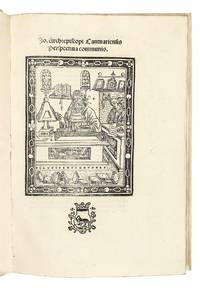
1504réf. 5444Venice: Giovanni Battista Sessa June 1504. THIRD OR FOURTH EDITION of the two editions of 1504 priority has not been determined. THE FIRST TO BE EDITED BY LUCA GAURICO. Hardcover. Fine. Bound in modern vellum. Title with large woodcut showing the author in his study surrounded by books lecturing his students one of whom takes notes. Sessa's cat-and-mouse printer's device appears on the same leaf.The text is illustrated with 77 woodcut diagrams. A very fine copy crisp and bright. There is a very light stain on the title page a bit of soiling in the gutter of leaf A3 and a discreet paper repair to the fore-edge of the final leaf. "The 'Perspectiva communis' was the most widely used of all optical texts from the early fourteenth until the close of the sixteenth century and it remains today the best index of what was known to the scientific community in general on the subject" DSB. It was first printed in Milan around 1482 then in 1503 it was included in a collection by Thomas Bradwardine "Praeclarissimum mathematicarum opus"Valencia. This 1504 edition the first edited by Luca Gaurico can be considered the third although another edition of the pre-Gaurico version was also published in 1504 at Leipzig. A mathematician from Naples and teacher of Scaliger Gaurico who also edited the works of Archimedes and Ptolemy completely revised the text. "The work on which Pecham's fame has chiefly rested is the Perspectiva communis probably written between 1277 and 1279 during Pecham's professorship at the papal curia. In the first book Pecham discussed the propagation of light and color the anatomy and physiology of the eye the act of visual perception physical requirements for vision the psychology of vision and the errors of direct vision. In book II he discussed vision by reflected rays and presented a careful and sophisticated analysis of image formation by reflection. Book III was devoted to the phenomena of refraction the rainbow and the Milky Way. "The central feature of Pecham's optical system and the dominant theme of book I of the 'Perspectiva communis' is the theory of direct vision. Here as elsewhere Pecham endeavored to reconcile all the available authorities-Aristotle Euclid Augustine al-Kindi Ibn al-Haytham Ibn Rushd Grosseteste and Bacon. Following Ibn al-Haytham Pecham argued that the emission of visual rays from the observer's eye is neither necessary nor sufficient as an explanation of sight; the primary agent of sight is therefore the ray coming to the eye from a point on the visible object. But in an attempt to follow Aristotle al-Kindi and Grosseteste as well Pecham argued that visual rays do nevertheless exist and perform the important but not always necessary function of moderating the luminous rays from the visible object and making them "commensurate with the visual power." Thus Pecham like Bacon resolved the age-old debate between the emission and intromission theories of vision in favor of a twofold radiation although to be sure priority was given to rays issuing from the visible object. "The rays issuing from points on the visible object fall perpendicularly onto the cornea and penetrate without refraction to the sensitive ocular organ the glacial humor or crystalline lens; nonperpendicular rays are weakened by refraction and therefore can be largely ignored. Since only one perpendicular ray issues from each point of the visible object and the collection of such perpendicular rays maintains a fixed order between the object and the eye a one-to-one correspondence is established between points on the object and points on the glacial humor and unconfused perception of the visual field is thus achieved. Vision is not "completed" however in the glacial humor. There is a further propagation of the rays or species through the vitreous humor and optic nerve to the common nerve where species from the two eyes combine and eventually to the anterior part of the brain and the "place of interior judgment." "Pecham's optical system included significantly more than a theory of direct vision. He briefly discussed the doctrine of species; treated at length the propagation of rays; and developed a theory to explain how solar radiation when passing through noncircular apertures gives rise to circular images. He expressed the full law of reflection and applied it to image formation by plane spherical cylindrical and conical mirrors; in this analysis he revealed an implicit understanding of the nature of the focal point of a concave mirror. Although he did not possess a mathematical law of refraction he successfully applied the general qualitative principles of refraction to the images that result from refraction at plane and circular interfaces between transparent media of various densities. In his discussion of the rainbow Pecham again attempted to reconcile different theories. He argued that all three kinds of rays rectilinear reflected and refracted concur in the generation of the rainbow. "Pecham's 'Perspectiva communis' is still extant in more than sixty manuscripts and went through twelve printed editions including a translation into Italian between 1482 and 1665. It was used and cited by many medieval and Renaissance natural philosophers including Dominicus de Clavasio Henry of Langenstein Blasius of Parma Lorenzo Ghiberti Leonardo da Vinci Albert Brudzewski Francesco Maurolico Giambattista della Porta Girolamo Fabrici Johannes Kepler Willebroad Snellius and G. B. Riccioli. It was lectured upon in the late Middle Ages at the universities of Vienna Prague Paris Leipzig Cracow Würzburg Alcala and Salamanca."DSB. Giovanni Battista Sessa, June hardcover