DE BERRY Duchesse THEAULON MarieBiblio.com

9 586 résultats
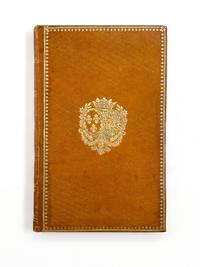
1816réf. 832071816. First Edition. DE BERRY Duchesse DE RANCÉ M. and THÉAULON Marie. LAnniversaire ou une journée de Philippe-Auguste. Paris: Cussac 1816. Slim octavo contemporary full straight-grain red morocco gilt gilt armorial coat of arms of La Duchesse du Berry on both boards elaborately gilt-decorated spine silk endpapers all edges gilt. $5500.First edition of the popular French play LAnniversaire from the library of La Duchesse de Berry with her gilt armorial coat of arms on both boards.This first edition of the French dramatic comedy LAnniversaire is from the library of Marie-Caroline de Bourbon-Sicile La Duchesse de Berry daughter of Francis I of the Two Sicilies and it contains her gilt coat of arms on both boards Olivier 2554. La Duchesse de Berry is well remembered for staging a brief rebellion against King Louis-Philippe in a vain attempt to gain the crown for her son Henri Dieudonné comte de Chambord. Her husband the Duc de Berry a son of Charles X of France had been assassinated in 1820. When Charles was overthrown in 1830 she tried to secure the succession for her son but was forced into exile. In 1832 disguised as a peasant she crossed the French border from Italy and made her way to the Vendée where she succeeded in instigating a brief but abortive insurrection June 1832. She was arrested in Nantes but was freed in July 1833 with the discovery of her recent marriage to an obscure Italian nobleman Count Ettore Lucchesi-Palli an act that exempted her from the French throne. She lived in Austria and Italy until her death Encyclopaedia Britannica. This one-act play in verse by dramatists de Rancé and Théaulon premiered at Théâtre-Français on November 16 1816. Text in French. Quérard 450. With gilt morocco bookplate of bibliophile Pierre Guerquin a director of Musées Nationaux de France. Bookplate of collector N.A.C. Embiricos. Tiny bit of marginalia to blank verso of front free endpaper.A fine copy with an impressive provenance. hardcover
réf. 155015Lucerne: C. J. Bucher Ltd 1972. Remarkable and strangely moving First and sole edition one of 300 copies only privately printed. This example preserves the scarce brown wrapper with the printed word "Tenage" along one edge. "One intriguing photobook from the early 1970s was made by an elderly US diplomat stationed in Zurich named Byron Y. Berry. Photographed on the streets of various cosmopolitan cities Teenage Styles and Trends 1967-1971: A Retrospect 1972 is a series of street portraits of 'young lads' as Berry called them focusing in particular on the youths' long hair. The book is a recalling of the aged photographer's own lost youth a frank appreciation of beauty and a valuable photo-document of 1960s' street culture. At the time he made this remarkable and strangely moving book. Burton Y. Berry was in his sixties. The book moves us because it is so intimately connected with photography and time - youth and age. First and foremost this is a celebration of beauty. a unique snapshot of an era when it was especially exciting to be young. The subtle but unmistakable erotic undertones however add a personal level that is both beguiling and mysterious. the book is to be valued not only for its contribution to the gay photobook but to the literature of youth fashion and street culture" Parr & Badger. Quarto. 63 full-page black and white photographic illustrations. Original illustrated black and white boards lettered in white to front cover. Housed in a black cloth clamshell box spine lettered in gilt by the Chelsea Bindery. Top edge knocked; wrapper creased and roughly opened: a very good copy. Parr & Badger III pp. 77 and 80. hardcover
1816réf. 55305Paris: Vente 1816. Fine. Royal wedding edition of this popular pre-Revolution comedy issued on the occasion of the marriage of Princess Marie-Caroline and the Duc de Berry - and from the library of the Duchess herself who famously sold her books after her failed coup in 1832. The Duchess's wedding occurred only a year after the restoration of the royal House of Bourbon in 1815 following Napoleon's final defeat at Waterloo. On that occasion a special performance of Andrieux's 1787 play was performed for the Duchess a devotee of the theater. This rare edition was printed as a memento of that event which was to have massive implications in French history. The Duchess's new husband was the king's brother; after the Duc de Berry's assassination in 1820 their son became the heir apparent to the French throne. But when the July Revolution of 1830 deposed the Bourbons the Duchess and her son went into exile. In 1832 however the Duchess of Berry clandestinely returned to France to lead a rebellion becoming "the most wanted woman in France" Samuels. Her coup failed and she was once again exiled; her story would later be dramatized in fiction by Alexandre Dumas as LES LOUVES DE MACHECOUL 1859. Realizing she would never return to her beloved library of some 8000 volumes at Chateau Rosny she made the decision to sell it. It was then one of the most famous libraries in France with a tremendous range in philosophy history travel science law theology fiction and theater. This copy's binding and bookplates mark its provenance from the library of the Duchess. It was bound by René Simier 1772-1843 who "had no superior and few rivals during his career" Ramsden 190 with his ticket announcing him as "Binder to the King to Her Royal Highness the Duchess of Berry and to His Royal Highness the Duke of Bordeaux." The binding is in the style the Duchess regularly ordered from Simier featuring her gilt arms on the boards upon a carefully selected full morocco. It further bears the engraved bookplate of Rosny on the unusual pink endpapers. Books from the Duchess's library still appear with some regularity on the market today but rarely with such a close personal connection to the Duchess herself. Contemporary full honey morocco boards tooled in gilt with the arms of the Duchess of Berry bound by René Simier with his ticket "Relieur du Roi de S.A.R. Madame Duchesse de Berry et de S.A.R. Mgr le duc de Bordeaux". Pink glazed endpapers all edges gilt. 4 82 pages. Engraved bookplate of the Bibliothèque de Rosny on front pastedown; bookplates also of Alexis Rouart and Eugène Aubry-Vitet. Only trace rubbing and soil. Vente unknown
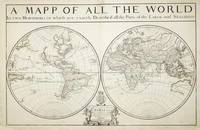
réf. 7758London: William Berry at ye Sign of the Globe between Charing Cross and Whitehall. 1680. No binding. Good. 575 x 885 mm. two sheets joined in early outline colour some professional repair to edge tears and reinforcement to lower corners not affecting the image with the accompanying page of geographical tables otherwise in good condition. A fine rare English double-hemispheric seventeenth century world map. In September 1678 Robert Morden fl. 1669 d. 1703 and William Berry 1639-1718 petitioned the crown for 'a licence to do all general and particular maps of the several parts of the world according to an alphabeticall manner'. Morden's connection with what appears to be the birth of the folio atlas is not heard of again. Berry began publishing a series of large two sheet maps with a group of the world and continents advertised in the 'London Gazette' from 1-5 July 1680. The world is also announced in the 'Term Catalogues' for the summer of that year. This only mentions the world map which would undoubtedly have been finished first and the continents would have followed. Berry did not advertise his next two sheet map that of England until February 1682. 'Through the 1680s Berry published nearly forty large maps of parts of the world sufficient to cover it all. From the late 1680s he clearly offered them bound together as a collection of maps as a handful of examples are known but this was clearly not the intention for the maps as none have borne any title page. Examples are known in the British Library the Library of Congress and the National Maritime Museum Greenwich all bearing either thirty-seven or thirty-eight maps. An example has been noted for sale by Maggs Brothers which bore sixty-nine maps the balance being made up of contemporary English maps by other cartographers dating the atlas to c.1704 and two further offered at Christies auctions in London in the 1980s' Burden. Cartographically the world map is drawn directly from that of Alexis-Hubert Jaillot 1674. Jaillot's map was in turn derived from Nicolas Sanson's geography who is here recognised in the running title above 'Described by Sanson Corrected and amended By William Berry'. Sanson had far more of a reputation in cartographic circles than Jaillot so it is natural that Berry would use his name. These 'amendments' include the patriotically named islands off Tierra del Fuego and 'New Albion' placed in California. New Guinea is distinctly an island and there is no southern continent. An ornate cartouche lower centre includes an effusive dedication to Charles II. Armitage 2012 pp. 41 & 99-100; Burden 1996-2007 532; Phillips 1909- 3442; Shirley 1984 501; Shirley 2004 T.Berr 1a; Tyacke 1973 p. 76; Tyacke 1978 no. 100 & pp. 109-10. William Berry at ye Sign of the Globe between Charing Cross and Whitehall. 1680 unknown
1996réf. SBBI-L-BBQ00827-RAG-20241Merlin Books Ltd 1996. paperback. Good. Our good condition books are generally good for reading but not for gifting or collecting. They could have imperfections such as creasing fanning inscriptions margin notes yellowing staining on edge or cover or pages bumps scuffs etc etc sometimes multiple of these. It's a wide category that encompasses anything that isn't almost-new down to anything that is slightly better than poor. We would NOT recommend gifting Good books - these should be considered reading copies. Our books are dispatched from a Yorkshire former cotton mill. We list via barcode/ISBN so please note that the images are stock images and may not be the exact copy you receive furthermore the details about edition and year might not be accurate as many publishers reuse the same ISBN for multiple editions and as we simply scan a barcode or enter an ISBN we do not check the validity of the edition data when listing. If you're looking for an exact edition please don't order at least not without checking with us first although we don't always have time to check. We aim to dispatch prompty the service used will depend on order value and book size. We can ship to most countries see our shipping policies. Payment is via Abe only. Merlin Books Ltd paperback
1930réf. 1000301930. Oil on canvas. 28 x 23 inches. Oil on canvas. 28 x 23 inches. Original 1930s Magazine Artwork. unknown books
1938réf. 1000331938. Oil on canvas mounted on foamboard signed lower right and dated '38. 32 x 24 inches. Oil on canvas mounted on foamboard signed lower right and dated '38. 32 x 24 inches. Original 1930s Magazine Artwork. unknown books
1937réf. 1000311937. Oil on canvas signed lower right and dated '37. 39 x 27 inches. Oil on canvas signed lower right and dated '37. 39 x 27 inches. Original 1930s Magazine Artwork. unknown books
1937réf. 1000321937. Oil on canvas signed lower right and dated '37. 42 x 27-1/2 inches. Oil on canvas signed lower right and dated '37. 42 x 27-1/2 inches. Original 1930s Magazine Artwork. unknown books
2003réf. 42820840Pre-publication printout. 2 356 pp. the published work was 446 pp. Comb-bound. Very good condition. Presentation copy inscribed by James Watson to Francis Crick and his wife: "For Francis and Odile from Jim 27 November 2002." This is the dedication copy with the printed dedication stating "To Francis Crick." Crick's wife Odile co-recipient of this presentation copy is famous for her drawing of the DNA molecule published in Nature in April 1953 and subsequently widely reproduced in textbooks scientific articles and popular literature. "It may be the most famous scientific drawing of the 20th century in that it defines modern biology" Terrence J. Sejnowski Salk Institute. "A remarkable alignment of the planets is occurring in 2003: the 50th anniversary of the double helix and the completion of the sequence of the human genome. As a defining figure in both land- mark events no other human being on the planet is positioned to write as authoritatively about all this as Jim Watson. In DNA: The Secret of Life he does so with clarity style and wit. If you really want to know what happened in the most important half-century of biology since the world began read this" Francis Collins. This splendid presentation copy represents the greatest scientific collaboration of the 20th century. The names Watson and Crick will forever be linked in the history of science. Provenance: Francis and Odile Crick inscribed to them by James Watson. [New York: Knopf] paperback
1830réf. 124608London: Newton Son & Berry c. 1830-1836. Fine pair of rare early 19th century celestial and terrestrial table globes published by Newton Son & Berry. Both the celestial and terrestrial globe measure 12 inches in diameter with a calibrated brass meridian ring and 19 inch mahogany horizon ring decorated with mounted hand colored decorations. Mounted on ebonized oak stands. Each globe is comprised of 12 richly detailed hand-colored gores with polar calottes the terrestrial globe detailing the earth's landmasses major countries and cities and the celestial showing the major stars in various sizes related to their brightness displayed with a table of magnitudes. Major constellations and all twelve zodiac signs are illustrated with detailed hand-colored drawings. The cartouche on the celestial globe is inscribed "Newton's New & Improved Celestial Globe On which all the Stars Nebulae & Clusters contained in the extensive Catalogue of the late E. Wollaston E.R.S. are accurately laid down their Right Ascensions and Declinations having been recalculated for the Year 1830 by W. Newton. Manufactured by Newton Son & Berry Chancery Lane London Published 1836." In near fine condition with some light restoration. Each globe measures 19 inches tall. The sphericity of the Earth was established by Greek astronomers in the 3rd century BC with the earliest terrestrial globe appearing during that period. The earliest known globe was constructed by Crates of Mallus in Cilicia now Cukurova in modern-day Turkey in the mid-2nd century B.C.E. Now known as the Erdapfel the earliest extant terrestrial globe was produced in 1492 by German mapmaker navigator and merchant Martin Behaim in Nuremberg Germany. Traditionally globes were manufactured by gluing a printed paper map onto a sphere often made from wood. Newton, Son & Berry unknown books