10 910 résultats
réf. 217574Paris, Adolphe Le Goupy, s.d. (1928) in-8, [2] ff. n. ch., 94 pp., [2] ff. n. ch. de réclames, avec 23 planches en photogravure hors texte, et une grande carte dépliante de la région d'élevage, broché.
1970réf. 25261Nantes aux Bureaux de la Société Archéologique de Nantes et de Loire-atlantique 1970-75 -in-8 demi-basane 7 années reliées en un volume, reliure demi-basane marron foncé in-octavo à coins (half binding sheepskin in-8 with corners) (24,2 x 16 cm), RELIURE D'ÉPOQUE, dos à 4 nerfs (spine with raised bands) décoré "or" et à froid (gilt and blind stamping decoration),Titre et Année frappées "or" (gilt title) avec un filet "or" de part et d'autre, double filets à froid de part et d'autre des nerfs et en tête et en pied, papier marbré violet et crème aux plats, toutes tranches lisses, couvertures marron Editeur imprimées en noir conservées, sans illustration (pour l'année 1967) + orné d'1 gravure hors-texte en noir + 2 gravures in-texte en noir (pour l'année 1968) + 3 gravures hors-texte en noir + 1 gravure in-texte en noir (pour l'année 1969) + 2 gravures hors-texte en noir (pour l'année 1970-1971) + 2 gravures hors-texte en noir et 4 gravures in-texte en noir (pour l'année 1972) + 5 gravures hors-texte en noir(pour l'année 1973), (XXIX + 48 + 1 p. de Tables) + ( XXVI + 79 + 1 p. de Tables) + (XXI + 66 pages + 1 p. de Tables) + (XXVI + 80) + (XIX + 73 +1 p. de Tables) + (XVII + 89)pages, 1970-75 Nantes aux Bureaux de la Société Archéologique et Historique de Nantes et de Loire-Atlantique Editeur,
réf. 200709603Paris, SELECTION READER'S DIGEST, 1994 ; in-4, 128 pp., cartonnage de l'éditeur.
réf. 200604363Paris, Sélection du reader's digest, 1994 ; in-4, 128 pp., cartonnage de l'éditeur. Un guide pratique pour les préparer, les arranger, les conserver.
1848réf. List3729Corning New York 1848. Two autograph letters signed from C. H. Berry. Each 3 pp measuring 8 x 10 inches. Very good plus. A pair of letters from C. H. Berry of Corning New York who was apparently both a schoolteacher and active in Free Soil circles in the area. The earlier letter written in 1847 provides an unexpected look at corporal punishment in the classroom. Berry writes: "I am in my school yet. I have four weeks or nearly that to keep yet. I storm round like an old sailor have my hands full but enjoy the pleasure of seeing the little 'varmints' learn. I had a speck of variety today. Several boys stayed out this forenoon after recess. This afternoon I called them up & after talking a spell told them I should punish them for staying out. One fellow squared himself & said he should not be punished! He was a huge fellow with a boxer's ring on his fingers weighing one or two ounces. He swore flat in my face when I began to talk with him. I told him in consideration of his being saucy he must take off his coat. I took the young man by the collar with one hand and applied a strap of harness leather to his legs with the other. He flourished his tongue his arms & legs in a furious way till finding my own was too long for him to reach me he dove for the poker. I just laid him out a couple of times & then plied my straps till his coat came off with a rush & numerous apologies followed it. He said he swore because he was mad he always did so & thought it very unfortunate that he had such a habit. I then punished him for staying out and told him to take his seat which he did very quietly." The second letter written during the immediate aftermath of the election of 1848 shifts dramatically toward national politics. Berry offers a frank assessment of the political future of anti-slavery organization: "In 'Free Soil' matters we have done up all we expected to here and are perfectly satisfied. Our party is firmly organized. Our cause has the sympathy of honest men of all parties and as Taylor is elected let me tell you just what I think of it: Cass has showed his hand and that party can not claim to be free soil men in 1852 or at any time hereafter. Taylor is in a position where he will be obliged to declare himself also. Now if Taylor disappoints the South and comes out a freedom man it will be in consequence of this Northern movement and we have attained all we wanted. But if which is more likely he goes for the South his supporters in the free states will be without the least color of excuse in 1852 and they must join our party & there will not be a grease spot of their organization left. The case then is this: Nothing but 'liberty' will satisfy the people of the north. The Hunkers can not stand on this platform for they have repudiated it; the honest ones will be with us. The Whigs must come on to our ground and join us as a party by the acts of their Executive or declare against liberty which will destroy their party here and bring them to us in a disorganized mass. Then with 'repeal' as our motto we will teach them the error of their ways. We can not fail to succeed in my view of the case. Free soil forever." Written before the formation of the Republican Party and more than a decade before secession the letter captures anti-slavery political sentiment at a transitional moment when Free Soil activists believed sectional political realignment increasingly inevitable. An unusually readable pair balancing ordinary rural life with emerging sectional politics in antebellum New York.
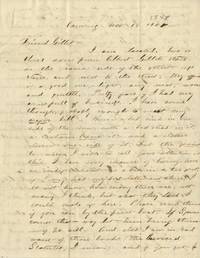
1848réf. List3729Corning New York 1848. Two autograph letters signed from C. H. Berry. Each 3 pp measuring 8 x 10 inches. Very good plus. A pair of letters from C. H. Berry of Corning New York who was apparently both a schoolteacher and active in Free Soil circles in the area. The earlier letter written in 1847 provides an unexpected look at corporal punishment in the classroom. Berry writes: "I am in my school yet. I have four weeks or nearly that to keep yet. I storm round like an old sailor have my hands full but enjoy the pleasure of seeing the little 'varmints' learn. I had a speck of variety today. Several boys stayed out this forenoon after recess. This afternoon I called them up & after talking a spell told them I should punish them for staying out. One fellow squared himself & said he should not be punished! He was a huge fellow with a boxer's ring on his fingers weighing one or two ounces. He swore flat in my face when I began to talk with him. I told him in consideration of his being saucy he must take off his coat. I took the young man by the collar with one hand and applied a strap of harness leather to his legs with the other. He flourished his tongue his arms & legs in a furious way till finding my own was too long for him to reach me he dove for the poker. I just laid him out a couple of times & then plied my straps till his coat came off with a rush & numerous apologies followed it. He said he swore because he was mad he always did so & thought it very unfortunate that he had such a habit. I then punished him for staying out and told him to take his seat which he did very quietly." The second letter written during the immediate aftermath of the election of 1848 shifts dramatically toward national politics. Berry offers a frank assessment of the political future of anti-slavery organization: "In 'Free Soil' matters we have done up all we expected to here and are perfectly satisfied. Our party is firmly organized. Our cause has the sympathy of honest men of all parties and as Taylor is elected let me tell you just what I think of it: Cass has showed his hand and that party can not claim to be free soil men in 1852 or at any time hereafter. Taylor is in a position where he will be obliged to declare himself also. Now if Taylor disappoints the South and comes out a freedom man it will be in consequence of this Northern movement and we have attained all we wanted. But if which is more likely he goes for the South his supporters in the free states will be without the least color of excuse in 1852 and they must join our party & there will not be a grease spot of their organization left. The case then is this: Nothing but 'liberty' will satisfy the people of the north. The Hunkers can not stand on this platform for they have repudiated it; the honest ones will be with us. The Whigs must come on to our ground and join us as a party by the acts of their Executive or declare against liberty which will destroy their party here and bring them to us in a disorganized mass. Then with 'repeal' as our motto we will teach them the error of their ways. We can not fail to succeed in my view of the case. Free soil forever." Written before the formation of the Republican Party and more than a decade before secession the letter captures anti-slavery political sentiment at a transitional moment when Free Soil activists believed sectional political realignment increasingly inevitable. An unusually readable pair balancing ordinary rural life with emerging sectional politics in antebellum New York. books
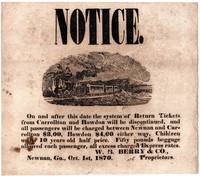
1870réf. 12823Newnan Ga: October 1 1870. Broadside 7.75 x 9 inches with engraved vignette at center. Old folds moderate foxing and dust-soiling light staining. Short closed tear to bottom edge. Overall very good. A delightful mid-19th-century Georgia railroad broadside advertising changes to the ticketing system for one of the southern rail lines owned by William Byrd Berry. Here rates for travel between Berry's hometown of Newnan and Carrollton or Bowdon are specified and the rates for children under the age of 10 are noted as half price. Further the broadside stipulates baggage is capped at fifty pounds and the excess will be charged "Express rates." The work is signed in type by "W.B. Berry & Co." and dated October 1 1870 in Newnan. The text is enhanced with a striking central vignette of a locomotive pulling several railcars through a mountainous region. William Byrd Berry 1831-1902 was a prominent businessman and landowner born and raised in Newnan Georgia. He served as president of various banks and was involved in a number of railroad interests in the state. As far as we can tell the present broadside is unrecorded. October 1 unknown
1870réf. 12823Newnan Ga: October 1 1870. Broadside 7.75 x 9 inches with engraved vignette at center. Old folds moderate foxing and dust-soiling light staining. Short closed tear to bottom edge. Overall very good. A delightful mid-19th-century Georgia railroad broadside advertising changes to the ticketing system for one of the southern rail lines owned by William Byrd Berry. Here rates for travel between Berry's hometown of Newnan and Carrollton or Bowdon are specified and the rates for children under the age of 10 are noted as half price. Further the broadside stipulates baggage is capped at fifty pounds and the excess will be charged "Express rates." The work is signed in type by "W.B. Berry & Co." and dated October 1 1870 in Newnan. The text is enhanced with a striking central vignette of a locomotive pulling several railcars through a mountainous region. William Byrd Berry 1831-1902 was a prominent businessman and landowner born and raised in Newnan Georgia. He served as president of various banks and was involved in a number of railroad interests in the state. As far as we can tell the present broadside is unrecorded. October 1 unknown books
réf. 174708Bourges, Librairie de Vermeil, 1848 in-12, 74 pp., broché. Couv. abîmée, dos factice.
réf. 217149Paris, Administration des guides Conty, s.d. in-16, 348-103-72-XII pp., carte en frontispice, ill. in-t., 14 cartes ou plans h.-t dont une sous pochette "in fine", percaline bleue (reliure de l'éditeur).
1936réf. 137561936 Paris, Editions de la Tournelle, 1936, in 8° broché, 189 pages.
réf. 35002Paris, Editions de la Tournelle, 1936. Gr. in-8°, 188p. Broché.
Paris Editions du Tambourinaire, 1952. In-8, broché, couverture rempliée, texte imprimé sur papier bleu clair, 154 pp. Belle édition imprimée sur les presses de " La Ruche " un des exemplaires numérotés sur vélin azur de Lana. Dessin en frontispice et illustrations dans le texte.
réf. 29424Paris Editions du Tambourinaire, 1952. In-8, broché, couverture rempliée, texte imprimé sur papier bleu clair, 154 pp.
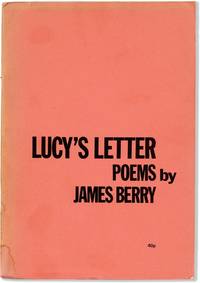
1975réf. 85005London: Limestone Publications / The City Literary Institute 1975. First Edition. Slim octavo 21.75cm; mimeographed sheets stapled into pink card wrappers printed in black; 23-32pp. This copy is from the library of to Puerto Rican editor translator and literary critic Roberto Marquez inscribed to him by the author on the title page: "Roberto Marquez / with best wishes / July 27 1976 / James Berry / 108 Stanford Avenue / Brighton / Sussex England." Early collection of verse by the Jamaican poet who migrated to the UK in 1948. He was known for being one of the earliest writers to integrate Jamaican vernacular in his poetry. The title poem is written in the voice of Lucy a Jamaican woman newly arrived in London and missing Jamaica and many of the poems represented here share the perspective of Jamaican migrants in English society. A nice inscription to Marquez who at the time was founder and editor of the journal Caliban: A Journal of New World Thought and Writing. Uncommon; OCLC notes a single holding at Cambridge. 85005. Limestone Publications / The City Literary Institute unknown
1975réf. 85005London: Limestone Publications / The City Literary Institute 1975. First Edition. Slim octavo 21.75cm; mimeographed sheets stapled into pink card wrappers printed in black; 23-32pp. This copy is from the library of to Puerto Rican editor translator and literary critic Roberto Marquez inscribed to him by the author on the title page: "Roberto Marquez / with best wishes / July 27 1976 / James Berry / 108 Stanford Avenue / Brighton / Sussex England." Early collection of verse by the Jamaican poet who migrated to the UK in 1948. He was known for being one of the earliest writers to integrate Jamaican vernacular in his poetry. The title poem is written in the voice of Lucy a Jamaican woman newly arrived in London and missing Jamaica and many of the poems represented here share the perspective of Jamaican migrants in English society. A nice inscription to Marquez who at the time was founder and editor of the journal Caliban: A Journal of New World Thought and Writing. Uncommon; OCLC notes a single holding at Cambridge. 85005. Limestone Publications / The City Literary Institute unknown books
réf. 202402601Paris, Marabout, 2004 ; in-4, 310 pp., br.
1936réf. 58886San Francisco:: Gelber Lilienthal Inc. 1936. First edition; one of 300 copies printed at The Grabhorn Press. publisher's quarter leather over decorated paper-covered boards in publisher's plain wrapper. Very slight tanning to endsheets; light use to the extremities of the leather spine; otherwise a fine copy in a wrapper with large chips at the ends of the backstrip. . 8vo. Illustrated from photographs including a frontispiece portrait by Edward Weston. Gelber, Lilienthal Inc., hardcover
1977réf. LFA-126712702Publication trimestrielle : 58 pages, format 170 x 250 mm, brochée, illustrée
réf. 71486Louviers, Pierre d'Esneval, 1982, in 8° broché, 399 pages ; illustrations hors-texte ; couverture illustrée.
réf. 170273Bourges, Manceron, 1836 in-8, 432 pp., avec 7 planches hors-texte gravées au trait, dont une grande vue dépliante de la ville de Bourges, culs-de-lampe et vignettes, broché sous couverture imprimée. Exemplaire massicoté récemment.
réf. 196615Bourges, Imprimerie en caractères et lithographie de Manceron, 1836 in-8, 432 pp., avec 7 planches hors-texte gravées au trait, dont une grande vue dépliante de la ville de Bourges "in fine", culs-de-lampe et vignettes, demi-basane fauve marbrée à l'imitation, dos à nerfs orné de filets, guirlandes et fleurons dorés, pièce de titre tabac (reliure postérieure). Bon exemplaire.
1836réf. 113309Bourges, Manceron, 1836, in-8°, 432 pp, avec 7 planches hors texte gravées au trait, dont une grande vue dépliante de la ville de Bourges, culs-de-lampe et vignettes, reliure plein maroquin brun foncé à grains longs, dos lisse orné en long, palette en queue, encadrement et motif à froid, décor d'encadrement doré sur les plats, coupes filetées, dentelle intérieure, tranches dorées (rel. de l'époque), dos uniformément passé, qqs rares rousseurs, bon état. Rare
1831réf. AMA-347Paris, Mame-Delaunay, 1831. in 8°, broché, couverture verte imprimée, non rogné rousseurs. (2)ff. (faux-titre et titre)-(3)ff.- (catalogue)-(1)f.-370 pp.,
réf. 7956Nevers, Publication du journal "Berry-Paris-Berry", 1954 ; in-4, broché. 152pp.-1f. - 1 portrait hors-texte en frontispice. Rousseurs marquées sur la couverture. Papier jauni.