6 risultati
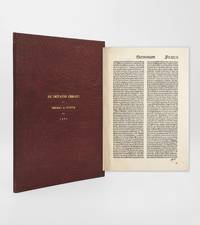
1494rif. 376720Nuremberg: Caspar Hochfeder 1494. Leaf XCII. Text in two columns 53 lines in black letter with rubricated N on verso running head Liber Sermonum. Small folio. Leaf with minor staining mounted in brown cloth folder with printed descriptive slip from 1927 Foliophiles portfolio of German Incunabula mounted opposite leaf. Leaf XCII. Text in two columns 53 lines in black letter with rubricated N on verso running head Liber Sermonum. Small folio. Attractive leaf from the Nuremberg 1494 edition of the Works of Thomas à Kempis printed by Caspar Hochfeder ISTC it00352000. Cf. Disbound and Dispersed 2005 Checklist 29. Provenance: General Theological Seminary bookplates perforated stamps Caspar Hochfeder unknown books
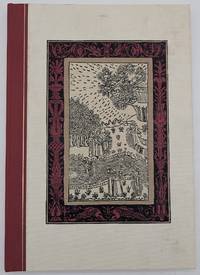
1975rif. 72168Provo UT: Friends of Brigham Young University Library 1975. Limited edition. Hardcover. Very Good. 59pp. Folio 39.5 cm 1/4 red cloth with white cloth over boards and pictorial stamping on the front board. With the leaf. Boards with large areas of light soiling more so on the rear board. Internally clean and bright. Number 48 in an edition of 50 containing a leaf with an original woodcut illustration. From an edition of 250 overall. Published in honor of the Centennial of Brigham Young University. Friends of Brigham Young University Library hardcover books
1472rif. 256254Strassburg: Johann Mentelin 1472. Single leaf printed recto and verso. Text in two columns 62 lines initials supplied in red 5 on recto one on verso. 1 vols. Folio. Fine. Mounted in card folder. Single leaf printed recto and verso. Text in two columns 62 lines initials supplied in red 5 on recto one on verso. 1 vols. Folio. Hain 10366; BMC I 56; ISTC No. in00133000 Johann Mentelin unknown books
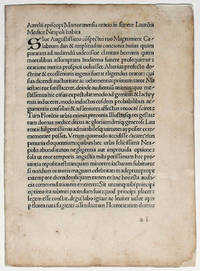
1492rif. 26804to. 20.5 x 15 cm 4to. 20.5 x 15 cm 8 ff. rather dog-eared at edges and with some light soiling. Disbound in a cloth-covered box. Rare first edition of this funeral oration for Lorenzo de Medici read in Santa Maria Nuova on 16 April 1492 evidently the only contemporary printed oration of the many delivered and printed in his honor to survive. "Lorenzo de' Medici… born January 1 1449 Florence Italy—died April 9 1492 Careggi near Florence Florentine statesman ruler and patron of arts and letters was the most brilliant of the Medici. He ruled Florence with his younger brother Giuliano 1453–78 from 1469 to 1478 and after the latter's assassination was sole ruler from 1478 to 1492." Brittanica.com The present publication is the sole oration devoted to Lorenzo in the Short-Title List of Funeral Orations from the Italian Renaissance Ca. 1374-1534 compiled by John McManamon and the only printed example featured in the 1992 exhibition at the Bibliotheca Nazionale Centrale Lorenzo dopo Lorenzo La Fortuna Storica di Lorenzo il Magnifico. Notwithstanding the poor survival rate of ephemeral publications and the controversial character of the laudandus the statistic remains remarkable. The motive for the present oration was overwhelmingly political and meant to insure continuation of the traditionally strong alliance between Naples and Florence at a difficult time of dynastic transition. According to Miglio DBI X.369-70 the work was published before it was read. A Naples edition was published the same year from the press of Cristannus Preller IGI VI.1722-A. The work was re-published in the 19th century by Vito Capialbi in Memorie di R. Zeno e A. Bienato Naples 1838 49-86. Milanese born Aurelio Bienato was Reader in Rhetoric at the University of Naples 1470-80 and later elected Bishop of Martirano modern Catanzaro in which sinecure he remained until his death. Miglio also lists an unpublished commentary on Quintilian Iter Italicum I.415-16 II.570 and a collection of Latin verses Elegantiarum epithomata an epitome of Lorenzo Valla's Elegantiae linguae latinae which went through a number of incunable editions 1479/80; 1488; 1491. US copies ISTC: Huntington Newberry and Yale. Provenance: Ritman copy. Goff B-667; BMC vi.784; GW IV.1346; Paolo Pira ed. Lorenzo dopo Lorenzo. La Fortuna Storica di Lorenzo il Magnifico Florence Biblioteca Nazionale 1992 I.24; John M. McManamon Funeral Oratory and the Cultural Ideals of Italian Humanism 1989 p. 256 & 41-43. Phillipus de Mantegatiss books
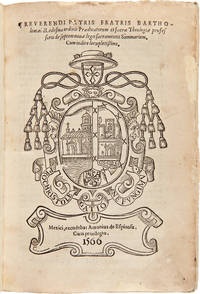
1566rif. 54413Mexico: Antonio de Espinosa 1566. A Major Mexican Incunable A very rare complete and substantial example of early Mexican printing. This work was produced and published by Antonio de Espinosa the second printer in the New World after Juan Pablos and is one of the most considerable efforts of his career in Mexico. Espinosa was brought to Mexico by Juan Pablos as an assistant and type cutter in 1550 and he eventually broke Pablos' monopoly and began printing for himself in 1559. The present work printed in 1566 is one of only a handful produced in Mexico during that decade and is one of the initial books of the Mexican incunable period. The text itself is the first edition of a religious work by Bartholomé de Ledesma explicating church sacraments in great detail later reprinted in Salamanca in 1585. The work is split into six parts. The first discusses the sacraments generally and the ensuing five treat individual sacraments in depth. Ledesma was a key figure in the early Mexican church as a close advisor of the second Archbishop in the New World Alonso de Montúfar and the chair of theology at the nascent University of Mexico founded in 1551. He was also one of the foremost proponents of book censorship and prohibition in New Spain and vigorously investigated private libraries and booksellers for forbidden materials and was responsible for the destruction of many volumes. He later became the Bishop of Oaxaca a position in which he served until his death in 1604. Overall the work is a fine example of the sophistication which Espinosa brought to early Mexican printing. The titlepage contains a fine coat of arms that of Archbishop Montúfar and the section on marriage sacraments includes several finely executed woodcut diagrams of consanguinity. The text is printed elegantly in a Roman type which Espinosa had introduced to New World printing with printed marginal notes in italic and woodcut initials throughout. Below the colophon is an excellent example of Espinosa's printer's device the first used on any book produced in the Americas. In his 1940 census of Mexican imprints Wagner located twelve copies of this work and over seventy-five years later OCLC adds only three more. It appears just four times in auction records of which one copy was incomplete. A rare desirable Americanum printed by the second printer in the New World and one of the earliest Mexican incunabula still obtainable. Small thick quarto. Contemporary vellum with yapp edges remnants of vellum ties at fore-edge. Light wear and soiling to vellum endpapers renewed. Small marca de fuego on top edge. Moderate wear to initial leaves moderate worming in lower corner and occasionally along lower margin all expertly repaired slightly affecting only a few printed marginalia and catchwords. Light tanning and occasional foxing. A very good copy overall. ICAZBALCETA 47. MEDINA MEXICO 50. PALAU 134124. SABIN 39677. WAGNER NUEVA BIBLIOGRAFIA MEXICANA 47. hardcover books
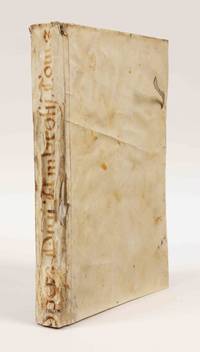
1554rif. 54409Mexico: Ioannes Paulus Brissensis 1554. From the First Press in the New World and the Most Extensive Work Printed in the New World Up to This Time: The First Philosophical Works and the Second and Third Secular Works Published in the New World Printed by Juan Pablos the first printer in the New World these are two of the first major books published in the Western Hemisphere and the largest produced up to that time. Both titles are the work of Fray Alonse de la Veracruz and are the earliest works of philosophy and humanist thought published in the New World as well as the second and third secular works printed in the New World after the 1548 Laws which survives in only two copies. Moreover these are the earliest books printed in the New World still obtainable in the present market. Alonso de la Veracruz was a pioneering theologian philosopher author and Augustinian missionary. He accompanied Father Francisco de la Cruz on a mission in New Spain in 1536 remaining there for the rest of his life. His works here centered on an examination of the philosophy and ideas of Aristotle. His goal was to rid classical philosophy of vain and useless speculation and form a Renaissance of sorts in the new Spanish territories. Beyond instigating a school of thought previously unknown in the New World Veracruz sought to reform earlier scholastic and humanistic practices. He became a noted master of the Mexican and Tarascan languages making him an indispensable educator. In 1553 he became the first professor at the University of Mexico publishing these works his most important the following year. The two present works sprang out of Veracruz's studies shortly after his appointment to the University. The first Recognitio Summularum. is a compendium of Logic. This is supplemented by a commentary on the Aristotelian Categories and the Posterior Analytics. These two philosophical works were the first to be written and published in the New World as well as the first to address texts of the classics. Printing in the New World began in 1539 when printer Juan Pablos established a press in Mexico City a full century before printing began in British North America. The very earliest products of the Pablos press that have survived now reside almost entirely in institutions or are known only by inference of the two dozen earlier works listed by Wagner six are known only by inference. These are by far the most extensive works printed in the New World up to this time. Both works are major substantial pieces of printing handsomely laid out in two columns with well-executed presswork. The titlepage of the first work here in facsimile is printed in red and black the earliest color printing in the New World. The typography is also a breakthrough. Pablos now had Antonio de Espinosa later the second printer in the New World working in his shop as a punchcutter and assistant. Espinosa led a departure from the gothic types previously used by Pablos and these two books are the earliest use of roman and italic types in the New World. The text also contains numerous attractive woodcuts - on the titlepages as capital letters in the text and as illustrations in the text. Eleven other copies are known to survive of the Recognitio according to Wagner's census published in 1960 of which nine were then in public collections and several of those are imperfect. Wagner located twelve copies of the Dialectica eleven in institutions. In several instances the two books are found bound together as here. The annotations and marcas de fuego indicate that the present copies were once a part of the library at the Franciscan monastery in Puebla. Two extraordinary works of surpassing rarity from the first press in the New World comprising an impressive array of firsts for printing in the Americas. 888; 8810 leaves. Folio. Recased in slightly later vellum other manuscript title on spine remnants of fore-edge ties. First titlepage in facsimile mounted on a stub; first work lacking leaf H1; second titlepage detached but present. Two marcas de fuego on top edge; early manuscript inscriptions on first and final leaves of text; one leaf of manuscript bound in at rear. Moderate worming throughout somewhat affecting text. Light dampstaining at top edge moderate tanning and foxing. Good. In a half morocco box. ICAZBALCETA BIBLIOGRAFIA MEXICANA 1954 ed 21 22. MEDINA MEXICO 22 23. VALTON 45 46. PALAU 359140 359145. WAGNER NUEVA BIBLIOGRAFIA MEXICANA 20 21. Kurt Reinhardt "Alonso de la Vera Cruz and the Beginnings of Philosophic Speculation in the Americas" in The Americas Vol. 1 no. 2 October 1944 pp.207-14. hardcover books