426 résultats
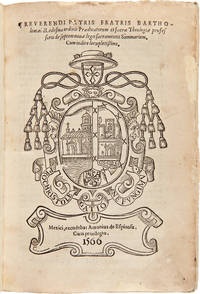
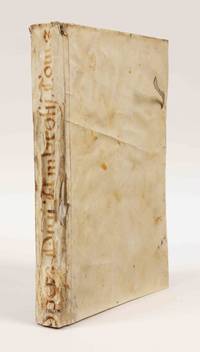
1566réf. WRCAM54413Mexico: Antonio de Espinosa 1566. 440416 leaves with several woodcut illustrations and woodcut initials throughout. Small thick quarto. Contemporary vellum with yapp edges remnants of vellum ties at fore-edge. Light wear and soiling to vellum endpapers renewed. Small marca de fuego on top edge. Moderate wear to initial leaves moderate worming in lower corner and occasionally along lower margin all expertly repaired slightly affecting only a few printed marginalia and catchwords. Light tanning and occasional foxing. A very good copy overall. A very rare complete and substantial example of early Mexican printing. This work was produced and published by Antonio de Espinosa the second printer in the New World after Juan Pablos and is one of the most considerable efforts of his career in Mexico. Espinosa was brought to Mexico by Juan Pablos as an assistant and type cutter in 1550 and he eventually broke Pablos' monopoly and began printing for himself in 1559. The present work printed in 1566 is one of only a handful produced in Mexico during that decade and is one of the initial books of the Mexican incunable period. The text itself is the first edition of a religious work by Bartholomé de Ledesma explicating church sacraments in great detail later reprinted in Salamanca in 1585. The work is split into six parts. The first discusses the sacraments generally and the ensuing five treat individual sacraments in depth. Ledesma was a key figure in the early Mexican church as a close advisor of the second Archbishop in the New World Alonso de Montúfar and the chair of theology at the nascent University of Mexico founded in 1551. He was also one of the foremost proponents of book censorship and prohibition in New Spain and vigorously investigated private libraries and booksellers for forbidden materials and was responsible for the destruction of many volumes. He later became the Bishop of Oaxaca a position in which he served until his death in 1604. Overall the work is a fine example of the sophistication which Espinosa brought to early Mexican printing. The titlepage contains a fine coat of arms that of Archbishop Montúfar and the section on marriage sacraments includes several finely executed woodcut diagrams of consanguinity. The text is printed elegantly in a Roman type which Espinosa had introduced to New World printing with printed marginal notes in italic and woodcut initials throughout. Below the colophon is an excellent example of Espinosa's printer's device the first used on any book produced in the Americas. In his 1940 census of Mexican imprints Wagner located twelve copies of this work and over seventy-five years later OCLC adds only three more. It appears just four times in auction records of which one copy was incomplete. A rare desirable Americanum printed by the second printer in the New World and one of the earliest Mexican incunabula still obtainable. ICAZBALCETA 47. MEDINA MEXICO 50. PALAU 134124. SABIN 39677. WAGNER NUEVA BIBLIOGRAFIA MEXICANA 47. Antonio de Espinosa hardcover books
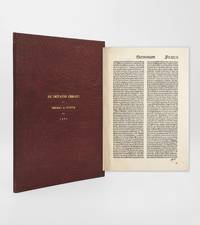
1472réf. 256254Strassburg: Johann Mentelin 1472. Single leaf printed recto and verso. Text in two columns 62 lines initials supplied in red 5 on recto one on verso. 1 vols. Folio. Fine. Mounted in card folder. Single leaf printed recto and verso. Text in two columns 62 lines initials supplied in red 5 on recto one on verso. 1 vols. Folio. From the Press of Johann Mentelin 1472. Hain 10366; BMC I 56; ISTC No. in00133000 Johann Mentelin unknown books
1492réf. D16270Venice: Hieronymus de Paganinis 1492. Hardcover. Very Good. 7 September 1492 from colophon: Impressa vero in felici Venetorum ciuitate sumptibus et arte Hieronymi de Paganinis Brixiensis. Anno gratie millesimo quadrigentesimo nonagesimosecundo. Septimus Idus septembris.. 8vo 170 x 120mm. 510 leaves of 552 lacking the Interpretation of Hebrew Names 41 leaves at the end and final blank. Signatures: A10 a-z8 aa-zz8 A-P8 Q12. Title printed with Biblia in gothic letter in upper margin above rectangular woodcut of St. Peter holding keys within double ruled border captioned Tu es petrus later hand coloring to halo and garb of Peter. Title verso with the Tabula alphabetica historiarum Bibliae compiled by Gabriele Bruno. Text printed double column index in triple column 50 lines to a full column printed in gothic type with red rubrics and headings rubricated versal initials alternating red and blue ink printed marginal citations throughout. Modern vellum yapped edges endpapers renewed; register and first few leaves of prologue little frayed to the margins some light dampstaining near end only light intermittent stains edges lightly browned annotations trimmed close in few margins and few minor marginal repairs otherwise a sound and solid incunable edition of the Biblia Latina retaining the inaugural woodcut. Scattered period Latin annotations and manicules in margins occasionally repeating a word in Scripture like Patientia or names of the biblical persons from text Helias Jezebel or Joab and names of kings and their sons are also curiously given much attention writing in more lengthy memory devices for their relationships Roboam filius Salamonis rex in Juda all seemingly the work of one scholar and another cancelled early inscription on A9 perhaps the name Carolii. Overall studied and plenty in inscriptions some annotations in Jeromes prologue and later books are written in red ink. This is the second octavo edition of the Latin Bible printed in Venice in 1492 containing the corrections by the Franciscan scholar Pierangelo da Montolmo named in the robust colophon as Petrus Angelus de Monte Ulmi; supposedly a folio edition was issued this same year by the same printer Girolamo de Paganini or Hieronymus de Paganinis though not found in standard references. The earliest octavo edition of the Latin Bible also known as the poor mans Bible was printed in Basel by Froben in 1491. This Venetian octavo edition is the first Latin Bible to include the Tabula alphabetica historiarum Bibliae an alphabetical table of contents compiled by the Franciscan Gabriele Bruno or Brunus in 1489. It is also the earliest printed Bible to display a woodcut on the title printers of Bibles had previously avoided title pages to best imitate manuscript sources. This 1492 edition was reprinted in 1497 and corresponded closely to the Brescian edition of 1496; the more common 1497 reprint reused the St. Peter woodcut but omitted Biblia on the title page. The woodcuts caption Tu es Petrus You are Peter is the formula spoken at papal coronations and the words have long been associated with arguments for papal authority. Interestingly Pope Alexander VI was ordained into the papal office the month prior to this printing on 11 August 1492. Corrected editions of the Bible abounded during the Renaissance a period of intense and progressive scholarship and increasing publishing opportunities; this edition is distinctly associated with Franciscan study and use and made revolutionary efforts to organize the Bible with Brunos new contents list. The new pocket-sized Bible was an easier and more affordable format to disseminate Scripture. Travelling clergy would have especially benefitted from its portability. This copy interesting for its somewhat heavy Latin marginalia dating closely to the period of the printing; the eager reader names biblical persons of interest and contemplates their genealogical relationships throughout. ISTC 594000. Hieronymus de Paganinis hardcover books
1493réf. D4438Venice: Johannes Rubeus 1493. Hardcover. Very Good. Venice: Johannes Rubeus 1 January 1493. Folio 315 x 225mm. 174 leaves. Collation: a 7; b-x 8; tabula 7. 61 lines Roman type capital spaces unrubricated. Contemporary notation and hand-drawn manicules indicating the text throughout many are whimsically flourished or holding objects. Final blank on watermarked paper of flying swan in pearled medallion. Content are in three parts the first is a revised and augmented version with excerpts taken from classical authors and Italian humanists and formulas for letter-writing. The second part consists of an anthology of prose writers including Cicero Lactantius Macrobuius Plutarchus etc. The third part contains selections from Petrarch dramatic poets Terence Seneca Plautus and a variety of humanist speeches by Renaissance copyists letter-writers and philosophers including Johannes Lamola Poggius Florentinus Galeatius Sforza and the author himself. Contents: Leaf 2a title: Oratorum omnium Poetarum: Hystoricorum: ac Philosophorum elegantes dicta: per Clarissimum iurum Albertum de Eiib in unum collecta faeliciter incipiunt. Leaves 120a-123b contain: Liber augustalis imperatorum Francisci Petrarchae Benvenuto Rambaldis continuation of Petrarchs Epitome vitarum virorum illustrium; Leaves 125a-129b: Francisci Petrarchae de aduersa fortuna Remedia; Leaves 129b- 132b: Francisci Petrarchae: de prospera fortuna remedia. Leaf 168b Colophon: Summa Oratorum omnium: Poetarum: Historicorum: ac Philosophorum Autoritates in unum collectae per clarissimum uirum Albertum de Eyb Vtriusque iuris doctorae eximium: quae Margarita poetica dicitur: faeliciter finae adepta est. M.CCCCLXXXXIII. Kalae. Ianuarii. Leaves 169a-175b: Tabula. totius . oprois. 18th-century three-quarter sheep over marbled pasteboards spine gilt with title silk book mark; wanting first and final original blank a few wormholes at the beginning and end some just affecting text; faint dampstaining in the upper margins few creased corners corner torn of m2 and marginal tear m8 very slightly spotted and soiled in places. From the Collection of Baron de Eyb his heraldic lithographed ex-libris dated 1899 to front pastedown an evident descendant of the author. Eyb is the name of an old Franconian noble family which is named after Eyb in Ansbach. It is likely this volume was owned by a contemporary with familial ties to the author and stayed within the family until the early 20th century. Eighth Edition of this important work of German Humanism. Albrecht von Eyb one of the earliest German Humanists was born in 1420 near Ansbach. Eyb went to Italy and devoted himself to humanistic study at the Universities of Pavia and Bologna. He returned to Germany in 1451 having been appointed Canon at Eichstätt and Bamberg. From 1452 to 1459 he was again a student at Bologna gaining the degree of doctor in 1459. That same year Eyb wrote Margarita poetica in honor of his mother Margarete von Wolmershausen. It was first published in Nuremberg by Johann Senschschmidt in 1472 and reprinted at least 13 times by 1503. It remained a popular manual of classical rhetoric by its three distinct focuses: letter-writing model orations and florilegia compilation of excerpts. The work is known for its vivid expression found within selected passages from classical and contemporary authors from Cicero to Petrarch. The Catholic Encyclopedia calls it a textbook of humanistic rhetoric consisting of a collection of passages in prose and verse from Latin authors to which are added specimens of humanistic eloquence. Of only about 40 in existence OCLC locates 13 copies of this edition in US collections. BMC V 417; Goff E177; GW 9536; HC 6824; Madsen 1547; Schmitt I 4233; Sheppard 4121; Proctor 5132 Johannes Rubeus hardcover books
1471réf. 59416Rome: Adam Rot 1471. after 2 Oct. 1471. 8vo 12 leaves printed in black with red heading some marginal chipping in two columns good. Probably HC 14820; Pr 3433; BMC IV 42; BSB-Ink 447; GW M42586. Rules and constitution of the Apostolic Chancery. Notes on Benedict XII 1334-1342; Boniface VIII 1294-1303; Paul II 1464-1471; Calixtus III 1455-1458; Boniface VIII 1294-1303; Alexander IV 1254-1261; Gregory X 1271-1276; Clement VI 1342-1352. Adam Rot unknown books
réf. D17853Hardcover. Fair. Leipzig: Martin Landsberg c.1492-1494 AND Leipzig: Verlag von S. Hirzel 1859. 2 works bound in one volume 8vo 193 x 123 mm. 41 of 42 leaves lacking blank final leaf. Bound in 19th century cloth over marbled boards sunned hand-written paper label on spine. First work with dampstaining at head and repairs with losses to text in final 8 leaves. Second work with light browning throughout. HC 13316. SOLD AS IS. hardcover books
1494réf. 376720Nuremberg: Caspar Hochfeder 1494. Leaf XCII. Text in two columns 53 lines in black letter with rubricated N on verso running head Liber Sermonum. Small folio. Leaf with minor staining mounted in brown cloth folder with printed descriptive slip from 1927 Foliophiles portfolio of German Incunabula mounted opposite leaf. Leaf XCII. Text in two columns 53 lines in black letter with rubricated N on verso running head Liber Sermonum. Small folio. Attractive leaf from the Nuremberg 1494 edition of the Works of Thomas à Kempis printed by Caspar Hochfeder ISTC it00352000. Cf. Disbound and Dispersed 2005 Checklist 29. Provenance: General Theological Seminary bookplates perforated stamps Caspar Hochfeder unknown
1472réf. 256254Strassburg: Johann Mentelin 1472. Single leaf printed recto and verso. Text in two columns 62 lines initials supplied in red 5 on recto one on verso. 1 vols. Folio. Fine. Mounted in card folder. Single leaf printed recto and verso. Text in two columns 62 lines initials supplied in red 5 on recto one on verso. 1 vols. Folio. Hain 10366; BMC I 56; ISTC No. in00133000 Johann Mentelin unknown
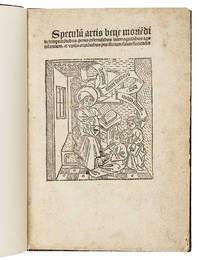
1495réf. ABC_47543Cologne: Heinrich Quentell 1495. Recent marbled paper over boards by the Geneva bookbinder Jean-Luc Honegger b. 1953 who set up his atelier ca. 1978 signed with his honegger stamp in blue ink at the foot of the back paste-down sewn on 3 recessed supports the marbled paper in an antique spot pattern see Wolfe 162-163 with black spots on unusually fine-grained grey Stormont spots and with veins in red turquoise orange dark blue and white black morocco spine label with the title in gold roman capitals reading up the spine. Small Chancery 4to 20.5 x 14.5 cm. With a large woodcut 10.0 x 8.8 cm on the title page: depicting a teacher Pope Gregory the Great ca. 600 CE declared a saint in 1295 with a dove on his shoulder his attribute seated behind a lectern with an open book instructing two of his pupils seated before him each with a book in his hands with above them a scroll inscribed Accipies tanti doctoris dogmata sancti. Set in a single column with 36 lines to the page in a rotunda gothic type Quentell type 7 here 79G though in the Typenrepertorium 80G with a larger textura gothic for the first line of the title Quentell type 10 155G though the only capital in that line is the 8 mm lombardic initial S Quentell initials e described as 6/7 mm but noting that they are used with type 10. With spaces left for manuscript initials 1 6-line and many 3-line a few - mostly on b1v and b2r - with manuscript guide letters in black ink. Most pages with a few words underscored in black ink. Quentells second quarto edition of the well-known manual on the art of dying in the original Latin matching his ca. 1493 quarto edition almost line for line and using the same woodcut quite different from any used with this text before that date. Quentells quarto editions contain the original long version of the text known as Speculum artis bene moriendi often attributed to Matthaeus de Cracovia or Albertus Magnus editions in Italian are often attributed to Dominicus de Capranica Cardinal of Fermo. The Ars moriendi was one of the earliest incunabula printed and consists of two related Latin texts written around 1415 and 1450 offering guidance on how to have a good death according to Christian beliefs of the late Middle Ages. The texts were written in response to the Black Death and social upheavals of the 15th century with the earliest versions likely composed in southern Germany. The highly popular Ars moriendi was translated into many West European languages and was the first in a tradition of guides to death and dying. The first edition in the original Latin appeared ca. 1474 but was preceded by a German edition in 1473 and perhaps by an edition in Italian described as ca. 1471/75. Quentell published the Latin text together with other works in a folio edition described as ca. 1484/89 but he published four quarto editions of the Ars moriendi alone described as ca. 1493 the present ca. 1495 ca. 1498 and another probably after 1500. He published no Ars moriendi editions in vernacular languages. His first three quarto editions have the same collation but the present edition matches the ca. 1493 edition almost line for line and uses the same woodcut while the ca. 1498 edition differs considerably and uses a different woodcut.Heinrich Quentell one of the greatest early Cologne printer-publishers issued many theological and philosophical texts for university use but also liturgical texts working both alone and with Johann Helman who may have also jointly employed contract printers and dispatched servants to sell books. Quentell was one of the first printers to consistently provide his books with title-pages with approximately 91% of his over 380 publications including one.Quentell used the present Magister cum discipulis-woodcut in several other editions including the Heymericus de Campo Promptuarium argumentorum 1492 GW 12406 and Jacobus van Gruitrode Speculum aureum animae peccatricis 1493 GW M10728. Wynkyn de Worde used a copy in his Parabolarum Alani cum commento 1508 STC 254.3 and other printers copied it as well.All Quentells Ars moriendi editions are undated and the present one used his types 7 and 10 and initials e which all apeared in his books in the period 1488 to 1500. The present edition is probably dated ca. 1495 in the literature because it appears to fall between the two quarto editions thought to date from ca. 1493 and ca. 1498.The bookbinder Jean-Luc Honegger still active today is best known for his bindings for the Bibliothèque Nationale de France in Paris and the Bodmer Foundation near Geneva. With the bookplate of the Bibliotheca Philosophia Hermetica Joost Ritman in Amsterdam and probably bound for them. Slightly browned water stains at the foot of a few leaves not approaching the text some smudges in the margins and on the blank final page. The binding slightly worn at the extremities and with a few unobtrusive scratches on the back board. Otherwise in very good condition and only slightly trimmed about 5 mm at the head and probably no more at the fore-edge and foot giving generous margins about 2 3 and 4 cm at the head fore-edge and foot respectively and some leaves with tranchefiles at the foot.l Bibliothèque Nationale Catalogue des incunables A598; BMC I p. 294; Bod-Inc A449; Bohonos Szandorowska Incunabula quae in bibliothecis Poloniae asservantur 562; BSB-Ink A766; Buffévent VIII 45; Goff A1098; Günther Wiegendrucke der Leipziger Sammlungen 781; GW 02610; HC 14911; ISTC ia01098000; Madsen Kongelige Biblioteks inkunabler 352; Ohly-Sack 274; ÖNB-Ink A483; Pell 1339; Polain 972; Proctor 1425; Sack Freiburg 306; Sallander Uppsala 2046; Schramm VIII 484; Schreiber Manuel de lamateur de la gravure sur bois et sur métal au XVe siècle 3671; Thienen Incunabula in Dutch libraries 425; UBL-Ink A354; USTC 739947; Voulliéme Die Buhdrucker Kölns 305; Voulliéme Inkunabeln der Königlichen Bibliothek 1011; Voulliéme Trier 697. Heinrich Quentell, hardcover
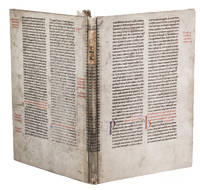
1486réf. 9BDEHOBV62VDWürzburg: Georg Reyser 1486. Later bound in two leaves from a 13th-century vellum theological manuscript rubricated and decorated with alternating red and blue initials with penwork. Folio. Printed in red and black in rotunda type 32 lines; printed area: 18 x 12 cm; type: 112a. With illustrations cut from 19th- or 20th-century reproductions of early woodcuts ca. 21 x 14 cm pasted on the front Annunciation and back pastedown Christophorus with the year "cccc xx tercio". Interesting example of the study of early printing in 19th-century England. The 12 leaves come from the library of the 19th-century collector Dr C. Inglis whose father boasted an impressive collection of early printed books. Inglis believed that the leaves came from an unknown work titled De vita et honestate clericorum ex consilio Moguntinum printed in 1453 by Gerhardus Episcopus. Tipped in is a letter to Inglis by the well-known bibliographer William Blades discussing this matter. Although the text opens with "De Vita et honestate clericorum ex consilio Maguntinensis Gerhardi Archiepiscipi" it was in fact part of Statuta synodalia herbipolensia printed at Würzburg by Georg Reyser in ca. 1486. The first 6 leaves are 2-d7 and the final 6 leaves are quire g.With owner's inscription of Sir Edward Coates bookplate with initials "CC" Clifford Coates the bookplate of Dr. C. Inglis and some annotations on front pastedown; an autograph letter signed by Wiliam Blades to C. Inglis tipped to flyleaf. 12 well-preserved leaves.l Cf. BMC II 572; Goff S-741; Hain 15036; Hubay Inc. Universitätsbibl. Würzburg 1953; ISTC is00741000. Georg Reyser, hardcover
1497réf. 64069New York & Strassburg: Ben Abramson Johann Gruninger 1946; 1497. 4to. 48 pp. Double-page title illustrated w/ woodcut engraving w/ 7 additional woodcut engravings. Quarter-orange cloth over illustrated boards cover art facsimile reproductions of illustrated leaves from the 1497 Buch der Cirurgia minor edgewear slight scuffing minor bumping to couple corners still VG copy; One leaf. 4to. 2 pp unpaginated. preserved in fold over flaps on front pastedown left margin repaired faint tidemark on upper third at corner still G clear artifact numbered on verso of title w/ gilt booklabel for the Aldredge Bookstore Dallas TX on rear pastedown. First editions thus No. 52 of 112 copies printed of this limited edition containing an original leaf from the 1497 edition: “the first important printed treatise in German. It combines a compilation of the ancient and medieval authorities with Brunschwig’s own extensive experience. . . and is notable for its woodcuts some of the earliest specimens of medical illustration.” The leaf included here is a survivor from Chapter Three addressing how to find veins and treat open wounds. Sigerist’s work was first published as an essay introduction with the R.Lier & Co. 1923 facsimile of Brunschwig’s Book of Cirurgia. See: Garrison & Morton 5559. Ben Abramson, [Johann Gruninger], hardcover
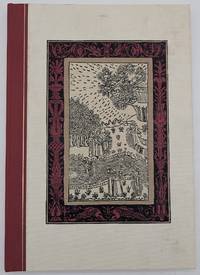
1975réf. 72168Provo UT: Friends of Brigham Young University Library 1975. Limited edition. Hardcover. Very Good. 59pp. Folio 39.5 cm 1/4 red cloth with white cloth over boards and pictorial stamping on the front board. With the leaf. Boards with large areas of light soiling more so on the rear board. Internally clean and bright. Number 48 in an edition of 50 containing a leaf with an original woodcut illustration. From an edition of 250 overall. Published in honor of the Centennial of Brigham Young University. Friends of Brigham Young University Library hardcover
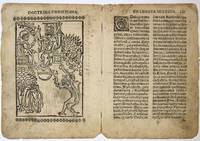
1560réf. 6658México 1560. First Edition Primera edición. 200x147mm. 7¾x5¾". México anterior a 1560. En 4º 200 x 147mm. 4 pp. fols. 52 y 53. Texto en mixteca. 1 xilografía a toda página. Hermoso grabado en madera producido en México durante la época incunable de su imprenta publicado antes de 1560. Pertenece a una Doctrina Christiana en lengua mixteca. En la hoja 52 verso gran xilografía a toda página representando a Dios sentado en el trono con la bola del mundo a sus pies su hijo sentado a la derecha y el Espíritu Santo a la izquierda debajo un grupo Santos rezando y una imagen del demonio. Se trata de una de las primeras xilografías impresas en América. unknown
1493réf. D4438Venice: Johannes Rubeus 1493. Hardcover. Very Good. Venice: Johannes Rubeus 1 January 1493. Folio 315 x 225mm. 174 leaves. Collation: a 7; b-x 8; tabula 7. 61 lines Roman type capital spaces unrubricated. Contemporary notation and hand-drawn manicules indicating the text throughout many are whimsically flourished or holding objects. Final blank on watermarked paper of flying swan in pearled medallion. Content are in three parts the first is a revised and augmented version with excerpts taken from classical authors and Italian humanists and formulas for letter-writing. The second part consists of an anthology of prose writers including Cicero Lactantius Macrobuius Plutarchus etc. The third part contains selections from Petrarch dramatic poets Terence Seneca Plautus and a variety of humanist speeches by Renaissance copyists letter-writers and philosophers including Johannes Lamola Poggius Florentinus Galeatius Sforza and the author himself. Contents: Leaf 2a title: Oratorum omnium Poetarum: Hystoricorum: ac Philosophorum elegantes dicta: per Clarissimum iurum Albertum de Eiib in unum collecta faeliciter incipiunt. Leaves 120a-123b contain: Liber augustalis imperatorum Francisci Petrarchae Benvenuto Rambaldis continuation of Petrarchs Epitome vitarum virorum illustrium; Leaves 125a-129b: Francisci Petrarchae de aduersa fortuna Remedia; Leaves 129b- 132b: Francisci Petrarchae: de prospera fortuna remedia. Leaf 168b Colophon: Summa Oratorum omnium: Poetarum: Historicorum: ac Philosophorum Autoritates in unum collectae per clarissimum uirum Albertum de Eyb Vtriusque iuris doctorae eximium: quae Margarita poetica dicitur: faeliciter finae adepta est. M.CCCCLXXXXIII. Kalae. Ianuarii. Leaves 169a-175b: Tabula. totius . oprois. 18th-century three-quarter sheep over marbled pasteboards spine gilt with title silk book mark; wanting first and final original blank a few wormholes at the beginning and end some just affecting text; faint dampstaining in the upper margins few creased corners corner torn of m2 and marginal tear m8 very slightly spotted and soiled in places. From the Collection of Baron de Eyb his heraldic lithographed ex-libris dated 1899 to front pastedown an evident descendant of the author. Eyb is the name of an old Franconian noble family which is named after Eyb in Ansbach. It is likely this volume was owned by a contemporary with familial ties to the author and stayed within the family until the early 20th century. Eighth Edition of this important work of German Humanism. Albrecht von Eyb one of the earliest German Humanists was born in 1420 near Ansbach. Eyb went to Italy and devoted himself to humanistic study at the Universities of Pavia and Bologna. He returned to Germany in 1451 having been appointed Canon at Eichstätt and Bamberg. From 1452 to 1459 he was again a student at Bologna gaining the degree of doctor in 1459. That same year Eyb wrote Margarita poetica in honor of his mother Margarete von Wolmershausen. It was first published in Nuremberg by Johann Senschschmidt in 1472 and reprinted at least 13 times by 1503. It remained a popular manual of classical rhetoric by its three distinct focuses: letter-writing model orations and florilegia compilation of excerpts. The work is known for its vivid expression found within selected passages from classical and contemporary authors from Cicero to Petrarch. The Catholic Encyclopedia calls it a textbook of humanistic rhetoric consisting of a collection of passages in prose and verse from Latin authors to which are added specimens of humanistic eloquence. Of only about 40 in existence OCLC locates 13 copies of this edition in US collections. BMC V 417; Goff E177; GW 9536; HC 6824; Madsen 1547; Schmitt I 4233; Sheppard 4121; Proctor 5132 Johannes Rubeus hardcover
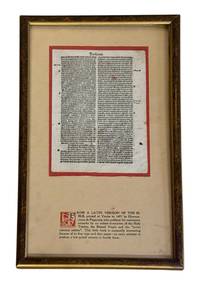
1497réf. 10301Venice 1497. 15.5x11cm leaf two columns matted with printed caption and in frame. Few faint smudges and stains frame with minor wear. Nicely presented leaf from Paganini's 1497 Latin Bible which is known for being one of the first due to its thin paper and compact fine type bibles produced in an affordable form. unknown
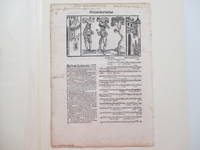
1496réf. 17350AB1496. Straßburg Grüninger I.XI. 1496 305 : 21 cm. One leaf with one woodcut. Leaf LXX 'Secundus actus' from the "Heautontimorumenos". The woodcut shows the two protagonists of the play. - With some old annotations. - Hain/Copinger 15431; Goff T-94; GW M45481. unknown
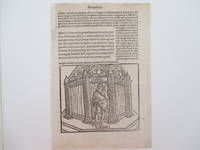
1493réf. 17352AB1493. Lyon 1493. 225 : 155 cm. One leaf with one woodcut. Leaf 223 shows the Terenz editor Calliopius in front of a polygonal building. The woodcut was also attributed to the master of the Lübeck bible.' - Hain/Copinger 15424; Goff T-91; GW M45397. unknown
1566réf. 54413Mexico: Antonio de Espinosa 1566. A Major Mexican Incunable A very rare complete and substantial example of early Mexican printing. This work was produced and published by Antonio de Espinosa the second printer in the New World after Juan Pablos and is one of the most considerable efforts of his career in Mexico. Espinosa was brought to Mexico by Juan Pablos as an assistant and type cutter in 1550 and he eventually broke Pablos' monopoly and began printing for himself in 1559. The present work printed in 1566 is one of only a handful produced in Mexico during that decade and is one of the initial books of the Mexican incunable period. The text itself is the first edition of a religious work by Bartholomé de Ledesma explicating church sacraments in great detail later reprinted in Salamanca in 1585. The work is split into six parts. The first discusses the sacraments generally and the ensuing five treat individual sacraments in depth. Ledesma was a key figure in the early Mexican church as a close advisor of the second Archbishop in the New World Alonso de Montúfar and the chair of theology at the nascent University of Mexico founded in 1551. He was also one of the foremost proponents of book censorship and prohibition in New Spain and vigorously investigated private libraries and booksellers for forbidden materials and was responsible for the destruction of many volumes. He later became the Bishop of Oaxaca a position in which he served until his death in 1604. Overall the work is a fine example of the sophistication which Espinosa brought to early Mexican printing. The titlepage contains a fine coat of arms that of Archbishop Montúfar and the section on marriage sacraments includes several finely executed woodcut diagrams of consanguinity. The text is printed elegantly in a Roman type which Espinosa had introduced to New World printing with printed marginal notes in italic and woodcut initials throughout. Below the colophon is an excellent example of Espinosa's printer's device the first used on any book produced in the Americas. In his 1940 census of Mexican imprints Wagner located twelve copies of this work and over seventy-five years later OCLC adds only three more. It appears just four times in auction records of which one copy was incomplete. A rare desirable Americanum printed by the second printer in the New World and one of the earliest Mexican incunabula still obtainable. Small thick quarto. Contemporary vellum with yapp edges remnants of vellum ties at fore-edge. Light wear and soiling to vellum endpapers renewed. Small marca de fuego on top edge. Moderate wear to initial leaves moderate worming in lower corner and occasionally along lower margin all expertly repaired slightly affecting only a few printed marginalia and catchwords. Light tanning and occasional foxing. A very good copy overall. ICAZBALCETA 47. MEDINA MEXICO 50. PALAU 134124. SABIN 39677. WAGNER NUEVA BIBLIOGRAFIA MEXICANA 47. hardcover
1554réf. 54409Mexico: Ioannes Paulus Brissensis 1554. From the First Press in the New World and the Most Extensive Work Printed in the New World Up to This Time: The First Philosophical Works and the Second and Third Secular Works Published in the New World Printed by Juan Pablos the first printer in the New World these are two of the first major books published in the Western Hemisphere and the largest produced up to that time. Both titles are the work of Fray Alonse de la Veracruz and are the earliest works of philosophy and humanist thought published in the New World as well as the second and third secular works printed in the New World after the 1548 Laws which survives in only two copies. Moreover these are the earliest books printed in the New World still obtainable in the present market. Alonso de la Veracruz was a pioneering theologian philosopher author and Augustinian missionary. He accompanied Father Francisco de la Cruz on a mission in New Spain in 1536 remaining there for the rest of his life. His works here centered on an examination of the philosophy and ideas of Aristotle. His goal was to rid classical philosophy of vain and useless speculation and form a Renaissance of sorts in the new Spanish territories. Beyond instigating a school of thought previously unknown in the New World Veracruz sought to reform earlier scholastic and humanistic practices. He became a noted master of the Mexican and Tarascan languages making him an indispensable educator. In 1553 he became the first professor at the University of Mexico publishing these works his most important the following year. The two present works sprang out of Veracruz's studies shortly after his appointment to the University. The first Recognitio Summularum. is a compendium of Logic. This is supplemented by a commentary on the Aristotelian Categories and the Posterior Analytics. These two philosophical works were the first to be written and published in the New World as well as the first to address texts of the classics. Printing in the New World began in 1539 when printer Juan Pablos established a press in Mexico City a full century before printing began in British North America. The very earliest products of the Pablos press that have survived now reside almost entirely in institutions or are known only by inference of the two dozen earlier works listed by Wagner six are known only by inference. These are by far the most extensive works printed in the New World up to this time. Both works are major substantial pieces of printing handsomely laid out in two columns with well-executed presswork. The titlepage of the first work here in facsimile is printed in red and black the earliest color printing in the New World. The typography is also a breakthrough. Pablos now had Antonio de Espinosa later the second printer in the New World working in his shop as a punchcutter and assistant. Espinosa led a departure from the gothic types previously used by Pablos and these two books are the earliest use of roman and italic types in the New World. The text also contains numerous attractive woodcuts - on the titlepages as capital letters in the text and as illustrations in the text. Eleven other copies are known to survive of the Recognitio according to Wagner's census published in 1960 of which nine were then in public collections and several of those are imperfect. Wagner located twelve copies of the Dialectica eleven in institutions. In several instances the two books are found bound together as here. The annotations and marcas de fuego indicate that the present copies were once a part of the library at the Franciscan monastery in Puebla. Two extraordinary works of surpassing rarity from the first press in the New World comprising an impressive array of firsts for printing in the Americas. 888; 8810 leaves. Folio. Recased in slightly later vellum other manuscript title on spine remnants of fore-edge ties. First titlepage in facsimile mounted on a stub; first work lacking leaf H1; second titlepage detached but present. Two marcas de fuego on top edge; early manuscript inscriptions on first and final leaves of text; one leaf of manuscript bound in at rear. Moderate worming throughout somewhat affecting text. Light dampstaining at top edge moderate tanning and foxing. Good. In a half morocco box. ICAZBALCETA BIBLIOGRAFIA MEXICANA 1954 ed 21 22. MEDINA MEXICO 22 23. VALTON 45 46. PALAU 359140 359145. WAGNER NUEVA BIBLIOGRAFIA MEXICANA 20 21. Kurt Reinhardt "Alonso de la Vera Cruz and the Beginnings of Philosophic Speculation in the Americas" in The Americas Vol. 1 no. 2 October 1944 pp.207-14. hardcover
réf. 45867Johann Gruninger Strasbourg 1485. 8vo Intact single page with appropriate light age tanning and creases and only a small tear at upper left edge. This is a single page of a very famous hand printed German bible from one of Europe's most important pre 1500 printers. Recently mounted on black board with a gold frame. Both sides are printed and the page is only lightly attached at its upper edge to the mounting. Obviously over 530 years old now and is a small example of great historical interest. Johann Gruninger Strasbourg 1485 unknown
1497réf. WB19676Strasbourg: Johann Reinhard Grüninger 26 April 1497. Hardcover. Very Good. Chancery Folio; 304 x 207mm; 490 leaves of 492 lacking blank Z6 and the final leaf of the table; a bifolium from gathering B is bound in A. It features red and blue Lombard capitals with a woodcut depicting Saint Jerome on the title page. The first bifolium has undergone extensive repair work at the gutter and outside edges with the first leaf being soiled chipped and laid down on new paper. Throughout the volume there are smaller repairs and tears with one larger tear that has been repaired affecting the text on page ss2. Dampstaining and some soiling are present particularly at the ends and there is worming affecting some of the text. The final leaf has been heavily repaired resulting in loss of text at the outer edge. The book is bound in modern black blindstamped morocco with clasps in a style reminiscent of the period with gilt edges showing some signs of wear. The provenance of the book includes extensive marginalia with an inscription indicating it belonged to Georgius Wenceslaus Pastor of Olbersdorf dated 1635 who acquired it from Samuel Ursinus. A Bible printed by the prolific Strasbourg printer Johann Reinhard Grüninger replete with annotations credibly by Georgius Wenceslaus the Lutheran pastor who served in Olbersdorf a town in the historical region of Silesia which is now part of modern-day Poland. It features a woodcut on the title page portraying Saint Jerome depicted both in contemplative study and in prayer at the foot of the cross. HC 3122; BMC I 111; BSB-Ink B-476; GW 4277; Bod-inc B-308; Goff B-600; ISTC ib00600000. Uncommon in commence. [Johann (Reinhard) Grüninger,] hardcover
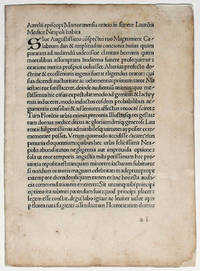
1492réf. 26804to. 20.5 x 15 cm 4to. 20.5 x 15 cm 8 ff. rather dog-eared at edges and with some light soiling. Disbound in a cloth-covered box. Rare first edition of this funeral oration for Lorenzo de Medici read in Santa Maria Nuova on 16 April 1492 evidently the only contemporary printed oration of the many delivered and printed in his honor to survive. "Lorenzo de' Medici… born January 1 1449 Florence Italy—died April 9 1492 Careggi near Florence Florentine statesman ruler and patron of arts and letters was the most brilliant of the Medici. He ruled Florence with his younger brother Giuliano 1453–78 from 1469 to 1478 and after the latter's assassination was sole ruler from 1478 to 1492." Brittanica.com The present publication is the sole oration devoted to Lorenzo in the Short-Title List of Funeral Orations from the Italian Renaissance Ca. 1374-1534 compiled by John McManamon and the only printed example featured in the 1992 exhibition at the Bibliotheca Nazionale Centrale Lorenzo dopo Lorenzo La Fortuna Storica di Lorenzo il Magnifico. Notwithstanding the poor survival rate of ephemeral publications and the controversial character of the laudandus the statistic remains remarkable. The motive for the present oration was overwhelmingly political and meant to insure continuation of the traditionally strong alliance between Naples and Florence at a difficult time of dynastic transition. According to Miglio DBI X.369-70 the work was published before it was read. A Naples edition was published the same year from the press of Cristannus Preller IGI VI.1722-A. The work was re-published in the 19th century by Vito Capialbi in Memorie di R. Zeno e A. Bienato Naples 1838 49-86. Milanese born Aurelio Bienato was Reader in Rhetoric at the University of Naples 1470-80 and later elected Bishop of Martirano modern Catanzaro in which sinecure he remained until his death. Miglio also lists an unpublished commentary on Quintilian Iter Italicum I.415-16 II.570 and a collection of Latin verses Elegantiarum epithomata an epitome of Lorenzo Valla's Elegantiae linguae latinae which went through a number of incunable editions 1479/80; 1488; 1491. US copies ISTC: Huntington Newberry and Yale. Provenance: Ritman copy. Goff B-667; BMC vi.784; GW IV.1346; Paolo Pira ed. Lorenzo dopo Lorenzo. La Fortuna Storica di Lorenzo il Magnifico Florence Biblioteca Nazionale 1992 I.24; John M. McManamon Funeral Oratory and the Cultural Ideals of Italian Humanism 1989 p. 256 & 41-43. Phillipus de Mantegatiss
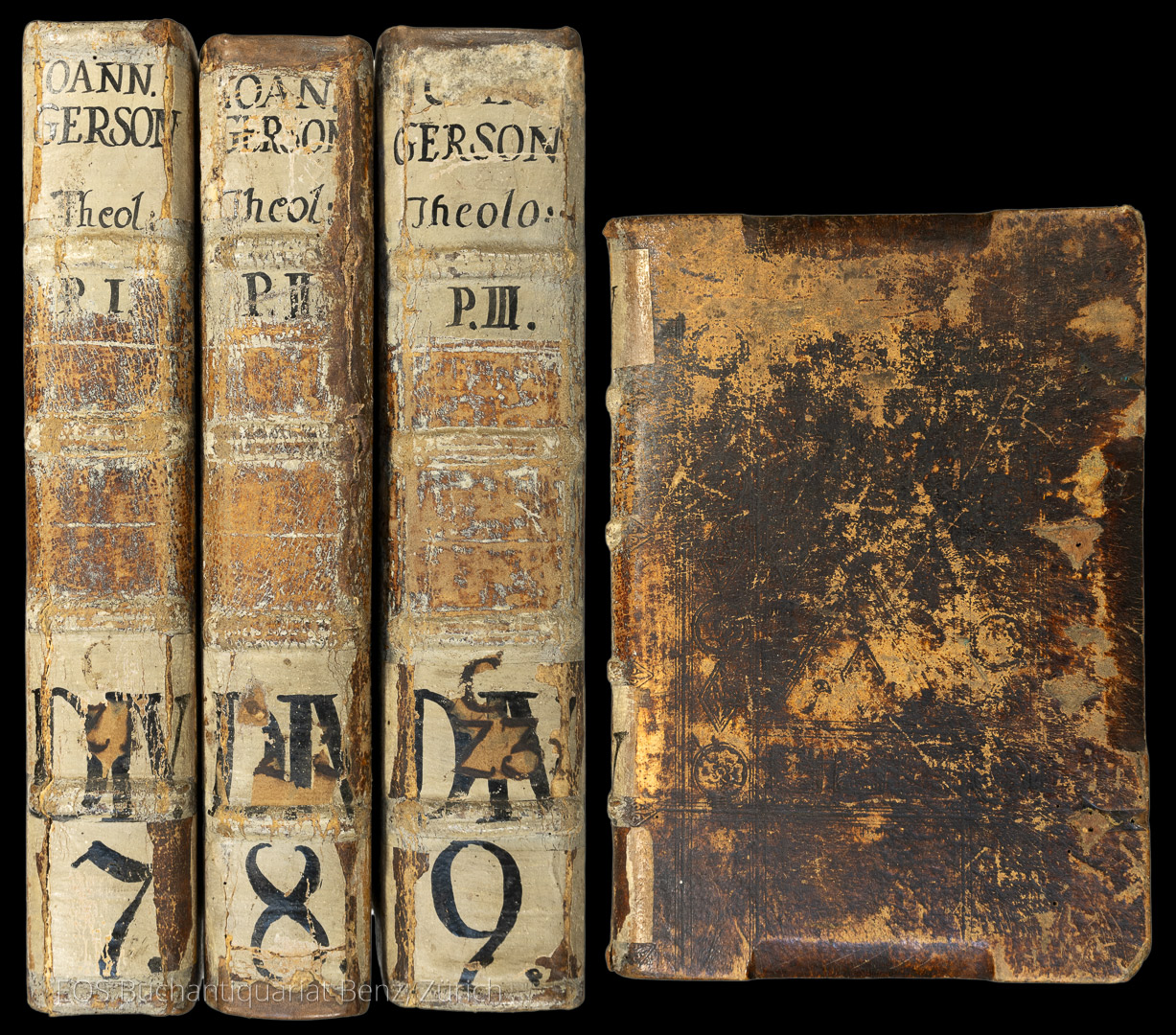
réf. 7672CBBasel, Nikolaus Kessler, 1489. 4° (32 x 23 cm). 46 Bl. (letztes leer); 188 Bl.; 229 (von 230) Bl.; 320 Bl. (das letzte leer), 2 Spalten, 57 Zeilen. Mit 3 sich wiederholenden Holzschnitten (nachgeschnitten nach der Strassburger Ausgabe) sowie mit durchgehenden Rubrizierungen und eingemalten Initialen in Rot und Blau. Verfärbte Schweinslederbände über Holzdeckeln der Zeit, mit Stempel- und Plattenprägung. + Wichtig: Für unsere Kunden in der EU erfolgt der Versand alle 14 Tage verzollt ab Deutschland / Postbank-Konto in Deutschland vorhanden +, 7672CB|7672CB_2|7672CB_3|7672CB_4 4 Teile in 3 Bänden. [4 Warenabbildungen]
réf. 65312[Köln, Johann Koelhoff d. Ä., um 1476-1477]. Fol. 45 nn. Bll. (ohne das letzte weiße; Got. Typ., 2 Kol., Rubriziert, eingemalte Initialen in Rot), Roter HLdr.-Bd. d. 20. Jhds. m. goldgepr. Rückentitel.
1496réf. 64508Basel, [Michael Furter], 13. März 1496. 4°. 22 nn. Bll. (2 Sp., 47 Z., Min. f. Init.), Mod. Ppbd. unter Verwendung eines alten Antiphonarblattes.