Pierre MAC ORLANBiblio.com
36 136 résultats
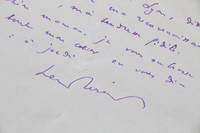
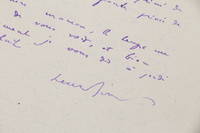
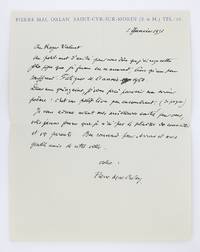
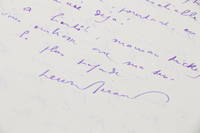
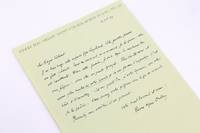
1949réf. 84075Saint-Cyr-sur-Morin: S. n. 1949. Fine. S. n. Saint-Cyr-sur-Morin 19 Octobre 1949 21 x 27 cm une feuille Autograph letter dated and signed by Pierre Mac Orlan 12 lines in blue ink to his young friend the beginning poet Roger Valuet. Fold marks inherent to being placed in an envelope. Pierre Mac Orlan thanks his poet friend for having offered him a pipe: ""J'ai bien reçu cette superbe pipe Longchamp. Votre gentille pensée me fait plaisir. Tout en écrivant en ce moment je la fume."" ""I received this superb Longchamp pipe. Your kind thought pleases me. While writing at this moment I am smoking it."" and congratulates him on his latest work and the progress achieved : ""Vous êtes en grand progrès. Plus sûr de vous et aussi plus maître de votre pensée et de vos formes d'expression."" ""You are making great progress. More sure of yourself and also more master of your thought and your forms of expression."" He encourages him to persevere and promises him a preface for his next work : "". c'est un grand don à notre époque que celui de la poésie. Vous aurez votre préface vers la fin de ce mois."" ""it is a great gift in our time that of poetry. You will have your preface towards the end of this month."" Originally from Arras Roger Valuet is a popular writer who signed under the pseudonym Roger Vilard numerous detective and espionage novels. At the beginning of his career he was helped by Pierre Mac Orlan who prefaced his first collection of poems. S. n. unknown
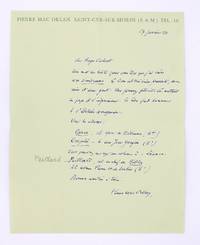
1950réf. 84039Saint-Cyr-sur-Morin: S. n. 1950. Fine. S. n. Saint-Cyr-sur-Morin 27 Janvier 1950 20.50 x 26.50 cm une feuille Laudatory autograph letter dated and signed by Pierre Mac Orlan 15 lines in blue ink to his young friend the beginning poet Roger Valuet who has just sent him his collection of poems Embruns: "". le livre est très bien présenté avec soin et goût. Vous pouvez féliciter le metteur en pages et l'imprimeur."" "". the book is very well presented with care and taste. You can congratulate the typesetter and the printer."" He provides him with the addresses of his friends Francis Carco Roland Dorgelès and Léonce Peillard so that they too might receive their copies of Embruns in order to better publicize and distribute this work. Fold marks inherent to being placed in an envelope. A native of Arras Roger Valuet was a popular writer who signed under the pseudonym Roger Vilard numerous detective and espionage novels. At the beginning of his career he was helped by Pierre Mac Orlan who wrote the preface to his first collection of poems. S. n. unknown
1946réf. 84037Saint-Cyr-sur-Morin: S. n. 1946. Fine. S. n. Saint-Cyr-sur-Morin 16 Juillet 1946 13.50 x 21.50 cm une feuille Autograph letter dated and signed by Pierre Mac Orlan 16 lines in black ink to his young friend the budding poet Roger Valuet. Fold mark inherent to postal handling. Pierre Mac Orlan thanks his friend for sending him tobacco which he seems to appreciate greatly and sends him a check to reimburse him: "". if you don't accept my check I won't accept the tobacco. thank you again for the St Claude blue."" A native of Arras Roger Valuet is a popular writer who signed under the pseudonym Roger Vilard numerous detective and espionage novels. At the beginning of his career he was helped by Pierre Mac Orlan who wrote the preface to his first collection of poems. S. n. unknown
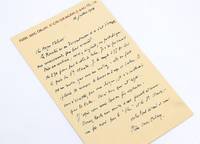
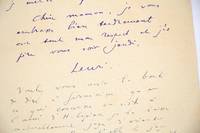
1945réf. 84040Poissy: S. n. 1945. Fine. S. n. Poissy 2 Juin 1945 13 x 21 cm trois pages Touching autograph letter dated and signed by Henri Béraud addressed to his mother-in-law while imprisoned at Poissy prison 65 lines in blue then black ink on three pages relating his situation as a prisoner while praising the love of the latter and his wife who watch over him and allow him to envisage prison life under better auspices. The letter is on the letterhead of the infirmary of the central prison of Poissy with fold marks inherent to being placed in an envelope. Henri Béraud rejoices at having been able to see his mother-in-law in good health and worries about the sacrifices she inflicts upon herself for the well-being of her imprisoned son-in-law: "". j'ai été heureux jeudi de vous voir avec si bonne mine.je pense aux difficultés. je crains que toujours que vous ne vous priviez pour moi."" "". I was happy Thursday to see you looking so well. I think of the difficulties. I always fear that you deprive yourself for me."" while remaining lucid about the indignity of his prisoner's condition which does not allow him to protect his loved ones: "". je compte tellement sur vous pour veiller sur notre Germaine Henri Béraud's wife pour l'obliger à se soigner et à se ménager."" "". I count so much on you to watch over our Germaine to force her to take care of herself and spare herself."" He considers his arrest and imprisonment illegitimate and abusive and shows confidence in his future with his mother and spouse ""by his side"": "". le triste et injuste sort qui m'est fait. C'est cela qui me donne le plus de confiance dans l'avenir - cela et votre bonté à mon égard chère maman et bien sûr l'amour de la plus noble et de la plus belle des épouses."" "". the sad and unjust fate that has befallen me. This is what gives me the most confidence in the future - this and your kindness toward me dear mother and of course the love of the noblest and most beautiful of wives."" Finally Henri Béraud continues in black ink with a recommendation for his wife: "". en ce qui concerne sa visite à l'ami d'H. Espiau je la laisse naturellement juge d'orienter cette conversation. au mieux de mes intérêts immédiats."" "". regarding her visit to H. Espiau's friend I naturally leave her to judge how to direct this conversation. in the best interest of my immediate concerns."" A bon vivant native of Lyon Henri Béraud was an international journalist and reporter Le canard enchaîné Le Crapouillot Petit Parisien France-Soir and Gringoire and a prolific writer Goncourt Prize 1922 for Le martyre de l'obèse and Le vitriol de lune published a year earlier whose political evolution moving from the extreme left to the extreme right pro-collaborationist is characteristic of the inexorable rise of totalitarianisms between the wars and the corruption of many French intellectuals. Friend of Roland Dorgelès Albert Londres and especially Joseph Kessel whom he met in 1922 in Ireland then recently and partially liberated from the British yoke Henri Béraud defended very left-wing opinions. But after a trip to the U.S.S.R. he began to revise his positions while drifting toward anti-parliamentarianism Anglophobia Faut-il réduire l'Angleterre en esclavage published in 1935 and dedicated to Joseph Kessel antisemitism ""without realizing it"" according to his friend journalist Jean-Galtier Boissière. It was the Stavisky affair and its corollary the riots of the fascist and anti-parliamentary leagues of February 6 1934 that triggered Henri Béraud's manifest passage to the extreme right going so far as to break his friendship with his great friend Joseph Kessel. In 1936 his violent articles in Gringoire would lead to the suicide of Popular Front Interior Minister Roger Salengro accused of desertion during the First World War. Arrested in September 1944 and condemned to death on December 29 1944 for intelligence with the enemy he was pardoned by General S. n. unknown
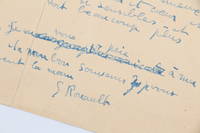
1930réf. 84180s. l.: S. n. 1930. Fine. S. n. s. l. s. d. circa 1930 21.50 x 18 cm une page Autograph letter signed by the painter Georges Rouault 19 lines in blue ink on one page apologizing for having to hastily postpone an appointment due to feeling unwell. Fold marks inherent to being placed in an envelope. His mind clouded by pain Georges Rouault presents his apologies for their appointment which he cancelled and attempts despite his correspondent's tight schedule to meet with him nonetheless: ""Je ne sais ce que j'ai pu écrire hier ayant été pris de violentes douleurs de tête et pressé de vous prévenir de l'impossibilité où j'étais."" ""I don't know what I could have written yesterday having been seized with violent headaches and pressed to inform you of the impossibility in which I found myself."" "". je suis bien désireux de vous voir avant et de vive voix de m'exprimer mieux qu'ici."" "". I am quite desirous to see you beforehand and to express myself better in person than here."" He feels better and ready to endure the physical ordeal of an interview while considering that he does not take much care of his precarious health: "". je malmène trop cerveau et coeur et alors se vengent mes organes si sensibles et qu'avec l'âge on doit beaucoup plus ménager."" "". I mistreat my brain and heart too much and then my organs so sensitive and which one must spare much more with age take their revenge."" S. n. unknown
1953réf. 84015Boulogne-sur-Seine Boulogne-Billancourt: S. n. 1953. Fine. S. n. Boulogne-sur-Seine Boulogne-Billancourt 5 Septembre 1953 11.50 x 18 cm une feuille une enveloppe Autograph letter dated and signed by André Malraux 14 lines in blue ballpoint pen from his Boulogne home on avenue Victor Hugo discussing his workload related to the preparation and delayed publication of the work Des bas-reliefs aux grottes sacrées for which André Parinaud is sending him documentation. André Malraux is not yet ready to send his work to the publisher: "". le livre ne parait pas cette année. Peut-être en mars 54. Et pour savoir où nous allons il faudrait que la préface au moins fût terminée. J'en ai encore pour deux mois."" "". the book is not coming out this year. Perhaps in March 54. And to know where we are going at least the preface would need to be finished. I still have two months of work ahead."" Fold mark from mailing envelope included. Resistance fighter participating in Combat André Parinaud is a journalist columnist art critic and writer. From 1959 to 1967 he held the position of editor-in-chief of the important weekly Arts bringing together the elite of French creation in all artistic fields: literature painting theater cinema. He would then conduct more than 1000 radio interviews with the greatest writers and artists including Salvador Dali Louis-Ferdinand Céline Colette Paul Léautaud André Breton Georges Simenon and André Malraux. While continuing to work at O.R.T.F. and radio he founded several festivals or artistic events such as Le Festival international du film d'art l'Académie nationale des arts de la rue. S. n. unknown
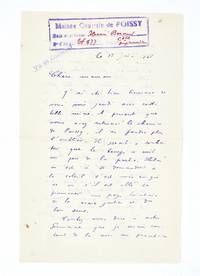
1946réf. 84064Poissy: S. n. 1946. Fine. S. n. Poissy 15 Juin 1946 13.50 x 21 cm une page recto verso Touching autograph letter dated and signed by Henri Béraud addressed to his mother-in-law while he was incarcerated at Poissy prison 40 lines in blue ink on one recto-verso page relating his situation as a prisoner while praising the love of the latter and his wife who watch over him and allow him to envisage prison life under better auspices thanks notably to the parcels that improve his daily fare. The letter is headed with the infirmary of the central prison of Poissy where Henri Béraud was being treated creasing traces inherent to being placed in an envelope. A printed stamp of the prison administration ""Seen and checked"" in the left and upper margin of the letter Henri Béraud rejoices in his mother-in-law's good health which allows her to visit him again: "". Now that you have found your way back to Poissy you must not forget it again."" even if the weather is not cooperating: "". One wonders if the sun has gone on strike or if it has gone for a walk in the distant land of true justice and common sense."" thus establishing a parallel between his dark condition as a prisoner and the darkness of the sky. He hopes to see his wife Germaine again: "". with the hairstyle that suits her so well."" and to receive new photographs of her. The author of Le Martyre de l'obèse wants to reassure his family thanks to whose support he copes: ""Tell them that morale remains strong - and the parcels are wonderful."" and ends his letter remaining the pamphleteer that he is with an anti-American quip: ""I embrace you with my deep and respectful tenderness although respect and Mickey clash a bit!"" He also requests paper and envelope to escape episodically from the darkness of his prison routine: "". don't forget to put envelope and paper in your letter."" and asks for news of his relatives: ""give me news of your in-laws who are also mine and who show me such generous affection."" A bon vivant native of Lyon Henri Béraud was a journalist and international reporter Le canard enchaîné Le Crapouillot Petit Parisien France-Soir and Gringoire and a prolific writer Prix Goncourt 1922 for Le martyre de l'obèse and Le vitriol de lune published a year earlier whose political evolution moving from the extreme left to the extreme right pro-collaborationist is characteristic of the inexorable rise of totalitarianisms in the inter-war period and the corruption of many French intellectuals. Friend of Roland Dorgelès Albert Londres and especially Joseph Kessel whom he met in 1922 in Ireland then recently and partially liberated from British rule Henri Béraud defended very left-wing opinions. But after a trip to the U.S.S.R. he began to revise his positions while drifting towards anti-parliamentarianism Anglophobia Faut-il réduire l'Angleterre en esclavage published in 1935 and dedicated to Joseph Kessel antisemitism ""without realizing it"" according to his friend the journalist Jean-Galtier Boissière. It was the Stavisky affair and its corollary the riots of the fascist and anti-parliamentarian leagues of February 6 1934 that triggered Henri Béraud's manifest passage to the extreme right going so far as to break his friendship with his great friend Joseph Kessel. In 1936 his violent articles in Gringoire would lead to the suicide of the Interior Minister of the Popular Front Roger Salengro accused of desertion during the First World War. Arrested in September 1944 and sentenced to death on December 29 1944 for intelligence with the enemy he was pardoned by General De Gaulle. S. n. unknown
1945réf. 84202Poissy: S. n. 1945. Fine. S. n. Poissy 22 Septembre 1945 13.50 x 21 cm trois pages Fine autograph letter dated and signed by Henri Béraud addressed to his mother-in-law while he was incarcerated at Poissy prison 43 lines in blue ink on one recto-verso page the day after his 60th birthday. The letter is on letterhead of the infirmary of the central prison of Poissy fold marks inherent to being placed in an envelope Henri Béraud erroneously indicated the year 1942 in the date instead of 1945. Henri Béraud overflows with thanks: "". quel époustouflant colis cette semaine ! Il n'y manquait que les petites bougies du rituel gâteau."" "". what a stunning package this week! All that was missing were the little candles from the ritual cake."" and projects himself into a happier and freer future: ""Espérons qu'au 21 septembre prochain nous le mangerons en famille. avec une bougie de plus."" ""Let's hope that next September 21st we'll eat it as a family. with one more candle."" He rejoices in his brothers-in-law's professional successes only to better caricature himself as the ugly duckling: "". vous seriez chère maman comblée par la vie si votre gendre ne vous donnait à lui seul plus de souci que toute la famille réunie ne vous en a jamais donné. Ce n'est pas mon moindre chagrin vous le savez."" "". you would be dear mama fulfilled by life if your son-in-law alone didn't give you more worry than the entire family combined has ever given you. This is not my least sorrow as you know."" and as a burden: "". il m'est cruel après toute une vie de travail d'être une charge pour les miens et de ne pouvoir leur apporter que le poids d'une destinée affreuse encore qu'immeritée pour vous plus encore que pour moi."" "". it is cruel to me after a lifetime of work to be a burden to my loved ones and to be able to bring them only the weight of a terrible destiny though undeserved for you even more than for me."" Henri Béraud is also tormented by his wife Germaine whom he senses is unhappy although she wants to hide it from him: "". il faut qu'elle me dise tout. J'ai tellement confiance en elle qu'elle ne doit rien me cacher. Nous la savons si courageuse ! mais mon propre courage a besoin de tout savoir."" "". she must tell me everything. I have such confidence in her that she must hide nothing from me. We know her to be so courageous! but my own courage needs to know everything."" After psychological concerns Henri Béraud shifts to the material imperatives so crucial for the prisoner he is: ""j'aurais besoin d'un tube de brillantine si toutefois il est possible d'en trouver. Je voudrais aussi que mes caleçons fussent prêts."" ""I would need a tube of brilliantine if it's possible to find one. I would also like my underwear to be ready."" even taking interest in the family garden: "". il faudra utiliser cette semaine au jardin la seconde moitié des grains envoyés par Pierre. C'est le moyen qu'ils ne soient pas tous perdus."" "". we'll need to use this week in the garden the second half of the seeds sent by Pierre. That's the way to ensure they're not all lost."" A bon vivant native of Lyon Henri Béraud was an international journalist and reporter Le canard enchaîné Le Crapouillot Petit Parisien France-Soir and Gringoire and a prolific writer 1922 Prix Goncourt for Le martyre de l'obèse and Le vitriol de lune published a year earlier whose political evolution moving from the extreme left to the pro-collaborationist extreme right is characteristic of the inexorable rise of totalitarianisms between the two wars and the corruption of many French intellectuals. Friend of Roland Dorgelès Albert Londres and especially Joseph Kessel whom he met in 1922 in Ireland recently and partially liberated from British rule Henri Béraud defended very left-wing opinions. But after a trip to the U.S.S.R. he began to revise his positions while drifting toward anti-parliamentarianism Anglophobia Faut-il réduire l'A S. n. unknown
1945réf. 84178Poissy: S. n. 1945. Fine. S. n. Poissy 6 Octobre1945 13 x 21 cm deux pages Touching autograph letter dated and signed by Henri Béraud addressed to his mother-in-law while he was incarcerated at Poissy prison 46 lines in blue ink on one recto-verso page relating his situation as a prisoner and worrying about his mother-in-law's failing health. The letter is on letterhead from the infirmary of the central prison of Poissy with fold marks inherent to being placed in an envelope. Henri Béraud is very sad not to have been able to see his mother-in-law who encounters some health problems preventing her comforting visits to Poissy: "". j'ai été bien peiné de ne pas vous voir jeudi."" ""I was very saddened not to see you Thursday."" but promises to see her again soon in good health: "". que du moins après cela je vous retrouve en belle santé et toute gaie comme toujours."" ""may I at least find you again after this in good health and all cheerful as always."" He asks for news of his helpful mother-in-law's family and positions himself as the ugly duckling of the family: "" . seul en somme votre gendre vous donne du souci. Que voulez-vous il faut bien que dans toutes les familles y comprises les meilleures on compte un mauvais sujet ."" ""alone in short your son-in-law gives you worry. What can you do it's necessary that in all families including the best ones there be one bad subject."" Finally Henri Béraud ironizes about his condition so as not to make ""his dear mama"" feel too guilty about missing their meetings in the visiting room Henri Béraud's only source of escape to the outside world: "". ne vous fatiguez pas surtout comme je vous soupçonne de le faire pour les colis de ce chenapan. Il est infiniment trop gâté et une fois de plus il vous remercien de tout coeur pour la peine que vous prenez."" ""don't tire yourself especially as I suspect you do for the packages of this rascal. He is infinitely too spoiled and once again he thanks you with all his heart for the trouble you take."" A bon vivant native of Lyon Henri Béraud was a journalist and international reporter Le canard enchaîné Le Crapouillot Petit Parisien France-Soir and Gringoire and a prolific writer Prix Goncourt 1922 for Le martyre de l'obèse and Le vitriol de lune published a year earlier whose political evolution moving from the extreme left to the extreme right pro-collaborationist position is characteristic of the inexorable rise of totalitarianism in the inter-war period and the corruption of many French intellectuals. Friend of Roland Dorgelès Albert Londres and especially Joseph Kessel whom he met in 1922 in Ireland when it was recently and partially liberated from British rule Henri Béraud defended very left-wing opinions. But after a trip to the U.S.S.R. he began to revise his positions while drifting toward anti-parliamentarism Anglophobia Faut-il réduire l'Angleterre en esclavage published in 1935 and dedicated to Joseph Kessel and anti-Semitism ""without realizing it"" according to his friend the journalist Jean-Galtier Boissière. It was the Stavisky affair and its corollary the riots of the fascist and anti-parliamentarian leagues of February 6 1934 that triggered Henri Béraud's manifest passage to the extreme right going so far as to break his friendship with his great friend Joseph Kessel. In 1936 his violent articles in Gringoire led to the suicide of the Popular Front's Interior Minister Roger Salengro accused of desertion during the First World War. Arrested in September 1944 and sentenced to death on December 29 1944 for intelligence with the enemy he was pardoned by General De Gaulle. S. n. unknown
1951réf. 84038Saint-Cyr-sur-Morin: S. n. 1951. Fine. S. n. Saint-Cyr-sur-Morin 5 Janvier 1951 21 x 27 cm une feuille Autograph letter dated and signed by Pierre Mac Orlan 13 lines in black ink to his young friend the budding poet Roger Valuet. Fold marks inherent to postal handling. Pierre Mac Orlan tired from his past year thanks his friend for offering him a pipe and promises to send him his latest work: "". in about two weeks I will send you my latest poem: it's a small unencumbering book 30 pages."" He sends his regards to Roger Valuet's family and to the people of Arras: ""I send you first my best friendship for you your young wife. and your parents. Kind regards to Arras and my dear friends in that city."" A native of Arras Roger Valuet is a popular writer who signed under the pseudonym Roger Vilard numerous detective and espionage novels. At the beginning of his career he was helped by Pierre Mac Orlan who wrote the preface to his first collection of poems. S. n. unknown
1946réf. 84179Poissy: S. n. 1946. Fine. S. n. Poissy 22 Juin 1946 13 x 21 cm une page recto verso Fine autograph letter dated and signed by Henri Béraud addressed to his mother-in-law while he was incarcerated at Poissy prison 43 lines in blue ink on one recto-verso page suffering psychologically from his situation as a prisoner. The letter is on letterhead from the infirmary of the central prison of Poissy with fold marks inherent to being placed in an envelope. Morally affected the prisoner Henri Béraud attempts to show optimism by putting his misfortunes in perspective: "". Mauvaise période ! Mais après la pluie le beau temps. Celui qui a trouvé cela est un consolateur qui en vaut bien d'autre et qui somme toute n'est pas le plus bête."" ""Bad times! But after the rain comes fair weather. Whoever found that saying is a comforter as good as any other and who all in all is not the most foolish."" He asks his wife Germaine to send him: "" . Si elle en a la possibilité elle peut forcer sur le pain d'épices qui vraiment est d'un grand secours."" ""If she has the possibility she can increase the gingerbread which truly is of great help."" and rejoices ironically about his condition : "". Pour le reste madame la marquise tout va très bien trop bien ! "" ""For the rest madame la marquise everything is going very well too well!"" Finally Henri Béraud impatiently awaits a new photograph of his wife: "". pour cela je suis insatiable. Et ma cellule pourtant en est illuminée dejà ! ."" ""for that I am insatiable. And my cell however is already illuminated by it!."" A bon vivant native of Lyon Henri Béraud was a journalist and international reporter Le canard enchaîné Le Crapouillot Petit Parisien France-Soir and Gringoire and a prolific writer Prix Goncourt 1922 for Le martyre de l'obèse and Le vitriol de lune published a year earlier whose political evolution moving from the extreme left to the extreme right pro-collaborationist position is characteristic of the inexorable rise of totalitarianism in the inter-war period and the corruption of many French intellectuals. Friend of Roland Dorgelès Albert Londres and especially Joseph Kessel whom he met in 1922 in Ireland when it was recently and partially liberated from British rule Henri Béraud defended very left-wing opinions. But after a trip to the U.S.S.R. he began to revise his positions while drifting toward anti-parliamentarism Anglophobia Faut-il réduire l'Angleterre en esclavage published in 1935 and dedicated to Joseph Kessel and anti-Semitism ""without realizing it"" according to his friend the journalist Jean-Galtier Boissière. It was the Stavisky affair and its corollary the riots of the fascist and anti-parliamentarian leagues of February 6 1934 that triggered Henri Béraud's manifest passage to the extreme right going so far as to break his friendship with his great friend Joseph Kessel. In 1936 his violent articles in Gringoire led to the suicide of the Popular Front's Interior Minister Roger Salengro accused of desertion during the First World War. Arrested in September 1944 and sentenced to death on December 29 1944 for intelligence with the enemy he was pardoned by General De Gaulle. S. n. unknown
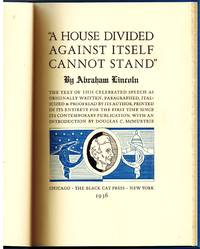
1936réf. 010649Chicago: The Black Cat Press 1936. Book. Near Fine. Cloth. Limited Edition. 8vo - over 7¾ - 9¾" tall. Limited Edition. "140 copies of this volume have been printed from Linotype Garamond on Ivory Wove Normandy Vellum. Title Page Decoration by Calvin Brazelton. Designed by N.W. F. Norman W. Forgue ." Blue cloth covered boards with gilt design to front and gilt lettering to the spine. Near Fine. Slight rubbing at spine end and tips. Slight toning to front paste down and end paper. " The text of this celebrated speech as originally written paragraphed italicized & proofreadby its author printed in its entirety for the first time since its contemporary publication." Norman W. Forgue was an American bookmaker typographer and founder of several private presses including At the Sign of the Gargoyle The Black Cat Press The Norman Press and Normandie House. The Black Cat Press Hardcover
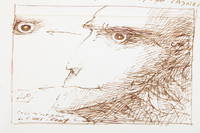
2002réf. 87842Lagnes: S. n. 2002. Fine. S. n. Lagnes 12 Avril 2002 23 x 16 cm une feuille Manuscript envelope by Louis Pons addressed to his friend art critic Georges Raillard specialist in the works of Joan Miro and Antoni Tapies on the verso of which he created an original drawing signed with his initials and bearing this humorous note: ""Ceci n'est pas de l'art brut."" The envelope reimagined by Louis Pons in his whimsical manner features below his personal address in Vaucluse a human face staring at an eye. S. n. unknown
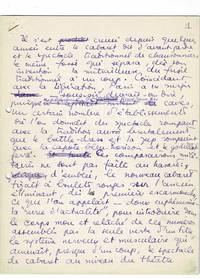
1953réf. 76377Paris: s. n. 1953. Fine. s. n. Paris s. d. ca 1953 21 x 27 cm 11 feuillets rédigés au recto Manuscript partly unpublished of an article on cabaret nine pages plus two additional pages written in purple ink on perforated squared paper sheets. Numerous deletions and corrections as well as several additions. The sheets are numbered in the upper right margin from 1 to 9 then 12 and 13. The first nine sheets of this text which was never published during Boris Vian's lifetime were transcribed in Les Vies posthumes de Boris Vian by Michel Fauré 1975. The text was erroneously dated 1948 by Fauré: the mention of Samuel Beckett's En attendant Godot whose premiere took place in 1953 makes this dating impossible. An interesting text evoking cabarets and the ""troglodytes"" a fine echo to the famous Manuel de Saint-Germain-des-Prés 1951: ""Let us give back to Saint-Germain-des-Prés what rightfully belongs to it: besides a certain tonnage provided to journalists short of copy this much-decried district - by those who precisely only knew it in its journalistic aspect - is at the origin of the profound transformation of cabaret. Yes there was indeed a reason why intelligent people like Sartre Prévert Camus Merleau-Ponty etc. in short all those who today count in literature or the arts followed with such attention the great movement of the cellars despite the turbulence of the troglodytes and the incongruity of the photographer monkeys despite the muddled activity of a generation of illiterate and boorish journalists despite the vacant curiosity of the gawker and the bitter resentment of the chamber pot emptiers of rue Dauphine."" After briefly evoking jazz a subject on which he is usually dithyrambic Boris Vian devotes the greater part of his text to theater: ""Jazz on one side carved out with great trumpet blows a place in the shade on the engine room side; that is its true environment: a smoky cellar a back room a dark laboratory where the faithful gather. . The musicians finally relaxed. But for their part the actors did not remain inactive."" Visionary Vian senses ""in the air a scent of renewal"" understanding the importance that cabaret theater would assume in the years to come. Two sheets not transcribed in Fauré's work evoke the theatrical avant-garde of the early 1950s: ""And it is no accident if En attendant Godot Samuel Beckett's astonishing play is a clown entrance that lasts two hours deals with nothing in particular poses all problems wrests laughter at the moment when one should be terrified . And it is no accident if the principal interpreter of Beckett's work this pillar of avant-garde theater is a cabaret veteran."" s. n. unknown
1885réf. 83957s. l. Paris 1885. Fine. s. l. Paris 12 juin 1885 11 x 16.90 cm 2 pages 1/2 sur un bifeuillet Autograph letter signed by Louise Michel addressed to Lucien Barrois; two and a half pages written in black ink on a white paper bifolium with black border. Transverse folds inherent to postal delivery. Louise Michel requests help for one of her acquaintances: ""Madame Maron à qui Lafont ou Clémenceau avait fait avoir promesse à la mairie d'un terme de son loyer elle en doit trois n'a plus entendu parler de rien et il faut qu'elle déménage pour aller en face où elle paiera moins. Sa propriétaire l'aurait attendue avec un terme payé sur les trois. Il faut enfin que ce soit vous qui rappeliez cette pauvre femme qui a rendu tant de services."" ""Madam Maron for whom Lafont or Clémenceau had secured a promise from the town hall for one term of her rent she owes three has heard nothing more and must move across the street where she will pay less. Her landlady would have waited for her with one term paid out of the three. You must finally be the one to remind them of this poor woman who has rendered so many services."" Moving letter testimony to the unwavering devotion of the former Communard. unknown
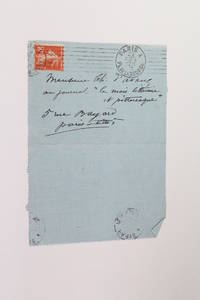
1911réf. 719101911. Fine. 21 avril 1911 11.10 x 15.10 cm Un feuillet Autograph letter signed by the painter George Desvallières to the director of ""Le Mois littéraire et pittoresque"" requesting authorization for the reproduction of a painting. One leaf. unknown
1948réf. 871601948. Fine. ""Pour moi l'amitié des assasins n'est pas l'amitié . tant pis si l'on me juge esclave et qu'on me juge sans coeur !"" For me the friendship of assassins is not friendship . too bad if I am judged a slave and judged heartless! s. d. 1948 21 x 30 cm 8 pages et demi sur 9 feuillets Exceptional autograph manuscript by Louis Aragon entitled ""Chronique de la pluie et du beau temps pour Europe mai"". 8 and a half pages in blue ink on 9 uniformly browned leaves. Numerous deletions and rewritings. Published in Europe no 29 May 1948 and does not appear in the book collecting these chronicles E.F.R. 1979. Superb nine-page militant profession of faith published in the anti-fascist literary review Europe. Aragon finds himself courted after the war in the name of ""friendship"" and ""freedom"" by various reviews but categorically refuses to publish alongside writers with Pétainist tendencies. The writer delivers his impressions after a radio interview in Belgium and meditates on ""two abstract monsters: freedom and friendship"" perverted at will in this early Cold War period when Sovietism becomes - to his great dismay - the new fascism. Very attached to the unified discourse advocated by communism which he calls ""national truth"" this notion serves as the guiding thread of his chronicle. Aragon writes in the midst of the Kravchenko affair and remains convinced by Sovietism which remains for him the great victor over Nazism. As a great literary witness to the suffering endured during the Occupation he is alarmed by the editorial choices of reviews seeking to obtain contributions from him: one shamelessly publishes a text by Montherlant totally oblivious to the Parisian martyrs during the war while the other affectionately justifies the allegiances of many French people to Marshal Pétain. It is also the occasion for a long and beautiful analysis of the idea of nation by Aragon who is unquestionably the national poet of this century. We find there in his inspired tirades the Aragonian ideal of healthy emulation among nations turned toward progress. Beautiful pages by Aragon in the midst of the crystallization of the Eastern and Western blocs. Aragon's ambition is to honor the memory of the Resistance by choosing to ""trust words when they are used for peace"". ""La Nation qui me paraît aujourd'hui encore être le groupe le plus étendu qui puisse se porter garant d'une vérité . la radio peut et doit transmettre à son public la vérité nationale . 'Qu'entendez-vous concrètement par vérité nationale ' Me demande-t-il comme il m'aurait sûrement demandé : qu'entendez-vous en disant qu'il fait grand jour en plein midi si je l'avais dit. C'est là le mécanisme des interviews. J'ai donc pris deux exemples concrets pour expliquer à quoi sert le maniement des abstractions. Deux cas récents où j'ai eu à me mesurer avec deux monstres abstraits : la liberté et l'amitié. La liberté d'abord. On sait comment les pires ennemis de la liberté font usage d'un livre qui s'appelle : J'ai choisi la liberté donnant le bénéfice d'un préjugé favorable de ce mot à tous ceux qui trahissent leur pays quand c'est pour choisir le système capitaliste . . Une revue qui s'édite à Montréal m'avait récemment écrit pour me demander ma collaboration. Son directeur littéraire faisait appel à l'homme libre l'italique est sienne que je suis. Cette façon de distinguer par la typographie en moi la possibilité d'être parfois un homme libre parfois non m'avait un peu inquiété. J'ai voulu voir sa revue . Mon Dieu le fait que ce numéro s'ouvre par un texte de M. de Montherlant me laisse libre de ne pas parler du contexte. On sait et j'imagine que M. Victor Barbeau de Montréal n'ignore pas que M. de Montherlant est sur la liste des écrivains avec lesquels les membres du Comité National des Ecrivains se refusent à collaborer. Ce qui doit sans doute m'expliquer pourquoi M. Barbeau s'adresse en moi à l'homme libre : c'est- unknown
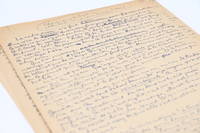
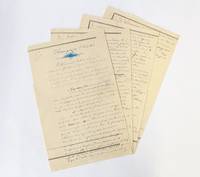
1890réf. 60481Paris 1890. Fine. Paris s. d. 1890 21.30 x 14 cm 3 pages in-8 au verso de 4 feuillets de l'Assistance publique de Paris VERLAINE Paul Complete autograph manuscript signed by Paul Verlaine of one of his Hospital Chronicles: We poets as well as they the workers our companions in misery Paris n. d. 1890 213 x 140 mm 8 3/8 x 5 1/2 3 pages in-8 at the back of 4 leaves of the Assistance publique de Paris Complete autograph manuscript signed by Paul Verlaine of one of his Hospital Chronicles 90 close lines in black ink on the verso of paper from the Assistance publique de Paris. The chronicle of one of Verlaines stays in hospital between September 1889 and February 1890. The note III has been crossed out in blue printers pencil. In the definitive collection this text is in fact second. In the version published by Le Chat noir on 5 July 1890 there appear to be no variations with the text of this manuscript. This is thus the final state of the text the one sent to the printer. Jacques Borel dates the writing of this chronicle to a hospital stay in Cochin in June 1890. Verlaine spent many days in hospital during his life especially in this period. During these stays he wrote Hospital Chronicles prose poems in eight parts. Here he mixed anecdotes observations of the lives of the patients and a delicate poetical analysis of the world of the hospital. Verlaine starts off with a troubling and tired observation: But certainly all the same the Hospital darkens despite the fine June weather.Yes the Hospital is dark despite philosophy insouciance and pride. Despite the fine weather the inflexibility of the system the misery and the sickness give the poet a gloomy take on things: let us punish all objections under pain of expulsion still severe even in this month of flowers and hay of warming days and clement nights if you have the devil at your back and debt and hunger at home. Discharge whether by way of being thrown out or getting cured and life outside did not offer more comfort than the stay itself: Clearly well all get out sooner or later more or less well more or less happy more or less sure of the future at any rate more or less alive. So we will think sadly.of our suffering emotional and otherwise of the doctors good or inhuman. This was a feeling he had already experienced during what he called my intervals the times when he was out of hospital. Life outside hospital was a miserable prospect despite his established fame. Verlaine compares his misery to that of the working classes who share his stays in various hospitals. The poet calls for resignation from his brothers artisans of one sort or another workers without a lifes-work and poets.and publishers too let us accept our fate let us drink up the cup of tea with barely any sugar or this little hot chocolate and let us be brave whether it be with our medicine or an enema or chewing tobacco. Let us follow their prescriptions closely let us obey all injunctions so that injections and colonics will seem sweet to us and let us reprimand all objections.. And along with them the poet wanted to take advantage of the beauties of June in quoting two verses from the Chanson sentimentale of Xavier Privas: We are pleased with ourselves in the strong sun. And under the green branches of the oaks we poets as well as they the workers our companions in misery.. Equal in the face of misfortune whether active or passive they might feel nostalgia once they were out: And perhaps some day we will miss these good times where you workers you could rest and where we we poets worked and where you artists earned your wine and your cups . Despite this reverie Verlaine was: tired of so much poverty provisionally believe me because I have been so used to it these last five years! and concludes bitterly with the observation of the lack of humanity in modern medicine: Hospital with a capital H an awful idea unknown
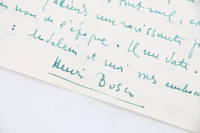
1965réf. 87843Nice: S. n. 1965. Fine. S. n. Nice 10 Février 1965 21 x 27 cm un feuillet recto-verso une enveloppe Autograph letter signed by Henri Bosco addressed to his friend and summer neighbor Georges Raillard 53 lines in green ink on a recto-verso sheet on letterhead from his Nice residence ""La maison rose"" Fold marks inherent to mailing envelope included. A discoloration stain in the right margin of the verso of the sheet affecting a few words. Henri Bosco congratulates his friend on emerging unharmed from his recent car accident and invites him to be more cautious: ""Il y a sûrement des grâces pour les usagers de l'imprudence. et aussi pour ceux du verglas. Si vous n'êtes pas imprudent - et j'en suis sûr - peut-être cependant ne pensez-vous pas au verglas. Il faut y penser. Faites-nous ce plaisir à nous qui vous aimons vous Alice Henri Edmond Florence. Cela fait cinq têtes."" There are surely graces for those who are imprudent and also for those dealing with ice. If you are not imprudent - and I am sure you are not - perhaps however you do not think about ice. One must think about it. Do us this favor we who love you - you Alice Henri Edmond Florence. That makes five heads. The author of Mas Théotime then recalls his troubles as a clumsy driver: ""Quant à moi qui en 1931 me fracassai et fracassai ma femme au sud de Burgos je me garderai bien de vous faire part de mes expériences routières. Après 36 ans e volant je ne pars jamais sans trembler un peu. Partir est un acte de foi. Rapide ou lent lucide ou somnolent orgueilleux ou modeste on n'est sûr de rien. Arriver est toujours un miracle."" As for me who in 1931 crashed and crashed my wife south of Burgos I will be careful not to share my road experiences with you. After 36 years at the wheel I never leave without trembling a little. Leaving is an act of faith. Fast or slow lucid or drowsy proud or modest one is sure of nothing. Arriving is always a miracle. Henri Bosco prefers to postpone the visit he had promised to make to his correspondent: ""Au lieu d'aller à Barcelone nous irons en Sicile. J'ai des droits à toucher en Italie pour mon ""Don Bosco"". Je les dissiperai dans ce pays."" Instead of going to Barcelona we will go to Sicily. I have rights to collect in Italy for my ""Don Bosco"". I will squander them in that country. and marvels at nature already reborn in this month of February: ""Les amandiers commencent à fleurir et chats et chiens s'exaltent. Il en résultera encore des chats et des chiens. Le nôtre qui reste à la chaîne il vaut mieux est tenu à l'écart de ces débauches. Cela n'améliore pas son caractère."" The almond trees are beginning to bloom and cats and dogs are getting excited. It will result in more cats and dogs. Ours who remains on a chain it's better is kept away from these debaucheries. This does not improve his character. He evokes his work as a writer: the publication of the new version of his Don Bosco: ""Mais moi je travaille ! Mon ""Don Bosco II"" est paru avec 100 très belles photos et un texte mine très édulcoré.Il m'a néanmoins coûté des sueurs et suis souvent dans de répréhensibles états de colère. Que Dieu me pardonne ! Je n'en avais pas à Don Bosco le pauvre ! mais à l'éditeur à la fois suisse germanique photographe et coupeur de cheveux en quatre. Il était hanté par le poil sur l'oeuf."" But me I work! My ""Don Bosco II"" has appeared with 100 very beautiful photos and a very watered-down text. It nonetheless cost me sweat and I am often in reprehensible states of anger. May God forgive me! I had none against Don Bosco the poor man! but against the publisher who is at once Swiss Germanic photographer and hair-splitter. He was haunted by finding fault with everything. and the writing of his memoirs: "". j'ai pu me remettre à la rédaction de mes souvenirs III que j'intitule ""Le jardin des Trinitaires"" Mais la mise en train parès tant de Suisse a été treès pénible d'autant que dès le début j'ai rencontré le diable et je m'en sui S. n. unknown
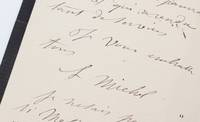
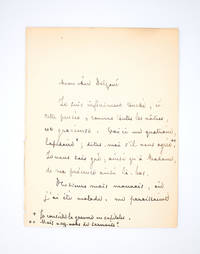
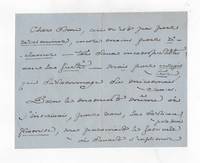
1892réf. 759251892. Fine. s. d. 15 avril 1892 12.60 x 16.40 cm 2 pages sur un double feuillet une carte et un calque Autograph letter signed by Stéphane Mallarmé to Alidor Delzant. Two pages written in black ink on a bifolium. Envelope enclosed. Also included is a signed autograph quatrain by Mallarmé on a card the one later inscribed on the mantelpiece: « Ici le feu pour renaître Tantôt durable ou charmant Comme l'amitié du maître Mêle du chêne au sarment. » Alidor Delzant was a lawyer collector and bibliophile. A friend of the Goncourt brothers he devoted a work to them and served as Edmonds secretary and executor. A fine letter in which Mallarmé evokes the composition of a quatrain to adorn Delzants mantelpiece: « Je suis infiniment touché et cette pensée comme toutes les vôtres est gracieuse. Voici un quatrain lapidaire je conseille la gravure en capitales; dites-moi s'il vous agrée. Mais usez-vous de sarments » Also included is the original tracing probably made by Mallarmé himself of the quatrain intended to decorate the lintel of Alidor Delzants library fireplace in his house at Paraÿs. Delzants reply to this letter is known: « Mon cher ami / Ces vers sont très beaux juste ce qui convenait pour glorifier la Cheminée de Paraÿs où les sarments pétillent autour des bûches des chênes. / Je demeure touché et reconnaissant. / Alidor Delzant. » unknown
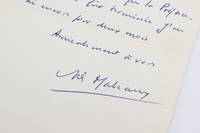
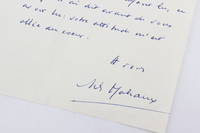
1954réf. 84014Boulogne-sur-Seine Boulogne-Billancourt: S. n. 1954. Fine. S. n. Boulogne-sur-Seine Boulogne-Billancourt 17 Mars 1954 13 x 21 cm une feuille une enveloppe Autograph letter dated and signed by André Malraux 14 lines in blue ballpoint pen from his Boulogne home on avenue Victor Hugo confirming a scheduled appointment. He thanks him for his ever-benevolent friendship: ""J'ai trouvé la Parisienne à mon retour. Je vous écris vous ayant lu ce que je vous ai dit avant de vous avoir lu : votre attitude m'est allée au coeur."" ""I found la Parisienne upon my return. I am writing to you having read you what I told you before having read you: your attitude touched my heart."" Fold mark from mailing envelope included. Resistance fighter participating in Combat André Parinaud is a journalist columnist art critic and writer. From 1959 to 1967 he held the position of editor-in-chief of the important weekly Arts bringing together the elite of French creation in all artistic fields: literature painting theater cinema. He would then conduct more than 1000 radio interviews with the greatest writers and artists including Salvador Dali Louis-Ferdinand Céline Colette Paul Léautaud André Breton Georges Simenon and André Malraux. While continuing to work at O.R.T.F. and radio he founded several festivals or artistic events such as Le Festival international du film d'art l'Académie nationale des arts de la rue. S. n. unknown
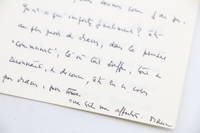
1969réf. 87858s. l.: S. n. 1969. Fine. S. n. s. l. 11 Décembre 1969 10 x 7.50 cm une feuille une enveloppe Autograph card dated and signed by Maurice Blanchot to his sister Marguerite 12 lines in black ink. Manuscript envelope included. ""Cher marg voici donc des paroles comme testamentaires accueille-les non comme venant de moi mais d'une recherche qui a par hasard et sans mérite ni démérite passée par moi qui m'y suis soumis comme j'ai pu qu'est-ce qui importe finalement être au plus près de chacun dans la pensée ""communiste"" là où tout souffre tout se reconnait se découvre être en ce coeur pour chacun pour tous. Avec toute mon affection. Maurice."" Dear Marg here then are words like testamentary ones receive them not as coming from me but from a search which has by chance and without merit or demerit passed through me who submitted to it as I could what matters finally to be as close as possible to each one in ""communist"" thought where everything suffers everything recognizes itself discovers itself to be in this heart for each one for all. With all my affection. Maurice. S. n. unknown
1911réf. 74273s. l.: S. n. 1911. Fine. S. n. s. l. 9 Juin 1911 13.50 x 21 cm quatre pages sur deux feuilles Remarkable autograph letter dated and signed by the dandy count four pages on two large sheets 16 lines written in black ink to his ""dear friend"" Henri Lapauze denouncing his failure to keep his word and provoking the poet's epistolary ire. Henry Lapauze was to celebrate Robert de Montesquiou in a tribute book regarding the latter and to his great chagrin he forgot him thus stinging his impulsive pride: "". it is not to recriminate even less to complain - both incompatible with pride - but to record what compensates for misunderstandings."" and additional affront to the dandy-poet's pride : "". you spoke. only of Lavedan !"" while double and supreme betrayal Robert de Montesquiou honored his promise by dedicating his latest work to him: ""At the very moment when I was inscribing for you the dedication promised by me I received the fascicle where the comments promised by you were to be expressed for the book that pays tribute to me."" The poet and writer Robert de Montesquiou would be very grateful to him: "". the poet and friend who both in one thank you affectionately in advance."" Henry Lapauze 1867-1925 was a journalist art critic then in 1905 curator of the Petit Palais converted four years earlier into a museum whose collections he considerably enriched by acquiring notably the Courbet Henner Falguière collections with at the twilight of his life a marked predilection for the Decorative Arts of which he was one of the ardent promoters. S. n. unknown
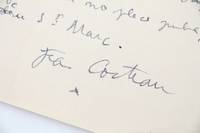
1946réf. 871451946. Fine. ""Ainsi les dieux grecs nous visitent encore et nous sentons autour de nous une tempête d'ailes un remous de merveilleux païen cette foule turbulente qui va de Zeus à Mercure et s'abat sur nos places publiques comme à Venise les pigeons de Saint-Marc"" Thus the Greek gods still visit us and we feel around us a storm of wings a stirring of pagan marvels this turbulent crowd that goes from Zeus to Mercury and swoops down on our public squares like the pigeons of Saint Mark's in Venice 1946 20.60 x 26.80 cm trois pages et une paperolle tapuscrite Autograph manuscript signed by Jean Cocteau entitled ""Le merveilleux païen"" 3 pages in black and blue ink on three leaves multiple rewritings and crossed-out passages. Accompanied by a typewritten bibliographical reference on paper. Pencil note by a previous bibliographer on the outer margin of the first leaf. Published in Plaisir de France no. 122 13th year December 1946 p. 18. Superb praise of ancient Greek culture and its theatrical pantheon of idols. Cocteau draws from his symbols to understand the modern world and compares Hollywood to the Olympus of old. Cocteau collaborates here in the issue of Plaisir de France devoted to ""Le Merveilleux dans l'Art et dans la Vie"" alongside Supervielle and Marcel Aymé. Fascinated from his beginnings by ancient mythology which floods his theatrical works Antigone Orphée La Machine Infernale. he writes a declaration of love to this blessed time when ""there existed a perpetual contact between human acts and their symbols"" when the marvellous was part of daily life. Numerous corrections mark the manuscript including the very title of the article which Cocteau had originally baptized ""L'Olympe"". Faithful to his mythological alter ego Orpheus who charms with his lyre and verses he will choose the shimmering tapestry ""Orphée et les Muses"" by Lucien Coutaud to illustrate this article. ""A cause du mécanisme moderne qui permet de reproduire le rare à d'innombrables exemplaires le rare se meurt et entre autres on fait du mot merveilleux un emploi abusif mot biffé. Le merveilleux cesse de l'être s'il se désingularise et l'on a une tendance à le confondre avec tout ce qui nous étonne encore : la radio la vitesse la bombe atomique. Or le merveilleux se trouve beaucoup plus en nous que dans les objets qui nous surprennent. Le véritable merveilleux c'est la faculté d'émerveillement qui s'émousse si vite chez l'homme. L'enfance le quitte. Il se blinde contre elle. Il juge il préjuge. Il repousse l'inconnu phrase biffée. S'il laisse agir en lui cette faculté atrophiée c'est pour fuir les fatigues qu'il s'impose. Il en use comme d'une drogue et se plonge pour quelques heures dans un livre ou dans un film. L'antiquité c'est l'enfance du monde. L'âge où l'enfance interroge et se meut dans un univers peuplé d'énigmes mot biffé. Les dieux grecs sont des oiseaux qui se posent sur leurs propres statues. Il y vivent à la mode des pigeons de nos squares. Il y observent les hommes qu'ils imitent ou qui agissent à leur exemple. Il existait donc un perpétuel contact entre les actes humains et leurs symboles qui se formaient tout de suite et devenaient des réalités. Deux mondes se superposent et se compénètrent. Phrase biffée Rien ne frappe en arrivant à Athènes comme cette familiarité d'une religion toujours pareille de siècle en siècle de peuple en peuple qui cette fois prenait un style de théâtre. Il fallait un décor où puissent jouer leurs drames et leurs comédies les acteurs aimés du public véritables vedettes de l'Olympe espèce d'Hollywood peuplé d'emplois divers de tragédiens de mimes de comiques et de belles filles plus ou moins mariées ensemble que la foule adore et auxquels on envoie des lettres et des cadeaux. Le moindre signe ""merveilleux"" du miracle grec relève d'un réalisme et c'est ce qui lui vaut un contact rapide. Et de même que passage biffé les yeux morts de la tête de Méduse unknown
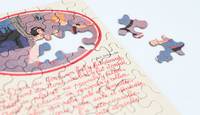
1925réf. 87657Paris: Galeries Lafayette 1925. Fine. Galeries Lafayette Paris s.d. ca 1925 12 x 17 cm environ 45 pièces cartonnées sous enveloppe de papier cristal First edition of this rare and fragile promotional item for the Galeries Lafayette consisting of 47 cardboard pieces with an illustration in medallion drawn by Jack Roberts and a children's song of eight verses. A handsome copy complete with its original printed crystal paper envelope. Â Galeries Lafayette unknown