Bela BartokBiblio.com

288 résultats
1937réf. 3111Basel 1937. Fine condition. 2 p. unknown
1925réf. 7699Berlin und Leipzig: Walter de Gruyter 1925. Cm. 255 pp. 2 236 pp. 88 di partiture in fine. Solida ed elegante legatura posteriore in mezza pergamena con piccole punte e titoli in oro al dorso. Piatto della bross. orig. conservato. Ottima conservazione parz. a fogli chiusi. Edizione originale in lingua tedesca fu pubblicato a Budapest nel 1924. Il sottotitolo recita: Tentativo di una "sistematizzazione" delle melodie contadine ungheresi. Walter de Gruyter unknown
réf. DADAX0673360563Brand: GoodYear Books 0000-00-00. paperback. New. 8.25x0.25x11.00. Buy with confidence. Excellent Customer Service & Return policy. Brand: GoodYear Books paperback
réf. 2202Undated signed thank-you card to unknown addressee. Undated signed thank-you card to unknown addressee. 90 × 56 mm. Béla Bartók’s signed thank-you card. With the handwritten text “Szerencsekívánatát sokszor köszöni” Many thanks for the good luck wishes on one side and Bartók’s signature on the other. . unknown
1913réf. 3391Budapest 1913. Near fine condition. 1 p. Béla Balázs 1884-1949 writer poet actor film aesthete film director critic film school teacher. His volume Misteriya Mysteries was published in Nyugat in 1912. It contains the one-act plays The Castle of the Bluebearded Prince The Fairy and The Blood of the Holy Virgin. At the time of the publication of The Mysteries Béla Bartók's musical transcription of The Bluebeard's Castle was already complete but no one agreed to perform the opera claiming that it could not be performed. But Béla Balázs did not rest. As a result of his efforts with the help of the Nyugat the original prose version of Bluebeard's Castle and The Blood of the Holy Virgin was staged in the Budapest Orfeum in 1913. Lajos Gulácsy created the sets for the performance. Béla Bartók played the piano between the two one-act plays. unknown
1918réf. 3908Budapest: Globus 1918. First edition. In original paper. First edition. In original paper. 32 pp. First separate edition. In the publisher's printed blue paper wrappers. A few underlinings and a contemporary pencil note at the end. Corners bumped. Otherwise in very good condition. First separate edition of the libretto of Bartók's only opera apparently printed for its world premiere at the Royal Hungarian Opera House in Budapest on 24 May 1918. Balázs wrote A kékszakállú herceg vára in 1910 as a Symbolist mystery play based on the Bluebeard legend drawing on the tradition of Perrault and Maeterlinck as well as Hungarian folk-ballad forms. Bartók set the text to music in 1911 but the opera remained unperformed for seven years. Following the success of The Wooden Prince it was finally staged at the Royal Hungarian Opera House on 24 May 1918 conducted by Egisto Tango with Oszkár Kálmán as Bluebeard and Olga Haselbeck as Judith. The present edition printed by Globus in 1918 is the first separate edition of Balázs's text. Apparently produced in connection with the premiere it identifies the work explicitly as an opera and significantly names both Balázs and Bartók on the title-page documenting the text in the form in which Bartók's opera first reached the stage. Globus unknown
1927réf. 3108Davos 1927. Very good conditon. On the picture Béla Bartók and her wife Ditta Pásztory. unknown
réf. 39912The designs represent the characters Bluebeard Judith his current wife 2 and his 3 former wives. Sheet size 456 x 305 mm. Some minor light browning. In very good condition overall. "Bluebeard's Castle Hungarian: A kékszakállú herceg vára literally The Blue-Bearded Duke's Castle is a one-act Symbolist opera . to a Hungarian libretto by his friend and poet Béla Balázs. Based on the French folk legend or conte populaire as told by Charles Perrault it l. deploys just two singing characters: Bluebeard Kékszakállú and his newest wife Judith Judit; the two have just eloped and she is coming home to his castle for the first time." Wikipedia ". the one-act opera A Kékszakállú herceg vára 'Bluebeard's Castle' 1911 is however a masterful Hungarian emulation of the realism of Debussy's Pelléas et Mélisande. Written to an expressionistic libretto by Béla Balázs about the 'mystery of the soul' the action of Bluebeard's Castle is negligible involving just two singing protagonists Bluebeard and his new wife Judith who progress through the opening of the eponymous castle's seven doors drawn by the woman's curiosity. The opera's climactic turning-point comes at the fifth door to Bluebeard's kingdom after which Judith's jealousy becomes obsessive leading to her eventual entombment along with all Bluebeard's previous wives and eternal darkness. Bartók's work changed the course of Hungarian opera by successfully developing a fluid form of Hungarian declamation of Balázs's ballad-like text based largely upon the inflections of parlando rubato folksong." Malcolm Gillies in Grove Music Online Perdziola an internationally-recognized set and costume designer for theater opera and ballet has worked extensively throughout the United States at such venues as the Metropolitan Opera San Francisco Opera Santa Fe Opera Lyric Theatre of Chicago American Ballet Theater Shakespeare Theater in Washington Boston Ballet and Miami Ballet as well as for various Broadway productions. He has also worked internationally for productions at the Monte Carlo Opera the Niedersächsische Staatsorchester in Hannover the Garsington Opera in the United Kingdom the Finnish National Ballet the Saito Kinen Festival in Japan and the Sydney Opera House. The artist has received three Helen Hayes awards and a Helpmann award; he has also been nominated for numerous additional awards. unknown
réf. 39912The designs represent the characters Bluebeard Judith his current wife 2 and his 3 former wives. Sheet size 456 x 305 mm. Some minor light browning. In very good condition overall. "Bluebeard's Castle Hungarian: A kékszakállú herceg vára literally The Blue-Bearded Duke's Castle is a one-act Symbolist opera . to a Hungarian libretto by his friend and poet Béla Balázs. Based on the French folk legend or conte populaire as told by Charles Perrault it l. deploys just two singing characters: Bluebeard Kékszakállú and his newest wife Judith Judit; the two have just eloped and she is coming home to his castle for the first time." Wikipedia ". the one-act opera A Kékszakállú herceg vára 'Bluebeard's Castle' 1911 is however a masterful Hungarian emulation of the realism of Debussy's Pelléas et Mélisande. Written to an expressionistic libretto by Béla Balázs about the 'mystery of the soul' the action of Bluebeard's Castle is negligible involving just two singing protagonists Bluebeard and his new wife Judith who progress through the opening of the eponymous castle's seven doors drawn by the woman's curiosity. The opera's climactic turning-point comes at the fifth door to Bluebeard's kingdom after which Judith's jealousy becomes obsessive leading to her eventual entombment along with all Bluebeard's previous wives and eternal darkness. Bartók's work changed the course of Hungarian opera by successfully developing a fluid form of Hungarian declamation of Balázs's ballad-like text based largely upon the inflections of parlando rubato folksong." Malcolm Gillies in Grove Music Online Perdziola an internationally-recognized set and costume designer for theater opera and ballet has worked extensively throughout the United States at such venues as the Metropolitan Opera San Francisco Opera Santa Fe Opera Lyric Theatre of Chicago American Ballet Theater Shakespeare Theater in Washington Boston Ballet and Miami Ballet as well as for various Broadway productions. He has also worked internationally for productions at the Monte Carlo Opera the Niedersächsische Staatsorchester in Hannover the Garsington Opera in the United Kingdom the Finnish National Ballet the Saito Kinen Festival in Japan and the Sydney Opera House. The artist has received three Helen Hayes awards and a Helpmann award; he has also been nominated for numerous additional awards. unknown books
1995réf. 102368Gioiosa. New. 1995. Paperback. 888640302X . FREE UPGRADE to Courier/Priority Shipping Upon Request - IN STOCK AND IMMEDIATELY AVAILABLE FOR SHIPMENT - Flawless copy brand new pristine never opened -- Text in Italian. 407 pages. Catalogue Raisonne Catalog Raisonné Complete Works Catalogo Ragionato Catalogo delle Opere L'Opera Completa Raisonnee Gioiosa paperback
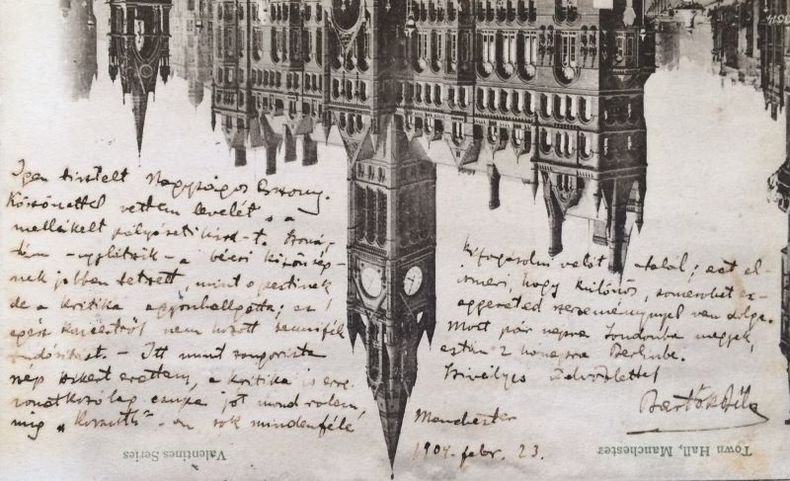
réf. 38Les débuts musicaux de Bartok.« Merci pour votre lettre et l’annonce jointe de la compétition. Il semble que ma sonate a été plus appréciée par le public à Vienne qu’à Pest. Cependant, il y a un grand silence de la part des critiques. Il n’y a eu absolument aucun compte-rendu du concert entier. Comme pianiste, j’ai eu un grand succès ici, et de cette façon je n’ai eu que des réponses positives des critiques. Alors qu’ils trouvent plein de défauts avec Kossuth, ils reconnaissent cependant qu’il s’agit d’une composition spéciale, quelque peu excessive. Je vais partir d’ici pour Londres où ke resterai quelques jours, puis j’irai à Berlin pour deux mois (…) ».
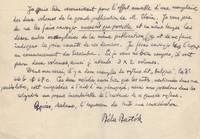
1934réf. 2245Budapest 1934. Bartok thanks to the recipient's earlier letter. He apologizes for the late reply but on the one hand he was very busy and on the other hand he wanted to wait for the publication of a study of folk music a copy of which he would send to Katzarova's boss Vasil Stoin with a German summary. He expresses his gratitude for the kind offering of an early work by Stoin. He mentions at the end of the letter that he also writes about Bulgarian rhythm in his latest essay. unknown
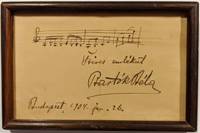
1904réf. 2018Budapest 1904. Handwritten note in ink signed in Budapest: 26 January 1904. Text reads “Szíves emlékül” “As a pleasant memory”. Folded once. In fine condition. Handwritten note in ink signed in Budapest: 26 January 1904. Text reads “Szíves emlékül” “As a pleasant memory”. Ca. 18.5 × 11.5 mm. A signed autograph score detail from Schumann’s Album für die Jugend Op. 68 No.12 Knecht Ruprecht by Béla Bartók. Around 1903–1904 Bartók gave numerous concerts sometimes at 3–4 different venues and countries per week where he often played Schumann’s compositions. Schumann’s work had a big influence on him in other ways as well: according to Suchoff Bartók found Schumann’s Album für die Jugend one of the few good material available for beginners. “From 1908 to 1909 he Bartók worked on a collection of eighty-five piano pieces titled For Children which were based on Hungarian and Slovakian folk music. In his lecture notes Bartók explains his purpose in composing this work: Already at the very beginning of my carrier as a composer I had the idea to write some easy works for piano students. This idea originated in my experience as a piano teacher; I had always the feeling that the available material especially for beginners has no real musical value with the exception of very few works—for instance Bach’s easiest pieces and Schumann’s Jugendalbum.” Suchoff 2004. Literature: Suchoff B. 2004: Bartók’s Mikrokosmos: Genesis Pedagogy and Style p. 13. Rowman & Littlefield. . unknown