HAYDN, Joseph 1732-1809Biblio.com
1 480 résultats
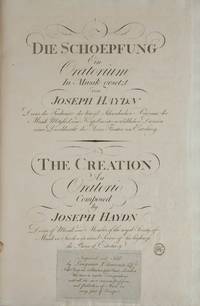
1800réf. 40127Vienna: The Composer 1800. Folio. Contemporary quarter dark tan mottled calf with ivory vellum-edged marbled boards titling gilt to spine. 1f. recto title verso blank 4ff. subscribers list 303 i blank pp. Text in German and English. Title and music engraved list of subscribers typeset. With Haydn's small circular monogrammatic handstamp "JH" to foot of title. Binding worn rubbed and bumped; minor loss to head and tail of spine. Occasional small stains and moderate browning; some signatures partially split at lower portion. In very good internal condition overall. First Edition. HWV Vol. II p. 36. Hirsch IV 799. Leipzig catalogue p. 19. Vecsey 303. Eitner V p. 66. BUC p. 456. RISM H2521. The Creation to a libretto by Gottfried von Swieten was first performed at the Palais Schwarzenberg in Vienna on 29 and 30 April 1798; its first public performance took place on 19 March of the following year at the Burghteater in Vienna. "There is hardly any doubt in the mind of the average music-lover that Haydn's Oratorio The Creation is tutto sommato his greatest single accomplishment and certainly ranks as one of the greatest products of any eighteenth-century mind. It occupies a central position in choral literature and its composition and first performances were the dominant features of Haydn's life in the late 1790s." Robbins Landon: Haydn Chronicle and Works Vol. IV: Haydn The Years of 'The Creation' 1796-1800 p. 12. Copies of the first edition of this monumental work containing the subscribers list are very scarce to the market. [The Composer] unknown
1800réf. 40127Vienna: The Composer 1800. Folio. Contemporary quarter dark tan mottled calf with ivory vellum-edged marbled boards titling gilt to spine. 1f. recto title verso blank 4ff. subscribers list 303 i blank pp. Text in German and English. Title and music engraved list of subscribers typeset. With Haydn's small circular monogrammatic handstamp "JH" to foot of title. Binding worn rubbed and bumped; minor loss to head and tail of spine. Occasional small stains and moderate browning; some signatures partially split at lower portion. In very good internal condition overall. First Edition. HWV Vol. II p. 36. Hirsch IV 799. Leipzig catalogue p. 19. Vecsey 303. Eitner V p. 66. BUC p. 456. RISM H2521. The Creation to a libretto by Gottfried von Swieten was first performed at the Palais Schwarzenberg in Vienna on 29 and 30 April 1798; its first public performance took place on 19 March of the following year at the Burghteater in Vienna. "There is hardly any doubt in the mind of the average music-lover that Haydn's Oratorio The Creation is tutto sommato his greatest single accomplishment and certainly ranks as one of the greatest products of any eighteenth-century mind. It occupies a central position in choral literature and its composition and first performances were the dominant features of Haydn's life in the late 1790s." Robbins Landon: Haydn Chronicle and Works Vol. IV: Haydn The Years of 'The Creation' 1796-1800 p. 12. Copies of the first edition of this monumental work containing the subscribers list are very scarce to the market. [The Composer] unknown books
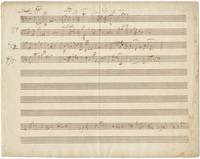
réf. 41685Large oblong quarto 241 x 309 mm. Notated in dark brown ink on the verso of the second leaf of a bifolium i.e. page 4 on 10-stave rastrum-ruled paper of British manufacture. Watermark dated 1794. Late spring or early summer 1795 see H.C. Robbins Landon: Haydn Chronicle and Works Volume III p. 495. With pencilled note in another hand to first page: "Haydn autograph notes of the 12 English Symphonies. Haydn misquotes the 2nd." Very slightly worn browned and soiled; minor foxing and very short splits to central fold; vertical crease to center of bifolium; lower edge with several miniscule tears. In addition to noting the musical incipits which comprise 25 measures spread out over 4 staves Haydn identifies the key time signature and year in which each symphony was first performed in noting the performance date of Symphony 97 however Haydn makes an error and cites 1791 instead of 1792. The sketch for the piano trio Hob. XV:25 is notated 5 staves below the symphonic incipits and consists of 9 measures of melodic material for the famous third movement. Provenance Leo Liepmannssohn auction catalogue Berlin 1907 lot 91. The Westley Manning Collection Sotheby's London 12 October 1954 lot 207. The London Symphonies were commissioned by the London impresario and violinist Johann Peter Salomon 1745-1815 and composed over the period 1791-95. Salomon was responsible for bringing Haydn to London where he became immensely popular largely through performances of his music at Salomon's concerts. "Haydn's London symphonies nos. 93-104 crown his career as a symphonic composer. Not only do they outdo the Paris symphonies stylistically but he produced them in person for rapturous audiences; this interaction stimulated him to ever bolder and more original conceptions. . The last six London symphonies are even more brilliant than the first six. . Haydn's determination to conquer new territory with each work is palpable." James Webster in Grove Music Online "The finale of Hob. XV:25 is the famous rondo "in the Gypsies Style." It seems that a composer's most popular works if not spurious are at least unusual manifestations of his style and this rondo fits this characterization. . Even though this finale was best known during the eighteenth century as a separate piece in many different settings its impact is best appreciated within the context of this keyboard trio cycle for the Andante and Poco Adagio the first and second movements hardly prepare one for its burst of energy." A. Peter Brown: Joseph Haydn's Keyboard Music Sources and Styles p. 377. ". the G major Trio 39 turned out to be Haydn's most popular piano piece because of the 'Gypsy Rondo' Finale. . It became an enormous favourite first in England and immediately afterwards on the Continent." Robbins Landon III pp. 431-432. A unique and interesting manuscript being a virtual catalogue of all the London Symphonies considered the crowning achievement of the composer's symphonic career and including music from the famous Gypsy Rondo some of Haydn's best music from his important London period. unknown
réf. 41685Large oblong quarto 241 x 309 mm. Notated in dark brown ink on the verso of the second leaf of a bifolium i.e. page 4 on 10-stave rastrum-ruled paper of British manufacture. Watermark dated 1794. Late spring or early summer 1795 see H.C. Robbins Landon: Haydn Chronicle and Works Volume III p. 495. With pencilled note in another hand to first page: "Haydn autograph notes of the 12 English Symphonies. Haydn misquotes the 2nd." Very slightly worn browned and soiled; minor foxing and very short splits to central fold; vertical crease to center of bifolium; lower edge with several miniscule tears. In addition to noting the musical incipits which comprise 25 measures spread out over 4 staves Haydn identifies the key time signature and year in which each symphony was first performed in noting the performance date of Symphony 97 however Haydn makes an error and cites 1791 instead of 1792. The sketch for the piano trio Hob. XV:25 is notated 5 staves below the symphonic incipits and consists of 9 measures of melodic material for the famous third movement. Provenance Leo Liepmannssohn auction catalogue Berlin 1907 lot 91. The Westley Manning Collection Sotheby's London 12 October 1954 lot 207. The London Symphonies were commissioned by the London impresario and violinist Johann Peter Salomon 1745-1815 and composed over the period 1791-95. Salomon was responsible for bringing Haydn to London where he became immensely popular largely through performances of his music at Salomon's concerts. "Haydn's London symphonies nos. 93-104 crown his career as a symphonic composer. Not only do they outdo the Paris symphonies stylistically but he produced them in person for rapturous audiences; this interaction stimulated him to ever bolder and more original conceptions. . The last six London symphonies are even more brilliant than the first six. . Haydn's determination to conquer new territory with each work is palpable." James Webster in Grove Music Online "The finale of Hob. XV:25 is the famous rondo "in the Gypsies Style." It seems that a composer's most popular works if not spurious are at least unusual manifestations of his style and this rondo fits this characterization. . Even though this finale was best known during the eighteenth century as a separate piece in many different settings its impact is best appreciated within the context of this keyboard trio cycle for the Andante and Poco Adagio the first and second movements hardly prepare one for its burst of energy." A. Peter Brown: Joseph Haydn's Keyboard Music Sources and Styles p. 377. ". the G major Trio 39 turned out to be Haydn's most popular piano piece because of the 'Gypsy Rondo' Finale. . It became an enormous favourite first in England and immediately afterwards on the Continent." Robbins Landon III pp. 431-432. A unique and interesting manuscript being a virtual catalogue of all the London Symphonies considered the crowning achievement of the composer's symphonic career and including music from the famous Gypsy Rondo some of Haydn's best music from his important London period. unknown books
1808réf. 95829London: Lavenu Cianchettini & Sperati 1808-1810. First editions of the first printings of the full orchestral scores of the complete symphonies of Beethoven Mozart and Hadyn. Quarto two volumes bound in three quarters morocco over marbled boards wit gilt titles and tooling to the spine including A Complete Collection of Haydn Mozart and Beethoven's Symphonies Cianchettini and Sperati and A Complete Collection of Mozart and Beethoven's Symphonies. A Compleat Collection of Haydn Mozart and Beethoven's Symphonies contains the first appearance of the full scores of Mozart's Overture to the Marriage of Figaro Mozart's Symphony no. 40 and no. 41. Fuld The Book of World-Famous Music 564-567. A Complete Collection of Mozart and Beethoven's Symphonies Lavenu contains the first appearance of the full scores of Mozart's Symphony no. 39 no 13 and no. 38. In very good condition with light toning to the text. An exceptional collection of the utmost rarity. 1786 saw the successful premiere of Mozart's The Marriage of Figaro in Vienna. Its reception in Prague later in the year was even warmer and this led to a second collaboration with Da Ponte: the opera Don Giovanni which premiered in October 1787 to acclaim in Prague but less success in Vienna in 1788. The two are among Mozart's most important works and are mainstays of the operatic repertoire today. In 1787 the young Ludwig van Beethoven spent several weeks in Vienna hoping to study with Mozart. No reliable records survive to indicate whether the two composers ever met. Beethoven would go on to become a crucial figure in the transition between the Classical and Romantic eras in classical music he remains one of the most recognized and influential of all composers with his best-known compositions including 9 symphonies; 5 piano concertos; 1 violin concerto; 32 piano sonatas; 16 string quartets; a mass the Missa solemnis; and an opera Fidelio. Lavenu, Cianchettini & Sperati hardcover