1 256 résultats
réf. 3952Brouillon de lettre concernant l'Allgemeiner Deutscher Musikverein, l'association musicale fonde par Franz Liszt en 1861 Weimar avec Franz Brendel pour incarner les idaux musicaux de la nouvelle cole allemande; Liszt le remercie pour lui avoir transmis le legs d'une gnreuse donatrice ...Madame de Muchanow en faveur de l'Allgemeine Deutsche Musik Verein et la Beethoven Stiftung [Fondation Beethoven]...J'aviserai l'emploi le plus conforme aux nobles intentions de l'illustre donatrice qui mrite au-del des plus brillants hommages qu'on tait heureux de lui rendre que nous rvrons de cSur : Prochainement le Comit qui a l'honneur de compter V. E. parmi ses membres Notre Musik Verein aura l'honneur de vous adresser ses plus reconnaissants remerciements et d'informer Votre Excellence de la rpartition des deux mille Thalers que je garde en dpt jusqu' mon retour Weimar ( au commencement d'aot) . Prochainement le Comit de notre Musik Verein aura l'honneur d'exprimer ses plus reconnaissants remerciements Votre Excellence et de l'informer de la rpartition des deux mille Thalers que je garde en dpt jusqu' mon retour Weimar, - au commencement d'avril... La comtesse Maria Kalergis-Muchanow (ne Nesselrode, 1822-1874), pianiste polonaise (elle reut des leons de Chopin) et mcne dart, entretint Paris un salon frquent par de nombreux artistes franais et europens, dont Chopin, Liszt, Rossini, Heine, Gautier, Musset... Amie de Cosima, la fille de Liszt, qui pousa Wagner, elle intervint pour que le compositeur allemand put faire jouer son opra Tannhaser Paris. Franz Liszt lui ddicaa plusieurs pices dont la Petite Valse Favorite et composa, son dcs en 1874, l'Elgie pour Piano N1. Maria Muchanow est l'origine de la cration de l'Institut de Musique Varsovie et de la Socit Musicale de Varsovie.En octobre 1842, Liszt avait t nomm Weimar Kapellmeister in auerordentlichen Diensten (matre de chapelle des services extraordinaires) par le grand-duc Charles-Frdric de Saxe-Weimar-Eisenach l'un des protecteurs de Richard Wagner et de Liszt. Le projet de lAllgemeiner Deutscher Musikverein naquit beaucoup plus tard, dans les annes 1860, de la tentative avorte de cration dune Fondation Goethe pour soutenir les arts. La tentative de Liszt fut un rel succs. Les statuts de la nouvelle association furent dposs en 1861. Au fil des ans lassociation devint le dpositaire de plusieurs fondations dont la Beethoven-Stiftung (Fondation Beethoven) en 1871, finance et enrichie par les dons, notamment du grand-duc Charles-Alexandre de Saxe-Weimar.
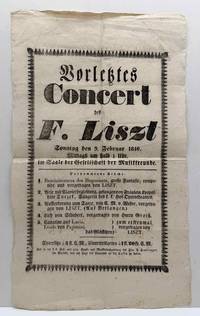
1840réf. 020628Vienna: T. Haslinger 1840. Print. Very good condition. Unbound. First Edition. Folio. Large broadside measuring 8 5/8" width by 14 9/16" height 219mm x 368mm. CONDITION: Untrimmed and unmounted with minor foxing minor soiling and several creases. A strong impression with the composer's name in large type 24mm - about 68 point font. Published at the genesis of the composer's "Lisztomania" period. The program marks the first time Liszt publicly performed his famous transcription of Paganini's "La Campanella" das Glockchen one of his most celebrated and difficult works. The GERMAN TEXT reads: Vorletztes Concert des F. Liszt. Sonntag den 9. Februar 1840 Mittags un halb 1 Uhr im Saale der Gesellschaft der Musikfreunde. Vorkommende Stucke: 1. Reminiscences des Huguenots grosse Fantasie componirt und vorgetragen von Liszt. 2. Arie mit Clavierbegleitung gesungen von Fraulein Leopoldine Tuczek Sangerin des k. k. Hof-Operntheaters. 3. Aufforderung zum Tanze von C. M. v. Weber vorgetragen von Liszt Auf Verlangen. 4. Lied von Schubert vorgetragen von Herrn Gross. 5. Cavatine aus Lucia zum erstenmal vorgetragen von Liszt. Etude von Paganini Das Glockchen. Sperrsitze a 3 fl. C. M. Eintrittskarten a 1 fl. 20 kr. C. M. sind in der k. k. Hof- und priv. Kunst- und Musikalienhandlung des Hrn .T. Haslinger am Graben und am Tage des Concertes an der Cassa zu haben. ENGLISH TRANSLATION: Penultimate Concert of F. Liszt. Sunday February 9 1840 at half past 1 in the Hall of the Gesellschaft der Musikfreunde. Pieces to be performed: 1. Reminiscences des Huguenots grand fantasy composed and performed by Liszt. 2. Aria with piano accompaniment sung by Miss Leopoldine Tuczek singer at the Imperial and Royal Court Opera Theater. 3. Invitation to the Dance by C. M. v. Weber performed by Liszt by request. 4. Song by Schubert performed by Mr. Groiss. 5. Cavatine from Lucia performed for the first time by Liszt. Etude by Paganini The Little Bell. Reserved seats at 3. fl C.M. Admission tickets at 1 fl. 20 kr. C.M. Are to be had in the Imperial and Royal Court and privileged Art and Music Shop of Mr. T. Tobias Haslinger on the Graben and on the day of the concert at the box office. T. Haslinger Paperback
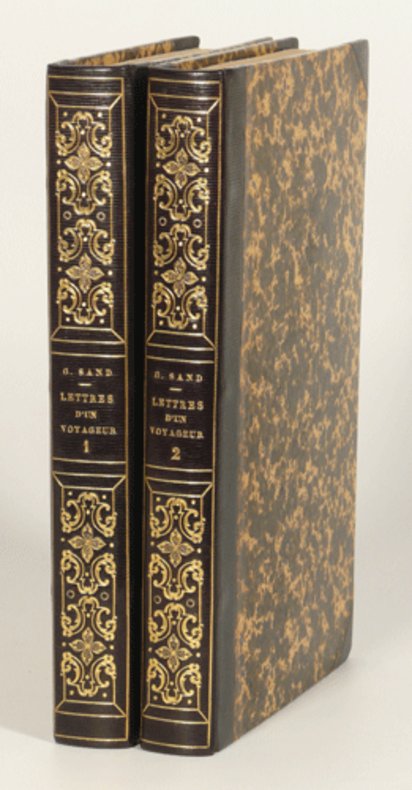
1837réf. 0030531837 Paris, Félix Bonnaire, 1837. Deux volumes in-8 (146 X 227 mm) demi-maroquin noir à grain long et à petits coins, dos lisse composé de deux grands compartiments entièrement ornés de fers dorés à décor rocaille et d'un petit compartiment central contenant auteur, titre et tomaison dorés, plats et dos (petits manques aux dos) de la couverture conservés (BERNASCONI). Tome I : faux-titre, titre, 422 pages ; Tome II : faux-titre, titre, 414 pages.
réf. 10637Used; Like New/Used; Like New. Original circular wooden canister possibly a piano wire case with inscription 'Cantemus Domino Dr. F. Liszt. XIX Aug. 1866' on the lid and '9 Juni 1867' on the inside of lid. Diameter 10 cm. Together with a small round token made of an ivory-like or fine bone material decorated with a miniature engraving and painting enhanced with sand and tiny clippings of grass depicting two angels and the letter 'L' interwoven with a cross. The token with a matching -sized round glass diameter 2.5 cm. On August 10th of the year 1866 the composer completed the 'Tristis est anima mea' from his oratorio 'Christus' composed 1862 - 1866 and it is conceivable that the text on top of the lid 'Cantemus Domino Dr. F. Liszt. XIX Aug. 1866' was carved to commemorate that occasion. We have been unable to locate any event letter or anything else specifically for August 19th of that year. The other date inscribed on the case June 9th of the following year was the day after the premiere of Liszt's 'Hungarian Coronation Mass' in Budapest. Following the 1867 Compromise between Austria and Hungary Liszt composed a festive Mass. Yet it took concerted action on the part of Hungarian musicians and public figures as well as the personal intervention of the Empress Elizabeth to have his "Hungarian Coronation" Mass performed instead of a work by a Viennese court composer at the coronation of the Austrian Emperor Franz Joseph and Empress Elizabeth as King and Queen of Hungary at the Church of Our Lady Matthias Church in Buda on 8 June 1867. The performers were from Vienna and Liszt was only present as a member of the audience in the gallery. It was only two years later that Liszt was able to conduct his Mass in Pest with Hungarian musicians and Ede Reményi was finally able to play the violin solos that had been intended for him from the start. unknown books
1860réf. 36281Leipzig 1860. Oblong folio approximately 234 x 320 mm. 19 measures. Notated in dark brown ink on 9-stave rastrum-drawn paper on the first page of a bifolium. With several corrections in Liszt's hand and the addition of numbering both above and within the staves referring to additional measures possibly being directions to a copyist. Pages 2 and 3 of the bifolium contain a manuscript copy of Felix Mendelssohn's Gondellied opus 19 number 6 entitled "Venetianisches Gondellied" at the head of the first page Page 4 is ruled but blank except for a short 1-1/2 measure sketch in pencil in an unknown hand. Moderate browning; somewhat creased and with some showthrough; small 7 mm tear to upper edge of first leaf; paperclip stain to upper corner of outer pages; minor remnants of mounting paper to final page. In quite good condition overall. The Liszt manuscript would appear to be an accompaniment to a song. The inclusion of the Mendelssohn copyist manuscript with the present Liszt autograph is quite interesting; it may in fact be in the hand of one of the copyists in Liszt's circle in Leipzig although this point will require further research. Liszt made arrangements of six of Mendelssohn's songs in the 1840s. We would like to thanks Drs. Rena Mueller David Cannata and Alan Walker for their advice regarding this manuscript. unknown books
2009réf. 12589AB2009. Leipzig 2009. 52 : 62 cm. Printed on hand made paper Portrait of Franz Liszt in heliography. Brilliant print from the old cooper-plates on hand-made paper. It shows the head of Franz Liszt surrounded by notes to his 'Rhapsodie Hongarien'. unknown