1250 risultati
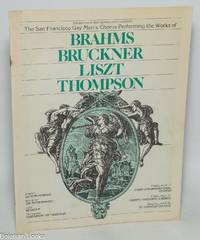
1981rif. 328689San Francisco: GGPA & SFGMC 1981. 20p. 8.25x10.75 inches local ads program notes staff very good program in stapled pictorial wraps. The Chorus formed in December 1978. GGPA & SFGMC unknown books
1866rif. 31560Paris: S. Richault PN 15383 R 1866. BERLIOZ Hector 1803-1869. Folio. Original publisher's light green printed wrappers. 1f. title 7 1 blank pp. Engraved. From the collection of pianist Mario Feninger 1923-2016 with his small handstamp to upper wrapper "Ex Mario Feninger de Rogatis Libris" and head of first page. Publisher's handstamp to foot of title. Wrappers detached. Somewhat worn and soiled; minor offsetting. First Edition co-published with Biedermann in Germany. LW A205. Searle 475. Raabe 142. LC Catalog 152. Liszt was a fervent champion of Berlioz while in Paris and transcribed a number of his works for piano. It was Berlioz who first introduced Liszt to Goethe's Faust. "A lucid and delicately laid-out scherzo of charming effect." Derek Watson: Liszt p. 201. S. Richault [PN 15383 R] unknown books
1904rif. 32061Mayence: Schott PN 13377.1 1904. Folio. Publisher's dark ivory illustrated wrappers printed in dark green. 1 title printed in green 2-9 i blank pp. 1f. advertisements. Musicseller's handstamp to blank lower margin of title. Slightly worn browned and soiled. A later edition. LW A159. Searle 160. Raabe 10/4. Number 4 from the first year of the "Années de Pèlerinage. Schott [PN 13377.1] unknown books
1840rif. 31569Braunschweig: G.M. Meyer PN 361 1840. SCHUBERT Franz 1797-1828. Folio. 1 title 2-19 1 blank pp. Engraved. Contents: - Erlkönig D 328 - Sei mir gegrüsst D 741 - Du bist die Ruh D 776 - Auf dem Wasser zu singen D 774 Musicseller's handstamp to foot of title. Slightly worn; very minor soiling offsetting and foxing throughout. An early edition. LW A42. Searle 558. Raabe 243. Liszt transcribed nearly 150 songs for solo piano including 44 of Schubert's Lieder. "His response to poetic imagery his conviction that purely musical images of poetic ideas are capable of projection to the listener and his belief that he could illustrate such imagery without words are keys to understanding Liszt's lifelong aesthetic. The musical image of the idea the true symphonic poem thus had its genesis in concept and form in Liszt's adoration of Schubert." Derek Watson: Liszt p. 214. G.M. Meyer [PN 361] unknown books
1875rif. 31570Wien: Ant. Diabelli und Comp. Friedrich Schreiber PN F.S. 6541 1875. SCHUBERT Franz 1797-1828. Folio. 1 title 2-7 1 blank pp. Engraved. Somewhat worn and browned; slightly foxed. Re-issue from first edition plates with "F.S." preceding the plate number with "Druck von A. Eckel in Wien" to lower left of first page of music. LW A42/11. Searle 558/11. Raabe 243/11. Liszt transcribed nearly 150 songs for solo piano including 44 of Schubert's Lieder. "His response to poetic imagery his conviction that purely musical images of poetic ideas are capable of projection to the listener and his belief that he could illustrate such imagery without words are keys to understanding Liszt's lifelong aesthetic. The musical image of the idea the true symphonic poem thus had its genesis in concept and form in Liszt's adoration of Schubert." Derek Watson: Liszt p. 214. Ant. Diabelli und Comp. [Friedrich Schreiber] [PN F.S. 6541] unknown books
1855rif. 31566Paris: Benoit ainé PN B. et C.ie 51871 1855. MEYERBEER Giacomo 1791-1864. Folio. 1f. title 29 1 blank pp. Engraved. Plate numbers and imprint of Brandus from their first edition of 1850. From the collection of pianist Mario Feninger 1923-2016 with his handstamp "Ex Mario Feninger de Rogatis Libris" to foot of title. Slightly worn and browned; occasional moderate offsetting; outer leaves partially detached and frayed and torn at edges; musicseller's handstamp to foot of title. First French Edition later issue with Benoit title page. LW A165/1. Searle 414/1. Raabe 223/1. Liszt made numerous transcriptions from the operas of Meyerbeer including L'Africaine Le Prophète Les Huguenots and Robert le diable. Benoit ainé [PN B. et C.ie 5187(1)] unknown books
1861rif. 31545Leipzig: C. F. Kahnt PN 787 1861. Folio. 1f. title within decorative shield engraving 3-11 1 blank pp. Engraved. Contents: 1. Vor der Schlacht; 2. Nicht gezagt; 2. Es rufet Gott uns mahnend. Musicseller's handstamp to foot of title. Spine reinforced with tape; slightly worn and browned; corners and edges frayed; dampstaining to right margin just touching music; title soiled; offsetting to caption titles. Second Edition with German titles. LW A207. Searle 511. Raabe 202. LC Catalog 164. Liszt's transcriptions of his three works for men's chorus S. 560/4-6 originally published in 1845. C. F. Kahnt [PN 787] unknown books
1930rif. 303424Leipzig Eulenburg ca. 1930. 1930. Small 8vo. Musical score. Introduction by Georg Munzer in German. Text of the Victor Hugo poem in French and German. 2 pages of publisher's advertisements at end. Contemporary 1/2 gilt stamped black morocco over white cloth upper cover with George Cukor's name stamped in gilt in lower right corner patterned endpapers. Very good. 120 pages 4 pages of acvertisements at end. Musical score: Eulenburg Edition No. 52. Signed and inscribed on third preliminary page to director George Cukor by composer/conductor Daniele Amfitheatrof: "For George Cukor as a remembrance of the exciting work on 'Heller With a Gun' With admiration Daniele Amfitheatrof 1959" Amfitheatrof scored the music for the 1960 Paramount film based on Louis L'Amour's novel and directed by Cukor which was released under the title "Heller in Pink Tights." Amfitheatrof 1901-1983 born October 29 1901; died June 4 1983; Russian-born composer/conductor emigrated to the United States in 1937 and conducted in Boston and Minneapolis; signed by MGM in 1939 but waited until 1943 for his first Hollywood film score "Lassie Come Home"; worked on over 130 films. From the library of noted "Gone With The Wind" Hollywood director George Cukor with his Paul Landacre bookplate on the front pastedown. Hardcover. Very Good/No Jacket. Leipzig, Eulenburg [ca. 1930]. hardcover books
2011br. Figura controversa, a fronte di un'indiscussa fama come eccezionale virtuoso del pianoforte, per il suo talento compositivo Franz Liszt manca ancora oggi di una definitiva collocazione nella storia della musica. Michele Campanella, fra gli interpreti lisztiani più noti a livello internazionale, ne delinea un ritratto complesso e "vissuto', che parte dalla sua personale esperienza di concertista. Dall'esposizione del "caso" Liszt, attraverso un discorso metodologico sugli aspetti tecnici necessari a un'adeguata interpretazione dei testi, si sviluppa un percorso musicale che è anche un racconto biografico, sino alla definizione di una nuova immagine del compositore ungherese. Trionfante virtuoso e frequentatore dell'alta società, Liszt termina i suoi anni chiuso nella riservatezza dell'asceta e nella sperimentazione di nuovi linguaggi musicali. Una storia da riscoprire.
2015ill., br. La presenza a Firenze di Franz Liszt (Raiding/Doborján 1811 - Bayreuth 1886), il più celebre pianista dell'Ottocento e uno dei massimi compositori rivoluzionari del secolo, non poteva non lasciare un segno inconfondibile sulla musica della città; considerando soprattutto che l'artista ungherese vi frequentò gli ambiti culturali per un tempo singolarmente vasto: alcuni mesi tra il 1838 e il 1839; e poi, con regolare assiduità, dal 1864 fino all'anno della sua morte. Dai tempi di Heinrich Isaac, Liszt fu il primo grande compositore non italiano intensamente coinvolto nella vita artistica fiorentina, tramite la propria azione e quella dei suoi allievi.
2020br. "Lisztmania" la definì Heine e nessun paese europeo ne fu immune. E ancora oggi - nel mondo - Franz Liszt (Raiding 1811 - Bayreuth 1886) è ricordato più per quella fama di virtuoso del pianoforte che per la sua vasta produzione musicale. In questa biografia romanzata, ove non mancano temerarietà e ironia, e forse qualche abbaglio, si racconta l'intensa vita di Liszt usando i tempi verbali al passato e al presente, come se si passasse dal grandangolo al primo piano. Una vicenda umana e professionale in cui, in ogni dettaglio, si rivela la grande ammirazione per questo genio «dalla natura generosa che preferisce la follia alla mediocrità e sa che le musiche del cuore sono le uniche di cui l'intelligenza non si stanca mai».
2016ril. Del pianista Liszt si è parlato e si parla molto spesso, rilevandone le straordinarie doti, lo straordinario successo, la straordinaria invenzione del recital che ha arricchito e modificato il panorama della vita musicale, la straordinaria costellazione dei suoi allievi. Ma il Liszt pianista non è in realtà monolitico, come non lo è il compositore, la sua evoluzione fu molto profonda e lo portò di volta in volta su posizioni ideologiche e culturali che, pur nella fondamentale coerenza della loro successione, sono in contrasto l'una con l'altra. Dopo un breve capitolo introduttivo l'autore fissa e analizza in quattro tappe il cammino di Liszt: la fase Biedermeier, la fase rivoluzionaria, la fase illuministica, la fase visionaria. Mancando del tutto i documenti storici dell'arte sonora di Liszt non è possibile raggiungere alcun risultato critico accertabile e accertato e verificabile dal lettore. Ma l'insieme delle testimonianze storiche indirette permette di giungere all'ipotesi che Liszt sia stato il maggiore fra gli artisti che si sono dedicati alla tastiera del pianoforte e che la sua ideologia rivoluzionaria, attenuata da lui stesso e successivamente corretta o, per meglio dire, deviata dai suoi successori, presenti germi ancora vitali che potranno essere ripresi e sviluppati. In definitiva, la tesi di fondo del volume è che il pensiero di Liszt non appartenga solo alla storia ma anche all'attualità e che, in quanto tale, possa ridiventare operativo.
2015brossura
2011Mm 130x200 Collana: Tascabili Bompiani. Brossura editoriale di 268 pagine, tavole in bianco e nero fuori testo, numerosi cliches. Esemplare in ottimo stato. SPEDIZIONE IN 24 ORE DALLA CONFERMA DELL'ORDINE.
1974Mm 150x215 Saggi. Brossura editoriale di pagine XVIII-354 con tavole in bianco e nero e a colori fuori testo, sovraccoperta figurata con leggeri segni d'uso, a cura di Ivan Vojtech. Opera in buone/ottime condizioni. Spedizione entro 24 ore dalla conferma dell'ordine.
1961Mm 120x180 Brossura editoriale di pagine 191 con numerose illustrazioni in bianco e nero. Opera in buone condizioni. Spedizione in 24 ore dalla conferma dell'ordine.
Paris, Le Club Français du Livre, 1950. Un volume de format in 8° de 198 pp.; quelques illustrations et fac similés d'autographes. Reliure de l'éditeur en pleine toile ocre, décorée. Dos légèrement passé, sinon bel état. Peu courant.
1929IN FRANCESE
1961
1980leggerissime qusi impercettibili tracce di usura
1939ILLUSTRATO copertina e costola con danni
1941Gallimard 1941, In-8 broché, 314 pages. Bon état.
1967303 S. Gr. 8°. Abb. auf Tafeln. OKart gering fleckig.
1969Partitur. 66 S. 4°. OKart. Namenszug auf Umschlag.
1927245 S. 8°. HLn. Notenbeisp.


