Liszt -- Sonata in B Minor Alfred Masterwork Edition
2011réf. Q-0739073230Alfred Music 2011-05-01. Paperback. New. In shrink wrap. Looks like an interesting title! Alfred Music paperback

GridFreed LLC · États-Unis105,52 $US≈ 94,27 €
1 249 résultats
1995réf. Q-0739033093Alfred Music 1995-07-01. Paperback. New. New. In shrink wrap. Looks like an interesting title! Alfred Music paperback
2011réf. Q-0739073230Alfred Music 2011-05-01. Paperback. New. In shrink wrap. Looks like an interesting title! Alfred Music paperback
1985réf. Q-0769240208Alfred Music 1985-03-01. Paperback. New. In shrink wrap. Looks like an interesting title! Alfred Music paperback
1986réf. Q-079350502XG. Schirmer 1986-11-01. Paperback. New. In shrink wrap. Looks like an interesting title! G. Schirmer paperback
1998réf. Q-0963976311Greenery Press 1998-12-01. Paperback. New. In shrink wrap. Looks like an interesting title! Greenery Press paperback
1986réf. Q-0793545331GS LIBRARY 5 1986-11-01. Paperback. New. In shrink wrap. Looks like an interesting title! GS LIBRARY 5 paperback
1986réf. Q-1423465997G. Schirmer Inc 1986-11-01. Paperback. New. In shrink wrap. Looks like an interesting title! G. Schirmer, Inc paperback
réf. 5243596Short description: In Russian. Liszt, Franz von. The Challenges of Criminal Policy by K.L. Pentkovsk. You are welcome to reach out to us for a detailed description of the copies currently available. Delivery of this book may take longer than usual including extended processing and pre-shipping time, no expedited shipping is available. Please advise us if you have a set date or a deadline to receive your order.SKU5243596
réf. 6317086Short description: In Russian. Liszt, Franz. Selected Articles. Moscow: Muzgiz, 1959. You are welcome to reach out to us for a detailed description of the copies currently available. Delivery of this book may take longer than usual including extended processing and pre-shipping time, no expedited shipping is available. Please advise us if you have a set date or a deadline to receive your order.SKU6317086
réf. 45168617like new. unknown
réf. 0483592757.Gpaperback. Good. Access codes and supplements are not guaranteed with used items. May be an ex-library book. paperback
réf. 45354284like new. unknown
réf. 0282085637.Gpaperback. Good. Access codes and supplements are not guaranteed with used items. May be an ex-library book. paperback
réf. 0259609145.Gpaperback. Good. Access codes and supplements are not guaranteed with used items. May be an ex-library book. paperback
réf. 0260998966.Ghardcover. Good. Access codes and supplements are not guaranteed with used items. May be an ex-library book. hardcover
réf. 0266881068.Ghardcover. Good. Access codes and supplements are not guaranteed with used items. May be an ex-library book. hardcover
réf. 0265678439.Gpaperback. Good. Access codes and supplements are not guaranteed with used items. May be an ex-library book. paperback
réf. 3952Brouillon de lettre concernant l'Allgemeiner Deutscher Musikverein, l'association musicale fonde par Franz Liszt en 1861 Weimar avec Franz Brendel pour incarner les idaux musicaux de la nouvelle cole allemande; Liszt le remercie pour lui avoir transmis le legs d'une gnreuse donatrice ...Madame de Muchanow en faveur de l'Allgemeine Deutsche Musik Verein et la Beethoven Stiftung [Fondation Beethoven]...J'aviserai l'emploi le plus conforme aux nobles intentions de l'illustre donatrice qui mrite au-del des plus brillants hommages qu'on tait heureux de lui rendre que nous rvrons de cSur : Prochainement le Comit qui a l'honneur de compter V. E. parmi ses membres Notre Musik Verein aura l'honneur de vous adresser ses plus reconnaissants remerciements et d'informer Votre Excellence de la rpartition des deux mille Thalers que je garde en dpt jusqu' mon retour Weimar ( au commencement d'aot) . Prochainement le Comit de notre Musik Verein aura l'honneur d'exprimer ses plus reconnaissants remerciements Votre Excellence et de l'informer de la rpartition des deux mille Thalers que je garde en dpt jusqu' mon retour Weimar, - au commencement d'avril... La comtesse Maria Kalergis-Muchanow (ne Nesselrode, 1822-1874), pianiste polonaise (elle reut des leons de Chopin) et mcne dart, entretint Paris un salon frquent par de nombreux artistes franais et europens, dont Chopin, Liszt, Rossini, Heine, Gautier, Musset... Amie de Cosima, la fille de Liszt, qui pousa Wagner, elle intervint pour que le compositeur allemand put faire jouer son opra Tannhaser Paris. Franz Liszt lui ddicaa plusieurs pices dont la Petite Valse Favorite et composa, son dcs en 1874, l'Elgie pour Piano N1. Maria Muchanow est l'origine de la cration de l'Institut de Musique Varsovie et de la Socit Musicale de Varsovie.En octobre 1842, Liszt avait t nomm Weimar Kapellmeister in auerordentlichen Diensten (matre de chapelle des services extraordinaires) par le grand-duc Charles-Frdric de Saxe-Weimar-Eisenach l'un des protecteurs de Richard Wagner et de Liszt. Le projet de lAllgemeiner Deutscher Musikverein naquit beaucoup plus tard, dans les annes 1860, de la tentative avorte de cration dune Fondation Goethe pour soutenir les arts. La tentative de Liszt fut un rel succs. Les statuts de la nouvelle association furent dposs en 1861. Au fil des ans lassociation devint le dpositaire de plusieurs fondations dont la Beethoven-Stiftung (Fondation Beethoven) en 1871, finance et enrichie par les dons, notamment du grand-duc Charles-Alexandre de Saxe-Weimar.
réf. 0656580976.Ghardcover. Good. Access codes and supplements are not guaranteed with used items. May be an ex-library book. hardcover
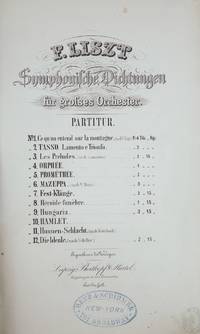
1874réf. 41065Leipzig: Breitkopf & Härtel PN 9056 1874. Octavo. Original publisher's dark ivory wrappers. 1f. recto title verso blank 1f. recto preface in German verso preface in French 1f. recto composer's note in German on performance practice verso same note in French dated "Weimar Mars 1856" 97 i blank pp. Title preface and note lithographed; music engraved. Small B & H stamp to lower outer corner of title. With publisher's catalogue to verso of lower wrapper. Wrappers slightly worn and soiled; spine lacking. Occasional small stains; dampstaining to lower outer corners of first leaves; one signature partiallky detached. Re-issue from first edition plates. Searle 97. Raabe 414. Sonneck p. 266. Liszt was a distinguished Hungarian composer pianist conductor and writer. "Sketchbook evidence points to 1846-7 as the years when Liszt began to conceive the idea of a series of programmatic orchestral works. Of the four works he named all based on French poetry Ce qu'on entend sur la montagne and Les Préludes eventually became symphonic poems. . Liszt's concentration on the symphonic poem largely coincided with his tenure as Kapellmeister in Weimar where he had an orchestra at his disposal and provided music for performances at the Court Theatre. The Grand Duke commissioned Liszt's 'overtures' to preface specific dramas which thereby determined the subject matter of what were to become a number of his symphonic poems. Cormac F2017 argues that Liszt's approach to the overtures and their transformation into symphonic poems was influenced by his experience of an array of dramatic media opera plays melodramas tableaux vivants and by his interaction with staff and actors involved in the dramatic productions in Weimar. A New German School acolyte Felix Draeseke writing about the symphonic poems in a series of essays from the late 1850s acknowledged the influence of dramatic music especially opera on Liszt's Festklänge. Draeseke also addressed the issue that continues to interest scholars - the symphonic poems' engagement with sonata form. . Looking at the 12 Weimar symphonic poems Vande Moortele . views all but three Orpheus Héroide funèbre and Hunnenschlacht as using sonata form as one of the central principles guiding their large-scale organization. Furthermore Liszt seems to have attempted the same merging of sonata form and sonata cycle evident in the B Minor Sonata in Tasso Les préludes and Die Ideale and possibly Ce qu'on entend sur la montagne. . Some of the symphonic poems include mimetic representation of scenes and actions such as Hunnenschlacht's depiction of a battle and Prometheus's evocation of a voice followed by a storm. The inclusion of such passages drew criticism that a number of the symphonic poems seemed formless and could not be understood without access to a programme. In other symphonic poems such as Les Préludes and Orpheus Liszt responded to a philosophical programme without compromising musical logic. In these cases critics recognized Liszt the 'tone poet' who could capture a poetic stimulus in an expressive evocative musical flow unified by a single theme that underwent transformations. In general Liszt's sumptuous orchestral colorings were the dominant focus of critics' positive reception of his symphonic poems and programme symphonies." Dolores Pesce Maria Eckhardt and Rena Charnin Mueller in Grove Music Online. Breitkopf & Härtel [PN 9056] unknown
1862réf. 41066Leipzig: Breitkopf & Härtel PN 9056 1862. Octavo. Original publisher's blue printed wrappers. 1f. recto title verso blank 1f. recto composer's note on performance practice in German verso same note in French dated "Weimar Mars 1856" 1f. recto preface in German verso preface in French 97 iii blank pp. Title note and preface lithographed; music engraved. With publisher's catalogue to verso of lower wrapper. With Beer & Schirmer New York and Musik-Antiquariat Doblinger handstamps to upper wrapper; Beer and Schirmer and publisher's handstamp to title. Wrappers worn soiled chipped and torn; spine reinforced with paper tape with small pieces of same tape to verso of upper wrapper. Minor internal wear. First Edition later issue. Searle 97. Raabe 414. Sonneck Orchestral Music p. 266. Liszt was a distinguished Hungarian composer pianist conductor and writer. "Sketchbook evidence points to 1846-7 as the years when Liszt began to conceive the idea of a series of programmatic orchestral works. Of the four works he named all based on French poetry Ce qu'on entend sur la montagne and Les Préludes eventually became symphonic poems. . Liszt's concentration on the symphonic poem largely coincided with his tenure as Kapellmeister in Weimar where he had an orchestra at his disposal and provided music for performances at the Court Theatre. The Grand Duke commissioned Liszt's 'overtures' to preface specific dramas which thereby determined the subject matter of what were to become a number of his symphonic poems. Cormac F2017 argues that Liszt's approach to the overtures and their transformation into symphonic poems was influenced by his experience of an array of dramatic media opera plays melodramas tableaux vivants and by his interaction with staff and actors involved in the dramatic productions in Weimar. A New German School acolyte Felix Draeseke writing about the symphonic poems in a series of essays from the late 1850s acknowledged the influence of dramatic music especially opera on Liszt's Festklänge. Draeseke also addressed the issue that continues to interest scholars - the symphonic poems' engagement with sonata form. . Looking at the 12 Weimar symphonic poems Vande Moortele . views all but three Orpheus Héroide funèbre and Hunnenschlacht as using sonata form as one of the central principles guiding their large-scale organization. Furthermore Liszt seems to have attempted the same merging of sonata form and sonata cycle evident in the B Minor Sonata in Tasso Les préludes and Die Ideale and possibly Ce qu'on entend sur la montagne. . Some of the symphonic poems include mimetic representation of scenes and actions such as Hunnenschlacht's depiction of a battle and Prometheus's evocation of a voice followed by a storm. The inclusion of such passages drew criticism that a number of the symphonic poems seemed formless and could not be understood without access to a programme. In other symphonic poems such as Les Préludes and Orpheus Liszt responded to a philosophical programme without compromising musical logic. In these cases critics recognized Liszt the 'tone poet' who could capture a poetic stimulus in an expressive evocative musical flow unified by a single theme that underwent transformations. In general Liszt's sumptuous orchestral colorings were the dominant focus of critics' positive reception of his symphonic poems and programme symphonies." Dolores Pesce Maria Eckhardt and Rena Charnin Mueller in Grove Music Online. Breitkopf & Härtel [PN 9056] unknown
réf. 0331092689.Ghardcover. Good. Access codes and supplements are not guaranteed with used items. May be an ex-library book. hardcover
réf. 0331092948.Ghardcover. Good. Access codes and supplements are not guaranteed with used items. May be an ex-library book. hardcover
réf. 0331087111.Ghardcover. Good. Access codes and supplements are not guaranteed with used items. May be an ex-library book. hardcover
réf. 0331086778.Ghardcover. Good. Access codes and supplements are not guaranteed with used items. May be an ex-library book. hardcover