1.826 resultados
1960ref. 88992Leonards-on-Sea: by the Author 1960. First Limited Edition. One of a thousand numbered copies this is no. 184. Inscribed and signed by Elgar on limitation page dated March 1961. 12mo 19cm. Original russet cloth; gilt spine and cover titles; 1271pp; text illustrations including 14 tipped-in original photographic plates. Cloth a bit rubbed and faded; slightly over-opened at half-title page; a previous owner has inserted an additional plate by hand and the original invoice from bookseller Oscar Shapiro is tipped on to front endpaper. Overall a Very Good copy. by the Author unknown books
1964ref. 37252London: Spring Books 1964. Hardcover. Very Good. Folio. Boards. 37 vi pp. 323 photographic illustrations of rare and historic musical instruments and related items. In dustjacket. Spring Books hardcover books
1977ref. 38021Edinburgh: Lyndesay G. Langwill 1977. Hardcover. Very Good. Quarto. Full dark red cloth with titling gilt to spine. xvi 307 pp. With occasional illustrations. Binding slightly bumped; dustjacket worn. Lyndesay G. Langwill hardcover books
1970ref. 36969London: Hamlyn 1970. Hardcover. Very Good. Octavo. Boards. 157 pp. Illustrated with 70 plates in color. Hamlyn hardcover books
1984ref. 36938Genève: Minkoff 1984. Softcover. Fine. Small octavo. Wrappers. 52 pp. Facsimile of the edition published in Brussels in 1823. Minkoff unknown books
1961ref. 36958London: The Holland Press 1961. 3 volumes. Quarto. 357; 383; 160 ccxix pp. Illustrated. In dustjackets. A facsimile of the original edition published in 1876-1878. The Holland Press unknown books
1970ref. 34051London: Hamlyn 1970. Hardcover. Very Good. Octavo. Boards. 157 pp. Illustrated with 70 plates in color. Hamlyn hardcover books
1895ref. 47419Jena: Carl Zeiss 1895. First Edition. Large slim octavo 27cm.; publisher's brown cloth over blue textured paper upper cover lettered in gilt; 4122pp.; steel-engraved text illus. throughout. Boards a bit rubbed and slightly bowed small spot of glue residue at top fore-edge corner of upper cover original gilt quite dulled though Parisian distributor's gilt-lettered cancel still brilliant contemporary American ownership inscriptions to front endpapers. Overall Very Good internally fine. Quite an attractive and uncommon trade catalog issued by the still-extant microscope manufacturer. This issue not separately catalogued in OCLC COPAC or KVK as of January 2020. Carl Zeiss unknown books
1975ref. 32572Wien: Sammlungskatalog des Museums fur Volkerkunde 1975. Softcover. Very Good. Octavo. Wrappers. xvi 320 pp. plates. From the collection of musicologist Stanley Boorman. Sammlungskatalog des Museums fur Volkerkunde unknown books
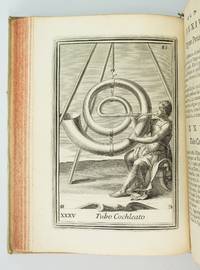
1722ref. ST21075Rome: Giorgio Plancho and Gettatore de' Caratteri 1722. FIRST EDITION. 250 x 180 mm. 9 7/8 x 7 1/4". 8 p.l. 170 pp. Contemporary stiff vellum raised bands burgundy morocco label lettered in gilt all edges sprinkled. Engraved title page frontispiece and 151 PLATES DEPICTING MUSICAL INSTRUMENTS. Front pastedown with bookplates of John Smith Esquire Arthur & Charlotte Vershbow Cia Fornaroli and David R. Godine. Cicognara 1596 citing 148 plates; Brunet I 1086 citing 136 plates; Graesse I 480. A long thin red ruled line to upper cover a few small cuts at edge of front board O1 with insignificant hole trivial loss of text a few light stains isolated faint browning to plates but quite AN EXCELLENT COPY--the leaves extremely fresh and clean and the binding entirely sound and perfectly inoffensive. This is an excellent copy of a sumptuously illustrated Baroque compendium of musical instruments which has been owned by three eminent collectors. A student of Athanasias Kircher the Jesuit scholar Filippo Bonanni also Buonanni 1638-1723 produced works on wide-ranging subjects including anatomy shell-collecting and porcelain lacquer. "Gabinetto Armonico" attempts to catalogue all known musical instruments including a broad range of horns as well as other wind percussion stringed and keyboard instruments not infrequently exotic in appearance and operation from all regions including Florida and the world of Islam. Many of the instruments included here were held in the collection of the Jesuit Collegio Romano where Bonanni was teaching at the time he composed the book; other information was gleaned from various authors and ethnographical reports. The book is organized based on the use for which the music is intended e.g. for festivals funerals battle worship hunting and even navigation. The very attractive illustrations by Flemish-born painter and publisher Arnold van Westerhout 1651-1725 depict the instruments in the hands of their players in their native costumes and environs. While some of the depictions of the ancient and foreign musicians are fanciful the majority of these engravings provide genuine invaluable information on music and musical instruments up to the early 18th century. The musicians are as interesting as the instruments dressed in keeping with the original homeland of the instrument ranging from King David with his harp to fashionable rococo ladies at the keyboards of spinet and cimbalo. Our copy is from the library of Italian ballerina Cia Fornaroli 1888-1954 and her husband Walter Toscanini 1898-1971 a bookseller and choreographer. The couple whose distinguished careers were split between New York and Italy assembled a large collection of works documenting the history of dance in Italy from the Renaissance until the 20th century. The bulk of their library now resides in the Jerome Robbins Dance Division of the New York Public Library for the Performing Arts. Our next notable owners were Arthur 1922-2012 and Charlotte Vershbow 1924-2000 who together built a large collection of prints illuminated manuscripts and printed books. Their collection sold at Christie's New York in a series of four auctions in 2013 the present volume was lot 771. Most recently our copy belonged to American publisher David R. Godine who trained as a printer at Leonard Baskin's Gehenna Press before founding his own publishing firm in 1970. His interest in the art of the book led him to build an extensive library of early printed books with a particular focus on antiquarian illustrated works. Two portions of his collection sold for more than $950000 at Bonham's New York in May 2026. The book is not particularly rare at auction but copies in desirable condition even without the distinguished provenance seen here command substantial prices. Giorgio Plancho and Gettatore de' Caratteri unknown books
ref. 41691A detailed image of an intricate Baroque interior depicting a musical scene incorporating various musical instruments lutes cellos viols and violins a harp a harpsichord wind instruments etc. open books of music a female lutenist with putto birds and a stag with an exterior view visible through classical arches. 309 x 253 mm. Within highly decorative engraved border featuring floral motifs stylized acanthus leaves and columns. Engraved by Austrian printmaker Prenner after the painting by Flemish artist Jordaens in the Imperial Habsburg collection at the Stallburg Gallery in Vienna. With "Ioann Iordan Pinxit" below image with dimensions of original painting to left "Alt. Altitudo height 2.5 Lat. Latitudo width 4.1 unc." Slightly worn browned and soiled; minor creasing at central fold; trimmed to within platemark just touching border; brief manuscript annotations to verso. Henning: Zeugnisse alter Musik Graphik aus fünf Jahrhunderten plate no. 3. Included in Prenner's noted multi-volume work Theatrum Artis Pictoriae published 1728-1733 documenting masterworks in the collection of Holy Roman Emperor Charles VI. While other plates from the series are regularly offered for sale this particular plate is quite rare. unknown books
1906ref. SJ13530Berlin Chicago & New York . . . :: Leitz 1906. 1906. 8vo. 118 pp. Illus. index. Dark green gilt-stamped cloth. Near fine. Scarce illustrated catalogue of microscopes and related accessories. Leitz, 1906. hardcover books
1877ref. 19034Paris: Bureaux du Journal 1877 - 1885. First Edition. Contemporary half leather and marbled paper. Very good; some modest chafing; occasional marginal notes. 8vo I - 4 368 pp. 3 plates; II - 3 - 524 12 pp.5 plates; III - 4 3 - 548 2 pp. 11 plates; V - 3 - 516 pp. 22 plates; VI - 4 3 - 646 pp. 17 plates including a mounted full-page albumen print of Pelletan's 'Continental' microscope - a 'class A' instrument of his own design selling for 600 Francs; VII - 4 3 - 666 pp. 6 plates; IX - 4. 1 - 534 pp. 5 plates plate 1 not bound in - as with other located copies. The asterisk indicating confused numbering of the plates but all are present. A run of an important journal in its formative years. The contents pages read like a who's who of nineteenth century microscopists writing on all matter of observations equipment lenses improvements and observations e.g. vol. 9 contains a number of articles and illustrations on penicillin ferments. The text is illustrated throughout. Bureaux du Journal hardcover books
1747ref. 24065London: T Heath Mathematical Instrument-maker . 1747. First Edition. Full contemporary half leather. Very good; binding rubbed; some rumpling to the extreme fore-edge of the folded plates. 8vo xxiii 1 - errata 1 - 107 1 - blank pp. 6 plates and a folding frontispiece illustrating the contents of the case of instruments. An early book explaining the use of the cased instruments. The author also provides a notable if truncated history of mathematical instruments of all sorts and a handlist of published works on the subject from the 16th century. Uncommon. See Clifton p. 131 for Thomas Heath. T Heath, Mathematical Instrument-maker .... hardcover books
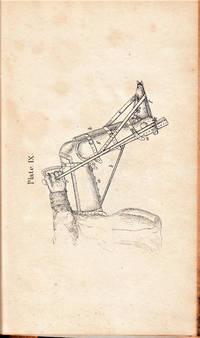
1827ref. 23078London: Printed for Thomas and George Underwood . 1827. First Edition. Contemporary three-quarter leather over binder's cloth. Very good; binding somewhat dry; two spots on the front cover. 8vo xvi 1 - 146 2 - adverts pp. 12 lithographic plates. A renown work for its introduction of new orthopedic devices for simple and complex cases. The book is an outline of the application of Amesbury's inventions and transcriptions of individual procedures from his case book. He also notes in the introduction that the various apparatus he refers to may be obtained at the shop of Mr Grafton in King Street Clifton Directory . p. 117 citing later dates and different addresses. Despite the evident hucksterism the treatise is of value for its awareness and treatment of orthopedic problems and collateral issues e.g. soft tissue trauma accompanying broken bones. In all an informed and remarkably adept treatise. Hirsch I p. 113. Printed for Thomas and George Underwood .... hardcover books
1905ref. 21058ca1920 / ca1905. Original manufacturer's fitted boxes. Near Fine. Two Planimeters in their original velvet and satin lined boxes. The Willis instrument retains its original 8 pp. instructional pamphlet. Planimeters are designed to find the area of a figure profiles plans sections indicator diagrams drawn to any scale on a plane surface by simple mechanical operation. The area is computed by tracing the outline of figure the maximum was a figure of 22 inches in diameter for this size instrument with the tracing point and reading out the result on a graduated measuring wheel; the scale on this device will read out to hundredths of a square inch. It is based on a design by the Swiss mathematician Jacob Amsler in 1856 who licensed it to Keuffel & Esser. The K & E instrument offered here has their catalog identification number 4211. The Willis design uses somewhat different construction and a novel readout design that purports to enhance accuracy because its tracing arm is able to move in a uniform "frictionless" precise manner without regard to the paper or surface quality. The readout can be changed to any of six scales provided with the mechanism. The last patent date cited is 1901 with an instrument serial number 5592. See Zoller Instruments and Methods . SIS Bulletin v. 75 2002 pp. 11-17. unknown books
1582ref. 13078Florence: G Marescotti 1582. First Edition. Modern linen over boards. Good with some erratic spotting and toning; backstrip wanting. Small 4to 53 1 - printer's device & privilege. The book is illustrated throughout. Lupicini was a military engineer who as early as 1552 had been involved in the sieges of Montalcino and Monticchiello. He also worked as a hydraulic engineer for the city of Venice. The book offered here is his explanation of a new astronomical staff devised by him. It could be used for various surveying problems or as a geometrical quadrant and cross-staff. The instrument also included a magnetic compass Breman and the text discusses its application to ballistics and cartography. This is the only printing of the treatise. Adams L-1723; Breman pp. 212 - 213; Riccardi II 59; H-L #2741; Sphaera Mundi #35. G Marescotti hardcover books
1890ref. 13043Various places: Various publishers ca 1890. First Editions. Original printed wrappers. There is some occ. chipping and separation of wrappers; otherwise very good. 8vo. All are illustrated. A superb group of late 19th century trade catalogs for German manufacturers of precision instruments for medical laboratories. In the instance of Petzold the firm was also known for its astronomical instruments. They are as follows: 1 W Petzhold - Instrumente und Apparate Physiologische Experimente und Vivisectionen Leipzig 1888 8vo. 20 pp. illustrated.; 2 E Zimmermann - Preis-Verzeichniss uber Apparate zu psychologischen u. physiologischen Experimenten Leipzig 1894 20 pp.; 3 O Moecke inhaber der firma O Hornn - Illustrietes Preis-Verzeichniss chirurgischer Instrumente . Leipzig 1888; 4 W Pfeffer - Ein neuer heizbarer Objecttisch . Leipzig 1890 18 pp. illustrated - WITH separately printed advertisements for the thermostat and object table in proof; 5 F Majer - Physiologische Apparate Leipzig 1888 illustrated - WITH an albumen print of the Hurthle kymographion and three sheets of autograph notes identified as 1897 in a clear hand describing same and its use and adjustment manufactured by Eugen Albrecht of Tubingen Universitats-Mechanikus. A rare group of German instrument makers catalogs. The Moecke has one holding in OCLC at Leipzig; everything else is unlocated. Various publishers unknown books
1834ref. 5227Philadelphia 1834. Not bound. Very good; some old folds. Folio sheet folded as 4 pp.; last page is a blank. The estate inventory of Benjamin Stancliff who was a maker of optical philosophical and mathematical instruments in Philadelphia from the late 18th to early 19th century. The inventory lists the tools supplies and instruments in his estate and what they sold for as well as an accounting for the total. Such inventories are exceptional and rare given the handful of people engaged in this trade. It offers a unique insight into the mode and manner of production and commerce in scientific instruments in colonial America. See Skerritt Catalog of the Charles E. Smart Collection .; NMAH web page for Stancliff in Wash. DC for citations and instruments. unknown books
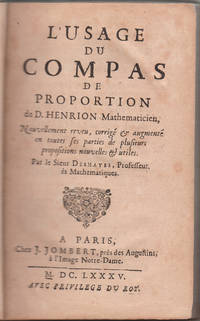
1685ref. 4661Paris: J Jombert 1685. Later Revised Edition. Full contemporary calf. Good; rebacked at an early date. 8vo 14 2 - blank leaf 16 290 12 - errata and index pp. an engraved title page and 2 folding plates of the instrument inscribed with Bion's name. It is also worth noting that the instruments illustrated on the plates are different more complex than those of the earlier printings of this book. Henrion's book first 1616 was an explanation of a simple calculating sector based on an original design by Galileo. Henrion took the idea from Gunter. The book offered here however offers a sophisticated device manufactured by Bion. The two plates accompanying the text bear the name of Bion who advertises the fact that the compass as well as other instruments were available through him at his shop on Quay de Horloge; it appears that he began to tout his instruments in the edition of 1681 where they first appear. One of the plates in the book was meant to be removed and serve as a pattern for manufacturing a simple version of the compass. The text consists of examples for various kinds of nautical engineering scientific and some metallurgical calculations. Some are quite complex and manifest a considerable level of skill in manipulating other scales than those scribed on to the limbs of the pattern instrument. Bion was clearly hoping to move his clientele toward purchasing an expensive version of the compass. Henrion's book was an ideal vehicle for advertising this instrument because of the popularity of the text. An interesting example of Bion's marketing strategies for the products of his workshop. DSB VI 271; see Drake on Galileo's sector for a discussion. J Jombert unknown books
1828ref. 1018London: R Taylor 1828. OFFPRINT. Original plain blue wrappers. Very good. 4to 2 - title page 257 - 289 paginated 1 - blank pp. 2 steel engraved plates. This a separately issued offprint retaining the original pagination. Kater was a member of the Royal Engineers. He devised and built a number of geodetic instruments for the accurate determination of the longitude and acceleration of gravity see Turner. But his most important contribution to scientific instrumentation is the device described in this offprint. The collimator permitted the alignment of a telescope attached to a circle in any position of the instrument with negligible error. See Lenzen & Multhauf on Kater's instruments. R Taylor unknown books
1912ref. 5142Munich: Deutschen Museums 1912. First Edition. Contemporary cloth. A fine copy. Folio. Frontispiece and 7 plates. Reichenbach was known as an inventor and designer of astronomical instruments and an engineer. He spent some time in England in the early 1790s where he met Boulton Watt and Ramsden. He returned to Germany and was commissioned an officer in the Bavarian army engineering corps. By 1805 he was engaged in the construction of high quality instruments at his own works in Munich where he employed Fraunhofer. This was the beginning of the modern era in German instrument making that resulted in devices of unprecedented power and precision. His workshops became national training centers. German technical excellence in the 19th century is a direct result of Reichenbach's intiative. The book offered here is a scientific biography that covers the development of his instrument designs and engineering projects e.g. his cast iron tube construction of bridges. A superb reference. DSB XI 354 - 355. Deutschen Museums hardcover books
1850ref. 1310Vienna: unk. 1850. First Edition. Later stiff boards. Fine. 8vo. There are 9 large fldg. litho. plates illus. details of the instruments. A very interesting pamphlet on the techniques of constructing self recording instruments. Jelinek was known for his work on the derivation and equations for the measurment of relative humidity see Napier-Shaw. Jelinek was convinced of the importance of consistent observations over long periods of time and felt that mechanical recording devices were the only way to obtain such information. The pamphlet offered here addresses these issues and suggests various ways in which it could be accomplished. unk., hardcover books
1881ref. 4809West Troy: A & A F Spitzli Publishers 1881. First Edition. Original publisher's decorated cloth. Near Fine. 8vo I - 182 2 1 - 70 2 - contents pp.; II - Frontispiece 3 - 5 6 - 118 12 - adverts pp. The text is illus. throughout. Two books bound as one but clearly meant to be issued together. The first book is an extremely useful encyclopaedia of all terms used in or related to the textile trade in the 19th century. There are detailed explanations of manufacturing terms types of cloth and material weaving design etc. Accompanying this is a separately paginated trade catalogue of instruments related to the sciences technical drawing instruments microscopy and items generally used in the design and manufacture of fabrics. It is a very unusual combination of goods. Absent from Romaine. A & A F Spitzli Publishers hardcover books
1768ref. 1017Paris: Arts et Metiers 1768. First Edition. Later 19th century bds. Very good; tide marks to corner of the last two plates; some dustiness; untrimmed. Folio 2 1 - 44 pp. 15 highly detailed copper engraved plates. This is a description of a ruling engine that would permit the consistent and accurate division of arcs. The duc de Chaulnes was constantly working on the development of this device throughout the 1760s. By 1768 he had perfected the first ruling engine 5 yrs. prior to Ramsden. The innovation of his design was the elimination of the part played by a skilled craftsman. By mechanical means de Chaulnes was able to produce consistent precise results. The book offered here includes the detailed plates of the device and also incorporates the design for his microscope to read the divisional increments. A major chapter in the history of the construction of accurate astronomical instruments. The work was originally part of the Description des Arts et Metiers v. 13. See Daumas for illustrations and a lengthy entry. Arts et Metiers unknown books