1 621 résultats
1967réf. RO20010401Semi-Méridan. 1967. In-8. Broché. Bon état, Couv. convenable, Dos satisfaisant, Intérieur frais. 10p environ, couverture légèrement passée.Illustré de photo de Polnareff.. . . . Classification Dewey : 784-Les instruments et leur musique
réf. 53242BBo.J. Udo Nolte, geboren 1950 in Dortmund.
réf. 53239BBo.J. Udo Nolte, geboren 1950 in Dortmund.
réf. 53241BBo.J. Udo Nolte, geboren 1950 in Dortmund.
réf. 92740A Paris, chez Durand, Neveu, Libraire, 1784, 3 volumes in-12 de 175x100 mm environ, T. I : xxiv-508 pages avec 13 planches hors-texte - T. II : 552 pages avec 23 planches hors-texte - T. III : 528 pages avec 20 planches hors-texte. Complet des 56 planches hors-texte. Plein veau marbré fauve, dos à nerfs portant titres et tomaisons dorés, filet doré sur les coupes, tranches rouges, gardes marbrées. 3 coiffes abimées, un accroc sur le dernier plat et le dos du tome I, quelques rousseurs, bordures de la planche 9 du tome II fendillées.
1965réf. R200137565musicales transatlantiques. 1965. In-8. Broché. Etat d'usage, Tâchée, Dos plié, Papier jauni. 157 pages, nombreuses partitions dans le texte, quelques photos et illustrations en noir et blanc hors texte - coins frottés.. . . . Classification Dewey : 784-Les instruments et leur musique
1879187pp., 20cm., imprimé sur papier de luxe, reliure toile rouge avec titre doré au dos et au premier plat, bon état, [contient e.a.: Catalogue du musée instrumental: Instruments européens, nos.166-279 (pp.93-183)], M81240
1880201pp., 20cm., br.orig., non coupé, bon état, [contient e.a.: Catalogue du musée instrumental: Instruments extra-européens, nos.280-406 (pp.101-132) & Instruments européens, nos.407-576], M81241
1886234pp.avec examples de partitions dans le texte, 20cm., imprimé sur papier de luxe, reliure toile rouge avec titre doré au dos et au premier plat, bon état, [contient e.a.: Catalogue du musée instrumental: Instruments extra-européens, nos.643-792 (pp.159-228) & instruments européens, nos.608-634 (pp.127-161) & Appareils divers, nos.635-642 (pp.162-168)], M81250
1881206pp.avec examples de partitions + 1 partition (6pp.), 20cm., imprimé sur papier de luxe, reliure toile rouge avec titre doré au dos et au premier plat, bon état, [contient e.a.: Catalogue du musée instrumental: Instruments extra-européens, nos.577-607 (pp.115-126) & instruments européens, nos.608-634 (pp.127-161) & Appareils divers, nos.635-642 (pp.162-168)], M81242
1890212pp.illustré de figures dans le texte, 20cm., non coupé, br.orig., bon état, [contient e.a.: Catalogue du musée instrumental: Instruments extra-européens, nos.793-878 (pp.153-211)], M81248
1879réf. M81240Bruxelles, Muquardt 1879 187pp., 20cm., imprimé sur papier de luxe, reliure toile rouge avec titre doré au dos et au premier plat, bon état, [contient e.a.: Catalogue du musée instrumental: Instruments européens, nos.166-279 (pp.93-183)], M81240
1880réf. M81241Bruxelles, Muquardt 1880 201pp., 20cm., br.orig., non coupé, bon état, [contient e.a.: Catalogue du musée instrumental: Instruments extra-européens, nos.280-406 (pp.101-132) & Instruments européens, nos.407-576], M81241
1881réf. M81242Bruxelles, Muquardt 1881 206pp.avec examples de partitions + 1 partition (6pp.), 20cm., imprimé sur papier de luxe, reliure toile rouge avec titre doré au dos et au premier plat, bon état, [contient e.a.: Catalogue du musée instrumental: Instruments extra-européens, nos.577-607 (pp.115-126) & instruments européens, nos.608-634 (pp.127-161) & Appareils divers, nos.635-642 (pp.162-168)], M81242
1890réf. M81248Gand/ Bruxelles, Ad.Hoste/ Muquardt 1890 212pp.illustré de figures dans le texte, 20cm., non coupé, br.orig., bon état, [contient e.a.: Catalogue du musée instrumental: Instruments extra-européens, nos.793-878 (pp.153-211)], M81248
1886réf. B81250Gand/ Bruxelles, Ad.Hoste/ Muquardt 1886 234pp.avec examples de partitions dans le texte, 20cm., imprimé sur papier de luxe, reliure toile rouge avec titre doré au dos et au premier plat, bon état, [contient e.a.: Catalogue du musée instrumental: Instruments extra-européens, nos.643-792 (pp.159-228) & instruments européens, nos.608-634 (pp.127-161) & Appareils divers, nos.635-642 (pp.162-168)], M81250
187421pp., 14cm., brochure originale, bilingue: français-néerlandais (tweetalig: Frans-Nederlands], texte frais, bon état, M108344
1954samen 333 fasc., per nr./12pp.sommige geïll. (samen +/- 4000pp.), wat roestplekken, stempeltjes
1985207pp.geïll.in kleur & zw/w., in oblong, [Tentoonstellingscatalogus Europalia 1985 Espana], VG
1985réf. M35541Brussel, Generale Bank 1985 207pp.geïll.in kleur & zw/w., in oblong, [Tentoonstellingscatalogus Europalia 1985 Espana], VG
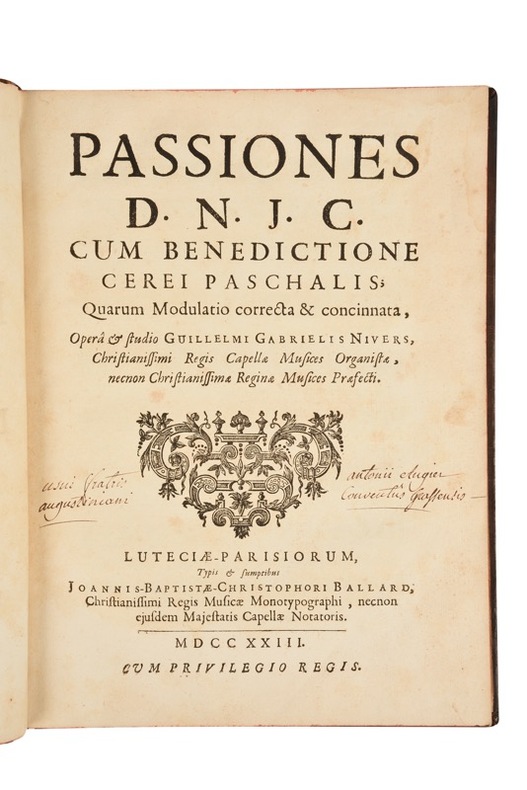
1723réf. 21655Paris, Jean-Baptiste-Christophe Ballard, 1723 ; relié ensuite, du même auteur : Lamentationes Jeremiae prophetae, quarum modulatio correcta et concinnata. (même éditeur et même date).Soit deux ouvrages reliés en un volume in-quarto, reliure de deuil en veau brun, fer des instruments de la Passion poussés à froid au centre des plats, fer à la tête de mort et tibias croisés poussés à froid dans les coins et sur les caissons du dos (reliure de l’époque) ; [4], 122 pp., [1] f. de Privilège ; [2] Titre et Privilège, 22 pp.
2017ABOUT THE BOOK:- Though we may never be able to comprehend human life, we know certainly that it is a movement of whatever nature it be. The existence of movement unavoidably implies a body which is being moved and a force which is moving it. Hence, wherever there is life, there is a mass moved by a force. All mass posses inertia, all force tends to persist. Owing to this universal property and condition, a body, be it at rest or in motion, tends to remain in the same state, and a force, manifesting itself anywhere and through whatever cause, produces an equivalent opposing force, and as an absolute necessity of this it follows that every movement in nature must be rhythmical. Man, however, is not an ordinary mass, consisting of spinning atoms and molecules and containing merely heat-energy. What is most wonderful of all, he is capable of increasing or diminishing his velocity of movement by the mysterious power he possesses by appropriating more or less energy from other substance, and turning it into motive energy. ABOUT THE AUTHOR:- Nikola Tesla (1856-1943) was a Serbian-American inventor, electrical engineer, physicist and futurist. Tesla's greatest invention is AC current powers almost all of the technological wonders in the world today, from home heating to computers to high-tech precision robotics. He went United States in 1884 to work for Thomas Edison in New York city. He soon struck out on his own with financial backers, setting Laboratories and companies to develop a range of electrical devices. Because of his eccentric personality and his seemingly unbelievable and sometimes bizarre claims about possible scientific and technological developments, Tesla was ultimately ostracized and regarded as a mad scientist by many late in his life. He became a naturalised U.S., citizen in 1891. The Title 'The Problem of Increasing Human Energy written/authored/edited by Nikola Tesla', published in the year 2017. The ISBN 9789351285564 is assigned to the Paperback version of this title. This book has total of pp. 54 (Pages). The publisher of this title is Kalpaz Publications. This Book is in English. The subject of this book is Science & Math / Experiments, Instruments & Measurement / Experiments & Projects. Size of the book is 13.34 x 21.59 cms Vol:-
2017ABOUT THE BOOK:- Though we may never be able to comprehend human life, we know certainly that it is a movement of whatever nature it be. The existence of movement unavoidably implies a body which is being moved and a force which is moving it. Hence, wherever there is life, there is a mass moved by a force. All mass posses inertia, all force tends to persist. Owing to this universal property and condition, a body, be it at rest or in motion, tends to remain in the same state, and a force, manifesting itself anywhere and through whatever cause, produces an equivalent opposing force, and as an absolute necessity of this it follows that every movement in nature must be rhythmical. Man, however, is not an ordinary mass, consisting of spinning atoms and molecules and containing merely heat-energy. What is most wonderful of all, he is capable of increasing or diminishing his velocity of movement by the mysterious power he possesses by appropriating more or less energy from other substance, and turning it into motive energy. ABOUT THE AUTHOR:- Nikola Tesla (1856-1943) was a Serbian-American inventor, electrical engineer, physicist and futurist. Tesla's greatest invention is AC current powers almost all of the technological wonders in the world today, from home heating to computers to high-tech precision robotics. He went United States in 1884 to work for Thomas Edison in New York city. He soon struck out on his own with financial backers, setting Laboratories and companies to develop a range of electrical devices. Because of his eccentric personality and his seemingly unbelievable and sometimes bizarre claims about possible scientific and technological developments, Tesla was ultimately ostracized and regarded as a mad scientist by many late in his life. He became a naturalised U.S., citizen in 1891. The Title 'The Problem of Increasing Human Energy written/authored/edited by Nikola Tesla', published in the year 2017. The ISBN 9789351285557 is assigned to the Hardcover version of this title. This book has total of pp. 54 (Pages). The publisher of this title is Kalpaz Publications. This Book is in English. The subject of this book is Science & Math / Experiments, Instruments & Measurement / Experiments & Projects. Size of the book is 14.34 x 22.59 cms Vol:-
1910réf. 10765611910. 16, 260 S. m. zahlr. Abb. im Text u. auf Taf. OPpbd (stärker beschabt u. bestoßen).
1897réf. 1509860Leipzig, C. Merseburger, 1897. Gr.-8vo. 8, 104 S. Neuer Lwdbd m. aufgez. OUmschl. (Deckentitel fälschlicherweise m. 4. statt 5. Aufl. bezeichnet, erste Lagen leicht gebräunt).