490 résultats
réf. 69288, Maison Bernard, 2026 Hardcover with dusjacket, 341 pages, Illustrated. full colors, 32x23cm, *New. ISBN 9789090406930.
réf. 8201 En feuillets, sous chemise imprimée à rabats de l'éditeur, quelques piqûres pâles sur la chemise. 20 x 14,5 cm, 111pp.-[4]-2f.b. + 4 planches h.-t. + suite en noir. Anvers, Editions Le Papegay, 1945.
réf. BN116207Sinful Souls Sinful Souls unknown
réf. 17848Paris, Jouaust, 1883. 2 vol.in-12, XV-306 pp. 6 pl. + 308 pp. 5 pl., demi-maroquin rouge de Becquet, double filet doré sur les plats, dos à nerfs orné de caissons et de fleurons dorés, tête dorée, couverture conservée (quelques minuscules frottements).
2000réf. 62162BBDourdan, Editions Vial, 2000. 4°. 31 x 22 cm. 144 Seiten, 6 Blatt. Gebundener Original-Pappband. [2 Warenabbildungen]
1798réf. 179971798 1798 PARIS CARLI sans date (731) IN FOLIO broche, en feuilles ,marges non rognes, 3 parties VIOLA titre+8p.,VIOLONCELLO:titre+8p., VIOLINO : titre +10p.(2 blanc) sous bandeau numero 27,[PN] 731,. [1798? ] rare edition originale gravée, bon etat,tache claire a une partie
1931réf. 51788London, William E. Hill & Sons, Violin-Makers 1931 In-4, bradel demi-vélin crème de l’éditeur, plat aux armes des Guarneri, dos lisse orné, étui, XXXVII-181 pp., 17 planches en couleurs sous serpente hors-texte, 44 planches en noir hors-texte, nombreuses illustrations dans le texte . Bel exemplaire.
1740réf. 11091Paris Le Clerc 1740 en ff. in-fol., titre, 21pp.,
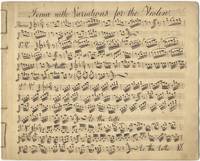
1830réf. 40871England 1830. Pierre Rode 1774-1830; Sir Henry Rowley Bishop 1786-1855; Adalbert Gyrowetz 1763-1850; Anon. Copyist musical manuscript. Oblong folio 245 x 305 mm. Sewn. Notated in black and brown ink on 14-stave rastrum-ruled paper. 10 pp. Contains five variation sets for violin by various composers: 1 Tema with Variations for the Violin. 3 pp. Nine variations on a waltz-like theme in F major. Following each variation the scribe indicates "tutti" or "to the tutti" indicating that these variations may have been performed with an ensemble of musicians. Unlocated. 2 Bishop Sir Henry Rowley 1786-1855 and Anon Variations from Home Sweet Home. 2 pp. Five variations on Rowley's well-known song. Bishop was an English composer who "in his day he enjoyed a commanding reputation as the guardian of the best traditions of English song and for a time he kept English opera alive almost single-handed. Yet he is now remembered for little but the song Home Sweet Home." Nicholas Temperley and Bruce Carr in Grove Music Online 3 Rode Pierre 1774-1830 Theme with Variations for the Violin. 2 pp. Four variations originally published as a solo for violin accompanied by a second violin viola and cello. "At the height of his career Rode was the most finished representative of the French violin school. Having assimilated Viotti's Classical approach he imbued it with characteristically French verve piquancy and a kind of nervous bravura. His artistic growth took place during the revolutionary decade and it is not surprising that his music is akin to that of Cherubini and Méhul and the operas of the 1790s; there is declamatory pathos martial dash and melting cantilena. His gift for lyrical often melancholy melody which represents a prominent trend in French music of this period made his music particularly attractive to German early Romantic composers. . At the height of his career Rode was the most finished representative of the French violin school. Having assimilated Viotti's Classical approach he imbued it with characteristically French verve piquancy and a kind of nervous bravura. His artistic growth took place during the revolutionary decade and it is not surprising that his music is akin to that of Cherubini and Méhul and the operas of the 1790s; there is declamatory pathos martial dash and melting cantilena. His gift for lyrical often melancholy melody which represents a prominent trend in French music of this period made his music particularly attractive to German early Romantic composers. . His innate gifts as a teacher are demonstrated in his 24 Caprices which balance the musical and technical needs of the student and have become an indispensable part of the violin curriculum." Boris Schwarz revised by Clive Brown in Grove Music Online 4 Gyrowetz Adalbert 1763-1850 Variations. 3 pp. Eight variations on a Tyrolean folksong popular at the time and the subject of numerous variation sets. Gyrowetz was a noted Bohemian composer and conductor. 5 Rossini Gioachino 1792-1868 Variations from the Tanti Palpiti. 2 pp. Five variations. The composer's Di tanti palpiti was the subject of variation sets by celebrated composers including Paganini Giuliani and Gelinek. Unlocated. Several small stains mainly to blank margins; minor soiling to final page mainly affecting its eight blank staves. These variations by the composers represented in the present manuscript are virtuosic incorporating rapid scales and arpeggios passages in double stops and bariolage. unknown
1830réf. 40871England 1830. Pierre Rode 1774-1830; Sir Henry Rowley Bishop 1786-1855; Adalbert Gyrowetz 1763-1850; Anon. Copyist musical manuscript. Oblong folio 245 x 305 mm. Sewn. Notated in black and brown ink on 14-stave rastrum-ruled paper. 10 pp. Contains five variation sets for violin by various composers: 1 Tema with Variations for the Violin. 3 pp. Nine variations on a waltz-like theme in F major. Following each variation the scribe indicates "tutti" or "to the tutti" indicating that these variations may have been performed with an ensemble of musicians. Unlocated. 2 Bishop Sir Henry Rowley 1786-1855 and Anon Variations from Home Sweet Home. 2 pp. Five variations on Rowley's well-known song. Bishop was an English composer who "in his day he enjoyed a commanding reputation as the guardian of the best traditions of English song and for a time he kept English opera alive almost single-handed. Yet he is now remembered for little but the song Home Sweet Home." Nicholas Temperley and Bruce Carr in Grove Music Online 3 Rode Pierre 1774-1830 Theme with Variations for the Violin. 2 pp. Four variations originally published as a solo for violin accompanied by a second violin viola and cello. "At the height of his career Rode was the most finished representative of the French violin school. Having assimilated Viotti's Classical approach he imbued it with characteristically French verve piquancy and a kind of nervous bravura. His artistic growth took place during the revolutionary decade and it is not surprising that his music is akin to that of Cherubini and Méhul and the operas of the 1790s; there is declamatory pathos martial dash and melting cantilena. His gift for lyrical often melancholy melody which represents a prominent trend in French music of this period made his music particularly attractive to German early Romantic composers. . At the height of his career Rode was the most finished representative of the French violin school. Having assimilated Viotti's Classical approach he imbued it with characteristically French verve piquancy and a kind of nervous bravura. His artistic growth took place during the revolutionary decade and it is not surprising that his music is akin to that of Cherubini and Méhul and the operas of the 1790s; there is declamatory pathos martial dash and melting cantilena. His gift for lyrical often melancholy melody which represents a prominent trend in French music of this period made his music particularly attractive to German early Romantic composers. . His innate gifts as a teacher are demonstrated in his 24 Caprices which balance the musical and technical needs of the student and have become an indispensable part of the violin curriculum." Boris Schwarz revised by Clive Brown in Grove Music Online 4 Gyrowetz Adalbert 1763-1850 Variations. 3 pp. Eight variations on a Tyrolean folksong popular at the time and the subject of numerous variation sets. Gyrowetz was a noted Bohemian composer and conductor. 5 Rossini Gioachino 1792-1868 Variations from the Tanti Palpiti. 2 pp. Five variations. The composer's Di tanti palpiti was the subject of variation sets by celebrated composers including Paganini Giuliani and Gelinek. Unlocated. Several small stains mainly to blank margins; minor soiling to final page mainly affecting its eight blank staves. These variations by the composers represented in the present manuscript are virtuosic incorporating rapid scales and arpeggios passages in double stops and bariolage. unknown books
1740réf. 220531740 un volume, reliure cartonnée recouverte d'un papier fantaisie vieux rose (reliure d'époque) in-folio (28 x 37,3 cm), dos long, étiquette crème manuscrite à l'encre brune en haut du dos, mors haut et bas du premier plat fendus sur 4 cm, toutes tranches non rognées, étiquette blanche EX-LIBRIS gravée en noir aux armes du Marquis de La BRETESCHE (ARMAND-MICHEL-MARIE- JOUSSEAUME) [« écu au champ de gueules à trois croix pattées dargent posées deux et une et à une bordure dhermines de sable ».] en haut du dos de la 1ère de Couverture, 1ff de table + 325 pages de musiques imprimées Gravées par Richomme, tityre gravé par Aubert, sans date [ca 1800] À Paris : chez Pleyel, rue Neuve des Petits Champs No 728 entre les rues de la Loi et Helvétius Editeur,
1820réf. 46029(Paris, Crochard, 1820). No wrappers. In ""Annales"". In ""Annales de Chimie et de Physique, Par MM. Gay-Lussac et Arago"" Tome XIV, Juin issue, pp. 113-222. (Entire issue offered with halftitlepage to vol. 14). Savart's paper: pp. 113-172 and 3 folded engraved plates. Plates with some scattered brownspots.
1820réf. 46029Paris Crochard 1820. No wrappers. In "Annales". In "Annales de Chimie et de Physique Par MM. Gay-Lussac et Arago" Tome XIV Juin issue pp. 113-222. Entire issue offered with halftitlepage to vol. 14. Savart's paper: pp. 113-172 and 3 folded engraved plates. Plates with some scattered brownspots. First printing of a pioneer paper on the acoustics of the violin and on the construction of the Trapezoidal Fiddle."In his earliest work Savart gave the first explanation of the function of certain parts of the violin. To learn how vibrations are transmitted from the strings to the rest of the instrument he induced vibrations in a free wood plate by passing a vibrating string over a bridge at its center; he also used Chladni’s sand-pattern technique to observe the resulting nodal lines. Savart showed that the bridge transmits the string’s vibrations; that the plate can be made to vibrate at any frequency; and that the corresponding mode is a modification of an unforced mode. He demonstrated that the sound post also serves to transmit vibrations and he explained that it therefore should not be placed under a nodal line. Thinking that symmetry and regularity would produce the best tone Savart built a trapezoidal violin with rectangular sound holes. When the instrument was played before a committee that included Biot the Composer Cherubini and other members of the Academy of Sciences and the Académie des Beaux-Arts its tone was judged as extremely clear and even but somewhat subdued."DSB.The issue also contains Eilhard Mitscherlich' famous paper in the first French version "Sur la Relation qui existe entre la forme cristalline et les proportions chimiques" pp. 172-190. unknown
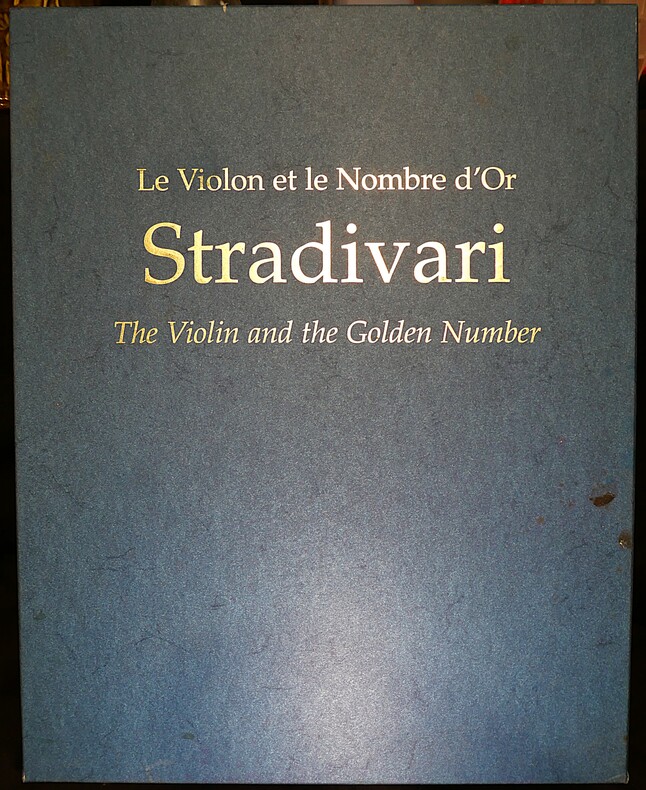
2005réf. 3cb5in4 broché, 163pp, nombreux dessins et schémas. 12 planches rhodoid représentant les moules des Stradivarius grandeur nature accompagnées de 12 calques correspondant, avec calculs géométriques en rapport avec le nombre d'or. Le tout dans un grand coffret bleu à titres dorés
2000réf. 53539(Oxford), British Violin Making Association, (2000). 4°. Mit zahlr. farb. Abbildungen. 416 S., OLwd. m. illustr. OUmschlag.
1847réf. 29822Paris: Aubert & Cie 1847. 215 x 220 mm. sheet size 346 x 253 mm. Printed on wove paper. Signed by the artist in the stone. Some foxing; remnants of paper mounting tape to verso. Aubert & Cie unknown
1847réf. 29822Paris: Aubert & Cie 1847. 215 x 220 mm. sheet size 346 x 253 mm. Printed on wove paper. Signed by the artist in the stone. Some foxing; remnants of paper mounting tape to verso. Aubert & Cie unknown books
1820réf. 46032Paris, Crochard, 1820. Uncut with orig. printed wrappers (Juin-issue). In ""Annales de Chimie et de Physique, Par MM. Gay-Lussac et Arago"" Tome XIV, Juin issue, pp. 113-222. (Entire issue in orig. wrappers). Savart's paper: pp. 113-172 and 3 folded engraved plates.
1820réf. 46032Paris Crochard 1820. Uncut with orig. printed wrappers Juin-issue. In "Annales de Chimie et de Physique Par MM. Gay-Lussac et Arago" Tome XIV Juin issue pp. 113-222. Entire issue in orig. wrappers. Savart's paper: pp. 113-172 and 3 folded engraved plates. First printing of a pioneer paper on the acoustics of the violin and on the construction of the Trapezoidal Fiddle."In his earliest work Savart gave the first explanation of the function of certain parts of the violin. To learn how vibrations are transmitted from the strings to the rest of the instrument he induced vibrations in a free wood plate by passing a vibrating string over a bridge at its center; he also used Chladni’s sand-pattern technique to observe the resulting nodal lines. Savart showed that the bridge transmits the string’s vibrations; that the plate can be made to vibrate at any frequency; and that the corresponding mode is a modification of an unforced mode. He demonstrated that the sound post also serves to transmit vibrations and he explained that it therefore should not be placed under a nodal line. Thinking that symmetry and regularity would produce the best tone Savart built a trapezoidal violin with rectangular sound holes. When the instrument was played before a committee that included Biot the Composer Cherubini and other members of the Academy of Sciences and the Académie des Beaux-Arts its tone was judged as extremely clear and even but somewhat subdued."DSB.The issue also contains Eilhard Mitscherlich' famous paper in the first French version "Sur la Relation qui existe entre la forme cristalline et les proportions chimiques" pp. 172-190. unknown
réf. 021-Wo.J. Radierung, auf chamoisfarbenem Kupferdruckpapier, signiert, numeriert und betitelt. 22,2:17,3 cm. Nr. 237 von 300 Exx. - Breitrandiger Abdruck mit leichtem Wischton.
réf. 46402963, Paris, Schott, 1886; in-4, demi-chagrin grenat, dos orné, non rogn. Titre, VIII pp., 415 pp.- Frontispice et 18 planches hors-texte avec un grand nombre de violons gravés sur bois. Ouvrage rare et très complet: histoire de l’origine du violon, construction, cordes italiennes et autres, luthiers français, italiens, allemands, anglais, anecdotes. Avec un index alphabétique des luthiers. Très bel exemplaire sur papier Whatman Turkey Mill. Il est très frais et bien relié.
réf. MUS012M1972 / 261 pages. relié Editions Libreria Del Convegno Cremona
19682 vols., roy. 8vo., First Edition, with numerous coloured and monochrome plates and facsimiles throughout; oatmeal cloth, a very good, bright, clean set in dustwrapper, the latter lightly chafed at edges. Nice set of a scarce and important work. VERY SCARCE IN THIS CONDITION.
1991réf. 53554Cremona, Editrice Turris, 1991. 4°. Mit 163 tlw. gefalt. bzw. farb. Tafeln. 351 S., OLwd. m. illustr. OUmschlag.