4 477 résultats
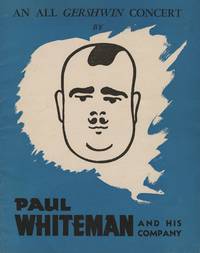
1948réf. BK0120Atlanta Georgia: Atlanta Music Club 1948. Illustrated program 18 pp. 10 ¾ x 8 ½ inches stapled in illustrated blue wrappers. Near fine condition. A program for Paul Whiteman's all-Gershwin concert at Atlanta's Municipal Auditorium on November 6 1948 built around Whiteman's close place in the history of Gershwin's concert music. Whiteman had commissioned Rhapsody in Blue and conducted its celebrated first performance at Aeolian Hall in 1924 with Gershwin himself at the piano. More than two decades later and eleven years after Gershwin's death Whiteman returned to the composer's work with this touring "musical tribute." The program ranges across Gershwin's popular and concert works opening with an instrumental medley of "Swanee" "Do It Again" "Of Thee I Sing" "Someone to Watch Over Me" and "Love Is Sweeping the Country." Vocalists Eugenie Baird and Russell McIntyre appeared alongside guitarist Mike Pingitore and saxophonist Al Gallodoro while pianist Jane Anderson performed a variation on "I've Got Rhythm" the first movement of the Concerto in F and as the finale Rhapsody in Blue. The booklet also contains a photographic portrait of Whiteman and several essays reviewing his career and his role in the development of American popular and concert music including "The Dean of Modern American Music" and "Tops' Moves to the Blue." . Atlanta Music Club unknown
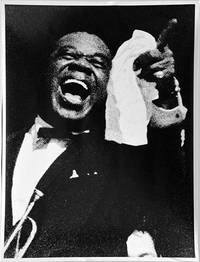
1950réf. 190253London: 1950s. Vivid images of jazz greats by one of the "obscure guys" of British jazz photography - from the collection of Charlie Watts From the collection of Rolling Stones drummer and jazz aficionado Charlie Watts: a delightful and absorbing archive of largely unpublished photographs by Jamie Hodgson an unsung hero of British jazz photography capturing both the exuberance and inwardness of the music. Among the jazz greats pictured are Dizzy Gillespie Ella Fitzgerald Duke Ellington Billy Strayhorn and Louis Armstrong. Perhaps the stand out photographs here are two superb studio images of Strayhorn one a memorable image showing him observing a goldfish in its bowl used on the cover of David Hajdu's 1996 biography Lush Life but unattributed another a delightful and unforgettable portrait of "Strays" lying on the studio floor cigarette in hand legs crossed wine glass within reach working on a score marked in 12/8 time with a quill pen and ink stand. A sequence of eight images focus on Louis Armstrong and date from 1956 through to 1970: one a particularly exuberant portrait of Pops sharing the limelight with Trummy Young Barrett Deems at the kit. These were nearly all taken in concert the exception being one marked "solo visit. Rehearsing with Norman del Mar conductor of the Royal Philharmonic Orchestra at the Royal Festival Hall for a concert in aid of the Hungarian Releif sic Fund. December 10th 1956". There are two fine shots of Dizzy Gillespie both in tux in his dressing room looking thoughtful and another of his up-tilted horn in its case the tag from his recent visit to France still attached to the handle. There is a witty bleached-out studio shot of Jimmy Rushing leaning into the horn of a gramophone and further images of the great singer one a boisterous backstage portrait of Rushing with Harry Carney and Jimmy Hamilton sitting in Rushing's capacious lap! smiling and laughing gathered on the stairs leading up to the gents' toilets and holding a gamut of reed instruments; plus a terrific image of "Mr. Five by Five" raising a pint behind the bar of a pub recalling Basie's reminiscence that "Me and old Rush. We were some pair. We just wanted to have a good time" Basie p. 37. Other portraits include a petulant Ella Fitzgerald Duke Ellington and individual images of Ellington alumni Paul Gonsalves Johnny Hodges Ray Nance Harry Carney Barrett Deems and Sam Woodyard; a chuckling Oscar Peterson; Lionel Hampton with Humphrey Lyttelton; Bud Freeman; a humorous shot of Eddie Condon sitting at a bar and scowling playfully; a tight close-up of a beaming Lionel Hampton; drummer Gus Johnson accompanying bassist Bob Haggart; and Ray Charles performing at the Capital Radio Jazz Festival in 1982. A full listing is available on request. For Hodgson 1930-2006 jazz was a private passion and these remarkable photographs did not see the light of day until a 2006 exhibition Masters of Jazz: Unseen Portraits held in the foyer of the National Theatre. In 2007 Jazz Improv magazine described him as one of the "obscure guys" of British jazz photography. His Guardian obituary noted that he "became known for his hobby rather than his profession. The man who owned the Kinnerton Street studio in London's Knightsbridge for many years earned his living in fashion and family photography. But it was the recent exhibition of 50 of his pictures in the National Theatre foyer that attracted more attention than anything previously shown by the largely anonymous Hodgson. Few knew of his work within the music world and fewer still knew of these unguarded often intimate images which were Hodgson's personal homage to the stars he observed and worshipped. All were taken during British tours many in the privacy of dressing rooms across London or in Hodgson's studio The Guardian jazz critic John Fordham regards these images as 'wonderful pictures'. 'They catch the mood on the night of jazz on and offstage' he said 'and they are very expressive of the big personalities of a lot of those old guys who started touring here in the 1950s and 60s after there had been a dearth of live US jazz in Britain'. Hodgson was a Londoner who took up photography after completing his national service in 1950. Starting out as a freelance he began by taking whatever commissions came his way - news and features aerial and architectural photography or commercial and children's pictures. A stint with the Mayflower Studios brought him into contact with advertising and various television personalities including Frankie Howerd Harry Secombe the Crazy Gang and the Ted Heath Band. In 1956 he set up his own studio where he did fashion shoots with Tania Mallet Jean Shrimpton and Sandra Paul He caught the change in mood from the snooty static haute couture fashion shoots of the 1950s to the more playful popular looks of swinging London in the 1960s. And at night he sneaked out to shoot his favourite jazz and blues bands playing across the capital". An important and captivating collection of jazz images imbued with the photographer's deep affection for the musicians the spontaneity of the portraits matching that of the music itself. Together 95 black and white photographs 46 measuring 223 x 170 mm; 49 measuring 402 x 305 mm each with identifying caption on verso by the photographer some with studio wet stamps or labels a number signed by Hodgson. Preserved in the photographer's own commercial boxes. Three prints Duke Ellington Billy Sytrayhorn Louis Armstrong framed and glazed by auction house overall measuring 445 x 620 mm. In excellent condition. Count Basie Good Morning Blues: The Autobiography of Count Basie 1987. unknown
1940réf. 169491United States: c. 1940-60. A visual record of a rarely seen and poorly documented world - an accidental history An unusually extensive group of these evocative "table photographs" striking records of largely African-American audiences in the glamorous sociable and intentionally inclusive world of mid-century nightclubs. Shot by in-house photographers developed on site and sold for a dollar at the end of the evening these quick souvenirs now amount to a rare visual history of a poorly documented milieu. As Gold notes they "turn the camera round": instead of performers we see the audiences - a critical part of what Jason Moran calls the jazz "ecosystem." The collection offers a nationwide survey of venues from the extravagant to the resolutely down-home. At New York's Café Zanzibar with its spectacular floor shows and "Zanzibeauts" the audience was integrated but largely white prompting Langston Hughes's caustic observation about the seating hierarchy - an impression borne out by the image here. Detroit's Gay Bar Lounge another "black and tan" joint catered to a mostly Black clientele and offered a rougher edge: in 1947 the barkeep famously shot two stick-up artists with the.38s kept beneath the cash register. Equally compelling are the histories of Black enterprise that surface. Oakland's Athens Elks Cocktail Lounge home to Lodge 70 of the Improved Benevolent and Protective Order of Elks of the World stood at the centre of West Oakland's vibrant musical scene hosting countless jam sessions and serving as the informal checkpoint for touring African-American musicians. In Los Angeles Dootsie Williams's Dooto Music Center founded by the trumpeter-turned-entrepreneur provided one of the city's foremost Black cultural venues praised by the Los Angeles Sentinel as "the most-needed cultural and recreation center in Southern California." The photographers themselves remain surprisingly elusive though a few can be traced. In Columbus George Pierce ran a record shop and studio in Bronzeville and supplied images to the Ohio Sentinel and other regional papers; in Detroit Earl Fowler's Top Hat Photo developed into a significant presence in the Black Press with Fowler later serving as chief of the Los Angeles bureau of Now! magazine. Beyond these contexts the photographs' enduring appeal lies in the human dramas unfolding across their tabletops: the conviviality style and fleeting alliances captured in a moment of collective ease. A scene from Gamby's in Baltimore is emblematic - six convivial hat-tipping men and two young women smiling through a forest of shot glasses presided over by a portrait of Fats Waller. It is warmly enigmatic yet inviting an offhand welcome extended across time. A more detailed description and full listing is available on request. Together 66 black and white gelatin silver print photographs 62 c.127 x 178 mm; 3 approximately 178 x 254 mm around 50 are in their original plain or printed souvenir folders the balance loose. Loose photos and folders with occasional wear and mild damp-staining some annotations verso of prints and to folders prints occasionally stapled into folders overall the group remains about very good. Ronald Auther "The Oakland Larks" The Shadow Ball Express: African American Baseball Renderings and other Facts of Life online; Clora Bryant et al Central Avenue Sounds; Jazz in Los Angeles 1930s-1950s 1998; Jeff Gold Sittin' In: Jazz Clubs of the 1940s and 1950s 2020; Robert Petersen "Before Motown: L.A.'s Black-owned Music Empire" PBS SoCal online. unknown
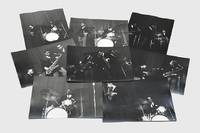
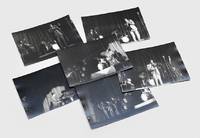
1960réf. 172596Paris: Michel Salou 1960. Superb images of the Messengers live in Paris An outstanding series of "in the moment" images showing one of the great Messengers lineups captured in Paris probably at the Olympia in 1960. The lineup comprises Blakey drums Wayne Shorter tenor sax Lee Morgan trumpet Bobby Timmons piano and Jymie Merrit bass. Blakey 1919-1920 was a master percussionist and the Jazz Messengers which he led for over 30 years was "the most famous academy in jazz" Cook & Morton. Wayne Shorter was relatively new to the band and his playing lent a "dark corrosive edge" to the front line while on ballads his tone became "softly beseeching". Lee Morgan "arguably the defining figure of hard bop" had been with Blakey since 1958. The photographer Michel Salou worked as a music executive producing albums by among others Sun Ra Live in Paris: At the "Gibus" 1973 the Mal Waldron Trio Ursula 1978 and the French pianists George Arvanitas and Rene Urtreger. He also appears in the annals of the Art Ensemble of Chicago as their "first booking agent. who helped them secure concert dates across France and elsewhere in Europe" Steinbeck p. 130. His excellent work as a lensman appears to have gone virtually unnoticed except that the National Portrait Gallery holds a single print of Ray Charles in performance. Eight original carbon print photographs 240 x 180 mm 6 landscape 2 portrait printed on heavy stock paper verso with Salou's identifying note in pencil. In excellent condition. Richard Cook & Brian Morton The Penguin Guide to Jazz Recordings eighth ed. 2006; Paul Steinbeck Message to Our Folks: The Art Ensemble of Chicago 2017. unknown
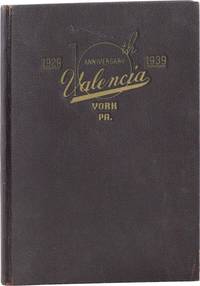
1939réf. 61627York Pennsylvania: The Valencia Ballroom 1939. Quarto. Spiral-bound leatherette boards hardcover; 94pp; illus. Trivial soil to covers with front board very slightly bowed at fore edge; internally fresh clean and unmarked; Near Fine. Promotional album for the storied Valencia Ballroom a popular musical venue during the Swing Band era. Strategically located on a route that connected New York Philadelphia and Baltimore the Valencia caught traveling orchestras on their way north or south thus bringing an impressive assortment of acts to the unlikely industrial city of York PA. Richly illustrated with photographs of the venue of the Tassia family owners and managers of the Valencia architectural views and dozens of portraits of the popular performers who played there including Eddie Duchin Kay Kyser Benny Goodman Sammy Kaye Guy Lombardo Bunny Berrigan the Dorseys and a host of others. Though the Valencia clearly favored white orchestras a few noteworthy African-American performers appeared there regularly and are pictured including Jimmy Lunceford Cab Calloway Duke Ellington and Claude Hopkins. A lavishly-produced souvenir and highly uncommon; OCLC notes four locations and we trace no other copies in the trade. The Valencia Ballroom unknown
2025réf. x-1038312779FriesenPress 2025. Hardcover. New. 330 pages. 6.00x0.88x9.00 inches. FriesenPress hardcover
1962réf. 172605Paris: Michel Salou 1962. The band's expanded voicings added orchestral sonority to rhythmic power An evocative sequence: one focusing on Blakey at the kit a particularly luminous shot another showing the front men playing percussion two of Freddie Hubbard soloing one of Curtis Fuller and another of Cedar Walton. Blakey 1919-1920 was a master percussionist and the Jazz Messengers which he led for over 30 years was "the most famous academy in jazz" Cook & Morton. The lineup here is Blakey drums Wayne Shorter tenor sax Freddie Hubbard trumpet Curtis Fuller trombone Cedar Walton piano and Jymie Merritt bass. When Lee Morgan left the band Blakey brought in Hubbard and Fuller with Cedar Walton coming in for Bobby Timmons. The new agglomeration formed perhaps "the most adventurous of Messenger lineups. The band's expanded voicings added orchestral sonority to rhythmic power". The photographer Michel Salou worked as a music executive producing albums by among others Sun Ra Live in Paris at the "Gibus" 1973 the Mal Waldron Trio Ursula 1978 and the French pianists George Arvanitas and Rene Urtreger. He also appears in the annals of the Art Ensemble of Chicago as their "first booking agent. who helped them secure concert dates across France and elsewhere in Europe" Steinbeck p. 130. His excellent work as a lensman appears to have gone virtually unnoticed except that the National Portrait Gallery holds a single print of Ray Charles in performance. Six original carbon print photographs 240 x 180 mm printed on heavy stock paper inscribed on versos in blue ballpoint: "clichés Michel Salou". In excellent condition. Paul Steinbeck Message to Our Folks: The Art Ensemble of Chicago 2017. unknown
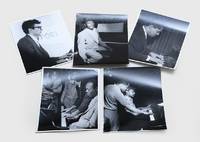
1950réf. 1726311950-60s. Attractive collection of portraits of five jazz greats those of Paul Bley and John Lewis are vintage prints from the studio of Burt Goldblatt with wet stamps on verso. Goldblatt's New York Times obituary describes him as "a prolific designer of moody jazz LP album covers. In the early 1950s after the introduction of the LP the most progressive American cover designs were created for jazz albums and Mr. Goldblatt was among the pioneers in establishing the cool-jazz style. It encompassed black-and-white portraits and studio photographs inspired by film noir as well as gritty street scenes often abstractly overlaid with flat colours evoking a sense of urban night life". The study of Paul Bley shows him performing at the Newport Jazz Festival where Goldblatt was very much the house photographer publishing an illustrated history of the festival in 1977. Bley in the avant-garde of developments in the music "has produced vivid vital jazz couched in an advanced and challenging idiom" Cook & Morton. That of John Lewis - leader of the MJQ one of the most successful small groups in jazz - is an intimate close-up shot of him at the keyboard. Bill Evans is shown standing at the keyboard working through some changes with another musician perhaps drummer Kenny Clarke; the figure at Evans's elbow may be fellow-pianist Hank Jones. Similarly Tommy Flanagan sporting a flat cap and plaid shirt is going over material with drummer Roy Haynes. Flanagan is perhaps best known for his work accompanying Ella Fitzgerald and Tony Bennett emerging in the '70s and '80s as "a bebopper of gentlemanly distinction" Cook & Morton. The shot of Wynton Kelly is a delightful unguarded portrait showing him at the piano smiling and clearly in conversation sporting a hat with upturned brim and hip suit. Like Evans Kelly played on Miles Davis's timeless album Kind of Blue and is described by the All About Jazz website as "a superb accompanist loved by Miles Davis and Cannonball Adderley". Five original silver gelatin prints each 254 x 200 mm. Bley: identified on verso in black felt tip Burt Goldblatt wetstamp; Evans: identified on verso in pencil; Flanagan: identified on verso in pencil; Kelly: ghost of tape marks on verso; Lewis: identified on verso in blue ballpoint Burt Goldblatt wetstamp. Very slight blue ink smudging to the front of the image of Bley otherwise all in excellent condition. Richard Cook & Brian Morton The Penguin Guide to Jazz Recordings eighth ed. 2006. unknown
réf. 5a1638Zimmerle Stuttgart 1977-1981. Je Heft ca. 55 S. mit einigen Abbildungen broschierte Einbände quart teils geringe Gebrauchsspuren. - Enthält: Jahrgang 1977 Heft 7 8 9 10 und 12 / Jahrgang 1978 Heft 1 bis 11 / Jahrgang 1979 Heft 1 bis 12 / Jahrgang 1980 Heft 1 3 4 und 12 / Jahrgang 1981 Heft 1 / Dazu 4 Hefte "down beat - the contemporary music magazine": Jahrgang 1978 Heft 7 und Jahrgang 1980 Heft 1 2 und 9 - unknown
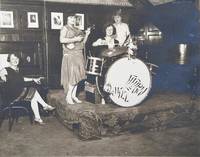
1928réf. 173491Austria: 1928-33. Girljazzband" wows 1920s Austria A delightful Jazz Age scrapbook that doubles as liber amicorum and guest book assembled by the pianist and singer Anny Gloss recording in part her career with the Ninon Fleuron Jazz Ladies opening a window into the experiences of European women in jazz during the music's formative years. The first set of newspaper clippings record that in 1928 Gloss was teamed with the American "Jazz Queen" Elsie Teele at the "charming and elegant" Viennese bar the Bonbonnière with Teele billed as "the female Whiteman" - she gave the Austrian premier of Gershwin's Rhapsody in Blue in 1927. Much of the album is then devoted to Gloss's experiences at Hotel Radetzky in Hinterbrühl Lower Austria where she performed as part of the Ninon Fleuron Jazz Ladies. At the time the other members of the band were the eponymous Ninon Fleuron drums pseudonym of Rosa Sophie Radio 1899-1974 Mariska Gerö violin and Gretl Heller piano. One advert mentions them "Singing the Latest American Song-hits" while a newspaper clipping praises their "rendering of classical music". The album contains numerous messages sometimes addressed to her directly from friends audience members and well-wishers. While most of these are in German some are in English "Your music makes me feel 10 years younger". The Ninon Fleuron Jazz Ladies which had various personnel came to an abrupt end with Hitler's invasion of Austria in 1938. Gloss also performed under the name Anni Hölzl as demonstrated by the cast list for a 1931 performance of Der Kärntner Totentanz and the programme for a concert in which she had a soprano solo 1933. Octavo 241 x 190 mm ff. 60 final 20 ff. blank. Contents generally on rectos only numerous items of ephemera pasted in including c.20 newspaper clippings 15 original silver gelatin photographs of which two are signed by Ninon Fleuron messages and autographs in various hands one watercolour sketch of the Karlskirche Vienna one concert programme loosely enclosed. Original patterned cloth covers light orange endpapers. Binding just slightly shaken otherwise in excellent condition. hardcover
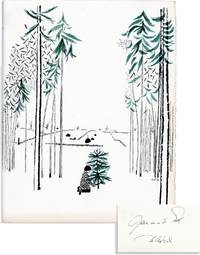
réf. 84869Roosevelt NJ: by the Author c.1956. Quarto 37cm. Printed card portfolio holding twelve lithographic plates loose as issued. All lithographs are signed in plate; Martin has inscribed the portfolio "Jean and Sol Libsohn / David" undated. Very mild external toning and soil; Near Fine. Inside of portfolio is printed with a holiday sentiment and also a brief blurb from Alan Lomax commenting on the illustrations. Scarce portfolio of lithographic prints reproducing Martin's illustrations for Alan Lomax's Mr. Jelly Roll a biography of jazz pianist Jelly Roll Morton published in 1956. Issued without imprint presumably printed as a Christmas gift to friends of the artist. This copy is inscribed to the photographer Sol Libsohn and his wife Jean who were Martin's neighbors in Roosevelt New Jersey a WPA town founded in 1939 which by the Fifties had become a destination for artists writers and musicians seeking refuge from but proximity to the New York art scene. Martin 1913-1992 was a noted mid-century illustrator known best for his many jazz album covers for Folkways and Blue Note in the Fifties and Sixties. Of the present portfolio we locate only a single copy in OCLC Pitt with no other example traced in commerce. unknown
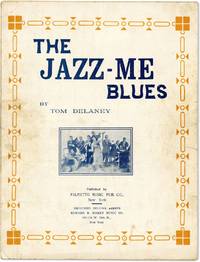
1921réf. 82277New York: Palmetto Music Pub. Co 1921. First Edition. Slim quarto 30.5cm; original pictorial wrappers; 6pp. Moderate wear handling and dust-soil to wrappers some creases and edge-tears with inner spine-fold archivally reinforced with a patch of paper tape remnant to upper end of same; complete Good to Very Good. One of the earliest hits by African American songwriter and composer Thomas Henry Delaney 1889-1963. Born in Charleston SC he would eventually become one of the most popular jazz and blues composers on Tin Pan Alley. The front wrapper reproduces a photograph of Lucille Nelson Hegamin 1894-1970 backed by the band Albury's Blues and Jazz Seven. In 1920 she became the second African American blues singer to record following Mamie Smith and Perry Bradford's August 1920 recording of "Crazy Blues." She recorded "Jazz-Me Blues" in 1921 backed by her husband Bill and his band the Blue Flame Syncopators; thanks to her recording Delaney's song would go on to become a jazz standard. OCLC notes a scant 8 holdings. 82277. Palmetto Music Pub. Co unknown
réf. 29392-A-60032J.J. Publications London 1948/1951. 16 issues together in halfcloth binding including original coves; trimmed a bit short. Contains: Volume 1 issues 5-8 1948 vol. 2 issues 1 -11 1949 and vol. 4 issue 11 1951. -slight traces of tape and wear on cover bookblock itself in good condition J.J. Publications, London, 1948/1951 hardcover
1999réf. x-0810835630The Scarecrow Press Inc. 1999. Hardcover. New. 237 pages. 8.75x6.00x1.00 inches. The Scarecrow Press, Inc. hardcover
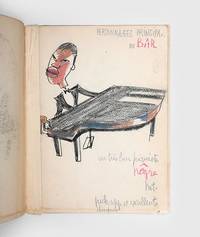
1937réf. 171091Paris: c. 1937. Jazz à la parisienne From the collection of Rolling Stones drummer and jazz aficionado Charlie Watts with his posthumous bookplate: a delightful and highly unusual illustrated "prospectus" of the requisites for running a successful bar in Paris in the late 1930s. First and foremost you'll need "un très bon pianiste nêgre" along with "2 barmaids" and of course "2 ou 3 nêgresses à laisser vagabonder dans le bar". There then follow three pages that offer pen portraits of various artists that you might like to include on the bill along with their contact details. These include "acteurs animant la soirée ou la nuit": character actor and singer Yves Deniaud 1901-1959 Neapolitan sinti jazz guitarist Henri Crolla 1920-1960 "a travaillé avec Djingo Rainart sic du Hot-club de France" "Trois Jeunes - chanteurs s'accompagnant à la guitare et à la flute" including another well-known actor Guy Decomble 1910-1964 and the photographer Pierre Jamet 1910-2000 a close friend of Robert Doisneau and Willy Ronis. The flamboyant impresario Henri Leduc winds up the volume described as a "personnage comique indispensable à l'atmosphere d'un bar". After the Liberation Leduc a native of Montmartre set up Le Bar Vert on the rue Jacob "the first café-restaurant to play American music" Cowan & Steward p. 234. Our unidentified artist concludes by remarking "We can find for you absolutely everything that you could possibly need elephants - naked ladies - non naked ladies - a 'bus - &c. &c. - whales". Quarto. Five pages of original artwork in pencil crayon and pastel with accompanying text. Commercial sketchbook by L. Bourdillon original blue card wrappers. Variably sunning to wrappers which show lght signs of handling contents toned pale tidemark to edges of leaves front blank professionally restored at the corners but overall very good. Alexander Cowan & Jill Steward eds. The City and the Senses: Urban Culture Since 1500 2007. unknown
1969réf. 81807New York: Macmillan 1969-70. Second and fifth volumes are first printings; remainder are second or later printings. Six octavo volumes. Uniform cloth hardcovers in dustjackets; 255223290246288287pp; illustrated with photographic plates halftones. All in Very Good or better condition in the original dustwrappers; jacket to 4th volume slightly ragged along upper edge else all Very Good or better. An indispensable set compiling reviews interviews profiles and critical articles with reading lists and selected discographies. Macmillan unknown
1995réf. 23-08-22-gw-7809-jmUtah Jazz 1995-01-01. paperback. Good. 0x0x0. Light wear. Good copy. Utah Jazz paperback
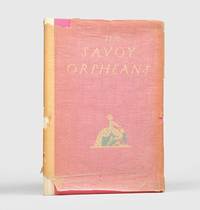
1924réf. 139822London: Published Privately at the Savoy 1924. First and only edition one of 1000 copies issued as a "first birthday" celebratory publication; scarce particularly so in the fragile glassine jacket. Loosely inserted in this copy is a slip printing soprano Luisa Tetrazzini's birthday wishes in green. The Savoy Orpheans were formed by former army bandmaster Debroy Somers in 1923 and were resident at the Savoy Hotel until contractual wrangles between W. F. De Mornys entertainments manager at the Savoy and the hotel company led to the orchestra disbanding on New Year's Eve 1927. During their four year tenure the Orpheans were among the cream of British dance bands and "patterned their instrumentation arrangements and classy presentations upon Whiteman's model" Baade p. 25. This attractive publication was printed at the Baynard Press which "employed highly skilled craftsmen. and printed many of London Transport's pictorial posters. the Baynard Press was amongst the largest and most technically accomplished printing firms in Britain" Science Museum. Library Hub locates only the British Library copy among British and Irish institutional libraries; WorldCat adding another copy at Rutgers University New Jersey. Square octavo pp. 16. With 3 tipped-in photogravures 2 showing the Orpheans the other the Savoy-Havana band all in situ in the Savoy Ballroom title page printed in green and pink decorative head- and tailpieces and occasional decorative sprays of notes in pink. Original white quarter cloth pink pictorial boards endpapers with musical notation in pink. With the glassine jacket Negligible rubbing to board edges faintest offsetting to endpapers; else a fine copy in the toned jacket with creasing and a couple of closed tears and chips to edges. Christina L. Baade Victory through Harmony: The BBC and Popular Music in World War II 2012. hardcover
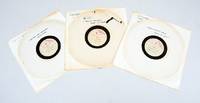
1960réf. 149122Chicago: Hugh Hefner c. 1960s. Lay back and think of Ellington A trio of discs cut specially for Playboy founder Hugh Hefner comprising two recordings by Duke Ellington "Mood Indigo" and "Sophisticated Lady" and one by Artie Shaw "Begin the Beguine". Each label printed in pink: "Custom Pressed by Jukeboxes Unlimited for Hugh M. Hefner" and bearing Playboy's rabbit logo and typed identification. "Hugh Hefner's initial exposure to music and especially to jazz like that of most people was through vinyl recordings and he's always been a record collector" Farmer p. 71. He was also the owner of a magnificent 1946 Wurlitzer 1015 jukebox see his sale at Julien's Auctions 30 November 2018. That lot was offered with 24 "original" 78rpm recordings by a group of artists including Artie Shaw Frank Sinatra Lena Horne and Harry James. Whether these discs were specially cut as here we have not been able to ascertain. What is certain however is the Playboy kingpin's love of jazz. "In this invented lifestyle for the modern age Hef decided that jazz was the go-to soundtrack. Jazz was the hippest music around and had been for decades. Playboy championed jazz at a time when most music critics were looking in all the wrong places for a truly American art form. Even the most forward-thinking composers of the era the Aaron Coplands and their ilk were still just building upon the European tradition. Jazz was bursting at the seams of the staid and academic classical world ripe with musical development rivalling the greatest of the old European masters. In 1957 Playboy produced a two-record set of their Jazz All-Star series featuring performers from Pops to Frank Sinatra to Dave Brubeck. They produced a second edition in 1958 and a third in 1959. Hefner then held the first Playboy Jazz Festival at Chicago Stadium in 1959" Jeff Fitzgerald at allaboutjazz website 28 September 2017. As a coda the jazz-soaked "Playboy's Theme" written and performed by Cy Coleman was the signature tune of the regular late night TV show Playboy's Penthouse. 3 aluminium-cored one-sided 10 inch acetate discs each with original label both Ellington discs with additional drive-pin hole; original plain paper sleeves annotated in ink possibly in Hefner's hand. Sleeves rather brittle torn and chipped with some loss but just about intact; a few abrasions and finger marks to discs. Patty Farmer and Will Friedwald Playboy Swings!: How Hugh Hefner and Playboy Changed the Face of Music 2015. unknown
2022réf. x-1648040853Dorrance Publishing Co. 2022. Paperback. New. 400 pages. 9.00x6.00x1.04 inches. Dorrance Publishing Co. paperback
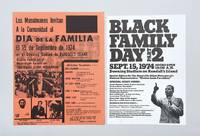
1974réf. 149163New York: Nation of Islam 1974. Scarce original handbills for the second of two extraordinary Black Family Days organized by the Nation of Islam in 1974 staged at Downing Stadium on Randall's Island New York and featuring music by among others Lionel Hampton Eddie Palmieri Machito Gil Scott-Heron Jimmy Cliff and "modern black music giants" Max Roach Clifford Jordan Archie Shepp and Jackie McLean. Black Family Day Part 2 was held on 15 September and followed Part 1 held in May the latter described as "the largest gathering of African-Americans in the history of Harlem" Clarke p. 189 when an estimated 70000 people attended and Farrakhan's address was recorded and distributed on the Nation of Islam's own label. "In September Scott-Heron joined Eddie Palmieri and Celia Cruz to perform at the Nation of Islam's Black Family Day at Downing Stadium on Randall's Island at the top of the East River below the Triborough Bridge. A stone's throw from where Robert Moses and the Triborough Commission ran their empire Brother Reverend Louis Farrakhan spoke for two hours to around twenty thousand people denouncing the United States as 'the wickedest nation on the face of the earth' under sunny fall skies. Jimmy Cliff sang 'I'd rather be a free man in my grave than living as a puppet or a slave'" Hermes. 2 handbills 266 x 190 276 x 223 mm printed on white and orange paper respectively text in Spanish on the latter both printed in black each incorporating a portrait of Louis Farrakhan the larger of the two with additional portraits of Eddie Palmieri Machito and Gil Scott-Heron. Each with lateral crease where once folded otherwise in excellent condition. Peter B. Clarke ed. New Trends and Developments in African Religions Westport Connecticut Greenwood Press 1998; Will Hermes Love Goes To Buildings On Fire: Five Years That Changed Music Forever Penguin 2014. unknown
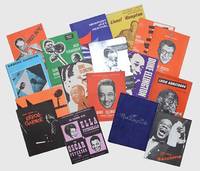
1950réf. 137205Late 1950s - early 70s. Excellent group of UK tour programmes for a constellation of jazz greats: Armstrong 2 Basie 8 Bechet Brubeck 2 Nat King Cole Eddie Condon Sammy Davis Jr. 2 Tommy Dorsey Ellington 4 Errol Garner 3 Lionel Hampton Ella Fitzgerald and Oscar Peterson Woody Herman Harry James JATP 4 Newport Jazz Festival Glen Miller Earl Hines and Jack Teagarden Bal du Moulin Rouge. 36 programmes quarto. Illustrated throughout. Original pictorial wrappers wire-stitched as issued. Overall in excellent condition. unknown
réf. B9781514466407Paperback / softback. New. paperback
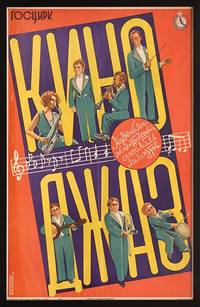
1937réf. 124905Moscow: Upravlenie tsirkov V.K.I. Circus Administration 1937. Uncommon print run of just 8000 copies. An advertisement for the Soviet Little peoples' circus group the "Musical and Eccentric Group of Lilliputians" founded in late 1920s under direction of Mikhail Kachuriner 1896-1976 and continued until shortly after his death. The main accent was always on musical talent the performers having musical instruments specially made for them although the group did include performers of "normal" height. "Lilliputian Jazz"was probably the most popular of similar circus groups of the time their first programme "Cinema Jazz" was a parody of some the great stars of the silver screen; Mary Pickford Charlie Chaplin Douglas Fairbanks and the like. A striking example of the work of Mikhail Dlugach 1893-1988 prolific graphic designer and poster artist whose early career centred on the film industry joining Reklam Film the dvertising department of the Soviet film agency. A member of AKhRR The Association of the Artists of the Revolution and ORRP The Association of Revolutionary Poster Artists in the 30s he continued to work in film but diversified into agitprop and exhibition design. In 1940 he helped to design the exhibition pavilion at the All-Union Agricultural Exhibition in Moscow. During the Second World War Dlugach he was was evacuated to Ufa and worked for Okna TASS creating war propaganda. After the war he continued working as a poster designer in politics and the arts including circus promotions. In 1958 he was one of the team involved in the design and building of the Soviet pavilion at the International Exhibition in Brussels. An attractive and unusual piece much enhanced by the presence of the pictorial programme. Lithographically printed colour poster 905 x 580 mm; together with Kino-dzhaz. Odessa: 1935. 4-page "broadsheet" promotional brochure graphics and images printed in sepia letterpress in black. A few minor chips and splits professionally repaired light creases from old folds consequent whitening of the print surface but remains very good. Presented in a black wooden frame with conservation acrylic glazing; the brochure lightly browned creases from folds some edge-slits but overall very good. unknown