4.816 Ergebnisse
1926Best.-Nr. 59638Chicago IL: Crane Co. 836 S. Michigan Ave. 1926. 4to. 47 1 pp. With over 150 of colour illustrations & blueprint floor plans throughout Gray printed boards w/ black & blue lettering on front cover minor shelfwear very slight chipping at foot of spine faint rust to staples at gutter margin of text block still VG copy. First edition of this scarce catalogue emphasizing the importance of colour and the latest modern crane fixtures valves and fittings mixing their compact and graceful gleaming white enamel on iron units with fine marbles and flawless crystal. Each of the individual designs includes elevation drawings along with each wall illustrated as it would appear on the blueprints on the facing page for the floor plans. Some feature Greco-Roman or Pompeian design elements while others show vivid Art Deco influences. Worldcat locates 6 copies The Strong DLC Hagley MO Hist. Mus. Cincinnati Carnegie. Crane Co., 836 S. Michigan Ave., hardcover
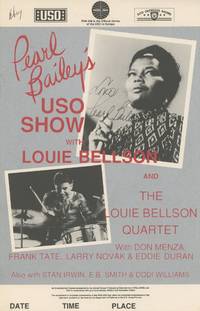
1950Best.-Nr. List2914Unknown location 1950. 7 x 11 inch poster. Some small marginal tears overall excellent. A small poster for Pearl Bailey with the Louie Bellson Quartet presented by the United Service Organizations and Department of Defense. Bailey 1918–1990 was a singer dancer and actress; she started her career performing at Black nightclubs on the east coast and later performed in several Broadway hits including an all-Black version of Hello Dolly! Louie Bellson 1924–2009 was Bailey’s husband a composer bandleader and jazz drummer credited with inventing the double bass drum setup. Bailey toured regularly with the USO beginning in 1941 though this poster is likely from later; the DOD was called the Department of War until 1949 and the USO was inactive between 1945 and 1950. unknown books
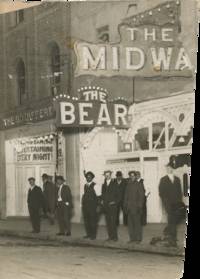
1910Best.-Nr. List2810San Francisco California 1910. Single photograph approximately 6 ½ x 9 inches manuscript verso reading “SF Barbary Coast 500 Block of Pacific ”THE SO DIFFERENT” now 550 Pacific Ave 1911”. Appears to be trimmed from a larger photograph. Portion of image cut and pasted with editorial overpainting. Some damage to edges and corners with one tear at right middle some residue from pasting a now-missing object; overall very good. A photograph taken on Pacific Street in about 1910 showing a group of men standing by the curb in front of The Midway The Bear and The So Different nightclubs note that the sign for The Midway is pasted in. This block in Barbary Coast—”Terrific Street”—was home to a number of dance halls and early jazz clubs many of which like Purcell’s So Different Café were “black and tan” – catering to all races. Founded by former Pullman porters Lew Purcell and Sam King shortly after the neighborhood was rebuilt from the 1906 earthquake and fire Purcell’s was one of the better-known clubs. Influential ragtime and jazz pianist Sid LeProtti led the So Different Jazz band and King Oliver and Jelly Roll Morton are among the alleged guest performers. Patrons could buy twenty-cent vouchers for a quick dance with one of the girls who worked and sometimes lived at the venue. Around 1913 though police began to crack down on drinking and dancing in the neighborhood and by the 1920s the venues were gone. unknown books
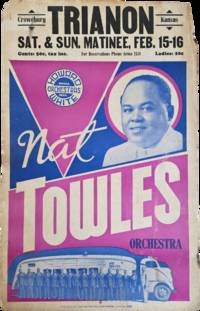
1930Best.-Nr. List2913Omaha Nebraska: The Metropolitan Press 1930. 14 x 21 ½ inch poster. Worn with marginal damage; very good plus. Nat Towles 1905–1963 was a jazz musician and bandleader from New Orleans. His band first called Nat Towles’ Creole Harmony Kings was a renowned territory band in Texas Oklahoma Kansas and Nebraska. They would later have residences in Omaha and Chicago and tour New York City. Offered here is a poster for the Nat Towles Orchestra at the Trianon Ballroom in Croweburg Kansas likely from the 1930s given the location and band name. Croweburg was a coal mining town—and a sundown town until 1912.1 1 “A.P.Roundtree Esq.” The Kansas Baptist Herald May 20 1912 1. The Metropolitan Press unknown books
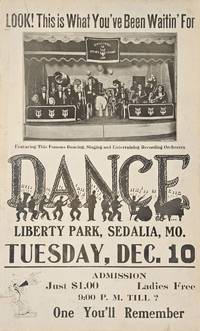
1929Best.-Nr. List2808Sedalia Missouri 1929. 11 x 18 inches heavy cardstock. Manuscript note verso reads “Flor Alpino Vals / Vanderbeck”. Some staining and tears mainly marginal. Overall very good to excellent. An advertisement for a performance by the Original Eleven Clouds of Joy likely an iteration—of which there were many—of the popular Kansas City-based swing jazz band Clouds of Joy. The group was formed in 1921 by trumpeter Terrence Holder 1897–1983 and in 1929 was led by saxophonist Andy Kirk 1898–1992 and found success largely due to the arrangements and playing of Mary Lou Williams. They would tour the US through 1948 playing Kansas City-style jazz had the top song on the Billboard chart in 1938 and the first single to hit number one on Harlem Hit Parade in its inauguration in 1942 with the song “Take It and Git.” Contemporary newspaper accounts list the band as performing under the name “The Original Eleven Dark Clouds of Joy” during this period though the banner in the photograph here omits the word ‘dark.’ This poster represents an uncommon relic of the band’s early days touring regionally roughly a decade before they enjoyed national success. unknown books
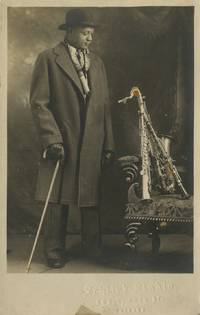
1920Best.-Nr. List3820Chicago Illinois: Schlink Studio 1920. Real photo postcard measuring approximately 3 ½ x 5 ½ inches. Studio portrait of an African American musician standing in overcoat hat gloves and cane beside a chair displaying a saxophone and clarinet. Divided postcard back. Light wear and soiling with small loss or surface disturbance at lower margin; very good. A real photo postcard portrait of an African American musician posed with saxophone and clarinet. The sitter is not identified but the portrait was clearly made to present him as a professional or semi-professional performer rather than as an informal amateur. The formal clothing cane and carefully arranged instruments give the image the character of a publicity or theatrical portrait. The combination of saxophone and clarinet is especially appropriate to early twentieth-century dance-band and jazz performance when reed players commonly doubled on both instruments. The photograph likely dates from the period in which Black musicians circulated through local orchestras theater bands dance halls vaudeville circuits and early jazz ensembles often leaving behind few named records apart from photographs like this. A strong real photo postcard portrait of an African American reed player with good visual presence and clear musical content. . Schlink Studio unknown books
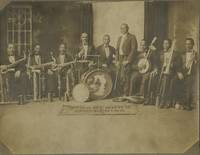
1922Best.-Nr. BK0009Pittsburgh: Sissman Studio 1922. Photograph measuring approximately 8 x 10 inches. Studio portrait of nine African American musicians posed with saxophones brass instruments violin banjo drums and other instruments with a rug prominently lettered "Bradford's Orchestra" at their feet. Photographer identified as Sissman Studio of Pittsburgh. Some wear and toning particularly at edges and corners; generally well preserved. An early photograph of Bradford's Orchestra an African American ensemble active in Pittsburgh under the direction of Walter Felix Bradford during the early 1920s. Nine musicians pose with an unusually extensive display of their instruments while the orchestra's name is incorporated prominently into the composition on a rug at their feet. The photograph was made by Sissman Studio a Pittsburgh photographic firm later located on Centre Avenue in the city's Hill District. Contemporary sources document Bradford's Orchestra performing over Pittsburgh's pioneering radio station KDKA during this period. A December 1922 program announced an 8:30 evening "Concert by Bradford's Orchestra under the direction of Walter Felix Bradford" with a varied program ranging from Mendelssohn and Verdi to popular marches and light orchestral music.1 The group is also listed as performing on KDKA in the Utica Observer-Dispatch in December 1922.2 The present photograph appears to be an otherwise unrecorded studio portrait of the same Pittsburgh organization. Bradford belonged to a substantial but poorly documented community of African American bandleaders and musicians working in Pittsburgh during the early twentieth century. Later accounts of musical life in the Hill District place him alongside such local ensembles as the Harlem Troubadours Gerty Long and Her Night Hawks and Walt Rainey's High Schoolers.3 These local orchestras formed an important part of the musical culture from which Pittsburgh would subsequently produce an extraordinary generation of nationally prominent Black musicians. 1 "Monday December 11 1922" Radio Broadcasting News 2 no. 28 December 9 1922 6. 2 "To-day's Radio Program" The Utica Observer-Dispatch December 11 1922 5. 3 Hugo A. Freund "Working the Seams: African American Professional Performers Moving Between White Public Culture and African American Private Culture" Pennsylvania Folklife 45 no. 2 1996: 91-97. . Sissman Studio unknown books
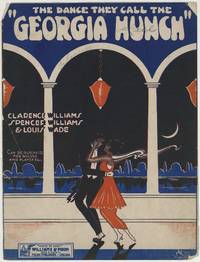
1920Best.-Nr. BK0059Chicago: Williams & Piron Music Publishers 1920. First. Four pages 9 ½ x 12 ¼ inches. Illustrated cover signed "Wilson. Detached at spine with slight chipping to margins; good overall. A scarce Williams & Piron sheet music imprint for The Dance They Call the "Georgia Hunch" with words and music by Clarence Williams Louis Wade and Spencer Williams. The attractive illustrated cover signed "Wilson" shows a couple dancing beneath the title. The song was issued by Williams & Piron in Chicago in 1920 during Clarence Williams's brief publishing partnership with New Orleans violinist and bandleader Armand J. Piron. Their firm advertised itself as the "House of Jazz." The song's title refers to the Georgia Hunch an early jazz or vernacular dance documented in period performance and later dance history sources. It does not appear to have become a standardized dance craze on the level of the shimmy black bottom or Charleston but it was more than an invented title; Williams recorded The Dance They Call the Georgia Hunch in 1921 as Okeh Records 8029 and the dance appears in later jazz-dance documentation though it apparently never reached the fame of more well known dance steps of the time. OCLC locates two copies institutionally at Baylor and the British Library. . Williams & Piron Music Publishers unknown books
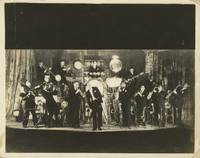
1932Best.-Nr. List3818New York City 1932. Silver gelatin photograph measuring 8 x 10 inches. Stage photograph of Cab Calloway and His Cotton Club Orchestra with Calloway at center before the band brass and reed sections drums bass guitar and stage lighting visible. Verso with mounting residue and manuscript note reading in part "from Irondome Bessemer album" or similar. Some wear creasing toning and mounting residue; very good. A large stage photograph of Cab Calloway and His Cotton Club Orchestra corresponding to a known 1932 image of the band made to mark the arrival of trumpeter Doc Cheatham. The photograph shows Calloway at center bending forward in his characteristic theatrical posture with the orchestra arranged behind him on the Cotton Club stage. By 1932 Calloway had become one of the defining entertainers of the Cotton Club era. He had taken over the Missourians in 1930 and the success of "Minnie the Moocher" in 1931 helped make him a national figure. The orchestra was also being reshaped during these years with musicians such as Doc Cheatham Morris White Walter "Foots" Thomas Benny Payne and others forming the sound and stage presentation of Calloway's early 1930s band.1 Mills Music used this same image in another press photograph indicating that it functioned as a promotional view of Calloway and the orchestra rather than merely as a private stage snapshot. 1 Jean-François Pitet "Morris 'Fruit' White: from the Missourians' banjo to Calloway's guitar" The Hi de Ho Blog May 20 2021 accessed July 21 2026 https://www.thehidehoblog.com/blog/2021/05/morris-fruit-white-from-the-missourians-banjo-to-calloways-guitar. . unknown books
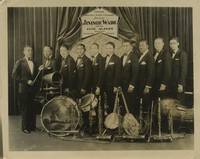
1920Best.-Nr. List3817Chicago Illinois: Chicago Amusement Service Corporation 1920. Silver gelatin photograph measuring 8 x 10 inches. Photograph shows Jimmie Wade and his Club Alabam Orchestra posed in tuxedos before a curtain with drums banjo brass reeds and string bass beneath a printed sign reading "Chicago Amusement Service Corporation Presents / Jimmie Wade and his Club Alabam Orchestra / Chicago / Vocalion Records. Some wear toning and soiling; verso with staining; very good. A large promotional photograph of Jimmie Wade and his Club Alabam Orchestra. Wade was an African American jazz trumpeter and bandleader active in Chicago from the 1910s through the early 1930s. His orchestra appeared at major Chicago venues and recorded for Vocalion in 1928. Club Alabam opened at 747 Rush Street in 1927 during Prohibition and operated as a cabaret-style nightclub under showman Dan Blanco who had previously worked in saloons amusement parks vaudeville and Chicago cabarets. The club belonged to the city's late-1920s nightlife world of floor shows dance orchestras illicit liquor and entertainment promotion. The sign in this photograph identifies Wade's orchestra Club Alabam Chicago Amusement Service Corporation and Vocalion Records. A strong Jazz Age photograph of an African American Chicago bandleader and his orchestra with connections to the Chicago nightlife scene of the period. Chicago Amusement Service Corporation unknown books
1950Best.-Nr. List2914Unknown location 1950. 7 x 11 inch poster. Some small marginal tears overall excellent. A small poster for Pearl Bailey with the Louie Bellson Quartet presented by the United Service Organizations and Department of Defense. Bailey 1918–1990 was a singer dancer and actress; she started her career performing at Black nightclubs on the east coast and later performed in several Broadway hits including an all-Black version of Hello Dolly! Louie Bellson 1924–2009 was Bailey’s husband a composer bandleader and jazz drummer credited with inventing the double bass drum setup. Bailey toured regularly with the USO beginning in 1941 though this poster is likely from later; the DOD was called the Department of War until 1949 and the USO was inactive between 1945 and 1950. unknown
1920Best.-Nr. List3817Chicago Illinois: Chicago Amusement Service Corporation 1920. Silver gelatin photograph measuring 8 x 10 inches. Photograph shows Jimmie Wade and his Club Alabam Orchestra posed in tuxedos before a curtain with drums banjo brass reeds and string bass beneath a printed sign reading "Chicago Amusement Service Corporation Presents / Jimmie Wade and his Club Alabam Orchestra / Chicago / Vocalion Records. Some wear toning and soiling; verso with staining; very good. A large promotional photograph of Jimmie Wade and his Club Alabam Orchestra. Wade was an African American jazz trumpeter and bandleader active in Chicago from the 1910s through the early 1930s. His orchestra appeared at major Chicago venues and recorded for Vocalion in 1928. Club Alabam opened at 747 Rush Street in 1927 during Prohibition and operated as a cabaret-style nightclub under showman Dan Blanco who had previously worked in saloons amusement parks vaudeville and Chicago cabarets. The club belonged to the city's late-1920s nightlife world of floor shows dance orchestras illicit liquor and entertainment promotion. The sign in this photograph identifies Wade's orchestra Club Alabam Chicago Amusement Service Corporation and Vocalion Records. A strong Jazz Age photograph of an African American Chicago bandleader and his orchestra with connections to the Chicago nightlife scene of the period. Chicago Amusement Service Corporation unknown
1932Best.-Nr. List3818New York City 1932. Silver gelatin photograph measuring 8 x 10 inches. Stage photograph of Cab Calloway and His Cotton Club Orchestra with Calloway at center before the band brass and reed sections drums bass guitar and stage lighting visible. Verso with mounting residue and manuscript note reading in part "from Irondome Bessemer album" or similar. Some wear creasing toning and mounting residue; very good. A large stage photograph of Cab Calloway and His Cotton Club Orchestra corresponding to a known 1932 image of the band made to mark the arrival of trumpeter Doc Cheatham. The photograph shows Calloway at center bending forward in his characteristic theatrical posture with the orchestra arranged behind him on the Cotton Club stage. By 1932 Calloway had become one of the defining entertainers of the Cotton Club era. He had taken over the Missourians in 1930 and the success of "Minnie the Moocher" in 1931 helped make him a national figure. The orchestra was also being reshaped during these years with musicians such as Doc Cheatham Morris White Walter "Foots" Thomas Benny Payne and others forming the sound and stage presentation of Calloway's early 1930s band.1 Mills Music used this same image in another press photograph indicating that it functioned as a promotional view of Calloway and the orchestra rather than merely as a private stage snapshot. 1 Jean-François Pitet "Morris 'Fruit' White: from the Missourians' banjo to Calloway's guitar" The Hi de Ho Blog May 20 2021 accessed July 21 2026 https://www.thehidehoblog.com/blog/2021/05/morris-fruit-white-from-the-missourians-banjo-to-calloways-guitar. . unknown
1922Best.-Nr. BK0009Pittsburgh: Sissman Studio 1922. Photograph measuring approximately 8 x 10 inches. Studio portrait of nine African American musicians posed with saxophones brass instruments violin banjo drums and other instruments with a rug prominently lettered "Bradford's Orchestra" at their feet. Photographer identified as Sissman Studio of Pittsburgh. Some wear and toning particularly at edges and corners; generally well preserved. An early photograph of Bradford's Orchestra an African American ensemble active in Pittsburgh under the direction of Walter Felix Bradford during the early 1920s. Nine musicians pose with an unusually extensive display of their instruments while the orchestra's name is incorporated prominently into the composition on a rug at their feet. The photograph was made by Sissman Studio a Pittsburgh photographic firm later located on Centre Avenue in the city's Hill District. Contemporary sources document Bradford's Orchestra performing over Pittsburgh's pioneering radio station KDKA during this period. A December 1922 program announced an 8:30 evening "Concert by Bradford's Orchestra under the direction of Walter Felix Bradford" with a varied program ranging from Mendelssohn and Verdi to popular marches and light orchestral music.1 The group is also listed as performing on KDKA in the Utica Observer-Dispatch in December 1922.2 The present photograph appears to be an otherwise unrecorded studio portrait of the same Pittsburgh organization. Bradford belonged to a substantial but poorly documented community of African American bandleaders and musicians working in Pittsburgh during the early twentieth century. Later accounts of musical life in the Hill District place him alongside such local ensembles as the Harlem Troubadours Gerty Long and Her Night Hawks and Walt Rainey's High Schoolers.3 These local orchestras formed an important part of the musical culture from which Pittsburgh would subsequently produce an extraordinary generation of nationally prominent Black musicians. 1 "Monday December 11 1922" Radio Broadcasting News 2 no. 28 December 9 1922 6. 2 "To-day's Radio Program" The Utica Observer-Dispatch December 11 1922 5. 3 Hugo A. Freund "Working the Seams: African American Professional Performers Moving Between White Public Culture and African American Private Culture" Pennsylvania Folklife 45 no. 2 1996: 91-97. . Sissman Studio unknown
1930Best.-Nr. List2913Omaha Nebraska: The Metropolitan Press 1930. 14 x 21 ½ inch poster. Worn with marginal damage; very good plus. Nat Towles 1905–1963 was a jazz musician and bandleader from New Orleans. His band first called Nat Towles’ Creole Harmony Kings was a renowned territory band in Texas Oklahoma Kansas and Nebraska. They would later have residences in Omaha and Chicago and tour New York City. Offered here is a poster for the Nat Towles Orchestra at the Trianon Ballroom in Croweburg Kansas likely from the 1930s given the location and band name. Croweburg was a coal mining town—and a sundown town until 1912.1 1 “A.P.Roundtree Esq.” The Kansas Baptist Herald May 20 1912 1. The Metropolitan Press unknown
1920Best.-Nr. List3820Chicago Illinois: Schlink Studio 1920. Real photo postcard measuring approximately 3 ½ x 5 ½ inches. Studio portrait of an African American musician standing in overcoat hat gloves and cane beside a chair displaying a saxophone and clarinet. Divided postcard back. Light wear and soiling with small loss or surface disturbance at lower margin; very good. A real photo postcard portrait of an African American musician posed with saxophone and clarinet. The sitter is not identified but the portrait was clearly made to present him as a professional or semi-professional performer rather than as an informal amateur. The formal clothing cane and carefully arranged instruments give the image the character of a publicity or theatrical portrait. The combination of saxophone and clarinet is especially appropriate to early twentieth-century dance-band and jazz performance when reed players commonly doubled on both instruments. The photograph likely dates from the period in which Black musicians circulated through local orchestras theater bands dance halls vaudeville circuits and early jazz ensembles often leaving behind few named records apart from photographs like this. A strong real photo postcard portrait of an African American reed player with good visual presence and clear musical content. . Schlink Studio unknown
1910Best.-Nr. List2810San Francisco California 1910. Single photograph approximately 6 ½ x 9 inches manuscript verso reading “SF Barbary Coast 500 Block of Pacific ”THE SO DIFFERENT” now 550 Pacific Ave 1911”. Appears to be trimmed from a larger photograph. Portion of image cut and pasted with editorial overpainting. Some damage to edges and corners with one tear at right middle some residue from pasting a now-missing object; overall very good. A photograph taken on Pacific Street in about 1910 showing a group of men standing by the curb in front of The Midway The Bear and The So Different nightclubs note that the sign for The Midway is pasted in. This block in Barbary Coast—”Terrific Street”—was home to a number of dance halls and early jazz clubs many of which like Purcell’s So Different Café were “black and tan” – catering to all races. Founded by former Pullman porters Lew Purcell and Sam King shortly after the neighborhood was rebuilt from the 1906 earthquake and fire Purcell’s was one of the better-known clubs. Influential ragtime and jazz pianist Sid LeProtti led the So Different Jazz band and King Oliver and Jelly Roll Morton are among the alleged guest performers. Patrons could buy twenty-cent vouchers for a quick dance with one of the girls who worked and sometimes lived at the venue. Around 1913 though police began to crack down on drinking and dancing in the neighborhood and by the 1920s the venues were gone. unknown
1920Best.-Nr. BK0059Chicago: Williams & Piron Music Publishers 1920. First. Four pages 9 ½ x 12 ¼ inches. Illustrated cover signed "Wilson. Detached at spine with slight chipping to margins; good overall. A scarce Williams & Piron sheet music imprint for The Dance They Call the "Georgia Hunch" with words and music by Clarence Williams Louis Wade and Spencer Williams. The attractive illustrated cover signed "Wilson" shows a couple dancing beneath the title. The song was issued by Williams & Piron in Chicago in 1920 during Clarence Williams's brief publishing partnership with New Orleans violinist and bandleader Armand J. Piron. Their firm advertised itself as the "House of Jazz." The song's title refers to the Georgia Hunch an early jazz or vernacular dance documented in period performance and later dance history sources. It does not appear to have become a standardized dance craze on the level of the shimmy black bottom or Charleston but it was more than an invented title; Williams recorded The Dance They Call the Georgia Hunch in 1921 as Okeh Records 8029 and the dance appears in later jazz-dance documentation though it apparently never reached the fame of more well known dance steps of the time. OCLC locates two copies institutionally at Baylor and the British Library. . Williams & Piron Music Publishers unknown
1929Best.-Nr. List2808Sedalia Missouri 1929. 11 x 18 inches heavy cardstock. Manuscript note verso reads “Flor Alpino Vals / Vanderbeck”. Some staining and tears mainly marginal. Overall very good to excellent. An advertisement for a performance by the Original Eleven Clouds of Joy likely an iteration—of which there were many—of the popular Kansas City-based swing jazz band Clouds of Joy. The group was formed in 1921 by trumpeter Terrence Holder 1897–1983 and in 1929 was led by saxophonist Andy Kirk 1898–1992 and found success largely due to the arrangements and playing of Mary Lou Williams. They would tour the US through 1948 playing Kansas City-style jazz had the top song on the Billboard chart in 1938 and the first single to hit number one on Harlem Hit Parade in its inauguration in 1942 with the song “Take It and Git.” Contemporary newspaper accounts list the band as performing under the name “The Original Eleven Dark Clouds of Joy” during this period though the banner in the photograph here omits the word ‘dark.’ This poster represents an uncommon relic of the band’s early days touring regionally roughly a decade before they enjoyed national success. unknown
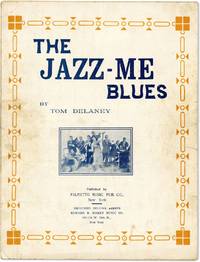
1921Best.-Nr. 82277New York: Palmetto Music Pub. Co 1921. First Edition. Slim quarto 30.5cm; original pictorial wrappers; 6pp. Moderate wear handling and dust-soil to wrappers some creases and edge-tears with inner spine-fold archivally reinforced with a patch of paper tape remnant to upper end of same; complete Good to Very Good. One of the earliest hits by African American songwriter and composer Thomas Henry Delaney 1889-1963. Born in Charleston SC he would eventually become one of the most popular jazz and blues composers on Tin Pan Alley. The front wrapper reproduces a photograph of Lucille Nelson Hegamin 1894-1970 backed by the band Albury's Blues and Jazz Seven. In 1920 she became the second African American blues singer to record following Mamie Smith and Perry Bradford's August 1920 recording of "Crazy Blues." She recorded "Jazz-Me Blues" in 1921 backed by her husband Bill and his band the Blue Flame Syncopators; thanks to her recording Delaney's song would go on to become a jazz standard. OCLC notes a scant 8 holdings. 82277. Palmetto Music Pub. Co unknown books
1921Best.-Nr. 82277New York: Palmetto Music Pub. Co 1921. First Edition. Slim quarto 30.5cm; original pictorial wrappers; 6pp. Moderate wear handling and dust-soil to wrappers some creases and edge-tears with inner spine-fold archivally reinforced with a patch of paper tape remnant to upper end of same; complete Good to Very Good. One of the earliest hits by African American songwriter and composer Thomas Henry Delaney 1889-1963. Born in Charleston SC he would eventually become one of the most popular jazz and blues composers on Tin Pan Alley. The front wrapper reproduces a photograph of Lucille Nelson Hegamin 1894-1970 backed by the band Albury's Blues and Jazz Seven. In 1920 she became the second African American blues singer to record following Mamie Smith and Perry Bradford's August 1920 recording of "Crazy Blues." She recorded "Jazz-Me Blues" in 1921 backed by her husband Bill and his band the Blue Flame Syncopators; thanks to her recording Delaney's song would go on to become a jazz standard. OCLC notes a scant 8 holdings. 82277. Palmetto Music Pub. Co unknown
1921Best.-Nr. 51295Scranton PA: International Textbook Co. 1921. Thick 8vo. vii 1 approx 450 pp sections separately paginated ix-xxi 1 pp. With 100s of text illustrations diagrams colour plates. Publisher’s three-quarter red buckram over green gilt lettering & ruling on spine marbled endpapers minor shelfwear dustsoiling to spine still VG copy. First editions of this very scarce and lavishly illustrated educational course on how to design construct and arrange window displays and floor displays of men and women’s clothing during the Jazz Age. Koerber 1871-1937 was an Hungarian-American designer and amazingly successful Display Manager for the Strawbridge & Clothier Department Store in Philadelphia at their five-story edifice flagship at Market & 8th. He emphasized and promoted the use of elaborate window displays with wax mannequins often with a particular theme and these needed to be constantly refreshed by the design department. In addition he highlighted the staging of merchandise on the floor such as putting men’s ties with their multi-coloured silks drawing shoppers to the men’s department and arranging women’s undergarments silks and evening wear in prominent positions to draw women further into specified sections. This work provides technical and practical information on wooden display forms flooring how to construct mannequins draperies holiday themes floor displays how to paint backdrops and more. The hundreds of photo images of window displays and floor displays provide an invaluable historical record for marketing during the Roaring 20s as well as offering a methodology of how these could be repeated and successful for other designers. Of particular interest is the extensive section on animatronics and motorized displays filled with information on lighting automatons and creating special effects. No copies located in Worldcat. International Textbook Co., hardcover
Best.-Nr. 3122Affiche originale. 1972. Impression en offset. Dim: 534 x 534 mm. Excepté deux petites taches bords partie sup, en très bon état.
1966Best.-Nr. 2111902156002108Not Available 1966. Soft Cover. Fine. The book is in fine condition. Not Available paperback