Delibes, LeoBiblio.com
409 résultats
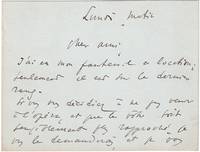
réf. 605465"Leo Delibes" in black fountain pen ink on stiff pale blue card. Monday morning n.d. 4 5/8" x 3 1/2" 1 leaf recto and verso. Text in French. Fine. Referring to an opera arrangement.
2011réf. SKU-1554AB13503275D.A.P./Distributed Art Publishers 2011. 1. Hardcover. Very Good. Very Good in a Very Good dust jacket; Hardcover; Dust jacket is clean and intact with just minor edgewear and has not been price-clipped Now fitted with a new Brodart jacket protector; Light wear to the boards; The textblock edges are unblemished; The endpapers and all text pages are clean and unmarked; The binding is excellent with a straight spine; This book will be shipped in a sturdy cardboard box with foam padding; Large Format 11.75" - 12.75" tall; 4.6 lbs; Painting illustration to the dust jacket with title in white lettering; 2011 D.A.P./Distributed Art Publishers; 288 pages; "Antonio Lopez Garcia: Paintings and Sculpture" by Francisco Calvo Serraller & Miguel Delibes. D.A.P./Distributed Art Publishers hardcover
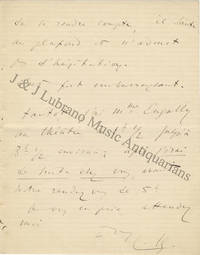
réf. 233083 pp. of a bifolium. Small octavo. Dated "Thursday morning." In French with translation. Delibes would like to see his friend to discuss some issue of importance. He also mentions several prominent musical figures in Paris: the baritone Jacques Bouhy; Philippe Gille the co-librettist of Delibes's opera Lakmé; Halanzier a director at the Paris Opera; and Léon Carvalho director of the Opéra-Comique. "In spite of everything Carvalho wants all the same to go ahead and at full steam. When one speaks to him of waiting. he jumps to the ceiling and does not accept any hesitation. This is very embarrassing." Slightly worn and creased. "Outside the theatre for which Delibes wrote nearly all his music his most notable work was as a composer of choruses now undeservedly neglected. His output of songs was relatively small and that of instrumental and church music almost negligible. His cantata Alger 1865 attracted much attention at the time but has lain in obscurity since. Despite his poor record at the Conservatoire his workmanship was of the highest order; he had a natural gift for harmonic dexterity and a sure sense of orchestral colour and nothing in his music is out of place. He was a disciplined composer and it is tempting to see in the exquisite pastiche dances that he composed in 1882 for Hugo's Le roi s'amuse not just a sharp ear for style but a genuine feeling for the world of 17th-century French classicism later to be espoused with such ardour by Saint-Saëns d'Indy and Debussy." Hugh Macdonald in Grove Music Online. unknown books
réf. 20320Paris Choudens, Editeur, sans date ( fin XIXème ) 0 in 8 (28x19) 1 volume reliure plein maroquin chocolat de l'époque, dos à nerfs, très orné, plats orné d'un décor d'encadrement de triple filets dorés avec fleurons d'angle, avec au centre du plat supérieur les lettres dorées: M D, tranches dorées, belle dentelle dorée intérieure, page de titre illustrée (lithographie tirée en sépia) 267 pages de musique notée. 4ème édition avec récitatifs. Superbe exemplaire, très finement relié ( Photographies sur demande / We can send pictures of this book on simple request )
réf. 271293 pp. of a bifolium. Ca. 161 x 102 mm. Dated "Sunday." On ivory paper. In French with translation. Delibes discusses a business venture with "our millionaire." He had hoped to see his correspondent the day before at a session of the Exposition jury or a soirée wasn't able to join him at the Opéra-Comique and asks him to give his regards to "Madame Gonzien." ". On Friday I went to meet our millionaire. You have been very kind to him and what I told him about you could only confirm this good impression. But personally he doesn't want to do anything; this is an absolutely firm stance. Only his brewery could benefit from the success of the thing. But he is the principal sponsor and shareholder and promised to 'push the wheel' in your desired direction. " Slightly worn and soiled; creased at folds; small ink stain to second page affecting one word. "Delibes's workmanship was of the highest order; he had a natural gift for harmonic dexterity and a sure sense of orchestral colour and nothing in his music is out of place. He was a disciplined composer and it is tempting to see in the exquisite pastiche dances that he composed in 1882 for Hugo's Le roi s'amuse not just a sharp ear for style but a genuine feeling for the world of 17th-century French classicism later to be espoused with such ardour by Saint-Saëns d'Indy and Debussy." Hugh Macdonald in Grove Music Online. unknown books
réf. 271293 pp. of a bifolium. Ca. 161 x 102 mm. Dated "Sunday." On ivory paper. In French with translation. Delibes discusses a business venture with "our millionaire." He had hoped to see his correspondent the day before at a session of the Exposition jury or a soirée wasn't able to join him at the Opéra-Comique and asks him to give his regards to "Madame Gonzien." ". On Friday I went to meet our millionaire. You have been very kind to him and what I told him about you could only confirm this good impression. But personally he doesn't want to do anything; this is an absolutely firm stance. Only his brewery could benefit from the success of the thing. But he is the principal sponsor and shareholder and promised to 'push the wheel' in your desired direction. " Slightly worn and soiled; creased at folds; small ink stain to second page affecting one word. "Delibes's workmanship was of the highest order; he had a natural gift for harmonic dexterity and a sure sense of orchestral colour and nothing in his music is out of place. He was a disciplined composer and it is tempting to see in the exquisite pastiche dances that he composed in 1882 for Hugo's Le roi s'amuse not just a sharp ear for style but a genuine feeling for the world of 17th-century French classicism later to be espoused with such ardour by Saint-Saëns d'Indy and Debussy." Hugh Macdonald in Grove Music Online. unknown
réf. 233364 pp. of a bifolium. Small octavo. Dated Monday evening December 5 between 1883 and 1891. On ivory paper with black borders. In French with translation. Having returned to Paris Delibes is anxious for news of the second run of his opera Lakmé. Because his correspondent's letter was delivered to the wrong address he has had to seek information elsewhere. Unfortunately another audience member has told him that the tenor and "basse chantante" have weak voices. Delibes suggests they replace the latter with a certain "Monsieur Schmidt" in order to increase ticket sales. In January he and his correspondent will discuss his opera Le Roi l'a dit which premiered at the Opéra-Comique on May 24 1873. "Unfortunately a more recent letter.tells me that our tenor is always weak as well as the 'basse chantante' i.e. high lyric bass and that the whole weight of the performance rests on Madame Alice Verheyden who alone has some success in the work. I add that these reports do not come from her husband!" Slightly soiled and foxed; creased at folds. "Delibes's workmanship was of the highest order; he had a natural gift for harmonic dexterity and a sure sense of orchestral colour and nothing in his music is out of place. He was a disciplined composer and it is tempting to see in the exquisite pastiche dances that he composed in 1882 for Hugo's Le roi s'amuse not just a sharp ear for style but a genuine feeling for the world of 17th-century French classicism later to be espoused with such ardour by Saint-Saëns d'Indy and Debussy." Hugh Macdonald in Grove Music Online. Lakmé is considered the composer's masterpiece. It offers more than just a fine vehicle for a star soprano; the two principal male characters Nilakantha and Gérald are firmly drawn and the music is melodic picturesque and theatrically strong. The opera was first performed at the Opéra-Comique Salle Favart in Paris on April 14 1883. Delibes's correspondent Miral was perhaps the director of the Théâtre Municipal de Nancy. If this is the case it is quite likely that the production mentioned in this letter took place there. unknown books
réf. 233364 pp. of a bifolium. Small octavo. Dated Monday evening December 5 between 1883 and 1891. On ivory paper with black borders. In French with translation. Having returned to Paris Delibes is anxious for news of the second run of his opera Lakmé. Because his correspondent's letter was delivered to the wrong address he has had to seek information elsewhere. Unfortunately another audience member has told him that the tenor and "basse chantante" have weak voices. Delibes suggests they replace the latter with a certain "Monsieur Schmidt" in order to increase ticket sales. In January he and his correspondent will discuss his opera Le Roi l'a dit which premiered at the Opéra-Comique on May 24 1873. "Unfortunately a more recent letter.tells me that our tenor is always weak as well as the 'basse chantante' i.e. high lyric bass and that the whole weight of the performance rests on Madame Alice Verheyden who alone has some success in the work. I add that these reports do not come from her husband!" Slightly soiled and foxed; creased at folds. "Delibes's workmanship was of the highest order; he had a natural gift for harmonic dexterity and a sure sense of orchestral colour and nothing in his music is out of place. He was a disciplined composer and it is tempting to see in the exquisite pastiche dances that he composed in 1882 for Hugo's Le roi s'amuse not just a sharp ear for style but a genuine feeling for the world of 17th-century French classicism later to be espoused with such ardour by Saint-Saëns d'Indy and Debussy." Hugh Macdonald in Grove Music Online. Lakmé is considered the composer's masterpiece. It offers more than just a fine vehicle for a star soprano; the two principal male characters Nilakantha and Gérald are firmly drawn and the music is melodic picturesque and theatrically strong. The opera was first performed at the Opéra-Comique Salle Favart in Paris on April 14 1883. Delibes's correspondent Miral was perhaps the director of the Théâtre Municipal de Nancy. If this is the case it is quite likely that the production mentioned in this letter took place there. unknown
2011réf. 96450D.A.P./Distributed Art Publishers Inc. New. Hardcover. FREE UPGRADE to Courier/Priority Shipping Upon Request - IN STOCK AND IMMEDIATELY AVAILABLE FOR SHIPMENT - Flawless copy brand new pristine never opened -- 286 pp. ; 210 illus. 199 in color. -- with a bonus offer--; The Spanish painter draughtsman and sculptor Antonio López García is so widely celebrated for the staggering exactitude of his painterly realism that it's sometimes easy to neglect the magical delicate atmospheres he conjures through his technical abilities. His paintings of what in anyone else's hands would seem the blandest subject matter imaginable--a blank wall a coat hook a kitchen sink the interior of a refrigerator--teem with an infused loving scrutiny that betrays the months and years of labor the artist devotes to each work. "Reality has a highly resonant physical appearance that twentieth-century man perceives from different angles to those of other ages" he once told an interviewer. Likewise his portrait sculptures attain an almost terrifying verisimilitude the eyes appearing ever on the verge of flickering into life and returning the viewer's gaze. In 2010 D.A.P. published the definitive monograph on López García's drawings. In this new volume we at last have the definitive monograph on the artist's paintings and sculptures. Carefully overseen by López García in its production this companion volume includes 200 full-color reproductions. Antonio López García was born in Tomelloso in the heart of Spain a few months before the outbreak of the Spanish Civil War in 1936. He studied at the School of Art in Madrid in the early 1950s where he soon proved himself a brilliant student and quickly became part of a nucleus of realist painters such as Francisco López Hernández Amalia Avia and Isabel Quintanilla. López García was the subject of Víctor Erice's 1992 film El Sol del Membrillo The Quince Tree of the Sun which closely chronicles the artist's attempts to paint a quince tree. . 2011. 1935202650 . D.A.P./Distributed Art Publishers, Inc. hardcover