Maestro, GiulioBiblio.com
Memories of mama Mary: Memoirs my life
ref. 1096974789.Gpaperback. Good. Access codes and supplements are not guaranteed with used items. May be an ex-library book. paperback

Bonita · Estados UnidosUS$ 66,17≈ € 59,00
751 resultados
ref. 0878880305.Glibrary. Good. Access codes and supplements are not guaranteed with used items. May be an ex-library book. unknown
ref. 1096974789.Gpaperback. Good. Access codes and supplements are not guaranteed with used items. May be an ex-library book. paperback
ref. 4796One without date and place but after 1952 the other postmarked London 2 August 1955. Both cards self-stamped. CARD ONE is very good and has printed on it a stamp of Queen Elizabeth II. Addressed to Powell and his wife it does not appear to have gone through the mails. 'Most kind of you to write - we led a quick <> in the car & then a meeting in the afternoon. We <>: Jill also who we havent seen lately. Many thanks signed Adrian C. B.' CARD TWO is somewhat aged with a stain and some wear on the address side. It reads 'I too have written to Kellogg's! signed Adrian C Boult'. One without date and place [but after 1952], the other postmarked London, 2 August 1955. unknown
ref. 21293London. September 1874. 1p 12mo. In good condition on lightly-aged paper folded twice. An elegantly-expressed sentiment: 'Mademoiselle Les malheureux sont mes Amis et l'oeuvre à la quelle vous vous interressez à sic toutes mes sympathies; malheureusement je suis si peu de choses que je ne puis vous témoigner que mon bon vouloir a l'oeuvre à la quelle vous vous interressez sicsi vivement.' London. September 1874. unknown
ref. 21277On letterhead of The Windsor Hotel Glasgow. 21 December no year. 1p 12mo. In fair condition lightly aged and grubby with three folds. The letter reads: 'Dear Streatfield it is no use sending me the Score of the Symphony here at present as I am too busy to look at it properly besides which all my Programmes are definitely fixed till the end of the season but if you will ask Mr. Hinton to send it to me to Hamilton Terrace 54 not 73 after Feby. when I shall be back in town I shall be pleased to look through it.' On letterhead of The Windsor Hotel, Glasgow. 21 December [no year]. unknown
ref. 19689London and Eastbourne: between 1918 and 1937. Finck was a well-respected and much-loved figure on the London musical and theatrical scene. His 'In the Shadows' was among the last tunes played as RMS Titanic went down. This miscellaneous collection of nine items in fair overall condition on lightly aged and worn paper. ONE: Autograph Manuscript by Finck contained names and outlines of anecdotes for inclusion in his memoirs. 2pp. 12mo. On letterhead of 212 Finchley Road London. As an example here is the text at the foot of one page: 'Include A. C. M. Club in Club stories. R. A. Roberts – Colisseum “By God! I'll ride to York.” Ralph Reader “Have you ever written a Ballet – about 50.” “Have you ever arranged one.”' TWO: Autograph Card Signed 'Paps' from Finck to his wife Mabel 'Darling Mams'. On letterhead of the Grand Hotel Eastbourne; 27 December 1918. A high-spirited missive beginning: 'I hope you all arrived safely & lost neither the bags or dogs.' On the address side Finck writes: 'I sent the wires I had a share I'm sending parcel to <Brennan>. I tipped the Chambermaid. I cannot get Laundry done. I've been for a week I had a rotten lunch. I'm having tea I bid you adieu.' THREE: Typed contract between Finck and the London publishers Hutchinson & Co. for a book to be titled 'In the Chair'. 19 October 1937. Signed by the firm's chairman Walter Hutchinson 1887-1950 and witnessed by 'W. T. Kimber' who was to go on and found his own firm. Possibly an intended follow-up to Finck's 'My Melodious Memories' which the firm published in 1937. FOUR: Typed Letter Signed from <James Baine> of London literary agents Curtis Brown Ltd. 20 October 1937. Regarding Item One which has been 'duly stamped at Somerset House'. FIVE and SIX: Manuscript Letter addressed to 'Dear George' the author's initials as signature being indecipherable. On letterhead of the Savage Club London. 6 December 1920. Thanking him for the 'generous cheque': 'but for those damned Cassells I would not have taken a penny'. Enclosing a Barclays Bank cheque for four guineas to 'Dr. Conran' signed by Finck 29 October 1927. Endorsed on reverse: 'p.p. P. C. Conran F. E. Munt'. SEVEN: Photographic image of Elizabethan gentleman on which is written by one of Finck's daughters the heading 'My 21st. Birthday April 17th. 1926.' Written over the image are various signatures in pencil including that of Finck. EIGHT: Typed carbon copy of letter from Finck to Sir Landon Ronald at the Guildhall School of Music. 19 May 1924. Accepting 'the Diploma of Fellowship of the Guildhall School of Music which the Music Committee of the Corporation of the City of London have so graciously offered to me.' NINE: Typed note: 'Mr. Herman Finck is of the opinion that there is something very illogical in the demand for a tax on his income from a Government which by rendering through noise his house useless for a composer to work in makes the earning of that income impossible.' On reverse in pencil: 'Book Mams “You've done a job of work in your time!”' London and Eastbourne: between 1918 and 1937. unknown
ref. 20162Menu from Pagani's Restaurant London. Dated by Mackenzie 4 November 1909. Attractive menu printed in black and gold on card bifolium folding into two 8 x 17 cm. panels partly detached. In fair condition lightly aged and worn. Calligraphic design with 'Pagani's' printed in gilt on the cover and the menu itself on the recto of the second leaf facing some calligraphic flourishes on the verso of the first leaf. The two inscriptions are both in pencil mainly on the recto of the second leaf but with the second extending somewhat onto the facing page. The upper of the two signed by 'A. C. Mackenzie' is dated 4 November 1909 and carries a bar of music 'Benedictus' and the inscription: 'Long life and happiness to H. Finck.' The second signed 'J. Mackenzie Rogan' also has a bar of music with the inscription 'Many happy returns'. Someone presumably Finck has made a pun in pencil on the facing page by adding the words 'meet at Pagani's' to the heading 'Menu' i.e. 'Men you meet at Pagani's'. Finck's 'In the Shadows' was one of the last tunes played as RMS Titanic went down. Menu from Pagani's Restaurant, London. Dated by Mackenzie 4 November 1909. unknown
ref. 19680On letterhead of The Palace Theatre Limited Shaftesbury Avenue London. 15 January 1912. 1p. 4to. On aged and worn paper. Reads:'To The Gentlemen of the Orchestra Commencing with February 17 '12 the system of sending deputies will be entirely abolished in this orchestra. To those members who are not desirous of continuing their engagement under this new rule I would ask that they gave their names to Mr Honrig before friday evening next in order that they may receive notice of the termination of their engagement four weeks from that date - 19th inst: Herman Finck Musical director'. Finck's 'In the Shadows' was one of the last tunes played as the Titanic went down. On letterhead of The Palace Theatre Limited, Shaftesbury Avenue, London. 15 January 1912. unknown
ref. 22031On his Roman letterhead: Via dei Foraggi 74 Roma. 1 March 1965. 1p 4to. In good condition lightly aged. In reply to a letter by Hodes he writes that he is 'happy to hear that Beethoven's Missa Solemnis has made such a deep impact on you which it should make on every listener'. He feels 'very much privileged indeed for having been granted the possibility to present this work for the first time in Israel' and hopes 'to have occasion to perform that great piece there again as well as others which will be important and good to hear'. On his Roman letterhead: Via dei Foraggi 74, Roma. 1 March 1965. unknown
ref. 17466On letterhead of the Grand Hotel Eastbourne. 8 October 1925. 2pp. 4to. In good condition lightly-aged. Unsigned copy of typed letter. with one autograph emendation. Addressed to 'My dear Harry'. He begins by explaining that he is in Eastbourne recuperating from the flu. 'As I did not rise until Monday last I missed the Sunday papers including alas the Referee. amended in autograph from 'the Rat' A cutting however from the Ref reached me here today containing an article of yours wherein you place me among your Hebrew musical collaborators. But I am not a Jew and after our close friendship of 35 years I thought you knew.' He appends four numbered 'Biographical Facts' including 'I went to a Protestant School and was baptized at St. John's Church Waterloo Bridge Road not far from the Old Vic' and 'My mother was born in Hereford. I have never heard of a Hereford Jewess.' The letter now takes an antisemitc turn with Finck suggesting that it was 'my nose that has deceived you all this time! But Jimmy Glover has a nose three times the size of mine. Must he be a Jew And after all Arthur Collins is only half a mo!' He does not ask for a disclaimer but to be flung 'back among the Christians' adding 'Seriously I wish I were a Jew. I would by now be a rich man.' He ends by suggesting that Newton get 'Bernard Marks to translate this back into my supposed tongue'. In a postscript he tells a story 'apropos St John's Church' his father and violin lessons. On letterhead of the Grand Hotel, Eastbourne. 8 October 1925. unknown
ref. 1083017209.Gpaperback. Good. Access codes and supplements are not guaranteed with used items. May be an ex-library book. paperback
ref. 1087263565.Gpaperback. Good. Access codes and supplements are not guaranteed with used items. May be an ex-library book. paperback
1983ref. 96424New York November 3 1983. 1983. Fine. - Nearly 400 words typed on his 11-3/4 inch high by 8-1/4 inch wide personal stationery. In his letter Serebrier informs his friend City Center Producer Jean Dalrymple that he has "been invited to conduct a pair of concerts with the American Symphony Orchestra in November 1984." "It will celebrate the 20th anniversary of the World Premiere of the Symphony No.4 by Ives." He goes on to mention that a feature article about him is to appear in "Symphony News" magazine and asks if she could get a copy for him and perhaps interest both U.P. and A.P. to cover it. Thinking of the publicity potential of the article he suggests that Carnegie Hall Magazine or Bravo Magazine might be interested in subsequently reprinting the article. Signed "Jose". Jean Dalrymple has subsequently drawn a line through the text indicating she had read the letter. Folded in half horizontally for mailing. Near fine. Jose Serebrier b. 1938 is an Uruguayan conductor and composer. He first conducted at the age of eleven with his school orchestra which toured the country. He graduated from the Municipal School of Music in Montevideo and subsequently won the National Orchestra's composition contest with his "Legend of Faust". He studied conducting with Eleazar de Carvalho and Aaron Copland at Tanglewood and with Pierre Monteux. His first symphony written at age 17 was conducted by Leopold Stokowski. Thereafter he held many conducting posts and toured widely with a number of orchestras. He was one of the most frequently recorded conductors of his generation. Jean Dalrymple 1902-1998 was the dynamic producer and director of theater and light-opera at Manhattan's City Center. Dalrymple began her career in Vaudeville appearing with James Cagney and Cary Grant in the early 1930s. She was a founding member of the American Theatre Wing the theatre service organization. She worked over the years as a personal manager for the likes of Leopold Stokowski Mary Martin Jose Iturbi Andre Kostalanetz Nathan Milstein and Lily Pons. She began her work at City Center with its founding in 1943 serving as a board member producer and publicist. Her productions there from the 1940s through the 1960s were a revitalizing influence on the whole New York theatre scene. In 1951 Jean Dalrymple married Major-General Philip deWitt Ginder commander of the Thunderbirds in Korea. She was a friend to Presidents and entertainment personalities throughout the world. New York, November 3, 1983. unknown
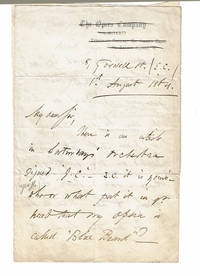
1864ref. 96471August 1st 1864. 1864. Good. - A two-and-a-half page letter consisting of over 80 words penned on three sides of 8 inch high by 5-1/8 inch wide "The Opera Company" stationery. Hatton has crossed out the letterhead and penned his home address below. In his letter addressed to James Couper sp Hatton seeks to correct the assumption made in an article about the title of his forthcoming opera: "My dear Sir" he writes "There is an article in Saturday's Orchestra signed 'J.C." -- J.C. it is yours -- what put it in yr head that my opera is called 'Blue Beard' The story of my work is as unlike the career of that courageous individual as it well can be." He goes on to write that he's not yet decided on a name for his work "but I think it is likely to be 'Rose de mai-" and requests that J.C. correct the mistake. Signed "J.L. Hatton". The recipient has penciled "yes JC" in the left margin of the first page affirming that he was indeed the author of the article. Folded several times for mailing with a couple of short tears along the edges of the folds. The bottom third of the integral second leaf has been clipped without loss to the text. Apparently once mounted into an album with paper remnants along the top and inner edges of the verso of the second leaf. Good. The English composer conductor pianist and singer John Liptrot Hatton 1809-1886 was a pupil of Michael Maybrick and also studied in the academy of Mr. Molyneux. An organist by the age of 16 he acted on the Liverpool stage and later performed in London in Macready's Drury Lane production of "Othello". A man of many talents he was making a name for himself as a musician and composer at the same time directing the choruses in the English Opera series at the Theatre Royal Drury Lane and composing his own works. His fist operetta "Queen of the Thames or The Anglers" was followed by a more ambitious work "Pascal Bruno". He composed numerous songs in the style of the German classics and performed as a pianist. Hatton toured in the U.S. from 1848 to 1850 performing several public and private concerts in New York City which included some of his own works. As a composer Hatton set to music various songs to poems by Robert Herrick perhaps the most famous of which was "To Anthea". Engaged as Director of Music at the Princess's Theatre in London he composed music for "Macbeth" "Sardanapalus King of Assyria" "Henry VIII" "Faust and Marguerite" and several of Shakespeare's plays. In 1864 his third opera "Rose or Love's Ransom" likely the work to which he refers in his letter was performed at the Royal English Opera Covent Garden. August 1st, 1864. unknown
1975ref. 95467December 31 1975. 1975. Fine. - New Year's greeting penned on the lined side of a 3 inch high by 5 inch wide index card. Signer "Jose" above his typed surname and with a bar of music penned above the signature. Fine The message dated "Dec. 31 1975" at top right reads: "Dear Jean: / Bon Apetit / and Happy New Year". Jose Serebrier b. 1938 is an Uruguayan conductor and composer. He first conducted at the age of eleven with his school orchestra which toured the country. He graduated from the Municipal School of Music in Montevideo and subsequently won the National Orchestra's composition contest with his "Legend of Faust". He studied conducting with Eleazar de Carvalho and Aaron Copland at Tanglewood and with Pierre Monteux. His first symphony written at age 17 was conducted by Leopold Stokowski. Thereafter he held many conducting posts and toured widely with a number of orchestras. He was one of the most frequently recorded conductors of his generation. Jean Dalrymple 1902-1998 was the dynamic producer and director of theater and light-opera at Manhattan's City Center. Dalrymple began her career in Vaudeville appearing with James Cagney and Cary Grant in the early 1930s. She was a founding member of the American Theatre Wing the theatre service organization. She worked over the years as a personal manager for the likes of Leopold Stokowski Mary Martin Jose Iturbi Andre Kostalanetz Nathan Milstein and Lily Pons. She began her work at City Center with its founding in 1943 serving as a board member producer and publicist. Her productions there from the 1940s through the 1960s were a revitalizing influence on the whole New York theatre scene. In 1951 Jean Dalrymple married Major-General Philip deWitt Ginder commander of the Thunderbirds in Korea. She was a friend to Presidents and entertainment personalities throughout the world. December 31, 1975. unknown
1866ref. 33982Eccleston St. S.W. London March 13th 1866. 1866. Good. - Over 39 words penned on a 7 inch high by 4-3/8 inch wide sheet of buff paper with an attached blank leaf. Michael Costa writes to arrange a meeting with the recipient: "On Thursday I am engaged in the morning but if you can come in the afternoon at 1/2 past three o'clock." He then closes with "Hoping your cold is better believe me truly yours" signed "M. Costa". Folded twice horizontally for mailing the letter is slightly soiled. Remnants of gray paper adhering to the right edge of the verso of the blank page would suggest that the letter was once mounted in an album. Good. The Italian-born conductor and composer Michael Costa 1808-1884 studied in Naples with his father at the Real Collegia di Musica and later with Niccolo Antonio Zingarelli. Although most of his works disappeared into obscurity he composed a significant number of operas symphonies and cantatas. After a visit to Birmingham he settled in England. In 1830 working as a conductor at His Majesty's Theatre Costa was able to influence many changes there and subsequently at Covent Garden. He was admired by Meyerbeer and Verdi. Having conducted several orchestras he took on English citizenship and was subsequently knighted in 1869. Among those compositions which survived are his ballets "Kenilworth" "Une Heure a Naples" "Sir Huon" and "Alma". His operas "Malek Adhel" and "Don Carlos" were produced in Paris and London. Eccleston St. S.W. [London], March 13th, 1866. unknown
1971ref. 254891971. 1971. Very good. - 6 bars of "String Quartet in D" penned on a 12-1/2 inch high by 9-1/4 inch wide sheet of ruled music paper inscribed and signed below the music: "For . / With the best wishes of the composer / Richard Bales / 7/26/71". The top corners of the music paper are lightly creased. The sheet has been folded twice for mailing & there is slight creasing to & 2 tiny chips out of the margins at the folds. Very good. 1971. unknown
ref. 0517532883.Ghardcover. Good. Access codes and supplements are not guaranteed with used items. May be an ex-library book. hardcover
ref. 1467034894.Ghardcover. Good. Access codes and supplements are not guaranteed with used items. May be an ex-library book. hardcover
ref. 18393NY: D. Appleton & Company. Very Good with no dustjacket. Hardcover. Dark green cloth bindings in very nice clean condition. Pages and structure all very good clean and tight. ; First three volumes. Each volume has nearly 800 pages. Illustrated throughout. Published in 1872 and 1873. ; Large 8vo 9" - 10" . D. Appleton & Company hardcover
1968ref. 78234Good. 1968. July 19-28 1968. Stapled/Soft Cover. J22 . paperback
ref. 446Hicksville New York: Exposition Press 1977. Hardcover. Small 8vo blue cloth. 118 pp. First edition. Inscribed by the author to May Sarton "in admiration for her library contributions." Fine in a very good slightly rubbed dust jacket. Hicksville, New York: Exposition Press, 1977 unknown
ref. 2090202120408647Not Available N.A. Soft Cover. Fine. Number of books: 1 Not Available paperback
1994ref. 2090202120415892import music service 1994. Soft Cover. Fine. Number of books: 1 import music service paperback
ref. 2090202120414105brilliant classics N.A. Soft Cover. Fine. Number of books: 1 brilliant classics paperback