Gallo Franco; Zignani PaoloMareMagnum

2.297 Ergebnisse
br. Amore giovanile di Nietzsche, poi oggetto di critiche aspre e di un rifiuto senza appello, Schumann fu probabilmente per il filosofo di Röcken un'esperienza più importante e duratura di quanto normalmente non si riconosca. Mediante un paragone con l'elaborazione e organizzazione delle forme brevi in Schumann, la prima parte del volume propone una lettura della filosofia nietzscheana e della sua predilezione per la forma breve collegandole coerentemente con l'istanza della polemica antifilistea propria anche di Schumann e analizzandone potenziale e contraddizioni nel quadro di una teoria dell'emancipazione, contro ogni lettura strettamente formalistica della scrittura nietzscheana. La seconda parte esamina la posizione di Schumann nel quadro di una riflessione complessiva sulla musica che fa i conti con la tensione tra norma e trasgressione, ordine e demonico, controllo ed eccesso. Con ampie analisi che vanno da Bach a Nietzsche, individua così nella musica schumanniana il centro di un'operazione di scrittura che non è più evocazione di affetti ma loro metamorfosi in sorgenti del linguaggio musicale. La creatività schumanniana, lungi dal poter essere allora classificata (seguendo Nietzsche) come reattività e piccineria nazionale, appare piuttosto alternativa profonda e radicale, per quanto non aproblematica, all'oltrepassamento dionisiaco nietzscheano.
ill., br.
br. Nella lettera a Clara Wieck del 12 aprile 1838, Robert Schumann scriveva "Ora la mia musica mi si presenta già meravigliosamente intrecciata in tutta facilità, sorge dal cuore ricolma di significato, e così è recepita da tutti coloro a cui la suono". Il "meraviglioso intreccio" cui allude Schumann è quello, tutto particolare, delle melodie, che dà spessore alla scrittura musicale. Da questa lettera è tratto, con leggera parafrasi, il titolo del volume, uno studio sul contrappunto nella musica schumanniana. Il contrappunto è l'arte della sovrapposizione e dell'intreccio delle linee melodiche, sorta di fili che creano così, metaforicamente, la trama e l'ordito, il tessuto musicale. Il tema centrale dell'indagine è appunto l'analisi della scrittura pianistica schumanniana, profondamente permeata, per quanto possa apparire strano ai più, di contrappunto. Ne sono studiate in particolare le peculiarità, mediante un costante raffronto con la produzione coeva, e la relazione con modelli del passato.
br. Robert Schumann, oggi indiscutibilmente considerato uno dei più grandi compositori romantici, in verità fu apprezzato dai suoi contemporanei soprattutto come scrittore e critico musicale. Infatti, per ironia della sorte, egli attese tutta la vita pur di veder riconosciuta la sua attività di compositore, ma persino nell'ultimo ricordo la sua fama di critico la precedette. Fu solo dopo la sua morte, avvenuta nel 1856, che, grazie al costante impegno della moglie Clara, di Johannes Brahms e di Franz Liszt, si riuscì a rivalutarne il ruolo di musicista. Si è giunti così all'estremo opposto: Schumann è passato alla storia unicamente in qualità di compositore. Per merito, o per colpa di questa indesiderata eterogenesi dei fini, abbiamo assistito inermi all'oblio della sua attività critica e al quasi totale disinteresse degli studiosi nell'approfondimento della sua valenza teorica. Il presente saggio filosofico ha lo scopo di colmare questa lacuna conoscitiva mettendo in luce il pensiero estetico di Robert Schumann e delineando in tal modo nuovi contorni nel suo profilo generale.
br. Sono raccolti in questo volume tutti gli scritti che Liszt ha dedicato agli Schumann, a testimonianza di un interesse e di un'ammirazione mai venuti meno, nonostante le peripezie della loro amicizia dovute, in particolare, al difficile carattere («delicato, irritabile, orgoglioso», lo definiva Liszt) di Clara Wieck. Come scrive Piero Rattalino nella prefazione al volume, «Liszt impiega più le armi dell'analisi psicologica che dell'analisi critica», e dunque «non possiamo cercare in lui la disciplina del critico, ma solo la simpatia dell'uomo-artista». Tuttavia, queste sue analisi rivestono una grande importanza, e in una duplice direzione: innanzitutto quella di una riflessione dello stesso Liszt sul proprio cammino creativo, sulla scia della «nuova era iniziata con Beethoven», di cui Robert Schumann, vero e proprio pensatore in musica, costituiva per Liszt un anello imprescindibile. In secondo luogo, quella di un'esemplare messa a fuoco, in presa diretta, delle 'ragioni' dell'arte degli Schumann. Come spiega ancora Piero Rattalino, «i romantici della musica non rappresentano una pia congrega: si combattono, si detestano, si fanno vicendevolmente la forca. Ma sono sostanzialmente solidali nella visione che hanno dell'arte». Un volume, questo, che, unitamente allo scritto del curatore e al saggio di Rattalino, porta un contributo decisivo alla conoscenza non solo del rapporto tra Liszt e Schumann, ma anche del complesso mondo del romanticismo musicale tedesco.
1984Best.-Nr. 35889Mainz: Schott 1984. Paperback. Very Good. Small quarto. original publisher's gray wrappers printed in dark blue. 139 pp. With a portrait of the composer and several musical examples in text. Schott paperback books
1880Best.-Nr. 35076London: William Reeves 1880. Hardcover. Very Good. 2 volumes. Octavo. Full dark brown cloth titling gilt to spines. 418 pp. 30 pp. publisher's catalogue; 540 pp. 45 pp. publisher's catalogue.With a reproduction bust-length portrait of Schumann from a drawing by Hendemann as frontispiece to Vol. 1. William Reeves hardcover books
1954Best.-Nr. 34326Wilhelmshaven: Heinrichshofen's Verlag 1954. Thick octavo. Full dark red cloth. 820 pp. 2ff. publisher's advertisements. In dustjacket. Ex-library with labels and poicket to rear free endpaper. Dustjacket slightly worn laid down to pastedowns. Heinrichshofen's Verlag unknown books
1914Best.-Nr. 33845Leipzig: Breitkopf & Härtel 1914. 2 volumes. 564; 511 pp. Binding slightly worn rubbed and stained. Minor browning. Breitkopf & Härtel unknown books
1925Best.-Nr. 34409Stuttgart: Engelhorns 1925. Octavo. Original publisher's dark yellow cloth with titling stamped in green to upper and spine. 335 pp. Illustrated with portraits etc. With small Simrock label to front pastedown previous owner's signature to free front endpaper. Binding spotted and slightly worn and soiled. Engelhorns unknown books
1948Best.-Nr. 32685London: Max Parrish & Co Limited 1948. 4 plates in colour & 41 black-and-white illustrations. Max Parrish & Co Limited unknown books
2008Best.-Nr. 50387London: Routledge 2008. First Edition. Octavo. Original laminated boards hardcover; 300pp. Bit of dusting to upper edge of text block else a tight unmarked new-appearing copy - Fine. Routledge unknown books
1824Best.-Nr. 42421Halle: Gebauerschen Buchhandlung 1824. First Edition. Octavo 21cm. Contemporary cloth-backed boards; xxii794pp. Shallow loss to cloth at crown; rubbing to boards and corners; still a straight sound copy Good or better. Text entirely in German. Meier 1796-1855 was a classical philologist and editor of the Allgemeine Litteraturzeitung as well as several other German philological journals. This prize-winning treatise on legal jurisprudence in classical Athens is his most enduring work remaining the standard study of the subject well into the 20th century see biographical entry in New International Encyclopedia 1922; also Allgemeine Deutsche Bibliographie on-line. Gebauerschen Buchhandlung unknown books
1980Best.-Nr. 40464Newark VT: The Janus Press 1980. 4to 29.5 cm 11.625". 40 pp.; illus. From Peter Schumann 1934 creator of political theater group Bread and Puppet Theater this limited abstract work is boldly illustrated with repetitive full-page drawings accompanied by large sections of text. Schumann both wrote and illustrated the play. "3500 copies have been printed offset at Magnani and McCormick in Enfield Connecticut on Linweave Velvetsheen Bright White Satin text basis 100 with Linweave Linen Midnight Black cover basis 80 & bound at The Stinehour Press in Lunenburg Vermont. 150 copies have been casebound at the Janus Press. The text is set in Trump Mediaeval Roman Italic and Bold" colophon. This is one of the 150 casebound copies. Fine Janus Press 197580 p. 48. Publisher's blue cloth with a black paper label printed in gray to spine and a black and gray illustration mounted to the front board. Crisp and clean. The Janus Press hardcover books
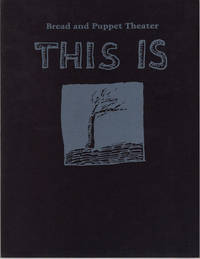
1980Best.-Nr. 40462Newark VT: The Janus Press 1980. 4to 27.9 cm 11". 40 pp.; illus. From Peter Schumann 1934 creator of political theater group Bread and Puppet Theater this limited abstract work is boldly illustrated with repetitive full-page drawings accompanied by large sections of text. Schumann both wrote and illustrated the play. "3500 copies have been printed offset at Magnani and McCormick in Enfield Connecticut on Linweave Velvetsheen Bright White Satin text basis 100 with Linweave Linen Midnight Black cover basis 80 & bound at The Stinehour Press in Lunenburg Vermont. 150 copies have been casebound at the Janus Press. The text is set in Trump Mediaeval Roman Italic and Bold" colophon. Fine Janus Press 197580 p. 48. Publisher's black wrappers with gray text and illustration to front wrapper. A very clean copy. The Janus Press unknown books
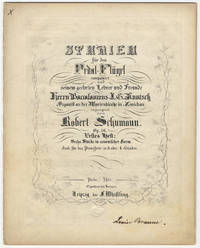
1845Best.-Nr. 24100Leipzig: F. Whistling PN 357 1845. Folio. Disbound. 1 title within decorative border by Krätzschmer 2-19 i blank pp. Title lithographed music engraved. Contemporary owner's signature "Louise Braune." in ink to lower right corner of title. Slightly browned and soiled throughout; spine slightly frayed. Professional paper repair to lower outer corner of one leaf; small tear to lower edge of one leaf; a few leaves creased at upper outer corner; cross in ink to upper inner corner of title price erased two overlapping publisher's blindstamps to foot. First Edition no additional volumes published. Hofmann p. 127. McCorkle pp. 251-52. Hoboken 15 103 with printed price of 1 Thlr. The collection includes six pieces. The designation "Erstes Heft" volume 1 implies that a continuation was planned but there were no further volumes. Hofmann pp. 127 and 131 suggests that the Skizzen für den Pedal-Flügel op. 58 were originally planned as the second volume of op. 56; they were however published by Breitkopf & Härtel. F. Whistling [PN] 357 unknown books
Best.-Nr. 24523On a slip of paper 68 x 109 mm. Dated London March 27 1909. In black ink. Slightly creased; right edge slightly frayed not affecting signature. Together with a three-quarter length vintage photograph of Schumann-Heink by the White Studio in New York ca. 177 x 126 mm. "Between 1897 and 1901 Schumann-Heink took part in four consecutive Covent Garden seasons and became a regular member of the Metropolitan company for a similar period 1898-1903 returning subsequently for single seasons only. By then she had begun the series of popular and profitable cross-country American concert tours that occupied much of the rest of her long career. In 1909 she returned to Dresden to sing the part of Clytemnestra in the première of Elektra. Although she could sing and very well virtually anything her English and American stage career centred on Wagner; and it was as Erda that she bade farewell to the Metropolitan in 1932 still captivating the audience as the American critic Olin Downes wrote with 'knowledge and imagination embodied in the tone and in every syllable of the text she delivered so memorably'. These words well describe the effect vividly conveyed by her Erda and Waltraute recordings made less than three years before. Although largely unrepresentative of her serious repertory her many other recordings made over a period of 25 years give a splendid impression of her powers: of her opulent and flexible tones from low D to high B the amazing fullness and evenness of her shake her artistic conviction dramatic temperament and vivid enunciation. Among them should be mentioned the brindisi from Lucrezia Borgia several versions all good the prison scene from Le prophète 'Parto parto' from La clemenza di Tito and the duet with Caruso 'Ai nostri monti' from Il trovatore." Desmond Shawe-Taylor in Grove Music Online. unknown books
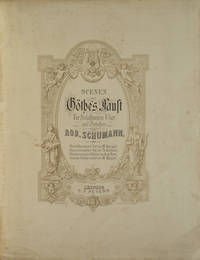
1880Best.-Nr. 24798Leipzig: C. F. Peters PN 4441 1880. Folio. Attractively bound in quarter mid-tan calf with raised bands on spine in compartments tooled in gilt and black black leather label with titling gilt marbled boards. i lithographic title within olive green decorative border by F. Baumgarten i table of contents 1f. part title: Erster Theil 3-54 1f. part title: Zweiter Theil 57-154 part title: Dritter Theil 157-282 pp. Lithographic transfer from engraved plates. The title also advertises a piano-vocal score by Woldemar Bargiel a piano reduction without text by Theodor Kirchner and a reduction for piano four-hands by August Horn. Slightly worn browned and foxed; title slightly stained. Hoffmann p. 333. C. F. Peters [PN 4441] unknown books
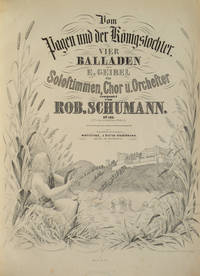
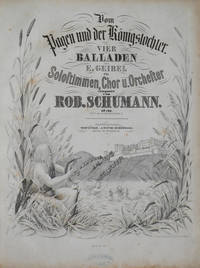
1857Best.-Nr. 24816Winterthur: J. Rieter-Biedermann PN 35 1857. Folio. Modern quarter tan calf with marbled boards and gilt titling to spine. 1f. iv 3-114 pp. Music engraved. Elaborate pictorial title lithograph by Friedrich Krätzschmer. Text printed separately within decorative border. Publisher's handstamp to foot of title. Minor foxing; title slightly trimmed at outer edge; final blank leaf lacking; other minor defects. First Edition first issue. McCorkle p. 581 583. Hofmann p. 307. Hirsch IV 919. Schumann's last choral-orchestral ballad Vom Pagen und der Königstocher sets text by Emanuel Geibel 1815-1884. It was composed during the summer of 1852 a period when Schumann's physical and mental condition was deteriorating rapidly yet the score is positively radiant. J. Rieter-Biedermann [PN 35] unknown books
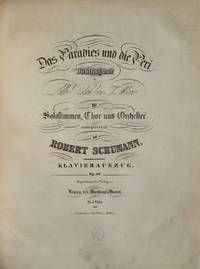
1844Best.-Nr. 24913Leipzig: Breitkopf & Härtel PN 7069 1844. Folio. Quarter mid-brown cloth with paper boards with octagonal paper label titled in manuscript to upper. 1f. title 1-4 text 3-133 i blank pp. Title lithographed text typeset music engraved. Handstamp "T. J. Roothaan & Co Muzijkhandel en biblioteek Amsterdam" to foot of title. With rhymed inscription in black ink to head of verso of title: "Der Tandler hatte kein Interessanteres / Drum schick ich dieses und kein Anderes! Haag im April 1932." Binding quite worn; spine frayed and partially lacking; last line of manuscript text to label crudely erased. Minor staining and foxing most noticeable to first leaves. With pencil markings to alto staves in part 3 pp. 77-83. First Edition variant issue distinguished by differently typeset text. Hofmann p. 115. McCorkle pp. 223-24. Hoboken 15 93 with original wrappers. The full score of the work was not published until 1845. The author of the inscription is unknown; the use of the word "Tandler" suggests that he is from either Austria or Bavaria. The text of the oratorio was translated from the English original by Emil Flechsig 1808-1878; Schumann made significant alterations. Breitkopf & Härtel [PN 7069] unknown books
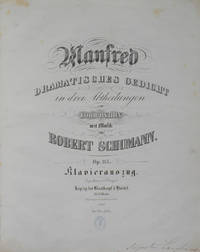
1853Best.-Nr. 24808Leipzig: Breitkopf & Härtel PN 8600 1853. Folio. Half black calf with textured cloth boards raised bands on spine in compartments gilt. 1f. title 1f. contents 12 cast list and poem in German translation 3-53 i blank pp. Title lithographed text of poem typeset music engraved. Contemporary owner's signature: "Auguste Langhans" in ink to foot of front free endpaper and lower right corner of title. Blindstamp to upper right corner of rear endpaper: "Buchbinderei von JGA Peper Neue Groningerstr. 7 Hamburg." Boards slightly worn and rubbed endpaper slightly stained and foxed. Minor internal foxing; small oval publisher's handstamp to foot of title. A very good copy on high-quality paper. First Edition. Hofmann p. 251 dated "November 1853". McCorkle p. 491 as IVe. Hoboken 15 202 incorrectly dated "1852"; with wrappers. Schumann set the poem in a German translation by Karl Adolf Suckow 1802-1847. The overture to Manfred was first performed in Weimar on March 14th 1852; the incidental music to the poem was introduced three months later in Leipzig. While the overture is a staple concert piece the remainder of the music is seldom performed. Breitkopf & Härtel [PN 8600] unknown books
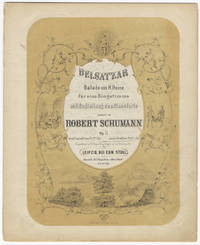
1858Best.-Nr. 25018Leipzig: Edm. Stoll PN 311 1858. Folio. Disbound. 1f. lithographic title by C.G. Röder p. 3 text 4-13 pp. engraved music. Hofmann p. 129. McCorkle p. 254. Edm. Stoll [PN 311] unknown books
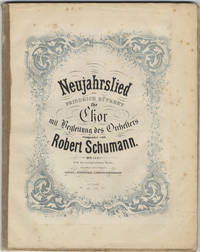
1862Best.-Nr. 24799Leipzig und Winterthur: J. Rieter-Biedermann PN 192 1862. Folio. Original publisher's wrappers with titling within decorative border. 1f. title within light blue decorative border 1f. text 3-95 pp. Engraved. In a custom-made dark green cloth folder. Handstamp of Novello to lower right corner of upper wrapper; leaf with pricing of parts laid down to verso. Publisher's catalogue with works by Schumann to verso of lower wrapper. Printer's note to lower left corner of p. 3: "Stich und Druck der Röder'schen Officin in Leipzig." Wrappers heavily browned worn and bumped; upper detached and frayed at lower edge with slight loss; spine reinforced with tape. Slightly worn; some foxing browning and dampstaining throughout. A good wide-margined copy. First Edition second issue. The first issue predates the opening of the publisher's office in Leipzig 1862 and has Winterthur as the only place of publication. Hofmann p. 315. Hoboken 245 first issue. The text is by Friedrich Rückert 1788-1866. Schumann set the poem in full and added the first stanza of the chorale "Nun danket alle Gott" melody by Johann Crüger text by Martin Rinckart. "This New Year's Song has some pleasing and original moments. In the earlier part of the piece there is a tuneful Mendelssohnian duet for soprano and alto and some dramatic writing for solo bass including most unusually for Schumann a short passage of recitative. Further variety is achieved by the imaginative use of a large orchestra. This is a work which would justify an occasional revival." Alan Walker: Robert Schumann: The Man & His Music p. 378. J. Rieter-Biedermann [PN 192] unknown books
1858Best.-Nr. 24812Winterthur: J. Rieter-Biedermann PN 35 1858. Folio. Modern quarter light tan calf with marbled boards and titling gilt to spine original publisher's decorative wrappers bound in. 1f. iv 3-61 pp. Music engraved. Elaborate pictorial title lithograph by Friedrich Krätzschmer. Text printed separately within decorative border. Publisher's catalogue to verso of lower wrapper. Publisher's handstamp to foot of title. Binding very slightly worn and rubbed; lower wrapper detached dampstained and slightly defective with loss to text at upper left corner. Slightly worn foxed and dampstained especially at outer margins; tears to two leaves with minor loss. First Edition later issue. The first issue was published in October of 1857. McCorkle p. 581 and 583. Hofmann p. 307. Hoboken 15 240 first issue. The catalogue to the lower wrapper also lists Schumann's op. 142 published in January 1858 but not op. 143 published in February 1860 which allows the dating of the present copy. J. Rieter-Biedermann [PN 35] unknown books