Hector BerliozBiblio.com

1 317 résultats
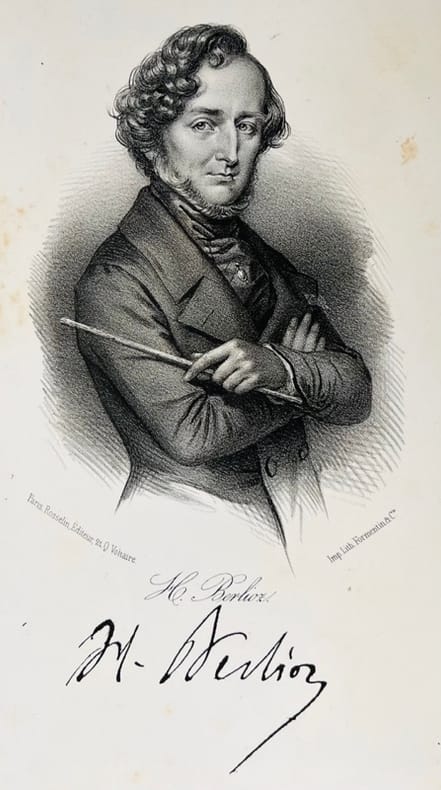
1870réf. 7Hector Berlioz. Mémoires. Paris Michel Lévy 1870 grand in-8 demi-maroquin vert à coins de l'époque dos à 5 nerfs richement orné. 509 4 pp. Edition originale publique de cet ouvrage remarquable et célèbre. Bel exemplaire bien complet du " beau portrait de l'auteur " en frontispice et en fin de volume du feuillet de vers de Shakespeare et des deux pages d'errata qui manquent parfois. Bonne reliure strictement d'époque. Reliure un peu frottée. La seconde garde manquante. Quelques coups aux coupes et coins défaut à la coiffe supérieure quelques rares rousseurs en début d'ouvrage. Intérieur très frais sinon. Bon exemplaire. Mémoires de Hector Berlioz membre de l'Institut de France comprenant ses voyages en Italie en Allemagne en Russie et en Angleterre 1803 - 1865. Avec un beau portrait de l'Auteur. A good copy in its original binding from the original edition of the memoirs of Berlioz: an essential book. Binding slighly rubbed a few tears light spots as usual at the beginning of the book which is otherwise very fresh Michel Lévy hardcover
réf. 1359Paris, Georges Petit & Allier frères, 1903. In-4, plein chagrin rouge vif, dos orné, tête or, filet d’encadrement perlé sur le 1er plat, roulettes intérieures, couverture et dos conservés, étui bordé, 228 pp. + 11 planches (Evelyne Fortin).
1886réf. 13601886 Paris, Librairie d’Art, 1886. In-4 br., couverture illustrée, 390 pp. Édition originale contenant de nombreux documents, dont 14 lithographies originales de Fantin-Latour, des portraits du compositeur par Émile Signol (1804-1892), Amédée Charpentier (né en 1822), Charles Baugniet (1814-1886), Adam-Salomon (1818-1881), Etienne Carjat (1828-1906), etc. Fac-similés de lettres et partitions, dessins, gravures, caricatures, autographes, reproductions des premières photographies de l’époque.
réf. BN382035Corpus Christianorum. Stephanus de Borbone Exempla Tractatus de diversis materiis predicabilibus Prologus - Liber primus. De dono timoris Corpus Christianorum. Stephanus de Borbone Exempla Tractatus de diversis materiis predicabilibus Prologus - Liber primus. De dono timoris J. Berlioz J.L. Eichenlaub eds. unknown
1844réf. 40297Paris, Jules Labitte, 1844. 2 vol. in-8 de (6)-422 pp. et (4)-370 pp., demi-veau blond, dos lisse orné (reliure de l'époque).
2018réf. __3761816014Barenreiter 2018. Hardcover. New. 304 pages. German language. 19.21x12.68x1.57 inches. Barenreiter hardcover
réf. 316604np nd. 1 page pen and ink on paper. 12mo 3-3/8 x 3-1/8 inches visible. Framed in gilt frame. 1 page pen and ink on paper. 12mo 3-3/8 x 3-1/8 inches visible. In translation: "Have the courtesy to send me the three articles on the debates that I left at your house a few days ago ." M. Gras is perhaps a relation to soprano Julie Dorus-Gras who performed as Teresa in the premier Berlioz' opera Benvenuto Cellini. unknown
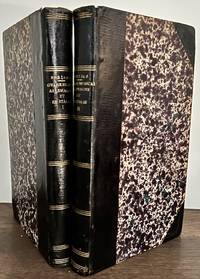
1844réf. 23701Paris: Jules Labitte 1844. First Edition. Hardcover. Three quarter gilt lettered black morocco marbled boards and marbled endpapers. 2 Vols. Very good. 422 370 pages. 21.5 x 13 cm. It was this period in his life 1840's Berlioz spent much of his time making music outside France. He struggled to make money from his concerts in Paris and learning of the large sums made by promoters from performances of his music in other countries he resolved to try conducting abroad. His extensive German tour in twelve German cities received enthusiastic receptions. The German public was better disposed than the French to his innovative compositions and his conducting was seen as highly impressive. He extravagantly praised Beethoven's symphonies and Gluck's and Weber's operas and scrupulously refrained from promoting his own compositions. One quire in Vol. I toned balance of interior clean and bright. Text in French. Jules Labitte hardcover
réf. 316604np nd. 1 page pen and ink on paper. 12mo 3-3/8 x 3-1/8 inches visible. Framed in gilt frame. 1 page pen and ink on paper. 12mo 3-3/8 x 3-1/8 inches visible. In translation: "Have the courtesy to send me the three articles on the debates that I left at your house a few days ago ." M. Gras is perhaps a relation to soprano Julie Dorus-Gras who performed as Teresa in the premier Berlioz' opera Benvenuto Cellini. unknown books
1844réf. 23701Paris: Jules Labitte 1844. First Edition. Hardcover. Three quarter gilt lettered black morocco marbled boards and marbled endpapers. 2 Vols. Very good. 422 370 pages. 21.5 x 13 cm. It was this period in his life 1840's Berlioz spent much of his time making music outside France. He struggled to make money from his concerts in Paris and learning of the large sums made by promoters from performances of his music in other countries he resolved to try conducting abroad. His extensive German tour in twelve German cities received enthusiastic receptions. The German public was better disposed than the French to his innovative compositions and his conducting was seen as highly impressive. He extravagantly praised Beethoven's symphonies and Gluck's and Weber's operas and scrupulously refrained from promoting his own compositions. One quire in Vol. I toned balance of interior clean and bright. Text in French. Jules Labitte hardcover books
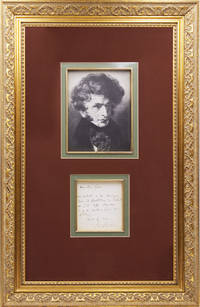
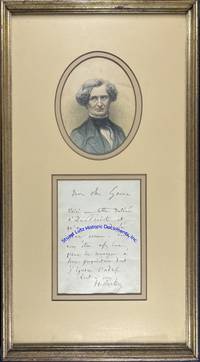
réf. 5622LOUIS-HECTOR BERLIOZ 1803-1869. Berlioz was a French composer and conductor of the Romantic movement.ALS. 1pg. N.d. N.p. An autograph letter signed H Berlioz. Berlioz wrote a brief missive in French asking the recipient to pass along a letter. My dear Garcia Here is a letter addressed toand that was addressed to me by accident. Will you be good enough to return it to his landlord whose address I dont know. All to you H Berlioz. It is matted and framed with a color engraving of Berlioz. In fine condition. unknown
réf. 5622LOUIS-HECTOR BERLIOZ 1803-1869. Berlioz was a French composer and conductor of the Romantic movement.ALS. 1pg. N.d. N.p. An autograph letter signed H Berlioz. Berlioz wrote a brief missive in French asking the recipient to pass along a letter. My dear Garcia Here is a letter addressed toand that was addressed to me by accident. Will you be good enough to return it to his landlord whose address I dont know. All to you H Berlioz. It is matted and framed with a color engraving of Berlioz. In fine condition. unknown books
1857réf. 1053BERLIOZ Hector 1803-1869 French composer. An 11-line ALS to "Monsieur" signed "H. Berlioz." 1 full p. 8vo. N. p. Paris 30 December 1857. Berlioz writes to an unnamed correspondent about what he wrote as music critic for the Journal des Débats 17 November in reply to M. Benoît Jouvin's comments in Figaro. According to the Hector Berlioz website Berlioz had written about the first production of Margot a comic opera in three acts at the Théâtre Lyrique 5 November 1857 by Jules-Henri Vernoy de Saint-Georges and Adolphe de Leuven music by Antoine-Louis Clapisson and also wrote there about "Inauguration de la salle Beethoven. CONCERT D'OUVERTURE." Berlioz writes about a response from Jouvin the publisher of Figaro a man about whom it has been said always left the theater irritated. Berlioz writes: "It is in the Journal des Debats of November 17th that I have replied to the few lines that Mr. Jouvin has published in the Figaro. But as regards to the article that he wrote in answer to my reply I did not have to answer it and I did not do so. Many thanks for all the gracious things for me contained in your letter receive my best feelings." From 1834 to 1863 Berlioz wrote more than 400 contributions to the prestigious and influential Paris paper the Journal des Débats which represent rather less than half of his entire output as music critic. Apparently unpublished and not one of his well over 3000 letters found in his Correspondance général 1972-2003. Very good with edges slightly browned and three edges very slightly rough.
réf. 362929/08/1852 Berlioz confirme qu'il a bien reu ...le billet de cinq cents francs montant de mon prlvement du mois de septembre. Je vous remercie de votre exactitude... ajoute-t-il. Il vient d'tre...gravement malade, mais me voil de nouveau sur pieds...Berlioz avait deux soeurs. L'ain, Anne-Marguerite appele aussi Nanci, pousa Camille Pal, un notaire grenoblois, en janvier 1832. Berlioz entretenait avec ses parents des rapports fidles attests jusqu' la fin de sa vie par une ample correspondance. Il se montre courtois, notamment envers ses deux beaux-frres (Marc Suat, l'poux d'Adle, notaire Vienne, et Camille Pal, l'poux de Nanci). Ceux-ci avaient t chargs par Berlioz de grer chacun une de ses proprits dauphinoises. Berlioz donna pouvoir en 1853 Camille Pal afin qu'il puisse rcolter les arrrages d'une de ses fermes.Corr. gnrale (P. Citron, 1972-75), T IV, N 1513.
réf. 4794Berlioz avait t invit pour prsider un concours orphonique dans sa ville natale, Grenoble. Les membres du jury taient composs entre autres de GOUNOD et dAmbroise THOMAS. Berlioz souffrait depuis de nombreux mois dune nvralgie intestinale, et cest trs malade quil assista aux crmonies du festival orphonique, ainsi qu linauguration de la statue de Napolon Ier sur linvitation de son beau-frre Camille Pal.Le compositeur dcline linvitation de son ami se rendre aux Combes : ...Je suis malade et ne puis accepter votre aimable invitation, les rugissemens de ces musiques militaires augmentent mon mal ; je ne sais si Gouot (?) [Gounod] et Thomas sont ici ; excusez moi jaurais bien voulu revoir les Combes...Berlioz entretint une correspondance suivie avec Albert Du Boys, (1804-1889), un compatriote dauphinois.Pourtant cest Paris que Berlioz le rencontra, lorsquil y vint tudier le droit en 1822 ou 1823. Secrtaire du vicomte Sosthne de la Rochefoucauld, directeur des Beaux-Arts de 1824 1830, Du Boys semble stre ce titre rendu utile Berlioz. Il crivit, avant fvrier 1823, les paroles du chant lgiaque Le Montagnard exil et de la romance Toi qui laimas, verse des pleurs , que Berlioz mit en musique. Du Boys fit aussi les paroles de la Ballade du pcheur daprs Goethe (1827) et du Ballet des Ombres daprs Herder (1829). Correspondance gnrale dHector Berlioz (Pierre Citron - Hugh J. Mac Donald, Flammarion, 2001), vol. VII, N 3372.
1860réf. 73029Nadar | Paris s. d. [circa 1860] | 6.50 x 10.30 cm | une photographie
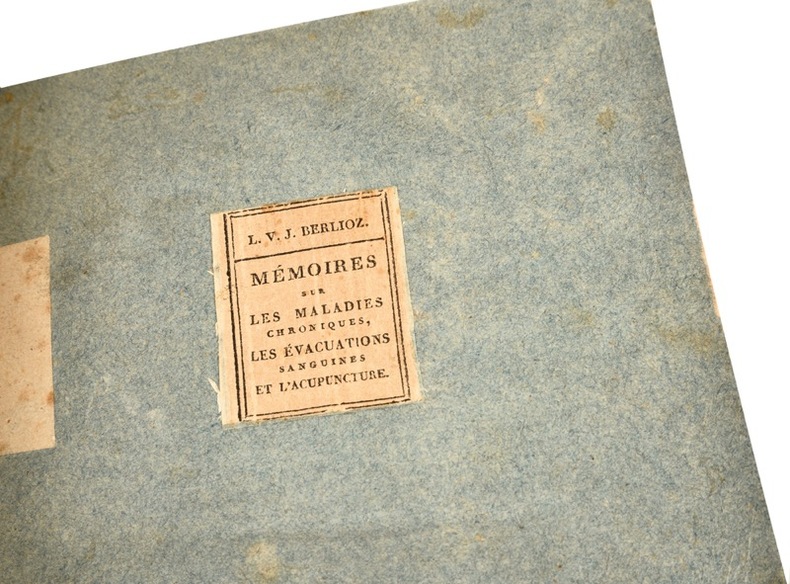
1816réf. 21648Paris, Croullebois, (imprimerie de Crapelet), 1816 ; in-8 (210 mm), demi-veau bleu outremer, dos à nerfs, titre doré, couverture bleu délavé de l’époque avec l’étiquette imprimée sur le plat, tête arasée, tranches non rognées (rel. de l’époque); VI, 343, [1bl.] pp., [2] pp. d’errata.
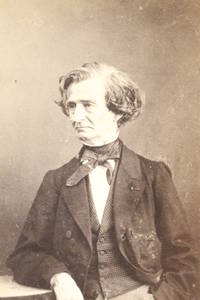
1860réf. 73029Paris: Nadar 1860. Fine. Nadar Paris s. d. circa 1860 6.50 x 10.30 cm une photographie Original albumen photograph carte-de-visite format mounted on card from Nadar studio 35 boulevard des Capucines. Manuscript annotations on verso. A copy of this photograph is held in the Music Department of the Bibliothèque Nationale de France. Nadar unknown
réf. 354342 pp. of a bifolium. Octavo. Dated "31 Juillet" no year. To an unidentified male correspondent. On lined paper. In French with translation. Berlioz apologizes for not being able to edit his article on Bortnyansky with which he hopes his correspondent will be satisfied. "The fragment of musical criticism which I wanted to add to the item on Bortnianski is in the hands of Mr. M. Levy's printer who is at present bringing out a book which contains this article. It is impossible for me - since the printer is not in Paris - to rework my manuscript. Therefore be good enough to be satisfied with the Russian article; it is accurate on the whole and it would be difficult for me to redo a study on Bortnianski and Emperor of Russia's singers that is already done." The composer/critic goes on say that he would be happy for extracts of the article to appear in L'Illustration and in a postscript asks his correspondent to send him a copy of the periodical in which his article appears. Slightly worn; creased at folds and very slightly overall. Dmitri Stepanovich Bortnyansky 1751-1825 was a Ukrainian singer composer and music director active in Russia. "During the 19th century Bortnyansky choral concertos and hymns gained popularity across Western Europe; some copies of concertos preserved in the library of the Hofkapelle in Vienna date from as early as 1780. Berlioz who heard the concertos in Russia in the 1840s praised the 'incredible freedom' of their approach to choral sonority Les soirées de l'orchestre Paris 1852 and included Bortnyansky's music in several of his own concerts in Paris." Marika Kuzma in Grove Music Online "Berlioz stands as the leading musician of his age in a country-France-whose principal artistic endeavour was then literary and in an art-music-whose principal pioneers were then German. In many senses the Romantic movement found its fullest embodiment in him yet he had deep Classical roots and stood apart from many manifestations of that movement. His life presents the archetypal tragic struggle of new ideas for acceptance to which he gave his full exertions as composer critic and conductor. And though there were many who perceived greatness in his music from the beginning his genius only came to full recognition in the 20th century. . Berlioz's views were presented regularly to readers of the Paris press. . He published three collections of criticism: Les soirées de l'orchestre 1852 Les grotesques de la musique 1859 and A travers chants 1862. In his feuilletons he wrote of new operas and singers .; his opinion on momentous occasions was of crucial interest for example at the première of Le prophète in 1849. He reviewed most of the concerts of the Société des Concerts; he wrote of new instruments and musical gadgets of his own impressions of music abroad and of important musicians visiting France; he wrote biographical notices of Gluck Beethoven Spontini Méhul and himself; he wrote fiction and fantasy often with a critical purpose; he wrote serialized treatises on orchestration and conducting. There are in short few facets of musical practice of the time untouched in his feuilletons. . In general Berlioz's opinions are trenchant and clearly expressed." Hugh Macdonald in Grove Music Online. unknown
réf. 354342 pp. of a bifolium. Octavo. Dated "31 Juillet" no year. To an unidentified male correspondent. On lined paper. In French with translation. Berlioz apologizes for not being able to edit his article on Bortnyansky with which he hopes his correspondent will be satisfied. "The fragment of musical criticism which I wanted to add to the item on Bortnianski is in the hands of Mr. M. Levy's printer who is at present bringing out a book which contains this article. It is impossible for me - since the printer is not in Paris - to rework my manuscript. Therefore be good enough to be satisfied with the Russian article; it is accurate on the whole and it would be difficult for me to redo a study on Bortnianski and Emperor of Russia's singers that is already done." The composer/critic goes on say that he would be happy for extracts of the article to appear in L'Illustration and in a postscript asks his correspondent to send him a copy of the periodical in which his article appears. Slightly worn; creased at folds and very slightly overall. Dmitri Stepanovich Bortnyansky 1751-1825 was a Ukrainian singer composer and music director active in Russia. "During the 19th century Bortnyansky choral concertos and hymns gained popularity across Western Europe; some copies of concertos preserved in the library of the Hofkapelle in Vienna date from as early as 1780. Berlioz who heard the concertos in Russia in the 1840s praised the 'incredible freedom' of their approach to choral sonority Les soirées de l'orchestre Paris 1852 and included Bortnyansky's music in several of his own concerts in Paris." Marika Kuzma in Grove Music Online "Berlioz stands as the leading musician of his age in a country-France-whose principal artistic endeavour was then literary and in an art-music-whose principal pioneers were then German. In many senses the Romantic movement found its fullest embodiment in him yet he had deep Classical roots and stood apart from many manifestations of that movement. His life presents the archetypal tragic struggle of new ideas for acceptance to which he gave his full exertions as composer critic and conductor. And though there were many who perceived greatness in his music from the beginning his genius only came to full recognition in the 20th century. . Berlioz's views were presented regularly to readers of the Paris press. . He published three collections of criticism: Les soirées de l'orchestre 1852 Les grotesques de la musique 1859 and A travers chants 1862. In his feuilletons he wrote of new operas and singers .; his opinion on momentous occasions was of crucial interest for example at the première of Le prophète in 1849. He reviewed most of the concerts of the Société des Concerts; he wrote of new instruments and musical gadgets of his own impressions of music abroad and of important musicians visiting France; he wrote biographical notices of Gluck Beethoven Spontini Méhul and himself; he wrote fiction and fantasy often with a critical purpose; he wrote serialized treatises on orchestration and conducting. There are in short few facets of musical practice of the time untouched in his feuilletons. . In general Berlioz's opinions are trenchant and clearly expressed." Hugh Macdonald in Grove Music Online. unknown books
1973réf. 37118New York: Vienna House Inc. . As New. Paperback. FREE UPGRADE to Courier/Priority Shipping Upon Request – – IN STOCK AND IMMEDIATELY AVAILABLE FOR SHIPMENT - AS NEW THE TEXT BLOCK IS PRISTINE CLEAN UNMARKED AND IN EXCELLENT CONDITION - -- with a bonus offer--; T-Berlet; Berlioz Hector; Entries selected edited and translated By Searle Humphrey Hector Berlioz : A Selection from His Letters . 1973. 0844301140 . Vienna House, Inc. paperback
1888réf. 94091Librairie De L Art. As New. Paperback. FREE UPGRADE to Courier/Priority Shipping Upon Request - IN STOCK AND IMMEDIATELY AVAILABLE FOR SHIPMENT - AS NEW THE TEXT BLOCK IS PRISTINE CLEAN UNMARKED AND IN EXCELLENT CONDITION - - Text in French. 338 pages. -- with a bonus offer-- . 1888. Librairie De L Art paperback
réf. 20031BERLIOZ HECTOR. 1803-1869. French composer; creator of Harold in Italy Symphonie Fantastique and other masterpieces. ALS. "Hector Berlioz". 2pp. 4to. Paris October 9 1834. To l'intendant general de la liste civile. In French with translation. "I am planning to give three concerts over the course of next November. The Salle des Menus Plaisirs which you have been kind enough to make available to me several times in the past is really the only venue in Paris that lends itself to these kinds of musical events. So I request that you will grant me permission to hold mine there. These concerts just like the ones I gave last years would take place on Sundays at 2 in the afternoon. With all my respect dear General Intendant your humble servant…" The 1830s were difficult for Berlioz. Bereft of the recognition he craved and unable to earn a steady income from composing he worked as a critic for several journals and newspapers and accepted the few commissions that came his way. Nevertheless he produced a number of works including the symphony Harold en Italiewhich premiered on November 23 1834 about a month and a half after writing our letter at the Paris Conservatoire then housed in the Salle des Menus Plaisirs a theater attached to the Hôtel des Menus-Plaisirs and the venue for most of Berlioz's symphonic works. Harold en Italie based on Byron's narrative poemso captivated Italian violinist and composer Niccolo Paganini for whom it was written that in 1838 he presented Berlioz with a gift of 20000 francs. Several weeks before the premiere the Paris Conservatoire was also the venue for another Berlioz program on November 9 which included his Symphonie fantastique as well as the first performances of Sara la baigneuse version H69A and la Belle voyageuse. A plaque outside the Salle du Conservatoire commemorates Berlioz's performances there. Our letter was written from 34 rue de Londres Berlioz's home between 1834 and 1836. Docketed in the top margin. Folded and slightly creased; a very early letter and as such uncommon.
1864réf. 3769Mai 1864 Berlioz, en habitu du festival de Bade [il y avait cr son opra Batrice et Bndict], organis tous les ans par Edouard Bnazet, annonce David Hermann Engel, la suppression du rendez-vous musical allemand :...M. Bnazet est venu passer quelques jours Paris, et la saison de Bade est supprime. Il m'a dit de suspendre tous mes prparatifs ; il n'y aura pas de festival. J'avais dj parl de vous et vous tiez adopt. Si cela se raccommode, je vous le ferai savoir.. Il ajoute, sans espoir ...Mais, ...Bellum ruit... Il nous manquait cela....Dans ses Mmoires, au chapitre 59, Berlioz crivit : M. Bnazet, le directeur des jeux, m'a engag plusieurs fois venir organiser et diriger le festival annuel de Bade, en mettant ma disposition pour excuter mes Suvres, tout ce que je pouvais demander. Sa gnrosit, en pareil cas, a dpass de beaucoup ce qu'ont jamais fait pour moi les souverains de l'Europe dont j'ai le plus me louer , puis dans une lettre sa sSur Adle, date du 11 mars 1858 (Corr. Gnrale, n 2283) : Bade c'est diffrent; on y gagne de l'argent, et on y fait de bonne musique, et on y trouve une foule de gens d'esprit, et on y parle franais ..BERLIOZ ET LE FESTIVAL DE BADE EN ALLEMAGNE : Bade tient une place de choix dans la longue histoire des rapports entre Berlioz et l'Allemagne : nulle autre ville allemande ne sera visite avec une telle frquence. De 1853 1863 le compositeur franais se rendra Bade plus d'une dizaine de fois et y retournera chaque anne partir de 1856. Ce qui l'amenait Bade : les Bnazet : le pre Jacques Bnazet (mort en 1848), puis le fils douard Bnazet (1801-1867) qui prit la succession de son pre la direction du casino de Bade. douard Bnazet, qui a tudi au Conservatoire de Paris, tait un homme cultiv qui entretenait de nombreuses connaissances dans le monde des arts. L'ambition de Bnazet tait de rehausser la petite ville thermale au rang de centre artistique qui attirerait l'lite de la socit europenne.Dans les annes 1850, Bnazet s'emploie raliser son projet ; il cre de nouvelles salles de jeux, un grand champ de course Iffezheim; un nouveau thtre qui ouvre ses portes avec l'opra de Berlioz Batrice et Bndict en 1862 (d'aprs la pice de Shalespeare "Beaucoup de bruit pour rien"). Mais, Bnazet, se dsintresse peu peu de Bade. Dans une lettre Camille Pal, Berlioz livre sa crainte...de perdre 2000 f de rente, par cessation de mon engagement annuel pour Bade, la suppression des jeux est toujours annonce et ds lors plus de musique. En outre, Bnazet parat dcid ne plus donner de festival... David Hermann Engel avait tenu l'harmonium au festival de Bade en 1859.Correspondance gnrale d'Hector Berlioz (P. Citron - Mac Donald, Flammarion 2001), Vol. VII, N 2859.
réf. 4805...Je ne suis pas all ce matin interrompre votre sommeil, ainsi que vous my aviez autoris. Ceut t inutile. Mr F. De Conches [Feuillet de Conches] est encore Fontainebleau o le Prsident chasse aujourdhui. Quand vous verrez Mr F. De Conches veuillez tre assez bon pour lui dire que ma demande a pour objet de faire quelque chose de grand, dexceptionnel, et non dobtenir les moyens ncessaires une excution musicale seulement plus pompeuse que de coutume. Pour que mon but fut atteint, il faudrait faire au moins ce que les associations dartistes ont fait dernirement, en excutant mon Requiem pour le Baron de Trmont. On ne couronne pas un Empereur tous les jours ; et lglise de Notre-Dame nest pas une glise de village....Le baron de Trmont, auquel Berlioz fait allusion dans sa lettre, dcd en juillet 1852, tait un rudit, bienfaiteur d'art et de musique, connu pour sa collection d'autographes. Une messe solennelle lui fut ddie dans lglise Saint-Eustache de Paris, pendant laquelle fut excut le Requiem de Berlioz, comme le rapporte Le petit courrier des Dames : Tout le monde sait (...) que le Requiem de M. Berlioz est une de ses Suvres les plus remarquables et les plus compltes. Lexcution a t parfaite, et grce lempressement des artistes, chanteurs et instrumentistes, lSuvre du matre a produit un effet immense... .Corr. gnrale (Pierre Citron, Flammarion, 1972-75), T IV, N 1530.